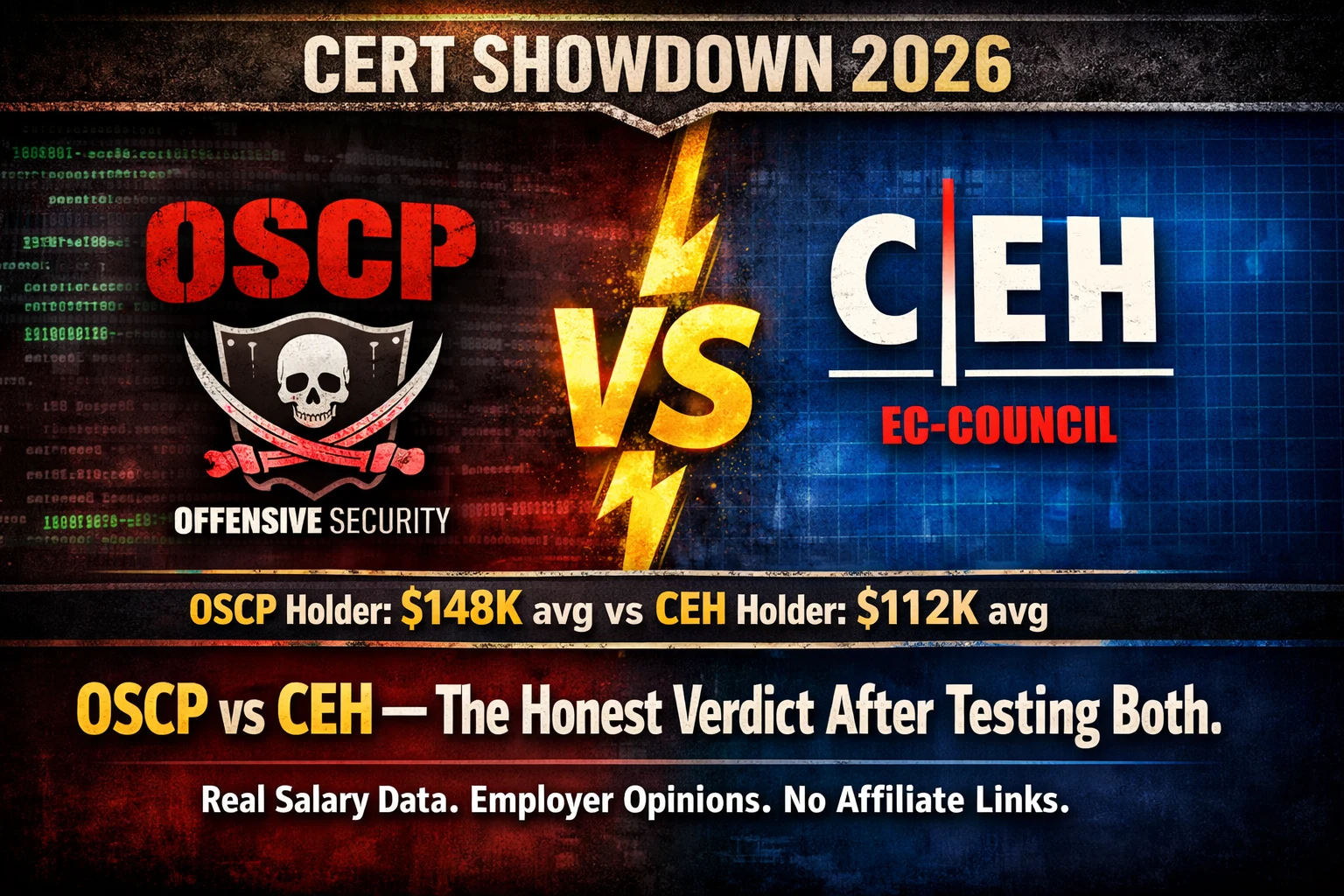
The OSCP vs CEH 2026 debate is the most argued topic in cybersecurity certification forums. Both camps are loud. Most comparisons are written by people selling one or the other. This guide has no affiliate links to either — just real salary data, honest difficulty assessments, real employer opinions from hiring managers, and the straight verdict on which one actually moves your career forward in 2026.
🏆
After reading this you will be able to:
Compare OSCP and CEH across 7 key dimensions · Know which pays more and why · Understand what employers actually think of each · Choose the right certification for your specific career path · Know what to do before OSCP if you’re not ready yet
~18
min read
📊 QUICK POLL
Which certification are you considering right now?
✅ Good — this guide will validate or challenge your thinking either way.
The honest answer depends heavily on your target role. Let’s go through the data.
The OSCP vs CEH question is asked by thousands of people every month who are making a real financial decision — these certifications cost $1,000–$1,500 each. Getting the choice wrong means spending money on a credential that doesn’t move the needle for your specific goal. Let’s make sure you get it right. See also the comprehensive full certification ranking guide covering all major ethical hacking credentials.
Quick Summary — OSCP vs CEH at a Glance
securityelites.com
OSCP VS CEH — COMPLETE COMPARISON 2026
Factor
OSCP
CEH
Provider
Offensive Security
EC-Council
Exam Format
24-hour practical hack + 24-hour report
125 multiple-choice questions, 4 hours
Cost (2026)
~$1,499 (90-day lab included)
~$1,199 (exam voucher only)
Difficulty
Very Hard — pass rate ~55–65%
Moderate — pass rate ~70–80%
Preparation Time
3–6 months (existing knowledge)
4–8 weeks study
Renewal
No expiry
3-year renewal required
Avg Salary (US Mid)
~$125,000–$145,000
~$105,000–$120,000
Best For
Pentest consultancies, red teams
Government, compliance, GRC
Employer Technical Respect
⭐⭐⭐⭐⭐ Industry gold standard
⭐⭐⭐ Recognised, not revered
OSCP vs CEH Complete Comparison 2026 — nine key dimensions. The pattern is consistent: OSCP wins on salary, technical employer respect, and offensive security relevance. CEH wins on difficulty (easier to pass), preparation time, and recognition in compliance/government roles. Neither is universally better — the right choice depends entirely on your target role.
Exam Format — Theory vs Practical
This is the most significant difference between the two certifications, and it is the root cause of every other difference in employer perception and salary outcome. CEH tests your knowledge of hacking concepts through multiple-choice questions. You need to know about SQL injection, social engineering, and network protocols — but you are never required to actually perform any of these. You answer questions, you pass or fail, you receive the certificate.
OSCP tests whether you can actually hack. During the 24-hour exam, you are connected to an isolated exam network containing multiple machines with different vulnerabilities. You must enumerate them, find exploitable vulnerabilities, gain initial access, and escalate privileges — all without internet access, without hints beyond what Offensive Security provides, and within the time limit. You then write a professional penetration testing report in the following 24 hours. If you cannot hack the machines, you fail. There is no way to bluff your way through.
CEH EXAM
125 multiple choice questions
4 hours duration
Topics: theory, tools, laws, attack types
Pass mark: 70%
Can retake with fee
Online proctored or testing centre No practical requirement
OSCP EXAM
24-hour live hacking exam
+ 24-hour professional report
Multiple machines to compromise
70/100 points to pass
No internet, limited hints
Proctored via webcam Must actually compromise systems
The practical vs theory divide explains the salary gap. A hiring manager who understands security knows that passing OSCP means you genuinely compromised machines under exam conditions. Passing CEH means you knew the right answers to multiple-choice questions. Both have value — but they are proving different things. For a role where you will actually perform penetration tests, the OSCP proof of practical capability is worth more.
Real Salary Data 2026 — The Financial Case
Salary data for OSCP vs CEH comparison requires controlling for experience level, role type, and location — comparisons that don’t control for these variables are meaningless. The figures below represent mid-level professionals (3–5 years experience) in penetration testing and offensive security roles in the US market, where the salary differential is most pronounced.
securityelites.com
OSCP VS CEH — SALARY COMPARISON 2026
OSCP HOLDER (MID-LEVEL)
$137K
US average — penetration testing roles
Range: $115K–$165K Role types: pentest consultant, red team, AppSec
CEH HOLDER (MID-LEVEL)
$112K
US average — security analyst roles
Range: $90K–$135K Role types: security analyst, SOC, GRC, DoD
WHY THE GAP EXISTS
OSCP holders predominantly work in penetration testing consultancy and red team roles — which have inherently higher compensation than analyst roles. CEH holders are more evenly distributed across security analyst, SOC, compliance, and government positions. The certification itself signals role type — and role type drives the salary more than the credential alone. OSCP + consultancy role = highest compensation pathway in offensive security.
OSCP vs CEH Salary Comparison 2026 — the $25,000 gap at mid-level reflects both the certification premium and the role type distribution. OSCP holders disproportionately work in high-paying consultancy and red team roles. CEH holders are more evenly spread across analyst, SOC, and compliance positions. Both salary ranges grow significantly with experience and specialisation.
What Employers Actually Think
The difference in employer perception breaks cleanly along organisational type. Security consultancies and technical red teams evaluate candidates based on practical demonstration — and OSCP is the recognised proxy for that. Government agencies and large corporate HR departments evaluate based on approved credential lists — and CEH appears on more of those lists (particularly DoD 8140 in the US).
WHERE OSCP WINS — TECHNICAL HIRING MANAGERS
Security consultancies (NCC Group, Rapid7, Crowdstrike, Coalfire) treat OSCP as the baseline credential for penetration tester roles. Red teams at major technology companies (Google, Microsoft, Meta) respect OSCP significantly. Bug bounty-adjacent security research roles list OSCP as preferred. The technical community’s consensus: OSCP proves you can actually hack — CEH proves you know the vocabulary.
WHERE CEH WINS — COMPLIANCE AND GOVERNMENT HIRING
US Department of Defense 8140 (formerly 8570) lists CEH as an approved baseline certification for IAT Level II and IAM roles — OSCP is not on that list. Government contractors and federal agencies hiring against DoD requirements frequently specify CEH. Large enterprises with HR-driven hiring processes recognise CEH more readily than OSCP because it appears in published credential frameworks.
THE HYBRID TRUTH
Many experienced professionals hold both. CEH provides compliance recognition and DoD clearance eligibility. OSCP provides technical credibility with practitioners. If budget allows both — get OSCP first (harder, more foundational, proves skill), then add CEH for compliance coverage if your target employer or government role requires it.
Difficulty — How Hard Is Each Really?
CEH difficulty is manageable for anyone with a solid IT background and 4–8 weeks of dedicated study using the official EC-Council study guide or third-party materials like Matt Walker’s All-in-One guide. The exam tests broad knowledge across many security domains — it rewards breadth over depth. The pass rate is estimated at 70–80%.
OSCP difficulty is in a different category. Candidates report that the PWK course and lab work — which must precede the exam — require 3–6 months of intensive practice for candidates who already have security fundamentals. The exam itself is 24 continuous hours of high-pressure practical hacking. The pass rate is estimated at 50–65% on first attempt. Many candidates who fail describe the experience as the most demanding professional challenge they have faced.
OSCP Readiness Checklist — Can You Root This?
✅ Root 10+ Easy HackTheBox machines independently (no walkthroughs)
✅ Root 5+ Medium HackTheBox machines independently
✅ Comfortable with manual privilege escalation (Linux + Windows)
✅ Active Directory enumeration and basic exploitation
✅ Buffer overflow exploitation basics
⚠️ If you can’t check all 5 — build skills before paying for OSCP
# Attempting OSCP unprepared = expensive failure
Cost Comparison — What You Actually Pay
OSCP TOTAL COST
PWK course + 90-day lab: $1,499
Exam attempt (included): Included
Retake if failed: $249
No renewal fee ever: Lifetime cert
Prep resources (HTB Pro): ~$14/month
Total all-in: ~$1,700–$2,000
CEH TOTAL COST
Exam voucher: ~$1,199
Official courseware: ~$850 (optional)
3-year renewal fee: ~$80
EC-Council membership: $80/year req’d
Study materials: ~$50–$100
Total all-in: ~$1,400–$2,300 (over 3 years)
OSCP is lifetime — no renewal fee, ever. CEH requires EC-Council membership and renewal every three years, meaning the total cost over a career is higher despite a similar initial price. On a purely financial basis, OSCP provides better long-term value if you are pursuing penetration testing roles where it commands the salary premium described above.
The Honest Verdict — Which One Is Right for You?
⚡ KNOWLEDGE CHECK
You want to become a penetration testing consultant at a security firm in 2026. Which certification path should you pursue?
CHOOSE OSCP IF:
You want to work as a penetration testing consultant · You’re targeting security consultancies or red team roles · You can consistently root Easy-Medium HackTheBox machines · You want a lifetime credential with no renewal · You want the highest salary ceiling in offensive security
CHOOSE CEH IF:
You’re targeting US government or DoD contractor roles · Your employer specifically requires CEH for compliance · You’re new to security and need a structured learning framework · HR-driven hiring is the primary route into your target organisation · You need a relatively quick credential while building practical skills
START WITH NEITHER IF:
You’re a beginner who can’t yet root a HackTheBox Easy machine · You haven’t completed networking and Linux fundamentals · You’re studying from scratch — start with eJPT and build the foundation first · Your certification budget is better spent on HackTheBox Pro and lab time right now
🏆
OSCP for consultancy. CEH for compliance. Neither if you’re not lab-ready yet.
The most expensive certification mistake is buying OSCP before you’re ready for it. Build the skills first on HackTheBox and TryHackMe. The cert follows — and it lasts a lifetime.
Is OSCP better than CEH for penetration testing jobs?
For penetration testing roles at consultancies and red teams: yes, OSCP is significantly more valued. It requires actually compromising machines during a 24-hour practical exam, proving hands-on skill that CEH’s multiple-choice format cannot. CEH is more recognised in government, compliance, and HR-driven hiring where it appears on approved certification lists.
What is the salary difference between OSCP and CEH holders?
OSCP holders earn approximately $15,000–$25,000 more per year than CEH holders at equivalent mid-level experience in the US. US averages: OSCP holder ~$137,000 vs CEH holder ~$112,000. The gap reflects both the certification premium and OSCP holders’ concentration in higher-paying consultancy and red team roles versus analyst and compliance roles where CEH is more common.
How difficult is OSCP compared to CEH?
The difficulty difference is substantial. CEH is a 125-question multiple-choice exam most candidates pass with 4–8 weeks of study. OSCP requires compromising multiple machines during a 24-hour practical exam with a pass rate of 50–65% on first attempt. Preparation typically requires 3–6 months of intensive lab work for candidates with existing security knowledge.
Is CEH worth it in 2026?
CEH has value in specific contexts: government and DoD contractor roles, large enterprise HR-driven hiring, and as a structured learning framework for security newcomers. It is not the strongest choice for penetration testing consultancy or red team positions where technical hiring managers make decisions. If your target role involves compliance, GRC, or government work: CEH makes sense. For offensive security consultancy: OSCP is the right investment.
What should I get before OSCP?
The recommended path: eJPT first (practical, ~$200, builds fundamentals), then PNPT (practical 5-day exam, includes Active Directory, opens junior roles), then OSCP when you can consistently root Easy-Medium HackTheBox machines independently. Attempting OSCP without this foundation leads to expensive failure. Many first-attempt failures report PNPT would have been the correct next step.
Can I get a cybersecurity job with only CEH?
Yes — CEH alone can secure entry-level and mid-level security analyst, SOC analyst, and compliance roles. Government and DoD contractor positions often list CEH as an accepted qualification. For penetration testing consultant roles and red team positions, CEH alone is typically insufficient — employers expect OSCP or equivalent practical certification in those roles.
The OSCP vs CEH question has a clear answer for most people — but it depends entirely on where you want to end up. I have interviewed penetration testing candidates and reviewed hundreds of CVs. OSCP on a CV tells me a candidate can actually hack. CEH tells me they understand the landscape. For a consultancy pentesting role, I want the OSCP. For a compliance or government analyst role, CEH is perfectly appropriate. Know your target. Choose accordingly. And if you’re not ready for either yet — the free course on SecurityElites is where you start.