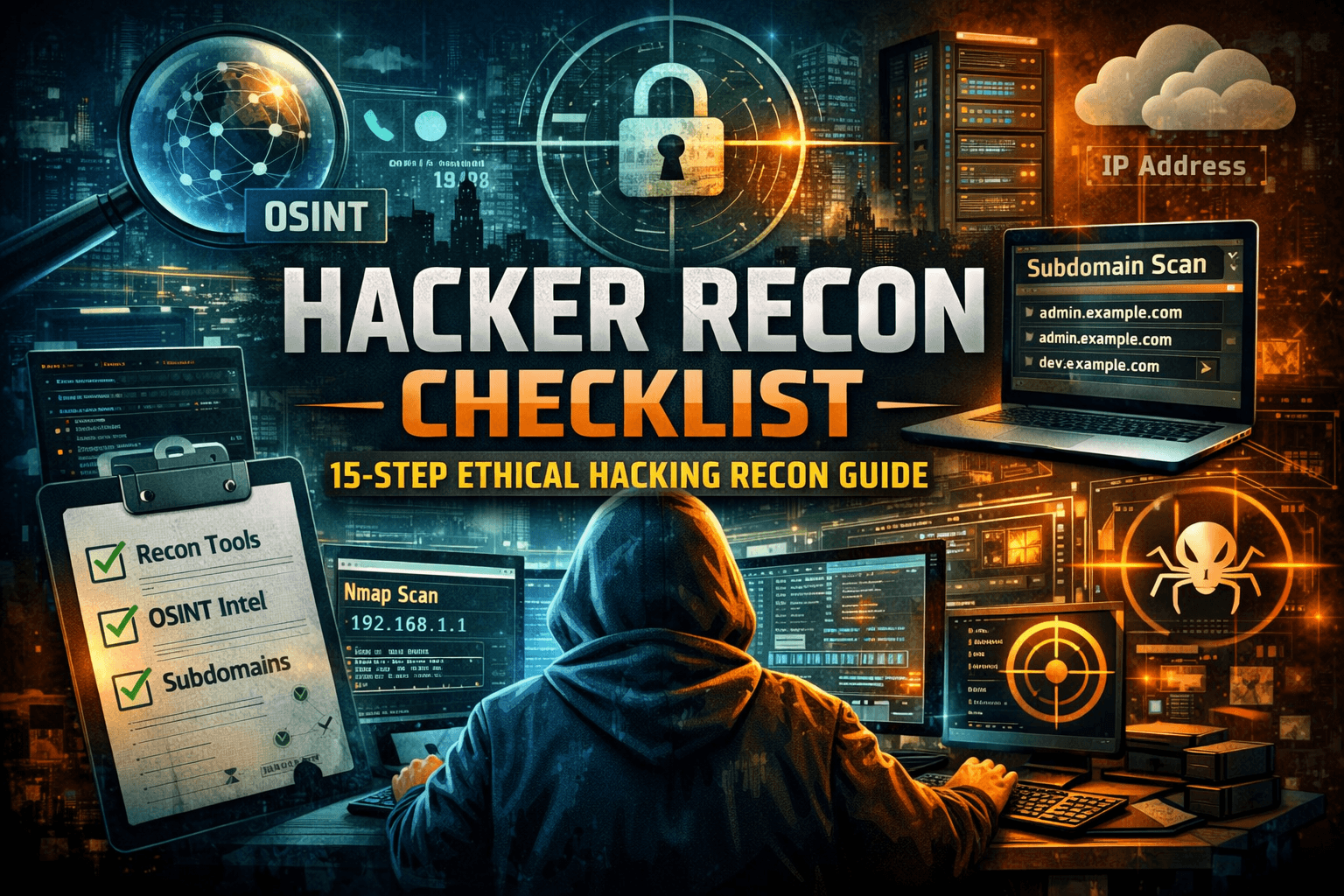
Before starting Hacker recon checklist, we should first understand what recon means.
Recon is the intelligence-gathering stage where hackers learn everything about a target before attacking it.
What is a Hacker Recon Checklist?
A Hacker Recon Checklist is a structured methodology used during the reconnaissance phase of ethical hacking and penetration testing to systematically gather intelligence about a target system before attempting exploitation.
Reconnaissance, often called recon, is the first phase of the ethical hacking process where attackers collect information such as domain details, subdomains, IP addresses, exposed services, technologies, and employee data.
Professional penetration testers use a penetration testing reconnaissance checklist to ensure no attack surface is missed. The process includes activities such as OSINT reconnaissance techniques, DNS enumeration, subdomain discovery, technology fingerprinting, and infrastructure mapping.
Table of Contents
A strong reconnaissance strategy dramatically improves success in bug bounty hunting, red team operations, and penetration testing engagements.
Reconnaissance in Ethical Hacking
Reconnaissance is the foundation of cybersecurity attacks and penetration testing methodology.
Most beginners believe hacking is about running exploit tools.
However, experienced ethical hackers know something very different.
The success of an attack depends heavily on the quality of reconnaissance.
Recon helps hackers identify:
- hidden assets
- exposed services
- weak infrastructure
- outdated software
- forgotten development environments
These weaknesses create entry points for attackers.
Passive Reconnaissance
Passive reconnaissance collects intelligence without directly interacting with the target system.
Examples include:
- Google searches
- public breach databases
- GitHub repositories
- LinkedIn employee information
- DNS record analysis
- WHOIS information
This technique is commonly called OSINT reconnaissance.
Passive recon is powerful because it does not trigger security alerts.
Tools often used include:
- theHarvester
- Maltego
- Recon-ng
- Shodan
You can learn more about OSINT research from the official Open Web Application Security Project (OWASP) documentation:
Active Reconnaissance
Active reconnaissance involves direct interaction with the target infrastructure.
Examples include:
- port scanning
- vulnerability scanning
- service enumeration
- subdomain probing
These activities may trigger security monitoring systems.
Common tools include:
- Nmap
- Amass
- Subfinder
- WhatWeb
Official Nmap documentation can be found here:
What Information Hackers Collect During Recon
A typical ethical hacker recon process collects the following data:
- company profile
- domains
- subdomains
- IP addresses
- DNS records
- technologies used
- exposed APIs
- cloud infrastructure
- open ports
- employee email patterns
All this information becomes the attack blueprint.
How Attackers Use Recon Techniques ?
Understanding the attacker mindset is essential for cybersecurity learners.
Hackers rarely attack systems randomly.
Instead, they follow a structured reconnaissance methodology.
Step 1: Target Identification
Hackers prioritize high-value targets such as:
- fintech companies
- SaaS platforms
- healthcare organizations
- e-commerce websites
- government systems
These sectors store sensitive information.
Step 2: Attack Surface Mapping
The attack surface represents all publicly accessible systems belonging to an organization.
Attackers map:
- domains
- subdomains
- APIs
- login portals
- development servers
- staging environments
Large enterprises often forget about older systems.
These forgotten assets are prime targets.
Step 3: Technology Fingerprinting
Hackers identify technologies used by a website.
For example:
- Apache or Nginx servers
- WordPress CMS
- JavaScript frameworks
- database technologies
If attackers identify outdated software, they immediately search vulnerability databases.
Step 4: Identifying Weak Points
After gathering information, attackers prioritize vulnerabilities such as:
- exposed admin panels
- outdated software versions
- misconfigured cloud storage
- exposed APIs
- leaked credentials
These weaknesses often lead to high-impact vulnerabilities.
Common Beginner Mistakes
Beginner ethical hackers often:
- rely only on automated tools
- skip passive reconnaissance
- fail to document findings
- miss hidden subdomains
Professional penetration testers treat reconnaissance as digital investigation.
SecurityElites Hands-On Lab: Hacker Recon Checklist Tutorial
This lab demonstrates a realistic penetration testing reconnaissance process using Kali Linux.
Lab Environment
Operating System:
Kali Linux
Target Domain:
example.com
Tools Required:
- whois
- dig
- subfinder
- assetfinder
- httpx
- nmap
- whatweb
- ffuf
Step 1: Domain Intelligence Gathering
Start by gathering domain ownership information.
Command:
whois example.com
This reveals:
- domain registrar
- creation date
- organization details
- name servers
Older domains often contain legacy infrastructure.
Step 2: DNS Enumeration
Next, examine DNS records.
Command:
dig example.com
Check:
- A records
- MX records
- TXT records
- NS records
TXT records sometimes reveal:
- verification tokens
- internal services
- third-party integrations
Step 3: Subdomain Enumeration
Subdomains dramatically increase attack surface.
Run:
subfinder -d example.com
Alternative tools:
assetfinder example.com
or
amass enum -d example.com
Example results:
api.example.com
dev.example.com
admin.example.com
mail.example.com
staging.example.com
Development servers are frequently vulnerable.
Step 4: Identify Live Hosts
Check which subdomains are active.
cat subdomains.txt | httpx
Output:
https://api.example.com
https://dev.example.com
https://portal.example.com
These become your primary attack surface.
Step 5: Technology Detection
Identify technologies running on the web server.
whatweb https://dev.example.com
Output may reveal:
- Apache
- PHP version
- WordPress
- JavaScript frameworks
Outdated versions often contain vulnerabilities.
Step 6: Port Scanning
Next, scan for exposed services.
nmap -sV dev.example.com
Example results:
22 SSH
80 HTTP
443 HTTPS
3306 MySQL
Exposed databases often indicate serious misconfiguration.
Step 7: Directory Discovery
Find hidden web directories.
Example command:
ffuf -u https://example.com/FUZZ -w wordlist.txt
Potential discoveries:
/admin
/backup
/api
/config
/test
Admin portals frequently contain vulnerabilities.
Step 8: GitHub Recon
Developers sometimes expose secrets publicly.
Search:
site:github.com example.com
Look for:
- API keys
- configuration files
- leaked credentials
Step 9: Employee OSINT
Search LinkedIn to identify employees.
Example query:
site:linkedin.com company name
Discover:
- developers
- security engineers
- IT administrators
Email patterns may also be identified.
Step 10: Recon Documentation
Professional hackers maintain a recon log including:
- discovered subdomains
- live hosts
- technologies
- open ports
- sensitive endpoints
This documentation becomes the foundation of penetration testing.
How Organizations Protect Against Recon ?
Organizations assume attackers constantly perform reconnaissance.
Security teams implement defensive measures.
Attack Surface Monitoring
Companies continuously scan their infrastructure for exposed assets.
Tools detect:
- forgotten domains
- exposed services
- shadow IT systems
DNS Monitoring
Unusual DNS queries may indicate reconnaissance activity.
Security teams analyze DNS logs to detect enumeration attempts.
Web Application Firewalls
Web Application Firewalls block automated scanning tools.
These systems detect patterns used by reconnaissance tools.
Rate Limiting
Rate limiting prevents attackers from rapidly scanning endpoints.
This slows down reconnaissance activity.
Bug Bounty Programs
Organizations encourage ethical hackers to responsibly disclose vulnerabilities discovered during reconnaissance.
Frequently Asked Questions
What is reconnaissance in ethical hacking?
Reconnaissance is the information-gathering phase of ethical hacking. During this stage, hackers collect intelligence about domains, subdomains, technologies, and infrastructure before attempting exploitation.
Why is reconnaissance important in penetration testing?
Reconnaissance allows attackers to identify weak points before launching attacks. Without proper reconnaissance, penetration testing becomes inefficient and random.
What tools are used for hacker reconnaissance?
Common tools include:
- Nmap
- Subfinder
- Amass
- Assetfinder
- Recon-ng
- Shodan
These tools help identify infrastructure and exposed services.
Can beginners practice reconnaissance legally?
Yes. Beginners can safely practice reconnaissance on training platforms such as Hack The Box, TryHackMe, and PortSwigger labs.
What is included in a Hacker Recon Checklist?
A Hacker Recon Checklist typically includes domain analysis, subdomain enumeration, OSINT research, technology fingerprinting, and infrastructure scanning.
What is OSINT reconnaissance?
OSINT (Open Source Intelligence) involves collecting publicly available information about a target from sources like social media, public records, and GitHub repositories.
Cybersecurity Career Advice
Reconnaissance is the most important skill in ethical hacking.
Many beginners focus only on exploitation tools, but experienced professionals know the truth.
The best hackers are excellent investigators.
A structured hacker recon checklist ensures no attack surface is overlooked.
To become a successful ethical hacker, practice:
- OSINT investigations
- subdomain enumeration
- technology fingerprinting
- attack surface mapping
These skills are essential for careers in:
- penetration testing
- bug bounty research
- red team operations
- threat intelligence
Recommended Next Skills
After mastering reconnaissance, learn:
- web vulnerability scanning
- SQL injection testing
- authentication attacks
- API security testing
- privilege escalation
Cybersecurity rewards methodical thinkers, not just tool users.