
Bug bounty hunting lets you legally find security vulnerabilities in company websites and get paid for reporting them. Google, Apple, Microsoft, Meta, and thousands of other companies run active bug bounty programs — and they are actively looking for researchers like you. This guide covers everything you need to start, from zero experience to your first paid report.
Table of Contents
What is bug bounty hunting?
A bug bounty program is a formal arrangement where companies invite security researchers to find and responsibly disclose vulnerabilities in their systems in exchange for a financial reward. It is crowdsourced security — companies get continuous security testing from thousands of researchers worldwide, researchers get paid for their findings.
The model exists because no internal security team can find every vulnerability. Attackers worldwide are constantly probing for weaknesses — bug bounty programs harness a global community of ethical researchers to find those weaknesses first.
Bug bounty hunting is completely legal when performed within the program’s defined scope. Every legitimate program publishes a policy document outlining exactly what you are authorised to test and what is off-limits.
How much can you earn from bug bounty hunting?
Rewards vary widely by program and vulnerability severity. Typical payout ranges:
- Low severity (P4) — $50–$300. Information disclosure, minor UI bugs.
- Medium severity (P3) — $300–$1,500. XSS vulnerabilities, IDOR on non-sensitive data.
- High severity (P2) — $1,500–$10,000. Authentication bypass, sensitive data exposure.
- Critical severity (P1) — $10,000–$100,000+. Remote code execution, SQL injection on production databases, account takeover at scale.
HackerOne has paid out over $300 million to researchers since 2012. Top researchers earn $300,000–$500,000 per year exclusively from bug bounty programs. Beginners realistically earn $1,000–$5,000 in their first six months while still learning.
The two major bug bounty platforms
HackerOne
The world’s largest bug bounty platform. Over 3,000 active programs including US Department of Defense, Twitter, Uber, and PayPal. Create a free account at hackerone.com. Your reputation score grows with each accepted report, unlocking access to private programs with higher payouts and less competition.
Bugcrowd
The second major platform, with a strong enterprise client base. Some programs run exclusively on Bugcrowd. Create accounts on both platforms — different companies use different platforms and you want access to the full market.
How to choose your first target program
Not all programs are equal for beginners. Look for:
- Wide scope — programs with many domains to test give you more opportunity to find something unique.
- Active response time — check the program’s median time to triage and median time to bounty. Fast-responding programs are worth more of your time.
- Beginner-friendly labels — some programs explicitly welcome new researchers.
- Recent activity — programs that show recent resolved reports are actively paying.
Avoid programs with very narrow scope (only one domain), extremely large programs with massive competition, and programs with long unresolved report backlogs.
The 4 vulnerability classes to target first as a beginner
1. Cross-Site Scripting (XSS)
XSS occurs when an application reflects user input back in the page without proper sanitisation, allowing script injection. It is the most commonly reported vulnerability class in bug bounty programs. Look for any field that reflects your input — search boxes, profile fields, URL parameters. Test with a basic payload and observe whether it executes.
2. Insecure Direct Object Reference (IDOR)
IDOR occurs when an application uses user-controllable identifiers — like numeric IDs in URLs — to access objects without verifying authorisation. If your profile is at /user/profile?id=1234, incrementing to 1235 and seeing another user’s data is a classic IDOR. No special tools required — just logical observation.
3. Subdomain takeover
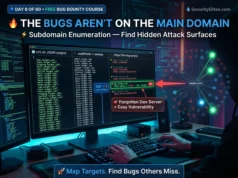
Occurs when a company has a subdomain pointing to a third-party service (like AWS S3 or GitHub Pages) that has since been deleted. An attacker can register a new account on that service and claim the subdomain. Find these with subdomain enumeration tools, then check each subdomain for hosting errors indicating an unclaimed service.
4. Information disclosure
Sensitive information accidentally exposed — API keys in JavaScript files, credentials in source code, debug information in error messages, server version information in HTTP headers. These are often low severity but excellent for building your report-writing skills and your platform reputation.
Essential bug bounty toolkit — all free
- Burp Suite Community Edition — intercepts and modifies web traffic. The single most important tool in web application security. Install it and spend one week just browsing websites through it before testing anything.
- Subfinder — subdomain enumeration. Finds all subdomains associated with a target domain.
- ffuf — web fuzzer for directory and parameter discovery.
- Nuclei — automated vulnerability scanner against known CVEs and misconfigurations.
- PortSwigger Web Security Academy — free interactive labs for every vulnerability class. Complete the Apprentice level before submitting your first report.
How to write a bug bounty report that gets paid
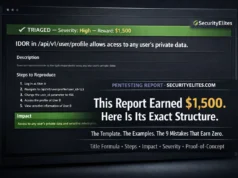
A poorly written report gets marked as Informative — noted but not paid. A well-written report gets paid and builds your reputation. Every report must include:
- Title — specific and descriptive. “Reflected XSS on search.company.com via the q parameter” not “XSS found”.
- Severity rating — justified using the CVSS scoring system. Do not overclaim severity — triagers lose trust in researchers who mark everything Critical.
- Steps to reproduce — numbered, precise, reproducible by someone who has never seen the vulnerability before.
- Impact statement — specifically what an attacker could do. “An attacker could inject a script that exfiltrates session cookies for any authenticated user who visits the affected page” — not “this is dangerous”.
- Proof of concept — screenshots, screen recordings, or code. The more concrete, the faster the triage.
Free resource: SecurityElites has a complete Bug Bounty course including methodology, platform walkthroughs, report writing templates, and a 60-day starter plan(coming soon). Free at https://securityelites.com/bug-bounty-hunting/
Frequently asked questions
How long does it take to get your first bug bounty payout?
Most dedicated beginners receive their first payout within 2–4 months of consistent practice. The first month is typically spent learning platforms and practising in labs. Month two involves your first reports — often returned as informative or duplicate. Month three, with refined methodology, typically yields first payments. The key variable is consistency of practice, not raw talent.
Do I need to know programming for bug bounty hunting?
Basic HTML, JavaScript, and an understanding of how HTTP requests work are sufficient to start. You do not need to be a developer. Many highly successful bug bounty hunters have no programming background — they focus on logic vulnerabilities and configuration issues rather than code-level bugs.
Is bug bounty hunting legal in India?
Yes — when performed within the scope of an authorised bug bounty program. Major Indian companies including Paytm, Zomato, and Razorpay run bug bounty programs. International platforms like HackerOne and Bugcrowd are fully accessible from India and pay in USD.
What is the difference between bug bounty and penetration testing as a career?
Bug bounty is freelance and self-directed — you choose targets, work your own hours, and earn per finding. Penetration testing is a client-engagement model — companies hire you for defined assessments, you follow a structured methodology, and you deliver reports. Many professionals do both. Bug bounty is a better starting point; penetration testing typically requires more structured experience and often certifications.