Red Team vs Blue Team vs Purple Team: Understanding Real Cybersecurity Warfare Inside Organizations.
What Most People Imagine vs Reality
A few years ago, during an enterprise penetration test for a financial organization, the CEO asked me something interesting:
“So… are you the hacker or the defender?”
That question perfectly captures the confusion most beginners — and even IT professionals — have.
They think cybersecurity is one team fighting attackers.
But in reality?
Modern cybersecurity works like controlled warfare inside an organization.
You have:
- Attackers simulating breaches
- Defenders protecting infrastructure
- And collaborators bridging both worlds
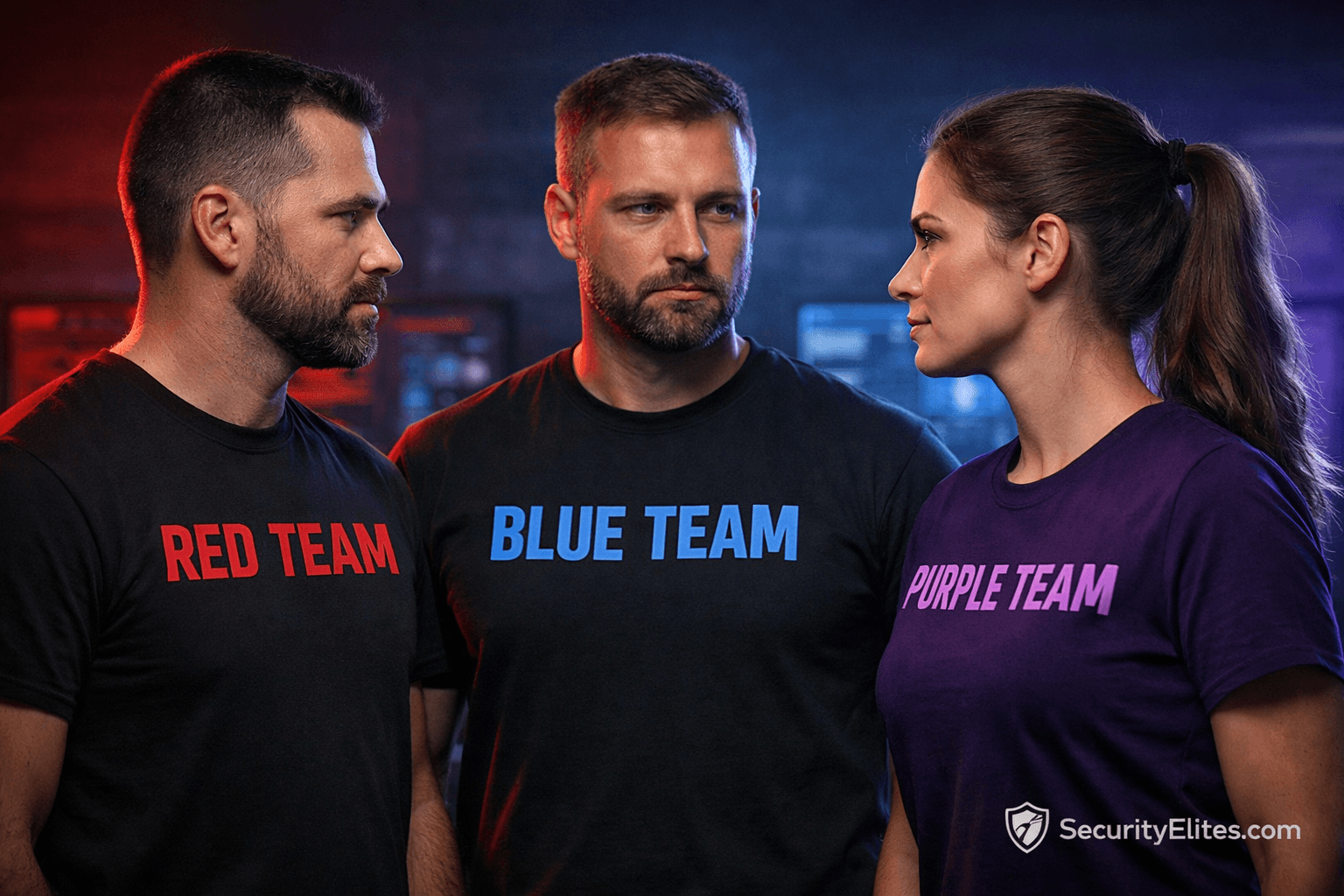
This is where Red Team vs Blue Team vs Purple Team comes into play.
Now here’s where most beginners get confused…
These teams are not job titles.
They represent security mindsets, methodologies, and operational strategies used in real enterprise environments.
Let me simplify this the way I explain to my students during professional security training.
🛡️ What Are Red Team, Blue Team, and Purple Team?
Cybersecurity today revolves around testing and improving an organization’s attack surface continuously.
Think of it like military training.
| Team | Role | Objective |
|---|---|---|
| 🔴 Red Team | Offensive Security | Break into systems |
| 🔵 Blue Team | Defensive Security | Detect & stop attacks |
| 🟣 Purple Team | Collaborative Security | Improve both sides |
Each team focuses on different stages of security testing, threat intelligence, and cybersecurity methodology.
Let’s break them down practically.
🔴 Red Team — The Ethical Attackers
The Red Team simulates real-world attackers.
Not script kiddies.
Not vulnerability scanners.
But advanced adversaries.
From my field experience, a professional Red Team engagement often runs silently for weeks — sometimes months — without employees knowing testing is happening.
🎯 Core Objective
Identify how far an attacker can go after gaining access.
This includes:
- Reconnaissance (information gathering)
- Vulnerability assessment
- Exploitation workflow
- Privilege escalation
- Lateral movement
- Data exfiltration simulation
Reconnaissance — basically intelligence gathering before attacking — is where professionals win or lose.
Best Certifications for Ethical Hackers in 2026 (Complete Career Roadmap)
✅ Real Red Team Workflow (Step-by-Step)
Step 1: Attack Surface Mapping
- Public assets
- Employee exposure
- Cloud misconfigurations
Step 2: Initial Access
- Phishing simulation
- Credential attacks
- Web exploitation
Step 3: Persistence
Maintain access without detection.
Step 4: Privilege Escalation
Move from normal user → administrator.
Step 5: Lateral Movement
Jump between internal systems.
Step 6: Objective Achievement
Access sensitive business assets.
🧰 Tools Used by Red Teams (And WHY)
Professionals don’t use tools randomly.
They support methodology.
- Nmap → Network visibility
- Burp Suite → Web exploitation testing
- Metasploit → Controlled exploitation
- Cobalt Strike → Adversary simulation
- BloodHound → Active Directory attack paths
The tool never makes the hacker.
Thinking does.
🚨 Beginner Mistake Alert
Many beginners believe Red Teaming = running scanners.
Wrong.
Real red teaming focuses on:
Human behavior + detection evasion.
🔵 Blue Team — The Digital Defenders
If Red Team represents attackers…
Blue Team represents reality.
They defend organizations 24/7.
During live cyber incidents I’ve handled, Blue Teams are the ones preventing business shutdowns.
🎯 Core Objective
Detect, respond, and recover from attacks.
Blue Team focuses heavily on:
- Defensive security
- Threat intelligence
- Log monitoring
- Incident response
- Security hardening
✅ Blue Team Operational Workflow
1. Monitoring
Using SIEM platforms to analyze logs.
2. Detection
Identifying abnormal behavior patterns.
3. Investigation
Confirming compromise indicators.
4. Containment
Stopping attacker movement.
5. Eradication
Removing persistence mechanisms.
6. Recovery
Restoring business operations.
🧰 Blue Team Tools Explained
- Splunk / ELK Stack → Log analysis
- EDR Solutions → Endpoint detection
- Wireshark → Traffic inspection
- OSSEC / Wazuh → Host monitoring
- Threat Intelligence Platforms
Why these matter?
Because attackers rarely crash systems.
They hide.
Blue Teams hunt invisibility.
Cybersecurity Career Roadmap 2026 – Complete Beginner to Expert Guide
💡 Mentor Note
Good defenders think like attackers.
The best SOC analysts I trained previously had penetration testing knowledge.
🟣 Purple Team — The Missing Link Most Companies Ignore
Now here’s where cybersecurity maturity begins.
A Purple Team is NOT a separate department.
It’s collaboration.
In many enterprises, Red Teams attack and submit reports… then nothing changes.
Purple Teaming fixes that gap.
🎯 Purple Team Objective
Improve organizational security through collaboration.
Instead of competition:
✅ Red Team shares attack methods
✅ Blue Team improves detection
✅ Both refine defenses together
Real Purple Team Process
Step 1: Red Team executes controlled attack
Step 2: Blue Team monitors detection gaps
Step 3: Immediate feedback exchange
Step 4: Detection rules updated
Step 5: Attack repeated for validation
This dramatically strengthens security testing maturity.
🧩 Real-World Scenario (From Enterprise Assessment)
During one enterprise assessment, our Red Team gained domain admin access within 48 hours.
Shocking part?
Blue Team detected nothing.
Instead of blaming them, we initiated a Purple Team exercise.
Results after collaboration:
- Detection improved by 70%
- Incident response time reduced drastically
- Attack visibility increased organization-wide
Security improved without buying new tools.
Just better teamwork.
What Is Ethical Hacking? Complete Beginner Guide (Step-by-Step 2026)
⚠️ Beginner Mistakes I See Repeatedly
After mentoring hundreds of students, these mistakes appear constantly:
- Learning only hacking tools
- Ignoring defensive security concepts
- No understanding of logging
- Skipping cybersecurity methodology
- Thinking certification = skill
This mistake alone causes many career failures.
Cybersecurity rewards balanced thinkers.
🔥 Pro Tips From 20 Years in Cybersecurity
✅ Tip 1: Learn Detection Early
Attackers who understand logs become elite.
✅ Tip 2: Study Active Directory Deeply
Most enterprise compromises happen here.
✅ Tip 3: Think Like Business Risk
Security protects operations — not ego.
✅ Tip 4: Automation ≠ Security
Human analysis always wins.
✅ Tip 5: Communication Skills Matter
Many pentesters fail during reporting phase.
⚖️ Ethical & Defensive Perspective
Let me be very clear.
Red Team skills must always be used:
✅ With authorization
✅ Inside legal scope
✅ For security improvement
Unauthorized testing is illegal.
Ethical hacking exists to strengthen organizations — not exploit them.
Professional cybersecurity operates on trust.
✅ Practical Checklist — Choosing Your Path
If You Want Red Team Career
- Learn networking deeply
- Master Linux & Windows internals
- Practice exploitation labs
- Study attack chains
If You Prefer Blue Team
- Learn SIEM tools
- Understand logs
- Study malware behavior
- Practice incident response
If You Aim for Purple Team
- Combine both skillsets
- Learn communication
- Understand detection engineering
⚡ Quick Recap Summary
| Team | Focus | Mindset |
|---|---|---|
| Red Team | Attack Simulation | Offensive |
| Blue Team | Defense & Monitoring | Protective |
| Purple Team | Collaboration | Strategic |
Cybersecurity maturity evolves:
Red → Blue → Purple
❓ FAQs — Red Team vs Blue Team vs Purple Team
1. Which is better: Red Team or Blue Team?
Neither. Both are essential for strong cybersecurity defense.
2. Is Purple Team a job role?
Usually no. It’s a collaborative security methodology.
3. Can beginners start with Red Team?
Yes — but understanding defensive security accelerates growth.
4. Which team earns more?
Experienced professionals in all teams earn competitively depending on expertise.
5. Do companies really use Purple Teams?
Yes. Mature enterprises increasingly adopt Purple Team exercises.
6. Is penetration testing same as Red Teaming?
No. Red Teaming simulates full adversary behavior beyond vulnerability assessment.
🏁 Final Thoughts
After two decades in cybersecurity, one truth stands strong:
Organizations don’t get hacked because tools fail.
They get hacked because teams don’t communicate.
Understanding Red Team vs Blue Team vs Purple Team isn’t just theory.
It’s the foundation of modern defensive security and real-world cyber resilience.
Master collaboration — and you master cybersecurity.