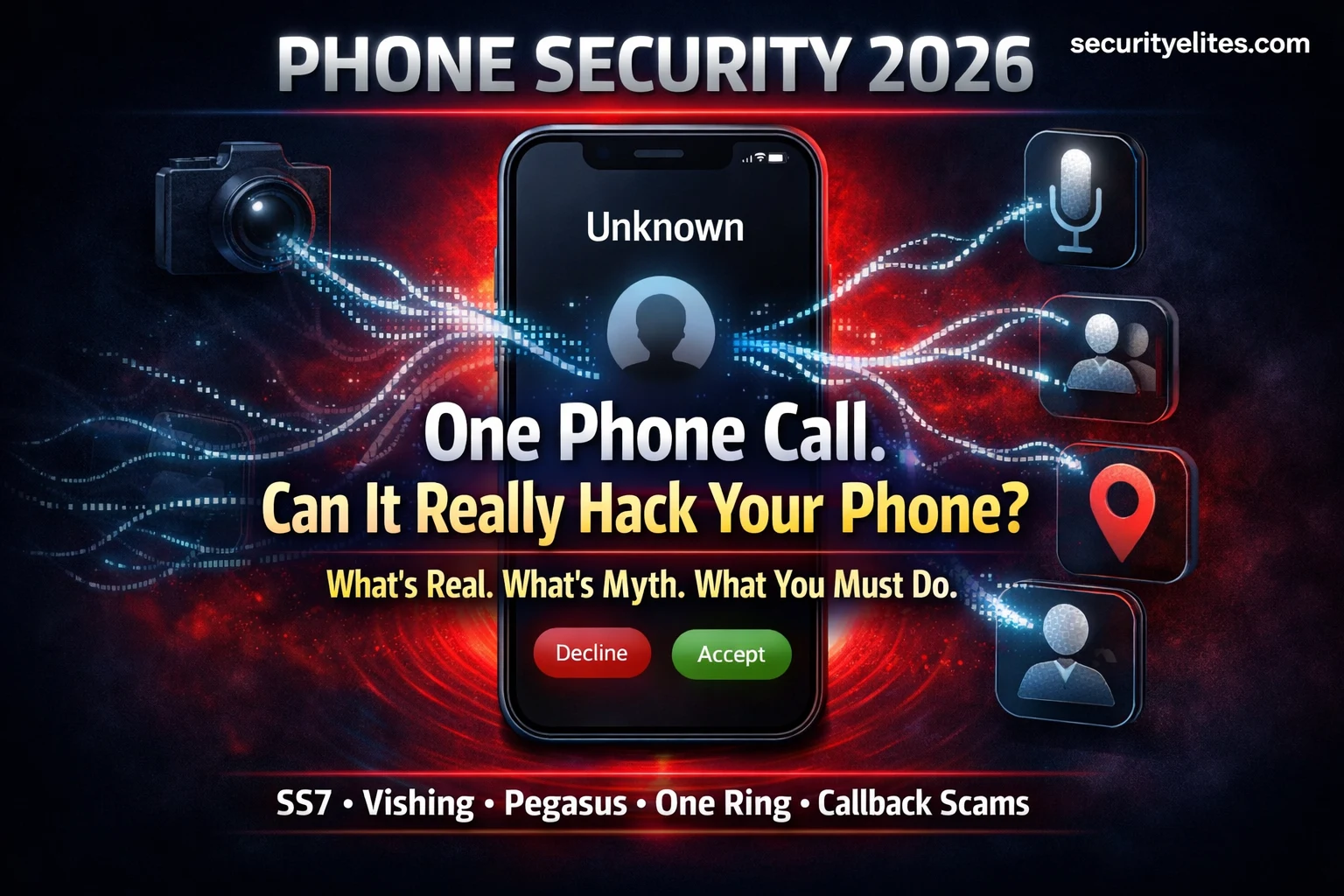
It’s one of the most frightening cybersecurity questions of 2026: can someone hack your phone just by calling you? The internet is full of terrifying claims. Some are complete myths. Some are dangerously real. This guide separates fact from fiction with technical precision — so you know exactly what to worry about, what to ignore, and what to do right now to protect yourself.
- The Direct Answer — What Is and Is Not Possible
- Myth vs Reality — The Definitive Breakdown
- SS7 Attacks — The Real Vulnerability in Every Mobile Network
- Vishing — AI Voice Cloning and Social Engineering Via Phone
- Callback Scams — The One Ring and Premium Rate Fraud
- Pegasus & Zero-Click Exploits — State-Grade Threats
- Complete Phone Call Protection — By Threat Level
The question “can someone hack your phone by calling you” generates 55,000 searches every month. The scale of the question reflects genuine public concern — and genuine public confusion. The answer is nuanced: it depends entirely on which attack you mean, who is executing it, and who you are. Let’s break down each scenario with precision.
The Direct Answer — What Is and Is Not Possible
For the vast majority of people receiving a regular phone call: no, simply having your phone ring — even if you answer — cannot install malware or directly compromise your device through the audio channel alone. The voice call mechanism on modern smartphones does not execute code. You cannot “receive malware through sound.”
However — and this is the critical distinction — phone calls are used as the entry point for several serious, real attack vectors that can absolutely lead to phone compromise, financial theft, credential theft, and account takeover. The attack is not the call itself. The attack uses the call as a social engineering vector, a network-level interception point, or in extremely rare state-sponsored cases, as a zero-click exploit delivery mechanism.
Myth vs Reality — The Definitive Breakdown
SS7 Attacks — The Real Vulnerability in Every Mobile Network
SS7 (Signalling System 7) is a set of protocols designed in 1975 that underpins virtually every mobile network on earth. It handles call routing, SMS delivery, roaming, and billing between carriers worldwide. The critical problem: SS7 was designed for a closed network of trusted carriers with no authentication mechanisms. In 2026, access to SS7 infrastructure can be obtained through compromised carriers in certain countries, insider threats, or by purchasing access through grey-market telecom providers.
An SS7 attacker with network access can intercept your calls and SMS messages in real time, receive your one-time passwords sent by SMS, track your physical location based on which cell towers your phone connects to, and redirect your calls and messages. This is not theoretical — SS7 attacks have been publicly demonstrated against politicians and journalists by security researchers at the Chaos Computer Club and documented by the German Bundestag’s investigation in 2014. Similar attacks have been reported as recently as 2024.
Use Signal or WhatsApp for sensitive calls and messages — both use end-to-end encryption that operates independently of SS7 and cannot be intercepted at the carrier level. Most critically: replace SMS 2FA with an authenticator app (Google Authenticator, Authy) or hardware key on all important accounts. SMS 2FA is vulnerable to SS7 interception. App-based TOTP codes are generated locally on your device and never transmitted over the cellular network.
Vishing — AI Voice Cloning and Social Engineering Via Phone in 2026
Vishing (voice phishing) is the phone call equivalent of email phishing. An attacker calls you, impersonating a trusted entity — your bank’s fraud department, HMRC or the IRS, your employer’s IT support, or in 2026’s most alarming evolution, a convincing clone of your family member’s voice — and tricks you into revealing credentials, approving transactions, installing remote access software, or providing verification codes.
AI voice cloning has changed the threat landscape dramatically. ElevenVoice and similar tools can generate a near-perfect clone of a specific person’s voice from as little as 30 seconds of audio — which is trivially available from a LinkedIn video, a YouTube interview, or a social media post. In 2024, a Hong Kong financial worker was tricked by an AI clone of their company CFO into transferring $25 million. This is not a theoretical attack. It is happening at scale in 2026.
Callback Scams — The One Ring and Premium Rate Fraud
The one-ring scam (wangiri — Japanese for “one ring and cut”) operates on a simple psychology: your phone rings once from an unfamiliar number, the caller hangs up before you can answer, and curiosity drives you to call back. The number routes to a premium-rate international line — often in Pacific Island nations, certain Caribbean islands, or African countries with premium international rate agreements — and charges $10–$30 per minute. The automated system on the other end keeps you on hold as long as possible.
A single one-ring call that you return and stay on hold for 5 minutes can add $50–$150 to your phone bill. Scam call centres run thousands of these simultaneously. Critically: simply receiving the one-ring call cannot harm you in any way. Your phone is not compromised by the incoming ring. The risk is purely the callback. Area codes to be particularly cautious about calling back: +232, +269, +242, +268, +222, +473 and other unusual international prefixes.
Never call back unfamiliar international numbers. Search any unknown number online before calling — scam numbers are rapidly indexed on reverse phone directories and community warning sites. Enable your carrier’s spam call filtering service. Most major carriers offer free robocall/spam filtering (AT&T Call Protect, T-Mobile Scam Shield, Vodafone Call Protect). If you mistakenly called a premium number and were charged, contact your carrier immediately — most will reverse fraudulent premium-rate charges.
Pegasus & Zero-Click Exploits — State-Grade Threats
Pegasus is real spyware developed by Israeli company NSO Group and documented extensively by Amnesty International’s Security Lab and the Citizen Lab at the University of Toronto. Between 2019 and 2021, Pegasus used zero-click exploits in WhatsApp and iMessage — meaning a device could be fully compromised by a missed call alone, with no user interaction required. The vulnerabilities used were subsequently patched by WhatsApp and Apple.
Zero-click exploits are extraordinarily rare, enormously expensive (estimated $500,000–$2M per deployment licence), and reserved exclusively for high-priority targets of state intelligence agencies — journalists, activists, politicians, dissidents, and human rights workers. Pegasus has been confirmed on the devices of journalists at major news organisations, political opponents of authoritarian governments, and human rights lawyers. For the overwhelming majority of people reading this guide, Pegasus is not a realistic threat model.
Journalists covering authoritarian governments, human rights lawyers, political dissidents, government officials handling sensitive intelligence, and civil society activists in high-risk regions. If you fall into these categories, consult Access Now’s Digital Security Helpline for a professional threat assessment and device audit. For everyone else: keep your phone OS updated (patches close known zero-click chains) and that is sufficient protection against this threat.
Complete Phone Call Protection — By Threat Level
which ones to ignore, and how to stop every one.
The five-step protection plan above takes 10 minutes to implement. The family safe word takes 30 seconds to establish. Do both today.
Frequently Asked Questions – Can someone hack your phone by calling
SecurityElites — Your Phone Can Be Hacked in Seconds — real attack methods explained
SecurityElites — What Is Phishing? — how vishing fits into the broader social engineering landscape
Amnesty International — Pegasus Technical Forensic Report — the definitive Pegasus documentation →
Citizen Lab — Targeted Threats Research — ongoing documentation of phone-based state surveillance →
The most important thing I can tell you about phone security is this: the attacks that are actually being used against ordinary people in 2026 are social engineering attacks — vishing, AI voice cloning, callback scams. Technical exploits like SS7 and zero-click malware are real but reserved for high-value targets. Focus your protection where the actual risk is. Establish the family safe word today. Replace SMS 2FA with an authenticator app. Update your phone. Those three steps handle 95% of your realistic threat surface.