?
Every year in January and February, millions of people search “where to start in cybersecurity” after deciding to change careers or enter the field for the first time. They find guides written in 2021, certification comparison articles with obvious affiliate bias, and Reddit threads that debate the same questions endlessly without resolution. This Cybersecurity for beginners guide is the 2026 version — written now, relevant now, with honest advice about what actually works.
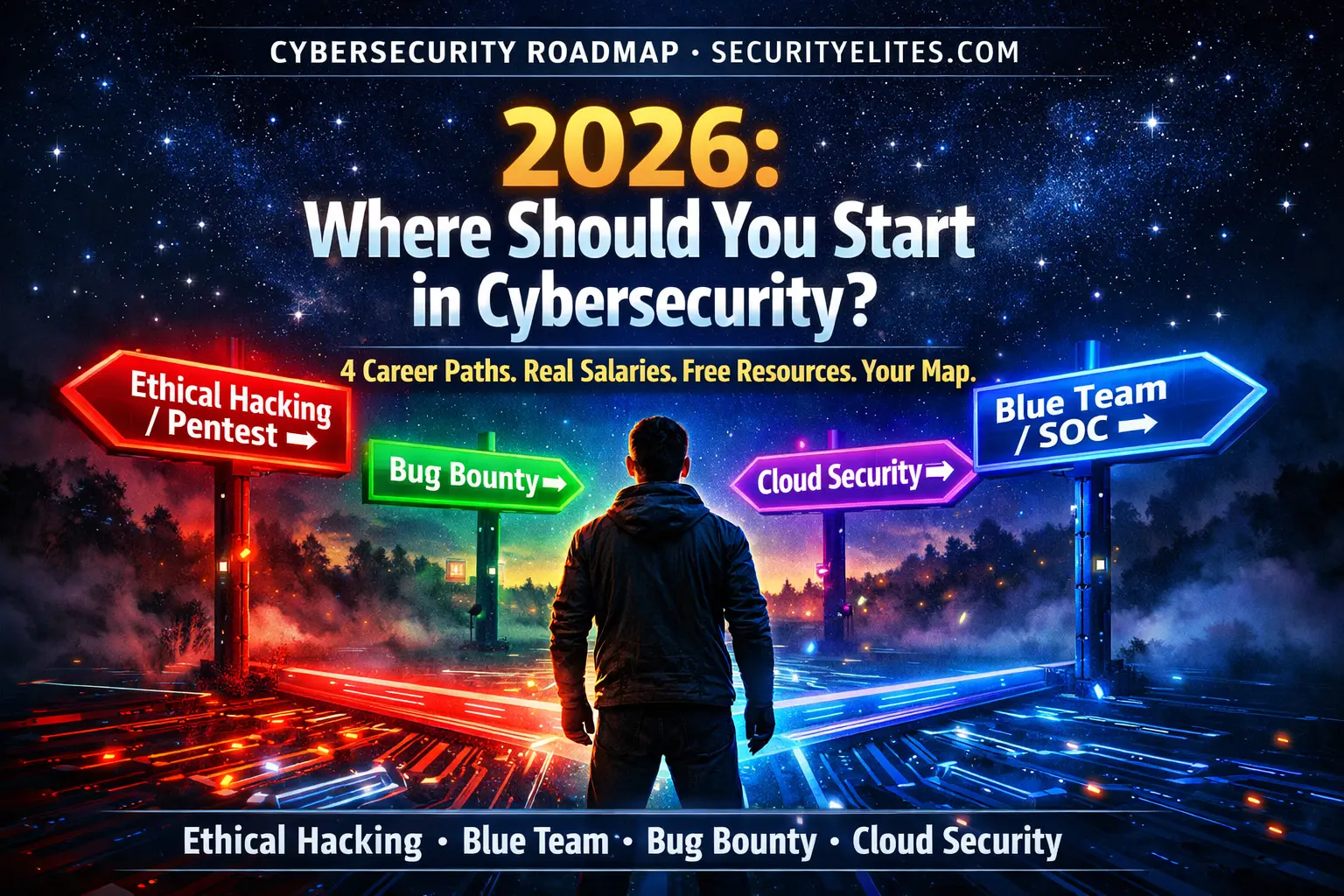
Cybersecurity is not one career. It is a family of careers — some offensive, some defensive, some technical, some strategic — and “where to start” depends entirely on which direction you are heading. This guide maps four realistic career paths, identifies the free resources and certifications for each, and gives you a realistic timeline for when you can expect to work in the field.
The cybersecurity skills gap has over 3.5 million unfilled positions globally. The industry needs you. The question is which version of you they need — and how to become that person as efficiently as possible.
3.5M+
Unfilled cybersecurity positions globally
$0
Cost to start learning right now
12–18
Months to first cybersecurity job (typical)
$75K
Median entry salary — US market 2026
securityelites.com4 CYBERSECURITY CAREER PATHS — CHOOSE YOUR DIRECTION
⚔️
Ethical Hacking / Pentest
Attack systems with permission to find vulnerabilities. The most technical and creative path. Highest ceiling for earnings and prestige.
Entry cert: eJPT
Senior cert: OSCP
Entry salary: $55K–$75K
Timeline: 12–18 months
🛡️
Blue Team / SOC
Detect and respond to attacks. Monitor SIEM alerts, investigate incidents, hunt threats. More positions available. Easier entry point for many.
Entry cert: Security+
Senior cert: GCIA / GCFE
Entry salary: $45K–$65K
Timeline: 6–12 months
💰
Bug Bounty
Find vulnerabilities in real applications for cash rewards. No employer needed. Start part-time. Unlimited income ceiling. Most flexible path.
Platform: HackerOne / Bugcrowd
First finding: 1–3 months
Income: variable ($0–$500K+)
Timeline: start immediately
☁️
Cloud Security
Secure AWS, Azure, GCP infrastructure. Fastest-growing specialisation. Highest average salaries. Requires cloud fundamentals first.
Entry cert: AWS Security
Senior cert: CCSP
Entry salary: $70K–$90K
Timeline: 12–18 months
All four paths share a common foundation: networking basics, Linux fundamentals, and security concepts. The first 3 months are identical regardless of direction. See the Universal Starting Point section below.
4 Cybersecurity Career Paths 2026 — Each path has different skill requirements, certifications, income models, and timelines. All share a common 3-month foundation. Choose based on what aspects of security interest you most — active (offensive/hunting) or reactive (defensive/responding).
⚔️ Path 1: Ethical Hacking and Penetration Testing
Ethical hacking is the most recognised cybersecurity career path — and the most technically demanding. Penetration testers are the professionals who simulate real cyberattacks against organisations with authorisation, find vulnerabilities, and deliver professional reports. It is the path with the highest technical ceiling and, for many practitioners, the most intellectually rewarding work.
⚔️ Ethical Hacking Path — Free Resources Stack
MONTH 4–6
Skills + Cert: Ethical Hacking Course Days 31–60 + PortSwigger Web Security Academy + Earn eJPT (~$200)
MONTH 7–12
Advanced + Portfolio: HTB machines + Ethical Hacking Days 61–100 + PNPT certification + CTF write-ups on GitHub
MONTH 12+
Apply: Junior pentester roles ($55K–$75K). Begin OSCP preparation for month 14–18.
🛡️ Path 2: Blue Team and Security Operations
The blue team is the defensive side of cybersecurity — monitoring networks for attacks, investigating security incidents, responding to breaches, and hunting for threats that bypassed initial defences. SOC (Security Operations Centre) Analyst is the most common entry-level blue team role, with more positions available than any other cybersecurity specialisation and a shorter path to first employment.
🛡️ Blue Team Path — Free Resources Stack
MONTH 1–3
Foundation: Professor Messer’s CompTIA Security+ course (free on YouTube) + TryHackMe SOC Level 1 path + Networking fundamentals
MONTH 3–6
Cert + SIEM: Earn CompTIA Security+ ($392) + Learn Splunk (free tier) or Elastic SIEM + TryHackMe Blue Team Labs
MONTH 6–9
Apply: SOC Analyst Level 1 roles ($45K–$65K). Build toward CySA+ and eventually GCIA for advancement.
Blue team is the fastest path to employment. SOC Level 1 roles are available at 6–9 months with Security+ — a significantly shorter timeline than offensive security roles.
💰 Path 3: Bug Bounty Hunting
Bug bounty is the only cybersecurity career path where you can start earning — even part-time, even as a student — within months of beginning. No employer. No office. No fixed salary ceiling. You find a vulnerability in a company’s programme, submit a report, and they pay you. The complete bug bounty guide and the 60-day Bug Bounty course cover every step of this path in detail.
Start today: Register on HackerOne.com → install Burp Suite (free) → read disclosed reports from one programme → begin testing. The 60-day bug bounty course walks through every step. First valid finding is realistic in months 1–3 with daily practice.
☁️ Path 4: Cloud Security
Cloud security is the fastest-growing and highest-paying cybersecurity specialisation in 2026. As organisations migrate infrastructure to AWS, Azure, and Google Cloud, securing those environments has become critical. Cloud security engineers command higher average salaries than most other security specialisations because the combination of cloud platform knowledge and security expertise is rare. This path requires learning cloud fundamentals before security layers on top.
☁️ Cloud Security Path — Starter Stack
Start with: AWS Cloud Practitioner (free study, $100 exam) → learn IAM, S3, EC2, VPCs fundamentals
Then: AWS Certified Security Specialty + CompTIA Security+ + CloudGoat (Rhino Security Labs’ vulnerable AWS environment)
Practice: flaws.cloud and flaws2.cloud (free intentionally vulnerable AWS labs) → document findings in portfolio
Apply at: Month 12–18 for Cloud Security Engineer or Cloud Security Analyst roles ($70K–$90K entry)
The Universal Starting Point — The Same for Every Path
Before choosing a specific direction, every cybersecurity beginner needs the same three-month foundation. These fundamentals unlock every career path and every learning resource above — nothing in cybersecurity makes sense without them:
securityelites.comUNIVERSAL FOUNDATION — FIRST 3 MONTHS (ALL PATHS)
📡 NETWORKING FUNDAMENTALS
TCP/IP, OSI model, DNS, HTTP/HTTPS, subnetting, ports and protocols. Every security technique either exploits or defends these concepts.
Free: TryHackMe Pre-Security, Professor Messer Network+
🐧 LINUX BASICS
Navigation, file operations, permissions, text processing, bash scripting basics. Security tools run in Linux. Fluency in Linux is non-negotiable in every career path.
Free: OverTheWire Bandit, TryHackMe Linux Fundamentals
🌐 HOW THE WEB WORKS
HTTP methods, request/response cycle, cookies, sessions, APIs, authentication mechanisms. Web security (offensive and defensive) is impossible without this foundation.
💡 SECURITY FUNDAMENTALS
CIA triad, common attack types, defence-in-depth, authentication vs authorisation, encryption basics. The conceptual vocabulary shared across all security domains.
Complete these 4 foundations before choosing your specialist path. They take approximately 3 months at 1 hour/day.
Universal Foundation — All four cybersecurity career paths require the same three-month foundation: networking, Linux, web fundamentals, and security concepts. Invest in these first regardless of which direction you are heading. They are the substrate everything else builds on.
Cybersecurity Salary Guide 2026 — By Role and Experience
| Role | Entry | Mid-Level | Senior | Key Cert |
|---|
| Penetration Tester | $55K–$75K | $80K–$110K | $120K–$180K | eJPT → OSCP |
| SOC Analyst | $45K–$65K | $65K–$90K | $90K–$130K | Security+ → CySA+ |
| Cloud Security Eng. | $70K–$90K | $95K–$130K | $130K–$200K | AWS Security → CCSP |
| Threat Intel Analyst | $55K–$75K | $75K–$100K | $100K–$140K | Security+ → GREM |
| Bug Bounty Hunter | $0–$2K/mo | $2K–$10K/mo | $10K–$500K+ | HackerOne profile |
US market annual figures unless noted. Bug bounty is monthly variable income. Salaries vary significantly by location, employer size, and specialisation depth.
The One Mistake That Kills Every Beginner’s Progress
Collecting courses instead of practising skills.
The most common pattern among people who spend years “learning cybersecurity” without ever getting a job or finding a bug bounty: they watch one course, then buy another, then start a third, and never spend sustained time in a terminal actually doing the things the courses describe. This is the equivalent of watching cooking shows for two years and then being surprised that you cannot cook.
Security is a physical skill. It lives in your fingers and your pattern recognition, not in your memory of what a course slide said. For every hour of content you consume, you need at least two hours of active terminal practice. No exceptions. No shortcuts.
Pick one path. Follow one resource. Practice daily. Finish it.
Every Resource You Need Is Already Free
Choose Your Path. Start Today. Everything Is Waiting.
Frequently Asked Questions – Cybersecurity for Beginners
Where should a complete beginner start in cybersecurity?
Choose a path. Build the universal foundation (networking, Linux, web basics, security concepts). Start with TryHackMe Pre-Security. Then follow your chosen path’s resource stack. The SecurityElites.com 100-Day Ethical Hacking Course is the most comprehensive free starting resource for the offensive security path.
Do I need a degree to work in cybersecurity?
No degree is required for most cybersecurity roles. The field is skills and certification-focused. Certifications, a strong portfolio, and demonstrable practical skills are more important than a degree for most hiring decisions. Government and some large enterprise positions may prefer or require degrees.
Is cybersecurity hard to learn?
The learning curve is significant but not uniquely difficult compared to other technical fields. The most important factor is active hands-on practice over passive learning. An hour of terminal practice produces more skill than five hours of video watching. Consistency matters more than raw intelligence.
What cybersecurity jobs are most in demand in 2026?
Cloud Security Engineer (fastest growing, highest salaries), SOC Analyst (highest volume of positions, fastest to entry), Penetration Tester (most prestigious, OSCP required for serious roles), Threat Intelligence Analyst, and DevSecOps Engineer. Over 3.5 million unfilled positions globally.
How long does it take to get a cybersecurity job from scratch?
6–9 months for SOC Analyst (with Security+). 12–18 months for junior penetration tester (with eJPT + portfolio). 12–18 months for cloud security roles. These are realistic timelines with 1–2 hours of daily consistent practice. More hours per day shortens the timeline proportionally.
ME
Mr Elite
Founder, SecurityElites.com | Security Educator
The “where to start in cybersecurity” question is asked millions of times every year — and answered poorly most of the time. Every answer either sells you a course, pushes you toward a specific certification the author is affiliated with, or gives you a vague answer about “getting a foundation” without defining what that foundation is. This article is the answer I wish existed when I started: specific paths, specific free resources, specific timelines, and the honest single piece of advice that actually determines success.