DVWA Web Hacking Tutorial DAY 3 — Breaking Authentication in DVWA: Brute Force & Login Logic Exploitation
The Weakest Door in Most Systems
Let me share something from real penetration testing engagements.
You would expect modern organizations to fall due to advanced zero-day exploits or complex malware attacks.
But surprisingly…
Most breaches still begin with login pages.
Yes. Simple authentication systems.
During one enterprise red-team assessment, we gained administrator access to an internal portal within 18 minutes — not by hacking servers — but by exploiting weak login logic.
Now here’s where beginners misunderstand hacking.
They imagine dramatic technical attacks.
Reality?
Attackers often just keep trying passwords intelligently.
Today, you move from observation into your first real exploitation phase.
We attack authentication.
And this is usually the moment students realize:
Web hacking is logical manipulation — not movie-style hacking.
Why Authentication Attacks Matter in Real Cybersecurity
Authentication controls protect everything behind them:
- User data
- Admin panels
- Financial systems
- Internal dashboards
- APIs
If authentication fails, security collapses.
In cybersecurity methodology, authentication sits directly on the attack surface frontline.
Something important happens here.
Organizations invest millions in firewalls and monitoring tools — yet overlook login protection mechanisms.
Beginners often assume brute force attacks are outdated.
They are not.
Even today, credential attacks remain among the top breach causes globally.
From incident response experience, compromised credentials appear repeatedly in ransomware investigations.
Why?
Because authentication logic is frequently implemented incorrectly.
And DVWA intentionally demonstrates these weaknesses.
Beginner-Friendly Concept — What Is Authentication Exploitation?
Authentication answers one question:
“Are you really who you claim to be?”
Web applications verify identity using:
- Username
- Password
- Sessions
- Cookies
Attackers attempt to bypass or abuse this verification.
Imagine a security guard checking IDs.
If the guard:
- accepts unlimited attempts,
- never locks doors,
- or trusts fake badges…
Entry becomes inevitable.
That’s brute force logic failure.
Let’s pause briefly.
Beginners think brute force means guessing randomly forever.
Professional attackers reduce guesses intelligently using patterns and leaked credentials.
Efficiency matters more than speed.
Professional Workflow — How Ethical Hackers Attack Login Systems
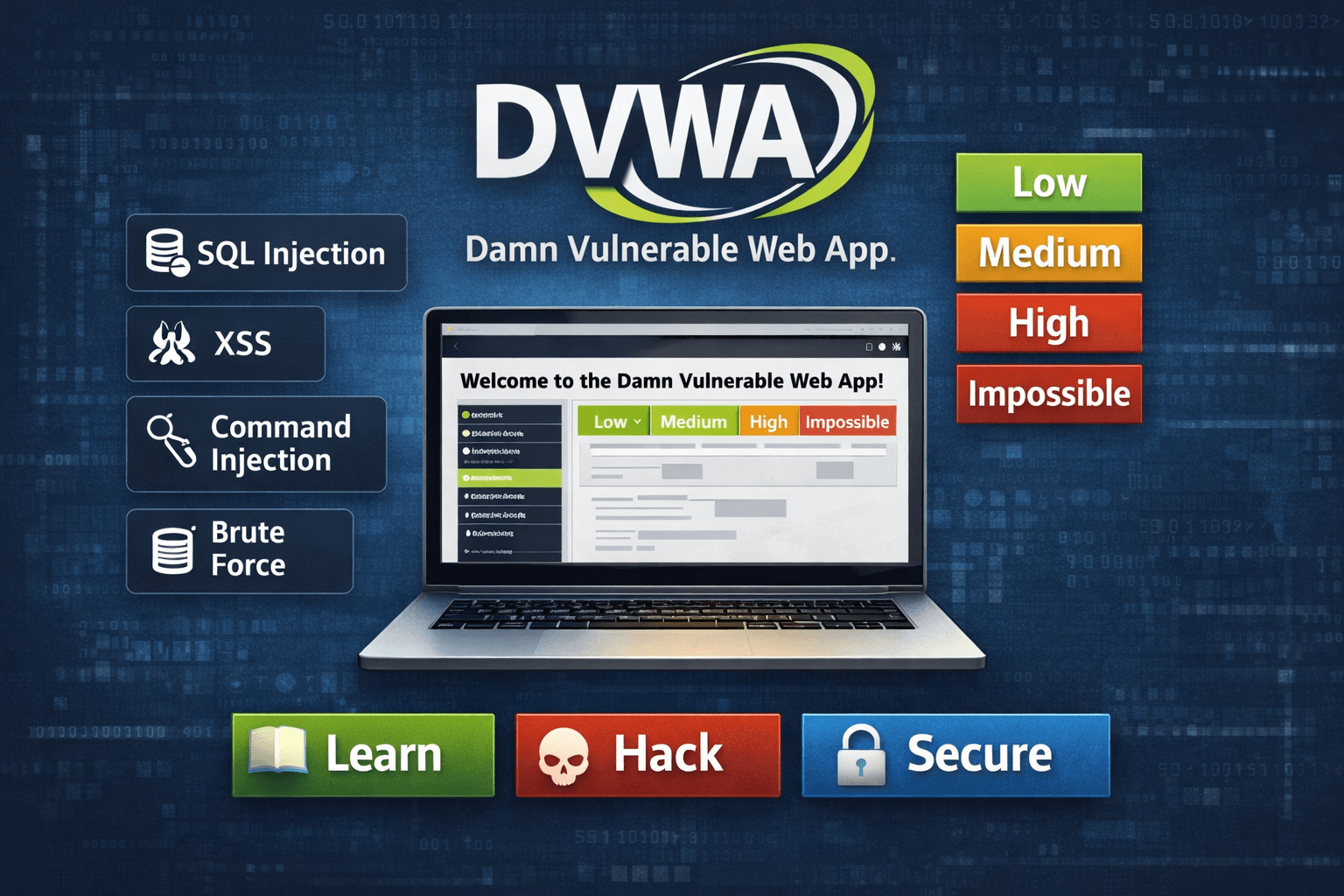
Open DVWA → Brute Force Module.
Before attacking, observe again.
Notice URL structure:
vulnerabilities/brute/
Enter incorrect credentials.
Watch response behavior carefully.
Now intercept request using Burp Suite.
You’ll notice something like:
username=admin&password=test&Login=Login
This request becomes your attack point.
Step 1 — Identify Authentication Parameters
Key parameters:
- username
- password
- submit action
Attackers target parameters, not interfaces.
Step 2 — Test Login Logic
Try:
- Wrong username
- Correct username + wrong password
- Empty values
Observe responses.
Do messages change?
Response differences reveal validation logic.
Step 3 — Launch Controlled Brute Force
Use Burp Suite Intruder.
Select password field as payload position.
Load password list.
Start attack.
Now watch carefully…
Successful login produces different response length.
That difference equals compromise.
Real-World Scenario — Corporate Login Failure
During a retail company assessment, login attempts were unlimited.
No CAPTCHA.
No lockout.
No monitoring.
Using controlled password spraying, administrative credentials were discovered within hours.
No exploit required.
The company had strong infrastructure security — but weak authentication controls.
Students often find this shocking.
Complex systems fail due to simple logic mistakes.
Tools Used by Professionals
✅ Burp Suite Intruder
Used for automated request manipulation.
Professionals analyze:
- Response codes
- Length differences
- Redirect behavior
Common beginner mistake:
Focusing only on visible success messages.
Servers reveal success subtly.
✅ Wordlists (Password Lists)
Attackers rarely guess manually.
Common lists include:
- rockyou.txt
- breached password datasets
Important insight:
Real attackers reuse leaked credentials.
Credential reuse drives modern breaches.
✅ Browser Session Analysis
After login success, observe cookies.
Authentication usually creates session tokens.
Session handling becomes critical later.
(We’ll exploit this soon.)
🚨 Beginner Mistake Alert
Students frequently:
❌ Attack without interception
❌ Ignore server responses
❌ Use massive wordlists blindly
❌ Miss successful attempts
❌ Forget security level settings
Another common confusion:
“If brute force works in DVWA, real systems must be easy.”
Not exactly.
Real targets implement defenses — but misconfigurations still occur regularly.
🔥 Pro Tips From 20 Years Experience
Professional pentesters rarely brute force aggressively first.
Instead they test:
✅ Default credentials
✅ Username enumeration
✅ Password reuse patterns
✅ Logic flaws
Something interesting happens here…
Often only one correct username dramatically reduces attack complexity.
Enumeration precedes brute force.
Always.
Defensive & Ethical Perspective
Blue teams defend authentication using:
- Rate limiting
- Account lockout
- Multi-factor authentication
- CAPTCHA
- Behavioral detection
Ethical hackers simulate attacks to validate these defenses.
Never attempt brute force attacks outside authorized environments.
Even excessive login attempts can trigger legal consequences.
Ethics defines professionalism.
Practical Implementation Checklist ✅
Today perform:
✅ Open DVWA brute force module
✅ Intercept login request
✅ Identify parameters
✅ Send request to Intruder
✅ Load password wordlist
✅ Launch attack
✅ Identify successful response
✅ Log in successfully
✅ Observe session cookies
Document findings carefully.
You just performed your first authentication attack.
Career Insight — Why Authentication Testing Is Valuable
Bug bounty platforms frequently reward authentication flaws highly.
Skills learned today apply directly to:
- Web Pentester roles
- Bug bounty hunting
- Red teaming
- Identity security testing
Many junior analysts overlook authentication testing.
Experienced professionals never do.
Because identity equals access.
Quick Recap Summary
Today you learned:
✅ Authentication attack concepts
✅ Login logic analysis
✅ Parameter identification
✅ Burp Suite Intruder usage
✅ Brute force methodology
✅ Session awareness
You successfully compromised authentication.
Tomorrow…
We attack the database itself.
And this is where web hacking becomes powerful.
FAQs
1. What is brute force attack?
It involves systematically testing credential combinations until valid authentication occurs.
2. Is brute force still relevant today?
Yes. Credential attacks remain among the most common breach methods.
3. Why intercept login requests?
Because attackers manipulate server communication directly.
4. Can authentication fail without weak passwords?
Yes. Logic flaws alone may allow bypass.
5. What indicates successful login?
Response length, redirects, or session creation differences.
6. Do companies really suffer from this?
Frequently. Authentication weaknesses appear regularly in audits.