

Hackers are watching you through camera right now. This is not a warning. This is already happening.Your phone can be hacked in minutes.
Not by some elite cybercriminal sitting in a secret lab. Not using expensive tools. But by ordinary attackers using techniques that are already available online. That’s the part most people underestimate. They assume hacking is complex. They assume they are not important enough to be targeted. They assume it won’t happen to them. And that’s exactly why it works.
Right now, as you read this, there are people being watched through their own devices — without any sign, without any alert, without any clue. Take a moment and think about your own habits.
You install apps quickly. You allow permissions without reading. You connect to Wi-Fi networks without thinking twice. You click links because they look harmless. None of these actions feel dangerous. But combined, they create a perfect entry point.
In 2026, cyber attacks are no longer limited to corporations or high-profile individuals. Everyday users are the primary targets because they are easier to exploit.
I’ve seen cases where people realized something was wrong only after receiving a message demanding money. By that time, the attacker had already collected enough information to create fear. And fear is the real weapon.
Table of Contents
What It Really Means Hackers are Watching You Through Camera
Let’s break this down in a simple and practical way.
Your device is like your personal space. It holds your conversations, your photos, your work, your private moments. Now imagine someone silently standing inside your room, observing everything without your knowledge.
That’s what camera hacking feels like — except it happens digitally.
Your camera is not just a tool for video calls. It is a direct visual access point into your life. And when an attacker gains access, they don’t just see your face. They see your environment, your habits, your routine, your surroundings.
They learn things about you that you never intended to share.
Most people don’t know this, but camera access is one of the most sensitive permissions on any device. Once granted, it can be misused in ways that are difficult to detect. And unlike physical intrusion, digital intrusion leaves no visible trace.
That’s what makes it dangerous.
How Webcam Hacking Actually Happens
Understanding how these attacks work is the first step to preventing them.
Step1 – The Entry Point
Every attack begins with access. Hackers don’t usually force their way in. They create situations where you let them in voluntarily.
This could be:
- Installing a free app from an unknown source
- Clicking a link in an email or message
- Downloading a file that looks legitimate
- Using cracked or modified software
These actions seem normal. There is no immediate sign of danger. But in the background, a small piece of malicious code gets installed.
This code is designed to stay hidden. Many of these attack methods are well documented by global security communities like OWASP, which regularly highlights how simple vulnerabilities can lead to full system compromise.
Step2 – The Permission Mistake
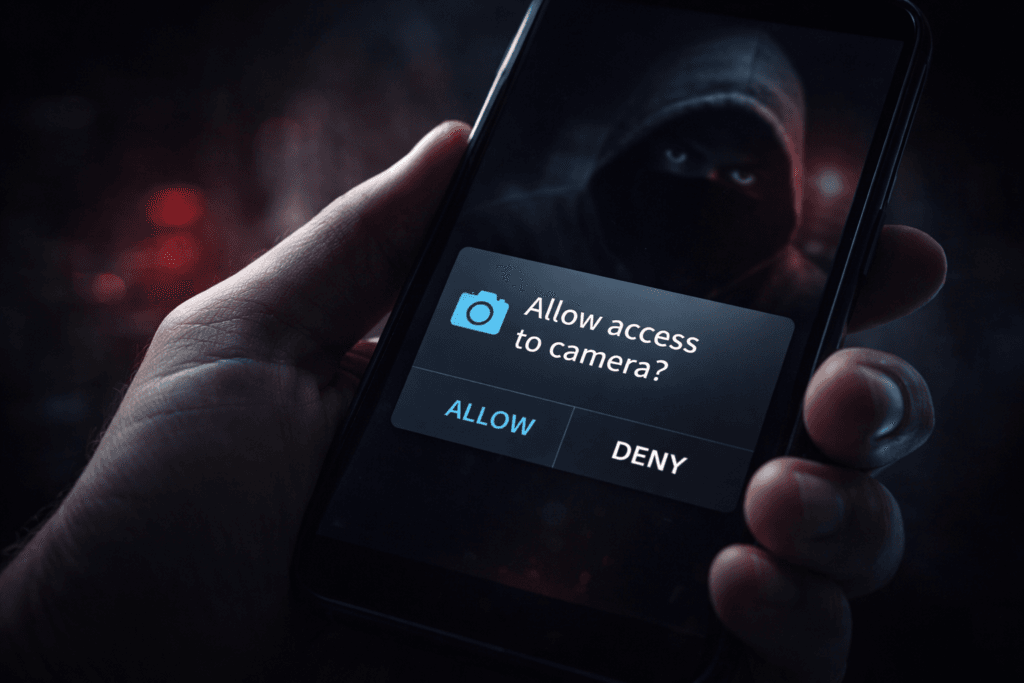
Once inside, the attacker needs control. This is where permissions come into play.
You see a popup asking for access to your camera. You allow it, because the app appears trustworthy or necessary.
But that single decision changes everything.
Most users don’t realize that permissions are powerful. They are not just formalities. They are control mechanisms. When you grant permission, you are giving the app authority over that function.
If the app is malicious, that authority is abused.
Step3 – Silent Control and Monitoring
After gaining permission, the attacker connects your device to a remote system.
From there, they can:
- Turn your camera on or off
- Record videos
- Capture images
- Monitor activity
And the most concerning part is this:
You won’t notice.
There are no clear signs. No alerts. No obvious changes. Your device behaves normally. And that’s exactly how attackers want it.
Step4 – Observation Before Action
Contrary to popular belief, attackers don’t always act immediately. They observe first.
They study your behavior, your schedule, your surroundings. They wait for the right moment.
This patience makes their attacks more effective and more damaging.
Step5 – Exploitation Phase
Once enough data is collected, the attacker uses it.
This could involve:
- Blackmail using recorded content
- Identity theft using gathered information
- Social engineering attacks based on personal details
- Selling data on underground platforms
At this stage, the victim is already compromised.
Reality Check – Things That Are Happening Right Now
These are not isolated incidents. These patterns are seen repeatedly.
1. The Free App Trap
A user downloads a free app that promises useful features. It works as expected.
But in the background, it begins accessing the camera. Days or weeks later, the user receives a threatening message.
By then, enough data has already been collected.
2. The Blackmail Situation

One of the most common outcomes is blackmail. The attacker sends a message claiming to have recordings.
Even if the content is limited, the fear it creates is enough. People panic. They react emotionally. Sometimes it behaves like ransomwares, where they demand ransom.
And that’s when mistakes happen.
3. The Work-from-Home Exposure
With remote work becoming common, devices are used for both personal and professional tasks.
A single phishing email can compromise an entire system. Once inside, attackers can access:
- Meetings
- Screens
- Sensitive files
This is how many serious breaches begin.
4. Targeted Attacks
In some cases, individuals are specifically targeted. This could be due to personal conflicts, financial motives, or other reasons.
The attacker focuses on one person and monitors them over time. These attacks are more deliberate and often more damaging.
Tools Hackers Commonly Use
The idea that hacking requires advanced tools is outdated. Many attacks use simple and accessible methods.
Remote access tools allow attackers to control devices from anywhere. Spyware apps are often hidden inside normal-looking applications. Phishing remains one of the most effective techniques because it relies on human behavior.
Even browser extensions can be used to collect data and access device features.
Most people don’t know this — many of these tools are easy to find.
This accessibility is one of the main reasons attacks are increasing.
How to Prevent Camera Hacking Attacks
Protection is not about doing one big thing. It’s about consistently doing small things right.
- Start by reviewing your permissions – Go through your apps and check which ones have access to your camera. If something doesn’t truly need it, remove it.
- Be selective about what you install – Avoid apps from unknown sources. Even if something looks useful, it’s not worth the risk if it’s not verified.
- Use physical protection – Covering your webcam is simple but effective. It ensures that even if your device is compromised, visual access is blocked.
- Keep your device updated – Updates fix vulnerabilities that attackers often exploit.
And most importantly, be cautious. Think before clicking. Think before installing.
These habits make a significant difference.
Laptop Webcam Security Tips Most People Ignore

Laptops are often more exposed than phones because of how they are used.
People download more files, browse more websites, and interact with more content.
To reduce risk:
- Disable the webcam when not in use
- Avoid downloading unknown files
- Be cautious with emails and attachments
- Use secure networks
These practices may seem basic, but they are highly effective.
Note:
Small actions often lead to big problems. Clicking links without thinking. Installing apps without verification. Ignoring updates.
These habits create vulnerabilities. And attackers look for exactly these opportunities.
Once access is given, it becomes very difficult to undo the damage.
Prevention is always easier than recovery.
Frequently Asked Questions – Webcam Hacking
Can hackers really watch you through your camera?
Yes, they can. If your device is infected with malware or a spying app, hackers can access your camera remotely. They don’t need physical access. Your phone can be hacked in minutes if you install the wrong app or click a malicious link.
How does webcam hacking work in simple terms?
It usually works through malicious apps or software. When you install them, they ask for camera permission. Once you allow it, the attacker can use that access to turn on your camera, record videos, or even watch you live without any visible alert.
Most people don’t realize this — they give permission themselves.
Can someone access my phone camera without me knowing?
Yes, and that’s what makes it dangerous.
Modern phone camera spying apps are designed to stay hidden. They don’t show notifications or warnings. You might be at risk without knowing, especially if your device already has a malicious app installed.
What are the signs that my camera might be hacked?
There are some warning signs you should never ignore.
If your phone suddenly starts heating up, battery drains faster than usual, or you notice unknown apps or high data usage, these could indicate something is running in the background.
These signs are often subtle, which is why most people miss them.
Does the webcam light always turn on during hacking?
No, and this is a common misconception.
Advanced malware can bypass the indicator light completely. So even if the light is off, your camera could still be active in the background.
Is covering the webcam actually effective?
Yes, it is one of the simplest and most reliable protections.
Even if your system is compromised, a physical cover ensures that no one can see through your camera. Many cybersecurity professionals use this method daily.
Can hackers access both camera and microphone together?
Yes. In many cases, attackers gain access to both.
This allows them not only to watch you but also to listen to conversations, which increases the risk of surveillance and blackmail.
Can hackers watch me even when my phone is locked?
Yes, if the device is already compromised.
Locking your phone only restricts physical access. Malware can still run in the background and access your camera or data.
Will a factory reset remove camera spyware?
In most cases, yes. A factory reset removes common malware and spyware.
However, after resetting, you should be careful about what you reinstall. If the same risky behavior continues, the problem can return.
Final Thoughts — Don’t Ignore This
Let me say this clearly. This is not something that might happen in the future. It is already happening.
Every day, people are being watched without realizing it. Not because they were careless, but because they were unaware.
Now you’re aware. Take a few minutes today. Check your device. Review your permissions. Remove anything suspicious.
Because once your privacy is gone…
There is no undo button.
And if someone was watching you right now…
Would you even know?