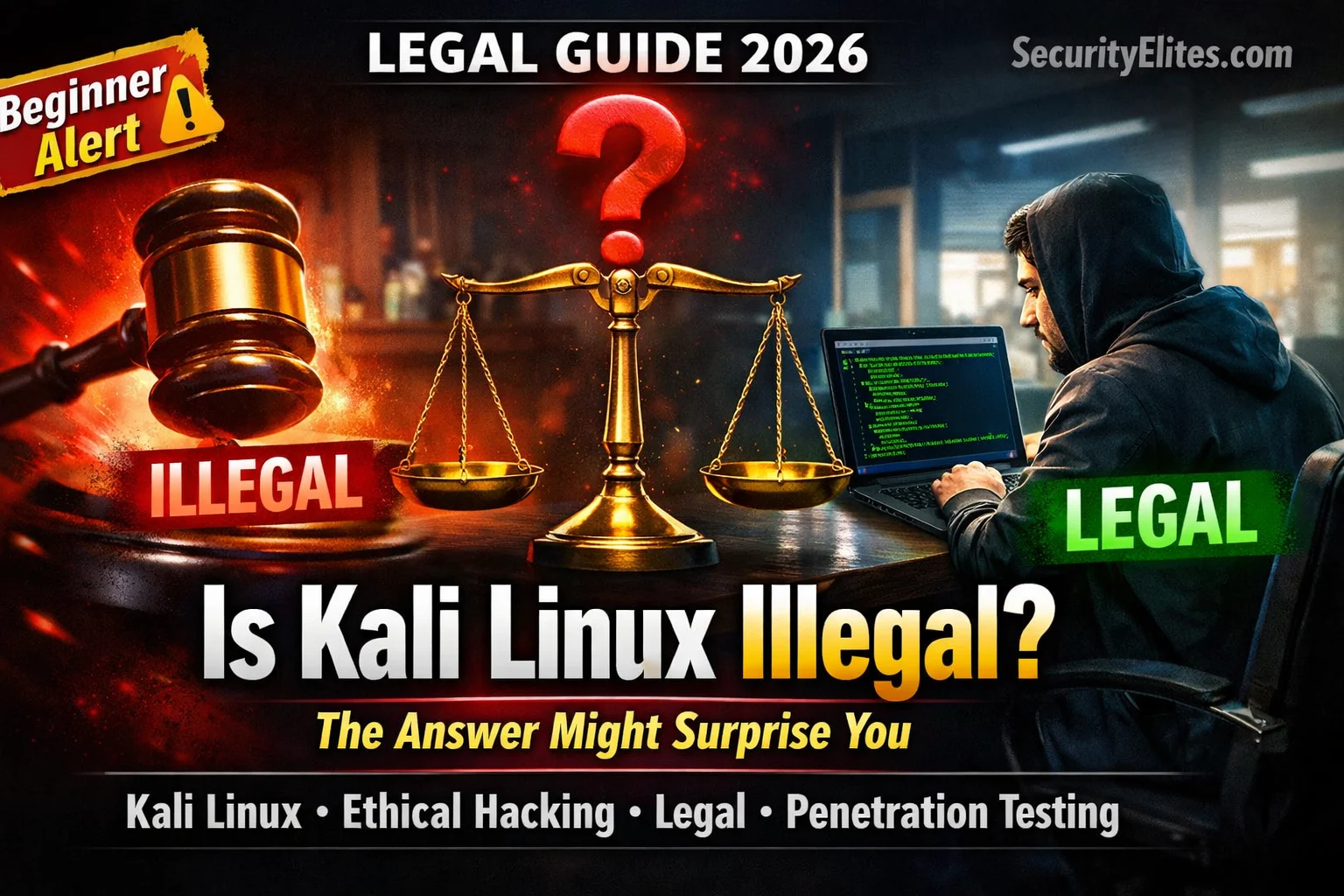
Every beginner who discovers Kali Linux asks the same question within the first hour: is Kali Linux illegal? It’s the right question. And the answer is more nuanced than any YouTube video or Reddit thread will tell you. The short version: the OS is legal. What you do with it determines everything. This guide gives you the complete, legally accurate picture — so you can learn ethical hacking with total confidence and zero legal risk.
The question is Kali Linux illegal is asked by tens of thousands of beginners every month. It reflects a genuine and healthy caution — you want to learn ethical hacking without accidentally breaking the law. That instinct is exactly right. Let me give you the precise, legally grounded answer.
The Direct Answer — Legal or Illegal?
Installing Kali Linux
Running it on your own machine
Using tools on your own network
Practising on lab VMs
Using HackTheBox / TryHackMe
Working as a professional pentester
Testing websites without permission
Intercepting others’ traffic
Using tools against employer systems
Accessing accounts you don’t own
“Just looking” without authorisation
Testing your school/university network
The legal status of Kali Linux is identical to the legal status of a kitchen knife. The knife is not illegal. Using it to harm someone is. Kali Linux is not illegal. Using it to access systems without authorisation is. The OS itself — an operating system built on Debian Linux — has no legal restrictions anywhere in the world. It is freely downloadable from kali.org and is used daily by tens of thousands of legitimate security professionals.
What Kali Linux Actually Is — Context Matters
Kali Linux is a Debian-based Linux distribution maintained by Offensive Security — a legitimate, respected cybersecurity training organisation that also runs the OSCP certification. It was purpose-built for penetration testing, security auditing, and digital forensics. It comes pre-installed with hundreds of security tools: Nmap for network scanning, Burp Suite for web application testing, Metasploit for exploitation, Wireshark for packet analysis, and dozens more.
Kali Linux is used by: government intelligence agencies, military cybersecurity teams, corporate penetration testing firms, independent security researchers, bug bounty hunters, IT administrators auditing their own infrastructure, forensic investigators, and cybersecurity students worldwide. It is the industry standard operating system for offensive security work. Its presence on your machine is a professional credential, not a legal red flag.
Legal vs Illegal — The Exact Line
The single principle that determines whether any hacking activity is legal or illegal is authorisation. Do you have explicit permission from the system owner to test that system? If yes: legal. If no: illegal. This principle is consistent across virtually every country’s cybercrime legislation. The tool used is completely irrelevant — scanning a network with Nmap or with a custom Python script carries identical legal weight if done without permission.
One of the most dangerous misconceptions among beginners is that “just scanning” or “just looking” without actually exploiting anything is legal. It is not. In the UK, US, and most countries, unauthorised port scanning of a system constitutes illegal computer access — even if you find nothing and do nothing. The Computer Misuse Act (UK) and CFAA (US) do not require successful exploitation. Unauthorised access attempt is sufficient for prosecution.
Laws That Apply — US, UK, India, Australia & EU
| Country | Key Law | What It Criminalises | Max Penalty |
|---|---|---|---|
| 🇺🇸 USA | CFAA (Computer Fraud and Abuse Act) | Unauthorised access to any protected computer | 10–20 years prison |
| 🇬🇧 UK | Computer Misuse Act 1990 (amended) | Unauthorised access / modification of computer material | 10 years prison |
| 🇮🇳 India | IT Act 2000 — Section 66 | Hacking — unauthorised access causing damage | 3 years + ₹5 lakh fine |
| 🇦🇺 Australia | Criminal Code Act — Part 10.7 | Unauthorised access to / modification of computer data | 10 years prison |
| 🇪🇺 EU | Directive on Attacks Against Information Systems | Illegal access, illegal system interference, illegal data interception | 2–5 years (member state dependent) |
5 Beginner Mistakes That Cross Legal Lines
Most beginners who get into legal trouble with hacking tools do not intend to break the law. They make one of these five specific mistakes — often out of curiosity or a misunderstanding of where the legal line sits. Read each one carefully.
Running Nmap or airodump-ng on any network you did not set up and do not pay for is illegal. “It was just a scan, I didn’t do anything with it” is not a defence. Unauthorised network scanning is a criminal act in the US, UK, India, and most other countries.
Good intentions are not a legal defence. Testing a company’s website without a signed scope agreement — even to report a vulnerability — can result in prosecution. Always get written permission first. If you find a bug without testing (e.g., you stumble on it as a normal user), use responsible disclosure but do not actively probe further.
Working for a company or attending a university does not grant you permission to scan or test their network. You need explicit written authorisation from the appropriate authority (CTO, CISO, IT security lead). Employees have been terminated and prosecuted for testing employer systems “to find weaknesses.” Get written permission in writing before you do anything.
Bug bounty programs give you permission to test specific assets defined in their scope document. Testing assets outside that scope — even assets owned by the same company — is unauthorised. Read the scope carefully before every test. “In scope” and “out of scope” have legal significance, not just programme significance.
Logging into any account — email, social media, admin panel — that you do not own, even with credentials you found in a public breach dump, is illegal account access. Testing IDOR vulnerabilities with another real user’s account (rather than a test account you created) can cross this line. In bug bounty, always use test accounts you registered yourself.
100% Legal Practice Environments — Set Up Today
You have three excellent options for practising Kali Linux and ethical hacking skills with complete legal protection. All three are free to start, all three provide explicit authorisation for all activity on their platforms, and all three are used by working professionals every day. You never need to touch a system you don’t own to develop world-class offensive security skills.
Who Uses Kali Linux Professionally
To fully answer the question of is Kali Linux illegal, it helps to know who uses it as a normal part of their professional work. Security consultancies like NCC Group, Rapid7, and Trustwave use Kali Linux as their primary operating system for client penetration testing engagements. The NSA, GCHQ, and equivalent agencies in NATO countries use it for defensive and offensive security research. Universities worldwide teach cybersecurity with Kali Linux as the standard learning platform.
The Offensive Security OSCP examination — the industry’s most respected practical penetration testing certification — explicitly requires candidates to use Kali Linux during the 24-hour exam. Having Kali Linux on your CV and citing your proficiency with its tools is a positive credential that improves your employment prospects in cybersecurity, not a red flag.
How you use it determines everything else.
Own your lab. Use authorised platforms. Stay in scope. Get permission in writing. Those four rules keep you fully legal while developing world-class skills.
Frequently Asked Questions
SecurityElites — Kali Linux Tutorial for Beginners 2026 — start using it safely from day one
SecurityElites — Ethical Hacking Roadmap 2026 — the full legal learning path from beginner to professional
Offensive Security — Official Kali Linux Download — always download from the official source →
HackTheBox Terms of Service — explicit authorisation for all hacking activity on their platform →
I have used Kali Linux professionally for years. I have never once worried about its legality — because I always work within authorised scope. The legal framework around ethical hacking is actually well-designed: get written permission, stay within scope, document everything. Follow those three rules and Kali Linux is simply a powerful, professional tool that happens to be free. The moral is simple: the OS is neutral. Your choices are not.