
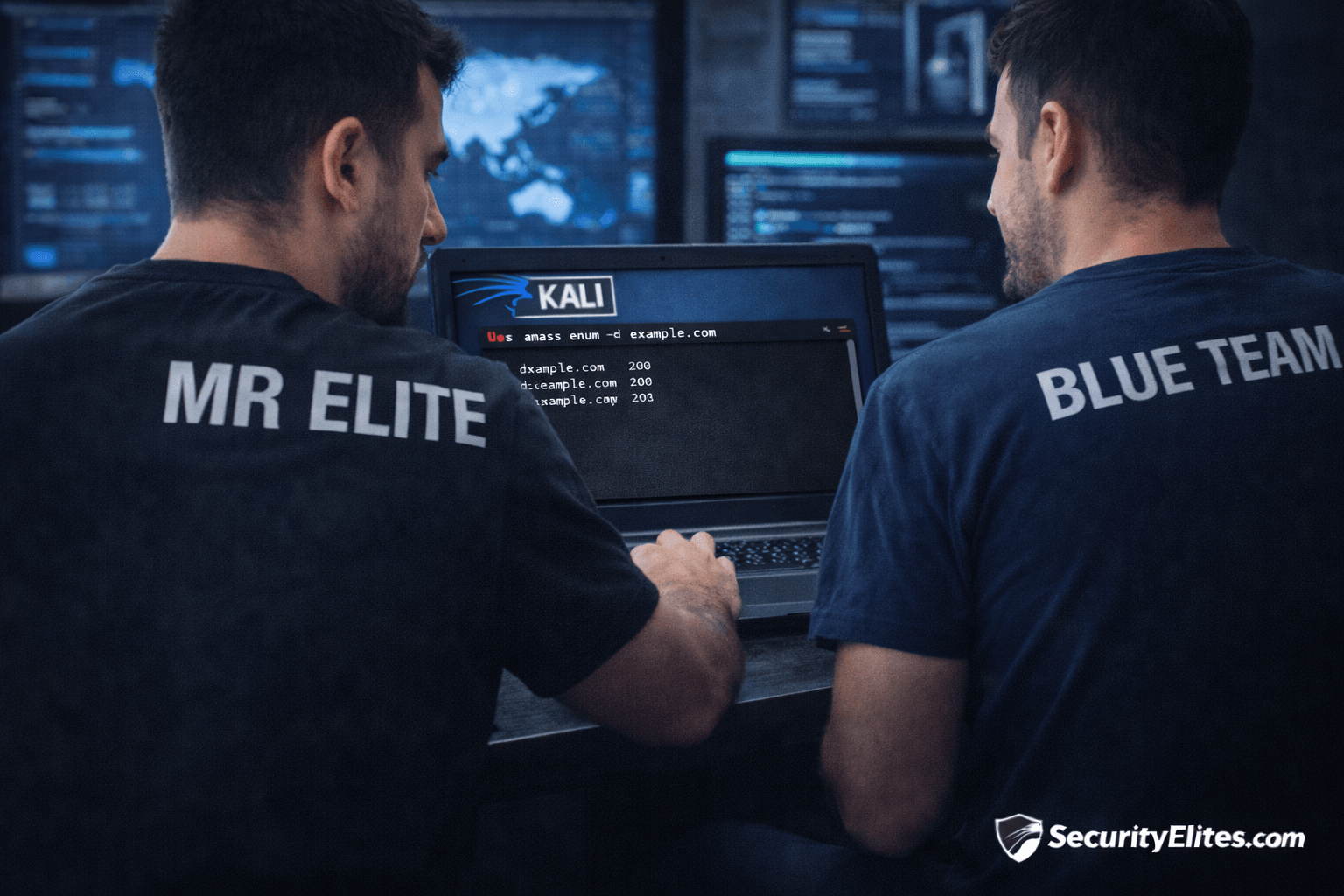
Information Gathering Using Kali Linux – Day 8
Attack Surface Expansion Using Amass (Advanced Reconnaissance)
Perfect! Now we officially move from Intermediate Recon to Advanced Professional Reconnaissance.
Up to Day 7, you learned how individual assets are discovered.
But real-world cybersecurity environments are not small.
Enterprise organizations may have:
- thousands of domains
- cloud assets
- acquisitions
- forgotten infrastructure
- shadow IT deployments
Manual enumeration stops working here.
Professionals automate intelligence correlation.
Today you learn the tool used by Red Teams, Bug Bounty Hunters, and Enterprise Recon Specialists.
Let me ask you something important.
Yesterday using Dirsearch, you discovered hidden directories.
Great progress.
But here’s a reality from enterprise penetration testing:
The biggest vulnerabilities rarely exist on known assets.
They exist on systems security teams don’t even know belong to them.
During a multinational assessment, the official scope listed only:
company.com
Looks simple.
But Amass enumeration revealed:
- regional domains
- cloud-hosted assets
- development platforms
- acquisition leftovers
Over 600 additional assets appeared.
One exposed staging server led to critical compromise.
No exploit sophistication required.
Just better reconnaissance.
Today we expand reconnaissance beyond visible infrastructure using:
✅ Amass
🎯 Why Attack Surface Expansion Matters
Modern organizations continuously deploy systems.
Developers create services.
Cloud teams launch instances.
Marketing teams register domains.
Security visibility struggles to keep up.
This creates something dangerous:
👉 Unknown Attack Surface
Attack Surface = all externally reachable assets.
If defenders don’t know assets exist…
They cannot protect them.
Amass helps ethical hackers discover:
- hidden subdomains
- related domains
- infrastructure relationships
- ASN mappings
- cloud assets
This step transforms recon into intelligence dominance.
Beginners often believe:
Sublist3r already found subdomains.
True — partially.
But Sublist3r relies mostly on search engines.
Amass combines:
✔ OSINT
✔ DNS intelligence
✔ certificate transparency
✔ network mapping
✔ infrastructure correlation
Completely different level.
🧠 Beginner-Friendly Concept Explanation
Think of Amass as an investigator connecting clues.
Instead of asking:
What subdomains exist?
Amass asks:
What infrastructure belongs to this organization anywhere on the internet?
Example discovery chain:
example.com
 ↓
api.example.com
 ↓
aws-api.example.net
 ↓
dev-cloud.example.org
Suddenly organization footprint expands.
Amass builds relationships automatically.
⚙️ Professional Recon Workflow (Continuation)
Your professional workflow now:
WHOIS
 ↓
DNS Enumeration
 ↓
Subdomain Discovery
 ↓
Host Discovery
 ↓
OSINT Intelligence
 ↓
Technology Detection
 ↓
Directory Discovery
 ↓
Attack Surface Expansion ✅
This mirrors real red-team methodology.
At this stage, recon becomes strategic.
🧪 Real-World Scenario
During a bug bounty program, the primary domain showed strong defenses.
No vulnerabilities discovered.
Amass enumeration identified:
legacy-payment.company.net
Old acquisition infrastructure.
Unpatched application server.
Remote code execution vulnerability.
Critical bounty awarded.
Security team unaware system was still online.
Amass exposed it.
🛠 Tool of the Day — Amass (Kali Linux)
Amass is one of the most powerful reconnaissance tools available.
Verify installation:
amass -version
✅ Step 1 — Basic Enumeration
amass enum -d example.com
Amass begins collecting intelligence from multiple sources.
Output:
dev.example.com
api.example.com
vpn.example.com
Insight 🔎
First runs may appear slow.
That’s intentional.
Amass performs deep correlation.
Quality over speed.
✅ Step 2 — Passive Enumeration Mode
Recommended starting point:
amass enum -passive -d example.com
Passive = stealth reconnaissance.
Ideal early-stage method.
✅ Step 3 — Active Enumeration
Authorized engagements only:
amass enum -active -d example.com
Performs deeper validation.
More accurate results.
✅ Step 4 — Save Results
amass enum -d example.com -o amass.txt
Professional documentation habit.
✅ Step 5 — Visualize Infrastructure
Generate graph database:
amass viz -d3 -o graph.html
Creates visual attack surface map.
Used heavily in enterprise audits.
🚨 Beginner Mistake Alert
❌ Running Only One Scan
Amass improves with repeated runs.
❌ Ignoring Related Domains
Assets may exist outside primary domain.
❌ Stopping at Enumeration
Validation comes later with scanning tools.
🔥 Pro Tips From 20 Years Experience
✅ Run Amass after completing passive recon.
Data enrichment improves accuracy.
✅ Compare outputs:
Sublist3r vs Amass.
Amass usually finds more.
✅ Pay attention to cloud indicators:
amazonaws
azure
cloudfront
googleapis
Cloud misconfigurations common.
Enterprise truth:
Large breaches often originate from forgotten cloud assets.
🛡 Defensive & Ethical Perspective
Blue teams use Amass for:
- External Attack Surface Management
- Asset inventory
- Shadow IT detection
Defensive security now requires continuous asset discovery.
Ethical rule:
Only enumerate authorized organizations.
Recon misuse has legal consequences.
✅ Practical Implementation Checklist
Today practice:
✔ Run passive Amass scan
✔ Compare with Sublist3r results
✔ Identify new domains
✔ Export results
✔ Generate visualization
✔ Update recon inventory
You now think like enterprise recon teams.
💼 Career Insight
Amass mastery is highly valued in:
- Red Team Operations
- Bug Bounty Hunting
- Threat Intelligence
- External Attack Surface Management (EASM)
- Advanced Pentesting
Senior professionals rely heavily on automated recon intelligence.
🔁 Quick Recap Summary
Your evolution:
| Day | Skill |
|---|---|
| Day 1 | WHOIS |
| Day 2 | DNS |
| Day 3 | Subdomains |
| Day 4 | Nmap |
| Day 5 | OSINT |
| Day 6 | Fingerprinting |
| Day 7 | Directory Discovery |
| Day 8 | Attack Surface Expansion ✅ |
You now uncover entire organizational footprints.
Tomorrow…
We detect live devices directly inside networks.
Recon becomes network-aware.
❓ FAQs
1. What is Amass used for?
Advanced asset discovery and attack surface mapping.
2. Is Amass passive?
It supports both passive and active modes.
3. Why is Amass powerful?
It correlates multiple intelligence sources automatically.
4. Do professionals use Amass?
Yes — widely in enterprise red teams.
5. Is Amass beginner-friendly?
Yes, when starting with passive mode.