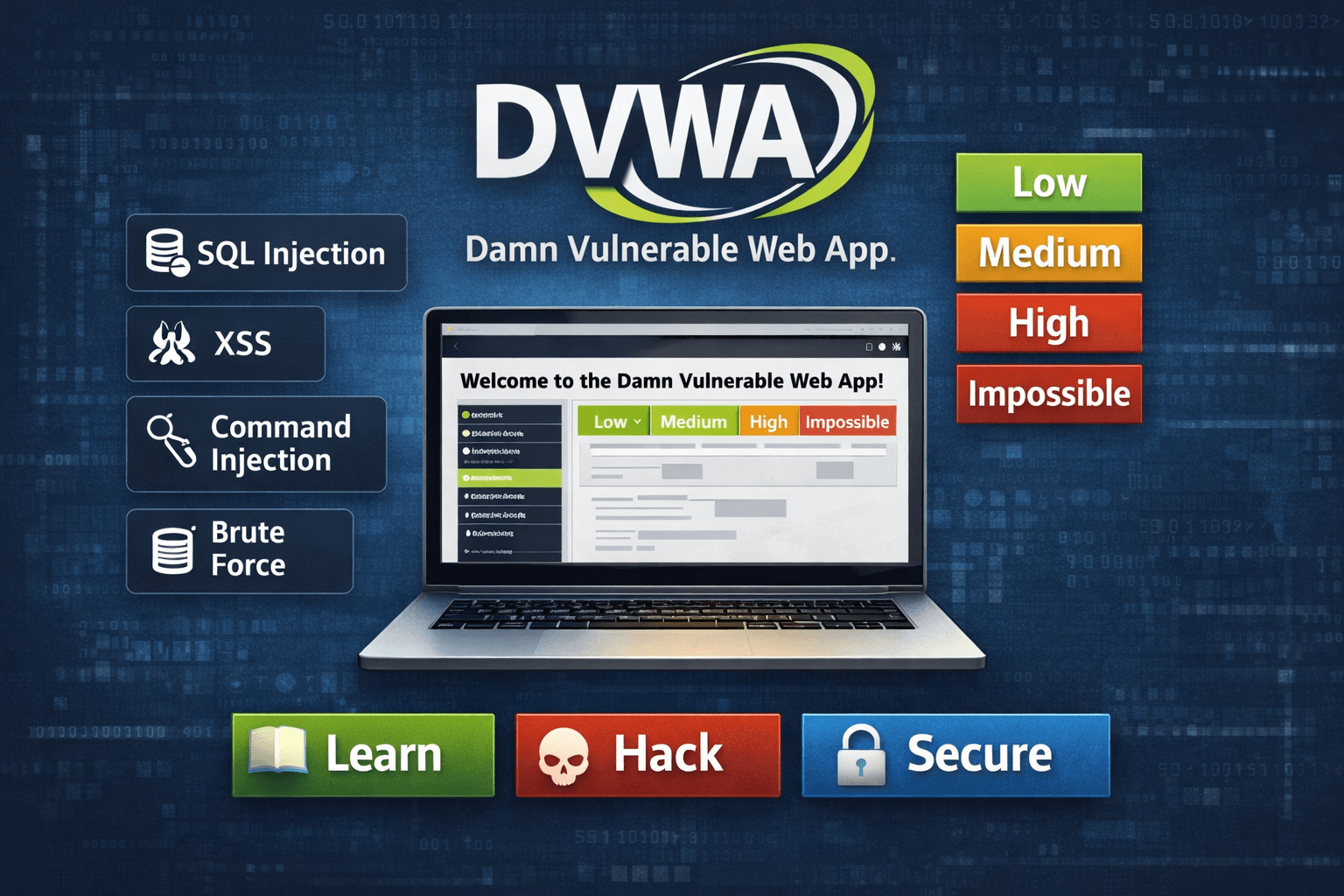
DVWA Web Hacking Tutorial DAY 6 — File Upload & Command Injection in DVWA: From Web Access to System Control
When Web Hacking Becomes System Hacking
Up to this point, your attacks affected:
- Logins
- Databases
- Browsers
But today…
You cross a critical boundary.
You move from web application exploitation into operating system compromise.
And this is the exact moment where real penetration tests start making organizations uncomfortable.
During an enterprise red-team engagement years ago, everything looked secure externally. Firewalls configured. Authentication hardened.
Yet full server access was achieved through something incredibly simple:
👉 An insecure file upload feature.
No advanced exploit.
No zero-day vulnerability.
Just poor validation.
Within minutes, attackers gained command execution on the server itself.
Now pause and think.
If an attacker can upload files or execute commands…
They are no longer interacting with the website.
They are interacting with the server.
Today you learn how that happens safely using DVWA.
Why File Upload & Command Injection Matter in Real Cybersecurity
Modern web applications constantly accept files:
- Profile pictures
- Documents
- PDFs
- Reports
- Media uploads
Organizations often assume uploaded files are harmless.
That assumption becomes dangerous.
Because servers don’t just store files — they sometimes execute them.
Something beginners rarely realize:
Many major breaches begin with upload features.
Similarly, command injection vulnerabilities allow attackers to manipulate system-level commands executed by applications.
From incident response investigations, compromised Linux servers frequently trace back to:
✅ File upload abuse
✅ Improper command validation
These vulnerabilities directly impact organizational security posture because they bridge application and infrastructure layers.
And once infrastructure is touched…
Impact escalates fast.
Beginner-Friendly Concept — Understanding the Danger
Let’s visualize this simply.
Imagine a company receptionist accepting packages.
Normal behavior:
Package stored safely.
Vulnerable behavior:
Receptionist opens and runs whatever arrives.
That’s insecure file upload.
Now command injection works similarly.
Application runs system command like:
ping 127.0.0.1
If user controls input:
127.0.0.1 && whoami
Server executes BOTH commands.
Let’s pause here.
Beginners often think hacking requires breaking into servers.
Reality?
Sometimes servers execute attacker instructions willingly.
That distinction is crucial.
Professional Workflow — File Upload Exploitation
Open DVWA → File Upload Module.
Step 1 — Understand Upload Restrictions
Upload a normal image first.
Example:
image.jpg
Observe success message.
Now we test validation logic.
Step 2 — Attempt Restricted Upload
Try uploading:
shell.php
If blocked — good.
Application checks extension.
But professionals ask:
👉 How strong is validation?
Step 3 — Bypass File Filters
Rename payload:
shell.php.jpg
Or:
shell.phtml
Many applications validate poorly.
If upload succeeds…
File may execute on server.
Step 4 — Access Uploaded File
Navigate to upload directory:
http://dvwa/hackable/uploads/
Execute uploaded file.
If successful — command execution achieved.
You now control server interaction.
Command Injection Workflow
Open DVWA → Command Injection Module.
Input field performs ping operation.
Test normal input:
127.0.0.1
Now inject:
127.0.0.1 && whoami
Server reveals executing user.
Try:
127.0.0.1 && ls
Directory listing appears.
Something important just happened.
You executed operating system commands remotely.
This is real system compromise behavior.
Real-World Scenario — Server Takeover via Upload
During a web security audit, an employee portal allowed resume uploads.
Only file extension validation existed.
Attackers uploaded disguised PHP shell.
Once accessed, they executed system commands, created admin users, and pivoted internally.
No exploit framework required.
Students often expect loud attacks.
But real compromises are quiet.
Simple.
Logical.
Devastating.
Tools Used by Professionals
✅ Web Shells
Small scripts enabling command execution.
Example behavior:
- Run OS commands
- Browse directories
- Upload/download files
Professionals use controlled shells only for proof-of-concept.
✅ Burp Suite
Intercept upload request.
Modify filename or MIME type manually.
Many filters fail server-side validation checks.
✅ Netcat (Advanced Concept)
Used later for reverse shells.
Creates remote command sessions.
We introduce this professionally in advanced labs.
🚨 Beginner Mistake Alert
Most common student errors:
❌ Uploading random payloads blindly
❌ Ignoring directory paths
❌ Not testing execution access
❌ Forgetting extension bypass
❌ Assuming upload success equals compromise
Another confusion:
“If upload works, system is hacked.”
Not always.
Execution capability defines severity.
🔥 Pro Tips From 20 Years Experience
Professional pentesters always check:
✅ Upload directories
✅ Backup folders
✅ Temporary files
✅ Image processors
✅ Export features
Something interesting happens after experience grows…
Upload features become immediate red flags.
Also remember:
Command Injection often hides in:
- Network tools
- Diagnostic pages
- Admin utilities
Developers trust system commands too easily.
Defensive & Ethical Perspective
Defenders prevent these attacks using:
- File type validation
- Server-side filtering
- File renaming
- Execution restrictions
- Input sanitization
- Least privilege execution
Ethical hackers demonstrate risk responsibly.
Never deploy persistent shells outside authorized labs.
Professional credibility depends on ethical restraint.
Practical Implementation Checklist ✅
Today complete:
✅ Upload normal file
✅ Attempt PHP upload
✅ Bypass extension filter
✅ Locate upload directory
✅ Execute uploaded file
✅ Access command injection module
✅ Run whoami command
✅ List directories
✅ Capture results via Burp
You have now simulated server-level compromise.
Major milestone achieved.
Career Insight — Why This Skill Is Powerful
File upload and command injection findings often rank critical severity in pentest reports.
Skills apply directly to:
- Red Team Operations
- Web Application Pentesting
- Cloud Security Testing
- Bug Bounty Programs
Many professional ethical hackers gain recognition through remote command execution discoveries.
This skill demonstrates true exploitation capability.
Quick Recap Summary
Today you learned:
✅ File upload vulnerabilities
✅ Filter bypass techniques
✅ Web shell execution
✅ Command injection logic
✅ OS command execution
✅ Server interaction concepts
You moved beyond application attacks…
…into infrastructure compromise territory.
Tomorrow is the final evolution.
You perform a full professional penetration test simulation.
FAQs
1. What is file upload vulnerability?
It occurs when applications allow dangerous files to be uploaded and executed.
2. What is command injection?
Attackers execute system commands through insecure input fields.
3. Does upload always mean compromise?
No. Execution capability determines impact.
4. Why is command injection critical?
It allows direct interaction with operating system resources.
5. Are these vulnerabilities common?
Yes, especially in poorly validated enterprise applications.
6. Do professionals really find these?
Frequently during web application audits.