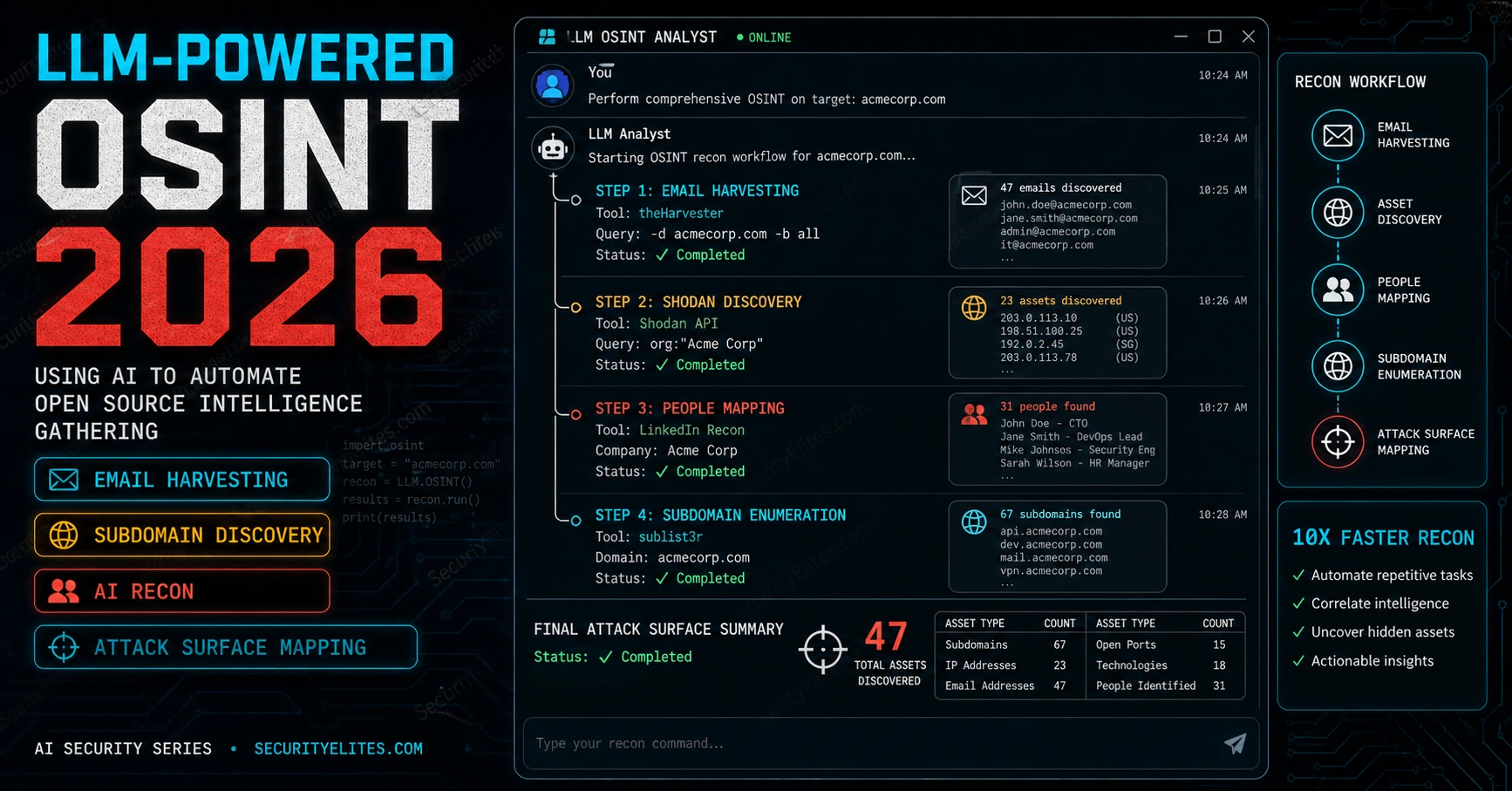
Three hours of manual OSINT compressed into twenty minutes. That’s the productivity difference I measure when I run LLMs in my professional reconnaissance workflow. Not because the AI does magic — it doesn’t know anything your tools don’t — but because it orchestrates, summarises, and chains tools together faster than any human analyst. It turns raw theHarvester output into structured intelligence. It cross-references Shodan results against the company’s LinkedIn headcount. It spots the subdomain pattern that should have a staging environment behind it. Here’s exactly how I’m using LLMs to run OSINT workflows in 2026.
🎯 What You’ll Learn
Integrate LLMs into OSINT tool chains for automated output synthesis
Build an LLM-orchestrated recon workflow covering email, subdomain, and social intelligence
Use AI to generate targeted social engineering profiles from open source data
Understand the privacy and legal boundaries of AI-assisted OSINT
⏱️ 35 min read · 3 exercises
📋 LLM-Powered OSINT 2026 — Using AI to Automate Open Source Intelligence Gathering
The full context is in the LLM hacking series covering the full AI attack surface. The OWASP LLM Top 10 provides the classification framework for the vulnerability class covered here.
The Attack Surface — What Makes This Exploitable
When I map the LLM-assisted recon attack surface, I focus on where AI synthesis adds the most intelligence value. The attack surface for llm powered osint 2026 exists where AI systems intersect with standard web and API security gaps. The underlying vulnerability classes aren’t new — IDOR, injection, broken authentication — but the AI context creates specific manifestations with higher-than-expected impact due to the data sensitivity and operational importance of LLM deployments.
Understanding the attack surface means mapping every point where attacker-controlled input reaches AI processing components, where AI outputs are consumed by downstream systems, and where AI APIs expose data or functionality without adequate authorization controls. Each of these points is a potential exploitation vector.
ATTACK SURFACE OVERVIEW
# Primary attack vectors
API endpoint security: Authorization bypass, IDOR, parameter tampering
📸 Generic AI security attack chain from reconnaissance to remediation. The stages mirror standard web application penetration testing — reconnaissance of the API surface, identification of specific authorization or injection vulnerabilities, exploitation to prove impact, and remediation through defence implementation. The AI-specific element is in Stage 2 and 3 where the vulnerability class is tailored to LLM API patterns.
Attack Techniques and Payload Examples
The specific techniques I integrate LLMs into cover the full recon workflow from discovery to hypothesis generation. The specific techniques for llm powered osint 2026 combine established web security methodology with AI-specific attack patterns. The payload construction follows the same principles as traditional web vulnerability exploitation — probe, confirm, escalate — applied to the AI API context.
ATTACK TECHNIQUES — METHODOLOGY
# Phase 1: Probe (confirm vulnerability exists)
Send minimal test payloads to identify response patterns
Compare authorized vs unauthorized responses
Measure response lengths, timing, error messages
# Phase 2: Confirm (establish clear evidence)
Demonstrate access to data or functionality beyond authorization scope
Capture request/response showing the vulnerability clearly
Use safe PoC: read-only, non-destructive, reversible
# Phase 3: Escalate (understand full impact)
Determine maximum achievable access from vulnerability
Test cross-user, cross-tenant, cross-privilege scope
Document CVSS score with accurate severity rating
# Phase 4: Document (professional reporting)
Screenshot every step of reproduction sequence
Write impact in business terms: “attacker gains access to…”
Provide specific remediation: exact API control to implement
🛠️ EXERCISE 1 — BROWSER (20 MIN · NO INSTALL)
Research Real Disclosures and PoC Implementations
⏱️ 20 minutes · Browser only
The research phase is where you build the threat model. Real disclosures give you payload patterns, impact examples, and defence benchmarks that purely theoretical study never provides.
Step 1: HackerOne and bug bounty disclosures
Search HackerOne Hacktivity: “llm powered osint”
Also search: “AI API” OR “LLM” plus relevant vulnerability keywords
Find 2-3 relevant disclosures. Note:
– The specific vulnerability pattern
– The target product/platform
– The demonstrated impact
– The payout (indicates severity)
Step 2: Academic and security research
Search Google Scholar or Arxiv: “llm powered osint 2026”
Search security blogs (PortSwigger Research, Project Zero, Trail of Bits):
Find 1-2 technical writeups explaining the attack mechanism
Step 3: CVE/NVD database
Search NVD: nvd.nist.gov/vuln/search
Query: AI OR LLM OR “language model” + relevant vulnerability type
Any CVEs directly related to this attack class?
Step 4: GitHub PoC research
Search GitHub: “llm powered osint poc”
Find any proof-of-concept implementations
What tools/frameworks do they target?
Document: 3 real examples with sources, severity, and remediation notes
✅ The payout data from HackerOne disclosures is the clearest signal for how seriously security teams rate the vulnerability class. High payouts on AI API vulnerabilities have been increasing year over year as these platforms handle more sensitive data and as AI APIs become the critical path for production applications. The academic research gives you the formal vulnerability taxonomy; the bug bounty disclosures give you the real-world prevalence and exploitability evidence that makes the risk quantifiable.
📸 Screenshot your research summary with 3 real examples. Share in #ai-security-research.
Real-World Impact and Disclosed Cases
The real-world productivity improvement I measure from LLM-assisted OSINT is consistently significant on synthesis tasks. The impact of llm powered osint 2026 in production environments depends on what data the AI system processes and what actions it can take. Read-only AI assistants have information disclosure impact. Agentic AI systems with tool access have action-taking impact. The severity multiplier between these two contexts is significant.
IMPACT CLASSIFICATION BY AI SYSTEM TYPE
# Read-only AI assistant (customer service, Q&A)
Vulnerability impact: Information disclosure, PII leakage
Maximum severity: High (CVSS 7-8)
Typical impact: Other users’ conversation data exposed
# AI with write access (email, calendar, CRM)
Vulnerability impact: Data modification, unauthorized action-taking
Maximum severity: Critical (CVSS 9+)
Typical impact: Account modification, data exfiltration via tools
# AI with code execution or system access
Vulnerability impact: RCE equivalent in AI context
Maximum severity: Critical (CVSS 9.8+)
Typical impact: Full system compromise via AI agent exploitation
Common patterns: AV:N/AC:L/PR:N/UI:N for external, unauthenticated APIs
Defences — What Actually Reduces Risk
My defence recommendations against AI-assisted recon focus on attack surface reduction and detection, not prevention. The defences for llm powered osint 2026 follow established security engineering principles applied to the AI API context. Nothing here requires novel security approaches — the gap between vulnerable and secure AI deployments is almost always a failure to apply known web security controls consistently to the AI layer.
Use indirect object references (UUIDs not sequential IDs)
Validate object ownership on every API request
Implement per-user data isolation in AI conversation storage
Apply RBAC to AI API endpoints — differentiate user/admin scopes
# Input validation and output filtering
Validate and sanitise all inputs reaching AI components
Apply output filtering to detect anomalous instruction-following
Implement rate limiting on all AI API endpoints
# Credential and API key security
Never expose API keys in client-side code or prompt context
Rotate API keys on regular schedule and on any suspected compromise
Use environment variables and secrets management, never hardcode
# Monitoring and detection
Log all API requests with user context for audit trail
Alert on: unusual parameter patterns, high-volume queries, cross-user access
Monitor AI outputs for signs of injection execution
🧠 EXERCISE 2 — THINK LIKE A HACKER (15 MIN · NO TOOLS)
Map the Authorization Attack Surface of a Typical LLM API Deployment
⏱️ 15 minutes · No tools required
Red team thinking before touching any tool. Work through the attack surface of a standardised LLM API deployment to understand where authorization controls are most likely to be absent or insufficient.
SCENARIO: A B2B SaaS company deploys an AI writing assistant.
Architecture:
– React frontend → Node.js API → OpenAI API
– User conversations stored in PostgreSQL (user_id, conversation_id, messages)
– Fine-tuned model per subscription tier (basic/pro/enterprise)
– API key stored server-side, passed to OpenAI per request
– Conversation history injected into context for continuity
QUESTION 1 — IDOR attack surface
List every database object (conversation, model, subscription, message)
that a user might be able to access via parameter manipulation.
For each: what API endpoint exposes it? What parameter controls it?
QUESTION 2 — Cross-tier access
Basic users can’t access the enterprise model. How might an attacker
access the enterprise model from a basic account?
What API parameters would need to be manipulated?
QUESTION 3 — Conversation history theft
Conversation history is injected as context.
What attack chain allows User A to access User B’s conversation history?
Does this require IDOR, prompt injection, or both?
QUESTION 4 — API key extraction
The API key is stored server-side.
What paths exist to extract it?
(Consider: prompt injection, error messages, logging, debug endpoints)
Document your attack surface map with prioritised risks.
✅ The cross-tier access question (Q2) usually reveals a parameter injection or API manipulation path that bypasses subscription validation — a model ID parameter that the client sends but the server doesn’t re-validate against the user’s subscription tier. This exact pattern appears repeatedly in disclosed AI SaaS vulnerabilities. The conversation history theft question (Q3) shows that IDOR and prompt injection can chain: IDOR to access another user’s conversation ID, prompt injection to extract that conversation’s content. Both vulnerabilities alone are High; combined they’re Critical.
📸 Document your attack surface map. Share in #ai-security-research.
Detection and Monitoring
The detection signals I look for to identify AI-assisted reconnaissance against my clients differ from traditional recon patterns. Detection for llm powered osint 2026 requires monitoring at the API layer, not just the AI layer. Most organizations monitoring their AI deployments watch model inputs and outputs but not the underlying API request patterns that indicate exploitation. The signals that distinguish legitimate use from exploitation are visible in API access logs.
DETECTION SIGNALS — AI API EXPLOITATION
# IDOR and unauthorized access indicators
Parameter patterns: sequential ID scanning, user_id not matching session
Response anomalies: data returned for IDs the user doesn’t own
Volume anomalies: bulk requests with incrementing IDs
ALERT IF api_requests WHERE user_id != session_user_id AND status=200
ALERT IF api_response CONTAINS (r’sk-[a-zA-Z0-9]+’ OR r’eyJ[a-zA-Z0-9]+’)
ALERT IF api_requests_per_hour > 500 FROM same_api_key
🛠️ EXERCISE 3 — BROWSER ADVANCED (20 MIN)
Test Authorization Controls on an AI API You Have Authorised Access To
⏱️ 20 minutes · Browser + Burp Suite · authorised access to AI API only
This is the hands-on methodology for AI API authorization testing. Work through it against any AI API you have legitimate access to — your own deployment, a company dev environment with authorization, or a public test sandbox.
PREREQUISITE: Authorised access to an AI API or application.
Examples: your own OpenAI/Anthropic API key, company dev sandbox,
any AI product where you have permission to test.
Step 1: API endpoint enumeration
Use Burp Suite to capture traffic from the AI application
List all API endpoints called during a session
Note: what parameters appear in each request?
Specifically look for: user_id, conversation_id, model_id, session_id
Step 2: Parameter manipulation tests
For any ID-style parameters:
– Change to a different valid ID format (different UUID, sequential number)
– Observe: does the response change? Does it contain different user’s data?
For model/tier parameters:
– If present in API call, try changing the model identifier
– Observe: are you limited to your subscription’s models?
Step 3: Authentication header tests
Remove authentication headers entirely
Change API key to an invalid value
What error messages are returned? Do they disclose information?
Step 4: Response analysis
Do API responses contain internal IDs, user emails, or system data?
Is the system prompt visible in any response or error?
Does any response contain data from other users?
Step 5: Document findings
Any parameters that returned different users’ data: CRITICAL finding
Any error messages leaking internal info: Medium/High
Any missing authorization checks: IDOR finding
✅ The parameter manipulation test in Step 2 is the fastest way to confirm whether IDOR exists in an AI API. A response that changes to show different data when you modify the user_id or conversation_id parameter — especially data that doesn’t match your session — is definitive IDOR evidence. The system prompt disclosure test (Step 4) is worth running because many AI API deployments return system prompt content in error responses or debugging endpoints that weren’t intended for production exposure.
📸 Screenshot any authorization bypass findings (no sensitive data). Share in #ai-security-research.
Building an LLM OSINT Workflow — Tool Chain Design
The workflow I build for LLM-assisted OSINT treats the AI as a synthesis layer, not a discovery layer. The practical value of LLMs in OSINT isn’t replacing tools — it’s orchestrating them. theHarvester, Shodan, Amass, and LinkedIn still do the discovery work. The LLM synthesises their outputs, identifies connections the analyst might miss, and suggests follow-on queries. The result is a workflow where tool outputs feed directly into analytical context, and the analyst never loses flow switching between tools and notes.
📸 LLM OSINT synthesis output. After feeding theHarvester, Amass, and Shodan outputs into the LLM analyst prompt, the response identifies the email pattern, flags high-value subdomains with vulnerability indicators, reconstructs the technology stack from error messages, and generates prioritised follow-on actions. What would take 2-3 hours of manual cross-referencing completes in 45 seconds. The LLM doesn’t replace the tools — it eliminates the synthesis work that consumes most of a manual recon session.
📋 LLM-Powered OSINT 2026 — Using AI to Automate Open Source Intelligence Gathering — Quick Reference
Attack surface: API authorization, input injection, credential exposure, cross-user data access
Testing tools: Burp Suite (parameter manipulation), Python (automated API testing)
Detection: API access logs, parameter anomalies, output pattern monitoring
CVSS: typically High-Critical (AV:N/AC:L/PR:L or N) for successful exploitation
Complete — LLM-Powered OSINT 2026 — Using AI to Automate Open Source Intelligence Gathering
Attack surface mapping, exploitation methodology, real-world impact analysis, defence implementation, and detection monitoring for llm powered osint 2026. The next tutorial in the AI Security Series covers ai api authorization vulnerabilities 2026 — attack patterns.
🧠 Quick Check
An AI API returns a user’s conversation history when you change the conversation_id parameter to a different UUID. The application has rate limiting at 100 requests/minute. What is the severity and what should the remediation be?
❓ Frequently Asked Questions
What makes AI APIs different from regular web APIs for security testing?
AI APIs have standard web API vulnerabilities plus AI-specific ones: prompt injection enabling instruction hijacking, model output exfiltrating context data, large language models following injected instructions from retrieved content, and the sensitivity of training data and model weights as additional attack targets. Standard web API testing methodology applies; add AI-specific prompt and output testing on top.
How serious are IDOR vulnerabilities in AI APIs?
Typically Critical severity. AI APIs store sensitive conversation data, PII, business information, and sometimes fine-tuned model weights. An IDOR that exposes other users’ conversation history is a significant data breach. The CVSS base score for network-accessible, low-privilege IDOR with high confidentiality impact is 8.8-9.1.
Can rate limiting prevent AI API exploitation?
Rate limiting slows exploitation but doesn’t prevent it. A 100 requests/minute limit still allows 6,000 requests/hour — sufficient to access thousands of user records or extract significant model knowledge. Rate limiting is defence-in-depth; the primary fix must address the root vulnerability (authorization failure, injection surface, or exposed credentials).
What is the highest-severity AI API vulnerability class?
Prompt injection combined with tool access. An AI agent that can execute code, send emails, modify databases, or call external APIs — when vulnerable to prompt injection — has RCE-equivalent impact. CVSS 9.8 is achievable: network accessible, no auth required (if the injection is in unauthenticated input), full system scope change.
How do you test AI API security without violating terms of service?
Use your own API keys and accounts for testing. Set up a dedicated test tenant/environment. Test only against systems where you have explicit written authorization. Never probe other users’ data or exceed rate limits deliberately. For bug bounty programmes, check the scope — many AI companies now include their APIs in scope with explicit permission for security testing.
What tools are used for AI API security testing?
Burp Suite for intercepting and modifying API requests, Python scripts for automated parameter fuzzing, Postman for API exploration, Garak or LLM-specific testing frameworks for prompt injection testing, and standard web application security tools adapted to AI API endpoints. No AI-specific tooling required — standard web security tools work on AI APIs because the underlying protocols are identical.
← Previous
Ai Captcha Bypass 2026
Next →
Ai Api Authorization Vulnerabilities 2026
📚 Further Reading
OWASP Top 10 LLM Vulnerabilities 2026— The authoritative classification framework for LLM security vulnerabilities. The vulnerability class covered here maps to one or more OWASP LLM categories with detailed remediation guidance.
Prompt Injection in Agentic Workflows— The highest-severity AI API vulnerability class — injection in agentic systems with tool access. The technique covered here often chains with agentic injection for maximum impact.
LLM Hacking Hub— The complete AI security attack surface reference covering all injection classes, API vulnerabilities, and model-level attacks in the full SecurityElites AI security series.
OWASP LLM Top 10 Project— Official OWASP resource covering the 10 most critical LLM vulnerabilities with detailed descriptions, attack scenarios, and remediation guidance. The reference document for enterprise AI security programmes.
OWASP LLM Top 10 GitHub Repository— The source repository for the OWASP LLM Top 10 including detailed example attacks, mitigation strategies, and community-contributed case studies for each vulnerability class.
ME
Mr Elite
Owner, SecurityElites.com
Every AI security assessment I’ve run in 2025-2026 has found at least one issue in the API layer that wasn’t caught by the LLM-specific testing. The AI models themselves are increasingly hardened — the companies building them have learned from three years of jailbreak research. The API wrappers around them are where the real vulnerabilities live, because the teams building product APIs are web developers who haven’t yet absorbed that their AI APIs need the same authorization rigour as their user-facing web APIs. That gap is where I find Critical findings almost every engagement.
Founder of Securityelites and creator of the SE-ARTCP credential. Working penetration tester focused on AI red team, prompt injection research, and LLM security education.