Every few months, I do what I call a “deepfake audit” on myself. I don’t do it because I’m paranoid. I do it because I want to understand my own exposure. I look at what I’m sharing online, what information is publicly available about me, and whether the people I trust and communicate with have a clear way to verify something really came from me. After spending years following AI security, I’ve seen how quickly these tools have improved. The technology is moving faster than most people’s understanding of what an attacker can actually do. In many cases, the problem isn’t carelessness — it’s simply that people are still using yesterday’s security habits for today’s threats.
So when I talk about how to protect yourself from deepfakes, I’m not asking you to become suspicious of everything you see or hear. I’m teaching you to become prepared. I want you to know which risks actually apply to you, what warning signs to look for, and what you should do when something doesn’t feel right. The goal is simple: build a few good habits now so that you don’t have to figure everything out under pressure later.
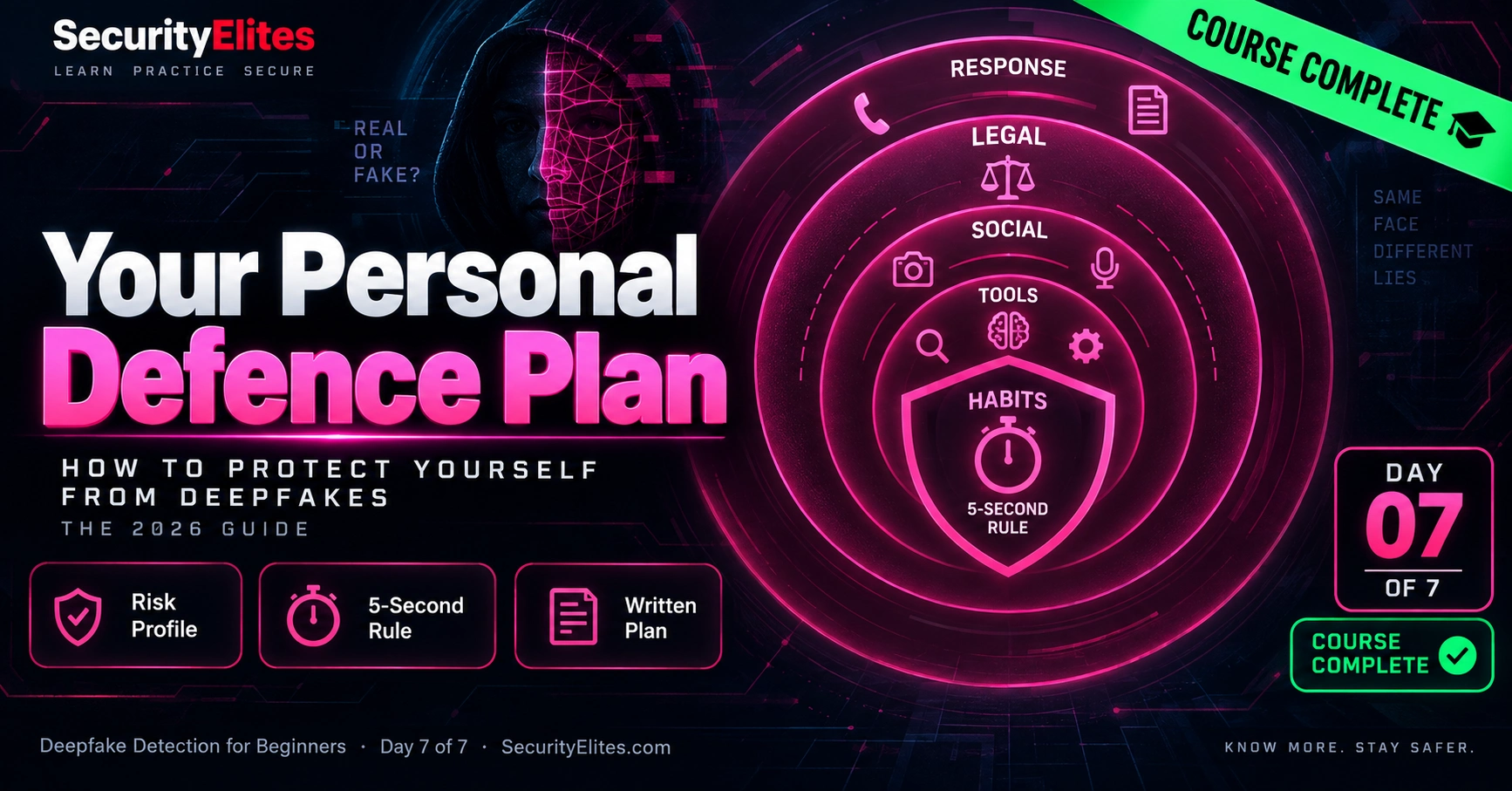
That’s what we’re going to build today. By the end of Day 7, you’ll have assessed your personal risk profile, chosen your 5-second rule and three verification habits, reviewed your social-media exposure, understood the basic reporting and legal options available to you, and created a simple written incident-response plan. Save that plan somewhere you can find it in 30 seconds. Don’t leave it as a mental note. If you ever need it, you’ll want the steps in front of you.
🎯 What You’ll Build in Day 7
⏱ 25 min read · 3 exercises · No tools required
- Days 1–6 complete — you need the full skill stack (detection knowledge from D1–D5 + tool workflow from D6) before building your personal defence system
- A text editor or notes app you’ll actually use — the day’s deliverable is a document, not a mental note
- 20 minutes for honest self-assessment during the exercises — accuracy matters more than comfort
How to Protect Yourself From Deepfakes — Day 7 of 7
- Your Deepfake Risk Profile — Honest Assessment
- The 5-Second Rule and Three Verification Habits
- Social Media Audit — What to Protect, What’s Fine
- What NOT to Post — The Training Data Risk
- The Legal Landscape — Your Rights in 2026
- Reporting and Response — What to Do If Targeted
- Your Complete Personal Defence Plan
- Questions and Answers
Over the past six days, we’ve learned how to spot deepfakes, examine videos and images more carefully, recognise voice-cloning signals, and use detection tools without blindly trusting their results. Today, I want to bring all of that together. How to protect yourself from deepfakes is ultimately about turning those detection skills into everyday habits and having a simple written response plan ready before something goes wrong.
I also want you to see this course as a starting point, not the finish line. If you’re serious about moving from beginner-level awareness into professional ethical hacking and security, the next step is to keep building your broader security knowledge. You can use our CEH Practice Exam resources to strengthen your preparation, while the AI Deepfake Hub keeps all of our deepfake security lessons in one place. From there, you can explore the wider LLM Hacking section and start connecting deepfake security with the larger world of AI security.
Your Deepfake Risk Profile — Honest Assessment
I always start personal defence planning with one simple question: what is your actual risk? Not the worst thing you can imagine happening, but what someone could realistically do with the information, photos, videos, and audio you already have online. I don’t want you building a security plan around fear. I want you building one around your real exposure, because that’s much more useful — and much easier to act on.
For most people, I find that one of three risk profiles fits reasonably well. As you read these, don’t try to pick the one that sounds safest. Be honest about where you are right now, in September 2026, based on your actual digital footprint.
High risk. You may fall into this group if you’re a public figure, regularly publish videos or podcasts, appear on television, or have a situation where someone has a strong personal or financial reason to impersonate you. You might also have years of high-quality face and voice material publicly available. If that’s you, I wouldn’t spend all my energy trying to remove every piece of content you’ve ever posted. At this point, I’d focus much more heavily on verification and response. I’d make sure the people closest to me know how to verify an unusual request, I’d have an out-of-band communication method ready, and I’d know who to contact if someone starts impersonating me.
Medium risk. This is probably where many working professionals sit. You might have active social-media accounts, professional photographs on LinkedIn or a company website, some videos online, and regular video meetings that could potentially be recorded. You have enough material for impersonation to be realistic, but your exposure isn’t unlimited. This is where I would work on both sides of the problem: reduce unnecessary exposure and build verification habits. You still have plenty of control over what you publish from this point forward, while a simple verification protocol can protect you when someone tries to use your identity against you.
Low risk. You might have a small online presence, very few high-quality photos or videos publicly available, and little or no public voice material. That doesn’t make you impossible to deepfake, but it generally means an attacker has less material to work with. In this situation, I’d put more effort into prevention: review what is already public, remove information you don’t need to expose, and think carefully before creating large amounts of new face or voice content. The goal isn’t to disappear from the internet. It’s to avoid unnecessarily increasing your exposure.
Here’s the part I really want you to remember: your risk profile can change. If you start a podcast, you’re suddenly putting much more of your voice into the public domain. Start a YouTube channel and your face becomes much easier to reproduce. Move into a public-facing role with regular media appearances, and your exposure can increase again. None of those choices are automatically bad — they’re simply choices that come with different security considerations.
That’s why I want you to reassess this profile whenever something significant changes in your digital life. Don’t think of it as a permanent label. Think of it as a quick security check that tells you where your attention should go. Once you know your current exposure, you can make sensible decisions about what to share, what to verify, and which protections are actually worth putting in place.
⚡ Quick Self-Assessment — Where Do You Stand?
Before you move on, take 30 seconds and answer these honestly. Give yourself 1 point for every “Yes.”
- Do I have public videos where my face is clearly visible?
- Do I have public recordings of my voice, such as podcasts, interviews, or videos?
- Do I regularly post high-quality photos or videos of myself on social media?
- Could someone find my workplace, role, family connections, or other personal details through my public profiles?
- Do I regularly use video calls for work, business, or other important conversations?
- Would an attacker have a financial, professional, personal, or reputational reason to impersonate me?
0–1 points: Your current public exposure appears relatively limited. Focus mainly on keeping unnecessary face, voice, and personal information from becoming public.
2–3 points: You have a meaningful deepfake exposure profile. Review your public content and start using consistent verification habits for unusual requests.
4–6 points: You have a higher level of publicly available material or potential targeting exposure. Put a formal verification and incident-response plan in place rather than relying on memory alone.
Important: This is a practical awareness exercise, not a scientific risk score. Your circumstances, public visibility, relationships, and the quality of available material matter more than the number itself.
✅ Your Next-Step Checklist
Now don’t just record your score and move on. I want you to turn it into one small action. You can finish this checklist in about 10 minutes.
- Write down your current risk level. Choose Low, Medium, or High based on your exposure today.
- Check your public footprint. Search your name and review the photos, videos, audio, profiles, and personal details that anyone can find.
- Remove what you don’t need public. Delete old content, tighten privacy settings, and reduce unnecessary personal information where practical.
- Choose your verification method. Decide how someone close to you can confirm that an unusual message, voice call, video call, or financial request really came from you.
- Create your 5-second rule. When something feels urgent, emotional, unusual, or financially important, stop for five seconds before responding.
- Tell at least one trusted person. Explain your verification rule so they know what to do if someone appears to impersonate you.
- Save your response plan. Keep your verification contacts, reporting links, evidence-preservation steps, and escalation contacts somewhere you can reach quickly.
Your goal today: don’t try to eliminate every deepfake risk. Reduce your unnecessary exposure, build reliable verification habits, and make sure you already know what you’ll do if an impersonation attempt happens.
The 5-Second Rule and Three Verification Habits
If there’s one habit I want you to take away from this course, it’s this: pause before you act. You don’t need to become an expert in deepfake detection, and you don’t need to analyse every video frame by frame. A short pause gives you something much more useful — time to ask whether the request actually fits the way this person normally communicates with you.
I call this my 5-second rule. Before acting on an unexpected message, request, voice call, video, or piece of content involving someone you know, stop for five seconds and ask yourself: “Is this normal for this person, through this channel, at this time?” I’m not asking you to become suspicious of everyone. I’m asking you to notice a pattern mismatch.
For example, imagine your CFO suddenly sends you a WhatsApp voice message asking you to transfer money, when financial requests normally arrive through your company’s established process. Or imagine your mother calls from an unfamiliar number and says she’s stranded somewhere and needs money immediately. The technology might sound convincing, but the situation doesn’t match your normal pattern of communication. That’s the moment to pause and verify.
Deepfake-enabled scams often become more dangerous when urgency is added to the request. The pressure is designed to make you react before you have time to think. That’s why I like the 5-second rule: it doesn’t tell you to reject the request. It simply gives you enough time to apply your normal verification process.
Now let’s turn that pause into three habits. These are the checks I want you to practise until they become second nature.
Habit 1: Verify unusual financial or credential requests through another channel. If someone asks for money, passwords, authentication codes, sensitive documents, or other important information, don’t verify them using the same channel that delivered the request. Call a known number. Start a new conversation using an established contact method. If you’re in the same workplace, verify in person when practical. The important principle is independence: don’t let the potentially compromised channel prove itself.
Habit 2: Check surprising images before you share them. If an image makes you immediately want to repost it because it’s shocking, exclusive, embarrassing, or politically charged, slow down. A reverse-image search can sometimes reveal that the image is old, taken out of context, or already circulating elsewhere. Tools such as Google Images or TinEye can be useful here. You don’t need to check every photograph you see — focus on content that makes a significant claim and that you’re considering passing on to other people.
Habit 3: Look for provenance when media is being presented as evidence. When an image or video is being used to support an important claim, check whether reliable provenance information is available. C2PA and Content Credentials can provide information about the origin and history of supported media. You can use the verification tools available through contentcredentials.org when appropriate. Remember one important limitation: the absence of credentials does not automatically mean that something is fake. Provenance is one signal among several, not a magic authenticity button.
Here’s how I want you to practise these habits: don’t wait for a real incident. For the next few weeks, deliberately pause when you receive an unusual request, independently verify anything financially important, and question surprising media before sharing it. The goal isn’t to make you slower at everything. The goal is to make your brain automatically recognise the few situations where slowing down can protect you.
✅ Your 5-Second Practice Checklist
- Pause before acting on an unusual request.
- Ask: Is this normal for this person, channel, and situation?
- Independently verify financial or credential requests.
- Reverse-search surprising images before sharing them.
- Check available provenance or Content Credentials for important media claims.
- Never treat one detection signal as absolute proof.
Social Media Audit — What to Protect, What’s Fine
This is where I want you to look at your social media with a security mindset rather than a fear mindset. I don’t want you deleting every photograph you’ve ever posted or worrying every time you upload a short video. Instead, I want you to understand which types of content expose more of your face, voice, and personal information, and then decide what you’re comfortable making public.
Start with the content that gives the most information about you. Clear, high-resolution photographs of your face are obviously useful for impersonation, especially when there are many of them from different angles and lighting conditions. Video can provide even more information because it may contain both your appearance and your voice, along with natural expressions and movements. Long recordings can therefore provide a richer reference than a single photograph. The important point is not that one photograph creates a perfect clone — it doesn’t. It’s that repeated, high-quality material can increase what an impersonator has available to work with.
Now look at what you could reasonably limit. I would pay particular attention to large collections of high-resolution portraits, hours of publicly accessible video, and recordings where my face and voice are consistently clear. One professional headshot on LinkedIn isn’t something I’d panic about. A public photography portfolio containing dozens of detailed portraits is a different exposure profile. Likewise, an occasional short video is very different from publishing hours of high-quality face-and-voice footage every month.
Don’t make the mistake of thinking you need zero public presence. That’s neither realistic nor necessary for most people. Normal social-media activity — occasional photographs, text posts, group pictures, travel photos, or short videos — is part of everyday digital life. My goal isn’t to eliminate that. My goal is to avoid unnecessarily creating a large, high-quality collection of face and voice material when I don’t have a reason to make all of it public.
There are also things I’d protect more carefully. I’d keep sensitive family photographs, especially images of children, away from public accounts whenever practical. I’d review who can see older posts rather than assuming that everything needs to remain public forever. For sensitive conversations, I’d use reputable services with strong privacy protections and understand their recording and sharing limitations. And I’d think twice before routinely sending voice messages when a text message would communicate the same thing — not because every voice message is dangerous, but because repeated voice recordings create more copies of your voice across your digital ecosystem.
One more thing I want you to remember: privacy settings are not a guarantee. A private account can still be screenshotted, recorded, compromised, or shared by someone who has access to it. So I treat privacy controls as a useful layer, not as a promise that content can never leave that audience.
🔎 Quick Social Media Audit
- Search my name and review what photographs, videos, and audio are publicly visible.
- Review old posts that contain clear, high-resolution images of my face.
- Check how much long-form face-and-voice video I have publicly available.
- Move sensitive family or children’s photos away from public visibility where practical.
- Review privacy settings on my major social accounts.
- Consider whether I really need to publish additional high-quality face-and-voice material.
- Remember that privacy settings reduce exposure but cannot guarantee control once content is shared.
The goal isn’t to disappear. It’s to make deliberate choices about what you publish, who can access it, and how much high-quality material you continuously make available for potential misuse.
What NOT to Post — The Training Data Risk
Now let’s make this practical. When I review my own social-media activity, I don’t ask, “Should I stop posting?” I ask a better question: “What am I putting online that gives someone substantially more material to work with?” That small change in thinking makes the audit much more useful.
Some types of content provide much richer face or voice information than others. That doesn’t mean one post automatically gives someone the ability to create a convincing deepfake. It means repeated, clear, high-quality material can give an impersonator more useful reference material than a casual snapshot.
Extended face-and-voice video. This is one category I’d think carefully about. A long, straight-to-camera video gives viewers a clear view of your face while also capturing your voice, expressions, pronunciation, and natural movements. If your work requires podcasts, public speaking, YouTube, or other long-form video, you may have little choice about publishing this material. In that case, I wouldn’t obsess over trying to eliminate your exposure. I’d put more effort into verification and response procedures.
Large collections of professional portraits. One professional headshot isn’t something I’d worry about. But if I had a public portfolio containing dozens of high-resolution portraits from different angles, poses, expressions, and lighting conditions, I’d ask whether all of those images really need to be public. Where possible, I’d keep the extended collection private and publish only the images I actually need for my professional or personal purpose.
Video across many different environments. A single office video tells a very different story from years of public videos recorded at home, outdoors, while travelling, in bright sunlight, in low light, and from different camera angles. More varied material can provide more reference information for someone attempting to reproduce your appearance in different circumstances. Again, I’m not saying that every vlog is dangerous. I’m saying that continuous high-quality exposure is worth recognising as part of your risk profile.
Clear, isolated voice recordings. Podcasts, interviews, voice demonstrations, professional recordings, and frequent voice messages can all add to the amount of usable voice material associated with you. I wouldn’t panic about an occasional voice message. But if I routinely publish long, clean recordings of my voice, I’d consider that when assessing my overall exposure.
What can you continue posting normally? Text posts don’t provide face or voice material for a deepfake. Landscape photographs without people are generally irrelevant to face impersonation. Group photographs where individual faces are small or partially obscured provide less useful material for a specific person’s facial modelling than clear, close-up portraits. Ordinary social-media photographs and occasional short videos are also part of normal online life.
The important distinction is not “safe versus dangerous.” It’s exposure level. A single photograph doesn’t suddenly make you a high-risk target, and deleting every old post isn’t a realistic security strategy. If you’re already highly exposed, removing one more photograph may have little practical effect. For someone with a Low or Medium exposure profile, however, being selective about what you publish going forward can help prevent that exposure from growing unnecessarily.
🔐 Before You Post — 20-Second Check
- Does this clearly show my face at high resolution?
- Does it contain a clear recording of my voice?
- Am I adding another long-form face-and-voice recording to an already large public collection?
- Do I really need to publish multiple versions of this content?
- Could I share a lower-resolution or less revealing version instead?
- Is there sensitive family or personal information visible in the background?
- Am I comfortable with this content remaining publicly accessible for years?
My rule: I don’t try to eliminate my digital footprint. I try to avoid unnecessarily expanding it with high-quality face, voice, and personal information when there is little benefit in doing so.
🚨 What to Do If Your Face or Voice Has Been Used
If you discover that someone has created or shared a deepfake of you, the first thing I want you to do is slow down. Your first reaction may be anger, embarrassment, or panic, but acting too quickly can make the situation harder to manage. Treat it like a security incident: preserve the evidence, verify what happened, and then work through your response steps in order.
- Capture the evidence. Save screenshots, URLs, usernames, timestamps, messages, and any surrounding context. If the content may disappear, document it before reporting it. Keep the original files where possible and avoid editing the evidence.
- Verify that it is actually an impersonation. Don’t rely only on a detection-tool score. Check the source, account that published it, surrounding context, and any available provenance information. If someone is making a claim or request using your identity, independently verify the situation through a trusted channel.
- Don’t amplify the content unnecessarily. If the material is harmful or fraudulent, repeatedly reposting it to warn people can unintentionally increase its reach. Share the minimum evidence necessary with the people or organisations handling the incident.
- Report the content. Use the platform’s impersonation, manipulated-media, privacy, or abuse reporting mechanism that best matches the incident. Keep a record of the report and any reference number you receive.
- Warn the people who could be targeted. If the deepfake is being used to impersonate you in messages, financial requests, workplace communications, or family conversations, contact the people most likely to believe it. Give them one clear instruction: verify unusual requests with you through your established out-of-band channel.
- Escalate serious incidents. If the impersonation involves financial fraud, threats, extortion, identity theft, harassment, or significant reputational harm, preserve all evidence and consider contacting the appropriate platform, financial institution, employer, legal professional, or law-enforcement/cybercrime reporting channel for your jurisdiction.
- Review your exposure afterwards. Once the immediate incident is under control, go back to your social-media audit. Look at where the impersonator may have obtained your photographs, videos, voice recordings, or personal information. Use that information to reduce unnecessary exposure and strengthen your verification protocol.
🛡️ My Deepfake Incident Checklist
- Stop and don’t respond impulsively.
- Capture screenshots, URLs, usernames, dates, and messages.
- Preserve original evidence where possible.
- Independently verify what happened.
- Avoid unnecessarily amplifying the fake.
- Report it through the appropriate platform mechanism.
- Warn people who could be targeted by the impersonation.
- Escalate fraud, threats, extortion, or identity theft through appropriate channels.
- Review how the attacker obtained the material.
- Update your personal verification and response plan.
Remember: your goal isn’t to prove to everyone that a deepfake is fake. Your goal is to contain the incident, protect the people who could be affected, preserve evidence, and restore control as quickly as possible.
🚨 Emergency Priority Order — If a Deepfake Is Being Used Against You Now
If you’re dealing with an active impersonation incident, don’t try to solve everything at once. I want you to work through these priorities in order:
- STOP THE DAMAGE.
Don’t send money, passwords, authentication codes, sensitive documents, or additional personal information. If the request involves an account or financial transaction, pause it immediately where possible. - VERIFY.
Contact the real person through a trusted channel you already know. Don’t use the phone number, link, account, or communication channel provided by the suspected impersonator. - PRESERVE EVIDENCE.
Capture screenshots and save URLs, usernames, messages, timestamps, transaction details, and relevant files. Preserve the original material whenever possible. - CONTAIN.
Report the impersonating account or content, secure affected accounts, change compromised credentials, and contact your bank or financial provider immediately if money or payment information is involved. - WARN THE RIGHT PEOPLE.
Tell family members, colleagues, customers, or other people who could be targeted. Give them one simple instruction: don’t trust unusual requests supposedly coming from me without independent verification. - ESCALATE.
For fraud, extortion, threats, identity theft, significant financial loss, or serious harassment, use the appropriate platform, financial institution, legal, or law-enforcement/cybercrime reporting channel for your jurisdiction. - RECOVER AND REVIEW.
After the immediate threat is contained, determine what information was exposed, where the attacker obtained it, and which verification or privacy controls need to change.
Remember the order: STOP → VERIFY → PRESERVE → CONTAIN → WARN → ESCALATE → RECOVER
If money has already been transferred: contact your bank or payment provider immediately. Don’t wait until you’ve finished documenting the deepfake. Financial recovery can be time-sensitive.
🌍 Deepfake Reporting — Official Channels by Country
If a deepfake is being used to impersonate you, commit fraud, threaten you, or distribute harmful content, the correct reporting route depends on where you are. I recommend starting with the official channel for your jurisdiction, preserving your evidence first, and then reporting the content to the platform involved.
🇺🇸 United States
Fraud or impersonation: Report scams and impersonation fraud to the Federal Trade Commission (FTC). The FTC accepts reports of scams, fraud, and impersonation schemes.
Internet-enabled crime: File a report with the FBI Internet Crime Complaint Center (IC3). The FBI specifically advises victims of AI/deepfake impersonation scams to report incidents through IC3.
Identity theft: Use the FTC’s identity-theft reporting resources if your personal information has been misused.
Intimate deepfake content: The FTC provides a dedicated reporting route for certain non-consensual intimate imagery, including digitally altered or AI-generated intimate images.
Emergency: If there is an immediate threat to your physical safety, contact local emergency services.
🇬🇧 United Kingdom
Fraud or cybercrime: In England, Wales and Northern Ireland, use Report Fraud, which replaced Action Fraud in December 2025. The service can be reached online or at 0300 123 2040.
Scotland: Contact Police Scotland on 101 for fraud or cybercrime reporting. For an emergency, use 999.
Suspicious emails: Forward suspicious emails to report@phishing.gov.uk.
Suspicious text messages: Forward the message to 7726. This is the UK’s free reporting service for suspicious mobile messages.
Financial scams: If the incident involves a financial service regulated by the FCA, you can also report it to the Financial Conduct Authority. If you’ve made a payment or disclosed financial information, contact your bank immediately.
🇨🇳 China
Online harmful or illegal information: Use the China Internet Illegal Information Reporting Center (12377). Its reporting system includes categories such as scams, infringement, rumours and other harmful online information.
Telecom and online fraud: 96110 is the dedicated anti-fraud warning and consultation number operated through China’s public-security system; official guidance also identifies it as a channel for reporting relevant fraud clues.
Deep-synthesis content: China’s deep-synthesis rules require relevant service providers to maintain public complaint/reporting channels and provide mechanisms for handling illegal or harmful deep-synthesis content.
Immediate danger or crime: Contact the local public-security authority/emergency police channel appropriate to your location.
🇸🇬 Singapore
Scam or impersonation: Contact the 24/7 ScamShield Helpline at 1799 if you’re unsure whether something is a scam. ScamShield also provides an official reporting mechanism through its app.
Police report: If you have been scammed or your identity/account has been misused, make a police report online or at a Neighbourhood Police Centre/Police Post. For urgent assistance, call 999. The Singapore Police also lists 1800-255-0000 for scam information and I-Witness for submitting information.
Financial loss: Contact your bank immediately if money or banking credentials are involved. Singapore’s official ScamShield guidance specifically recommends contacting the bank as an immediate step.
Platform reporting: Report the impersonating account, message, image, or video directly to the relevant platform as well. Keep screenshots and URLs for your police report.
🇮🇳 India
Cybercrime: Use India’s National Cyber Crime Reporting Portal for online and social-media cybercrime complaints. The portal provides a specific Report Other Cybercrimes route for online and social-media crimes.
Financial cyber fraud: Call 1930 immediately. The Government of India’s portal identifies 1930 as the 24/7 cybercrime helpline for immediate reporting of cyber financial fraud.
Suspicious accounts, URLs and identifiers: The National Cyber Crime Reporting Portal also provides a Report Suspect facility for suspicious website URLs, WhatsApp numbers, Telegram handles, phone numbers, email IDs, SMS identifiers and social-media URLs.
Emergency: For an emergency or a crime requiring immediate police assistance, the portal lists 112 as the national police emergency number.
State/UT escalation: The portal provides State/UT cybercrime nodal and grievance officer information if further escalation is required.
📋 What to Include in Your Report
- Screenshots of the deepfake and surrounding context.
- Original files where available.
- URLs to the content and impersonating accounts.
- Username, profile ID, phone number, email address, or other identifier.
- Date and time you discovered the content.
- Description of how your identity was impersonated.
- Any financial transaction details or payment records.
- Copies of messages, emails, or requests associated with the incident.
- Platform report/reference numbers after you report the content.
My rule during an incident: preserve first, report through the appropriate official channel, report the content to the platform, and keep every reference number. Don’t send additional money or sensitive information to anyone claiming they can “recover” your losses unless you have independently verified who they are.
Run a structured audit of your own social media accounts for deepfake training data exposure. The goal is honest assessment — not paranoia, not complacency. This audit converts abstract “you’re exposed” thinking into concrete “here’s exactly what training data exists for me right now” data. That specificity is what makes decisions actionable.
- Open your most-public social media account — the one with least privacy restriction. Count photos showing your face at reasonable resolution (over 500 pixels on the short dimension). 20+ photos represents a meaningful face-model dataset.
- Count videos showing both face and voice simultaneously for 30 seconds or longer. 10+ minutes total across all videos represents enough voice content for a high-quality voice clone. Note this number — it’s the more important of the two.
- Check angle and lighting diversity. Are your face photos mostly from one flattering angle in similar lighting (limited training data diversity), or from many angles under many conditions (rich training data)?
- Make any privacy adjustments you decide are worth making. Common decisions: change audience for high-quality extended face/voice videos to friends-only; hide old professional photoshoot posts; make older accounts private. This doesn’t eliminate risk — the content still exists — but reduces future access.
- Write your training data score: [X face photos, Y minutes video, angle diversity Low/Medium/High]. This score updates your Day 5 Exercise 3 assessment and feeds into your written plan in Exercise 3 today.
The Legal Landscape — Your Rights in 2026
This is the part of deepfake defence where I want you to slow down and separate what the law actually provides from what you may have heard online. The legal landscape is changing quickly, but there isn’t one universal “deepfake law” that protects everyone in every situation. Your options depend on where you live, what the deepfake contains, how it was distributed, and what harm it caused.
So I don’t want you memorising a dozen laws. I want you to understand the practical principle: document first, identify the applicable jurisdiction, use the platform’s reporting process, and escalate serious cases through the appropriate legal or law-enforcement channel.
The EU AI Act. As of August 2, 2026, the AI Act’s Article 50 transparency obligations apply to certain AI-generated and manipulated content, including deepfakes. The rules include obligations around marking or disclosing AI-generated or manipulated content in relevant circumstances. The European Commission’s guidance makes an important distinction: these are transparency requirements, not a blanket rule saying that every deepfake is illegal or that every victim automatically receives a takedown remedy.
Non-consensual intimate deepfakes. This is one area where legal protections have become particularly specific. In the United States, the federal TAKE IT DOWN Act covers non-consensual intimate visual depictions, including certain AI-generated or digitally altered images and videos. Covered platforms must provide a notice-and-removal process and, when they receive a valid request, remove the relevant content and known identical copies within 48 hours. The FTC began enforcing the platform requirements in May 2026.
The UK has also strengthened its protections around intimate-image abuse. UK law covers sharing or threatening to share intimate images without consent, and 2026 legislation added further offences relating to purported intimate images and tools used to generate them. Online platforms are also subject to new duties concerning the removal of reported non-consensual intimate images.
Defamation, fraud and impersonation still matter. You don’t necessarily need legislation containing the word “deepfake” to have a potential legal remedy. Depending on the facts and jurisdiction, a fabricated video or audio recording may intersect with existing laws concerning defamation, fraud, harassment, identity misuse, privacy, copyright, or other forms of unlawful conduct. The exact claim depends heavily on what was created, what was communicated, who received it, and what harm resulted.
That’s why I would be careful with statements such as “deepfakes are illegal” or “you can simply sue the creator.” Neither is universally true. A fictional parody, manipulated political content, fraudulent impersonation, and non-consensual intimate deepfake can raise very different legal questions.
What about India? India’s regulatory framework is also evolving. The Ministry of Electronics and Information Technology published proposed 2025 amendments concerning synthetically generated information and the IT Rules. Because the regulatory position can change through amendments, notifications, and implementation, I would check the current MeitY rules and the National Cyber Crime Reporting Portal rather than treating a draft proposal as settled law.
The practical lesson I want you to take away is simple: don’t wait until you understand every legal detail before taking action. Preserve the evidence, report the content to the platform, identify the correct reporting authority for your jurisdiction, and seek qualified local legal advice when the incident involves serious financial, professional, reputational, intimate, or personal harm.
⚖️ Your Legal Response Checklist
- Preserve screenshots, URLs, files, messages, usernames, and timestamps.
- Identify where you and the person responsible are located, if known.
- Determine whether the incident involves fraud, threats, harassment, intimate imagery, impersonation, or reputational harm.
- Report the content through the platform’s official reporting mechanism.
- Use the appropriate government or law-enforcement reporting channel for your jurisdiction.
- Contact your bank immediately if money or financial credentials are involved.
- Consider speaking with a qualified local lawyer when the harm is significant.
- Keep every report number, case reference, and communication in one incident folder.
My rule: I don’t try to become my own lawyer during a deepfake incident. I preserve the facts, use the official reporting channels, and get professional advice when the consequences are serious. The law is changing quickly, so always verify the current rules that apply where you live.
Reporting and Response — What to Do If Targeted
The reporting sequence you follow in the first hour after discovering a targeted deepfake determines most of the outcome. Speed matters enormously — content spreads faster than takedowns, and evidence disappears faster than investigations open. Preparing this sequence while calm is what makes it usable under stress.
Immediately (first 60 minutes):
Screenshot and document everything before it disappears — the content itself, the URL, the date and time, the account that posted it, any account details you can capture. This documentation is essential for both platform reporting and any subsequent legal or police action. Do not engage directly with the content or the posting account — engagement often triggers algorithmic promotion and can lead to escalation. Report to the platform using their synthetic-content, AI-generated media, or impersonation reporting mechanism (all major platforms have one in 2026). If the content is intimate, contact NCII Alliance at stopncii.org — their hash-matching system removes content across participating platforms including Meta, TikTok, Reddit, X, OnlyFans, and Pornhub. Contact anyone you know who may have seen the content to clarify — the earlier you get ahead of the narrative, the smaller the reputation damage.
Within 24 hours:
Consult legal counsel if the deepfake involves defamation or significant harm. Most defamation and privacy specialists offer initial consultations, and early advice meaningfully shapes response trajectory. Consider a public statement via verified channels if you’re a public figure and the content is spreading — a clear denial from your verified account slows spread significantly. File a police report if there’s financial fraud, threats, or serious harm — the report is often required for insurance claims or platform escalation. Contact platform trust and safety directly if standard reporting seems slow.
If financial fraud is involved. Call your bank’s fraud line immediately — not tomorrow, right now. Banks can sometimes recall wire transfers within hours of the transaction, and the chances drop sharply after 24 hours. File a police report the same day, even if you’re embarrassed. Contact your national fraud reporting body — FBI IC3 at ic3.gov in the US, Action Fraud in the UK, Scamwatch in Australia.
Your Complete Personal Defence Plan
The deliverable of Day 7 — and of the entire course — is a written one-page personal defence plan. Not a mental note. A document. Somewhere you’ll find it in 30 seconds if you ever need it.
The one-page structure has five sections. Fill each with specific details for your situation.
Section 1: My risk profile. Low / Medium / High based on today’s Exercise 1 audit. Write a single sentence explaining what puts you in that profile so future-you remembers the reasoning when you review the plan in six months.
Section 2: My verification protocol. Who I call back — list the specific people (CFO, family members, key business partners). On what known number — list the actual numbers, not “the number I have saved” but the specific digits. For what types of requests — financial, credential, emergency. This is the section that literally stops the Hong Kong pattern.
Section 3: My sharing limits. What I post publicly versus what I keep private. Based on the honest audit results — if you decided high-resolution portraits go on private-only accounts, write that down. If you decided long-form video stays limited, write that down. The written commitment reinforces the habit.
Section 4: My tool stack. Which two or three tools from Day 6 you use for quick checks. Most people settle on Hive plus reverse image search plus C2PA as their default three, but your specific choice depends on what content you encounter most.
Section 5: My incident response. Who I call first if targeted — a specific name and phone number. What I document immediately — screenshot, URL, date, posting account. Where I report — the specific platform report links, NCII Alliance if intimate, national fraud body if financial. Include the actual URLs and phone numbers, not “look up the right one.”
One page maximum. Save somewhere accessible in 30 seconds. Phone notes app, printed at home, or pinned in a note-taking system you use daily. Update every six months as your situation changes.
Build your personal threat model — which attack type you’re most vulnerable to, who might have motive and means, and what your specific weak points are. This grounds your defence in your actual situation rather than general guidance. Most people discover their biggest gap through this exercise, not through detection training.
- Who might have motive to deepfake you specifically? Most people’s honest answer is “no one specific” — that’s fine and correct, because the risk is opportunistic not targeted for most non-public individuals. If there is someone specific — business dispute, contested divorce, activist opposition — write that.
- What’s the most plausible attack type for your situation? For most people: bystander in political disinformation, romance scam impersonation, fraudulent identity use — not targeted BEC. Match the attack type to your actual risk profile.
- What’s your most exploitable verification gap? Who could call impersonating a trusted person and have highest chance of you complying without out-of-band verification? Be honest — this is where protocols matter most.
- What social engineering hook would be most effective against you specifically? An urgency scenario (“your daughter is in hospital”), an authority framing (“this is the CFO”), a relationship trigger (“I need help urgently”). Knowing what would work on you tells you what to guard against.
- What single protocol change closes your biggest gap? A code word with your mother? A callback rule with your CFO? A three-way video-call rule for anyone in an online-only relationship? Write the single most impactful change and commit to establishing it this week.
Write your personal deepfake incident response plan. Not a long document — one page, written now, saved somewhere accessible in 30 seconds. The value of having it written before an incident is that you don’t have to make decisions under shock and time pressure if something happens. This is the deliverable that turns a course into a permanent resource.
- Create a document in whatever tool you’ll actually use — text editor, Google Doc, Notes app on your phone. The tool matters less than the accessibility.
- Section 1 — If I see a deepfake of myself posted online: Document first (screenshot, URL, date, posting account). Report to the platform via synthetic/AI-generated content mechanism. If intimate: contact stopncii.org. Contact your trusted first-call person. Consult legal counsel if significant harm.
- Section 2 — If I’m in a suspected deepfake attack call or message: Hang up or don’t respond. Call the real person’s known number directly to verify. Document the original contact attempt including phone number, time, and what was said.
- Section 3 — If I’ve already sent money or credentials: Call bank immediately at [your bank fraud number]. Call IT or security if corporate at [contact and number]. File police report at [local non-emergency number]. Report to national fraud body at [IC3.gov / Action Fraud / Scamwatch].
- Section 4 — My first call in any deepfake emergency: Name and contact of trusted person who will help you think clearly under stress. This is the person you call before doing anything else. Write their name and phone number.
- Save the document. Phone notes app pinned to top. Printed and stuck to the fridge at home. Pinned in your Notion or Obsidian. Whatever you’ll actually find in 30 seconds. Test the retrieval — can you actually get to it in 30 seconds from lock screen right now?
Questions and Answers
After completing this course, will I always spot deepfakes?
Honestly, no — and anyone who tells you otherwise is overselling. What you have after seven days is a substantially higher baseline than most people, plus the tool stack and protocols that catch attacks even when your visual detection fails. The realistic expectation: with the workflow from Day 6 and the habits from Day 7, you’ll catch roughly 80 to 90 percent of what you encounter in normal life. High-quality deepfakes from sophisticated attackers will still occasionally pass. That’s why protocol matters more than detection — out-of-band verification stops the attack regardless of whether your detection succeeded. The realistic goal is not perfect detection; it’s a defence system where any single component’s failure doesn’t compromise the whole. That’s what you built.
My employer needs deepfake awareness training — will this course count?
The course covers most of what employer-mandated deepfake awareness training addresses, but formal compliance depends on what your employer requires. If they need a specific vendor’s course for regulatory reasons (SOC 2, financial compliance), this course doesn’t formally substitute — but the material overlap is high, and someone who completed this would pass typical corporate awareness testing. For personal fluency and applied skill, this course is more thorough than most corporate awareness training. If you want formal credentials, the natural next step is CEH certification, which covers deepfake awareness within its social engineering module and carries recognised professional weight.
What happens when AI-generated media becomes completely indistinguishable from real?
This is the question I get most from technical audiences. My answer: detection becomes less useful, protocol becomes more essential. When the fake is technically indistinguishable, no detection tool helps — but out-of-band verification still works because it doesn’t try to detect the fake, it verifies the genuine through a channel the attacker can’t intercept. Provenance systems like C2PA also still work because they verify authentic content cryptographically. The direction of travel over the next five years is unmistakable: detection becomes a losing arms race, provenance verification becomes the primary workflow, and out-of-band protocol becomes the essential final layer. Everything Day 7 focuses on scales into that future.
Should I be scared?
Concerned enough to act — build the habits, write the plan, establish the protocols with key contacts — is the right calibration. Scared enough to be paralysed or paranoid is not useful and is not the goal. Most people who complete this course report the opposite of increased fear — they report reduced anxiety because they now have specific, practical responses ready rather than vague dread about a threat they didn’t understand. Knowledge is antidote to the anxiety of unknown threats. Your course completion is not the moment to start worrying more; it’s the moment where you start worrying less because you know what you can actually do.
What’s the most important single thing I can take from this course?
The out-of-band verification protocol from Day 4, established with the three to five most important people in your work and personal life. It’s the single highest-ROI thing in the entire course. It takes fifteen minutes per contact to establish. It costs nothing. It works against every current and future deepfake regardless of quality. And it’s the specific defence that would have prevented most of the documented large-dollar cases we covered in Day 5. If everything else from this course fades from memory, keep that one protocol active with your key contacts. Your future self will thank you for it if you’re ever targeted.
Where should I go next after completing this course?
Three natural next steps depending on your goals. For professional AI security career development, the CEH certification path is where deepfake awareness sits within a broader security curriculum — start with practice exams to gauge your current level. For deeper AI security specifically, the SecurityElites LLM Hacking Hub covers prompt injection, LLM Top 10, and broader AI attack surfaces beyond deepfakes. For continuing personal protection focus, revisit your written plan every six months, update your out-of-band protocols annually, and stay current with the six-tool detection stack as tools improve or new ones appear. Everyone completes this course with a different goal — the next step depends on yours.
Further Reading
- AI Deepfake Hub — the full SecurityElites deepfake library
- AI Security Awareness — broader corporate awareness reference
- CEH Practice Exam — professional certification path with deepfake coverage
- NCII Alliance — the hash-matching removal mechanism for intimate content
- OWASP LLM Top 10 — next-level AI security framework