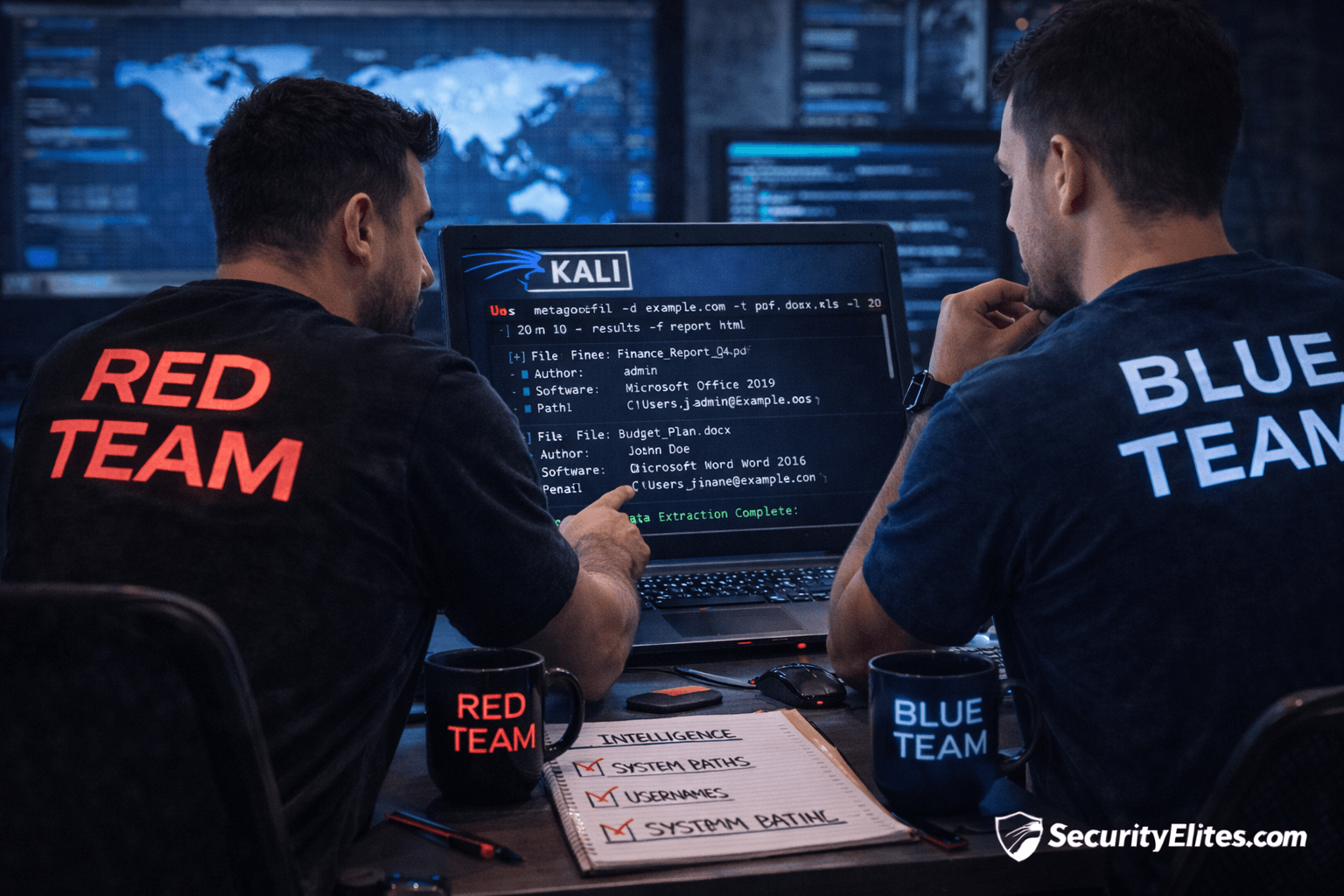
This article teaches metadata extraction as a reconnaissance technique using Metagoofil, a Kali Linux tool that searches for and analyzes hidden information in publicly available documents. It demonstrates how organizations routinely leak sensitive intelligence—usernames, system paths, software versions, infrastructure details—through document metadata that remains embedded even after visible content is sanitized. Metadata intelligence represents a critical gap in security defenses, often bypassing technical protections entirely and providing attackers with valuable information for social engineering and internal access attempts.
- Metadata leaks bypass technical defensesThe article presents a real corporate assessment where strong perimeter defenses, no exposed ports, and no vulnerable servers proved insufficient because publicly downloadable PDFs revealed employee usernames, internal system paths, software versions, and workstation names like 'FINANCE-PC-07.' This demonstrates that metadata extraction succeeds where vulnerability scanners fail, making it a critical reconnaissance vector that security teams rarely audit.
- Documents contain persistent hidden propertiesEvery document embeds metadata including author names, creation software, system names, directory paths, and timestamps. Common leak sources include PDF, DOCX, XLSX, PPT, and ODT files. The article illustrates this with an example where a cleaned Word document still contained 'Author: Rahul Sharma, Machine: HR-LAPTOP-02, Software: Microsoft Office 2016,' information invisible to normal users but immediately valuable to attackers.
- Metagoofil automates Google-based extractionMetagoofil searches Google for documents matching a target domain and automatically extracts metadata. The basic command syntax is 'metagoofil -d example.com -t pdf,doc,xls -l 20 -n 10 -o results -f report.html,' where options specify domain, file types, search limits, download count, output folder, and HTML report filename. The tool generates structured intelligence directly usable in penetration test reporting.
- Naming conventions enable targeted attacksThe article emphasizes that professionals prioritize patterns like 'admin,' 'it,' 'finance,' 'backup,' and 'server' in extracted usernames and paths, as these reveal internal role structures. A real government audit scenario shows how identified username patterns like 'admin_it' from document paths enabled successful password spraying attacks and administrative access without triggering vulnerability detection.
- Older documents present higher intelligence valueThe article notes that older documents leak more metadata during audits, serving as goldmines of information. Combined with the guidance to analyze software versions revealed in metadata, attackers can identify outdated technologies and systems that may be more vulnerable to exploitation.
- Blue team mitigation requires proactive sanitizationDefensive recommendations include removing metadata before publishing documents, sanitizing content, using metadata-cleaning tools, and enforcing publishing policies organization-wide. The article indicates many organizations unknowingly leak intelligence daily, highlighting the need for systematic metadata removal practices.
- Metadata analysis integrates with broader OSINTThe article positions metadata intelligence as step 10 in a 10-day reconnaissance progression following WHOIS, DNS, subdomains, Nmap, OSINT, fingerprinting, directory discovery, Amass, and internal discovery. Professionals correlate metadata findings with other OSINT data to identify patterns that emerge only through comprehensive intelligence synthesis.
- Passive reconnaissance avoids detection triggersMetagoofil operates passively by relying on public document searches through Google rather than direct target scanning, making it undetectable by intrusion detection systems or security monitoring tools while still providing actionable reconnaissance intelligence.
Bottom line: Metadata extraction through tools like Metagoofil represents a critical but often-overlooked reconnaissance technique that consistently leaks organizational intelligence—usernames, infrastructure design, software versions, and system paths—despite strong technical perimeter defenses. Organizations must implement proactive metadata sanitization policies and security teams should audit document metadata exposure as part of their threat assessment, as attackers routinely exploit this intelligence v
Information Gathering Using Kali Linux – Day 10
Metadata Intelligence Gathering Using Metagoofil (Hidden Data Extraction)
Excellent! Now we enter one of the most underestimated — yet extremely powerful — reconnaissance techniques used in real investigations.
Until now, we learned about:
✅ External Recon
✅ Infrastructure Discovery
✅ Attack Surface Expansion
✅ Internal Network Mapping
But professional penetration testers eventually ask a different question:
What information leaks through documents themselves?
Because organizations share documents publicly every day.
And documents… remember everything.
Today you learn how intelligence hides inside files.
Let me tell you about a real corporate security assessment.
No exposed ports.
No vulnerable servers.
Strong perimeter defenses.
Everything looked secure.
But publicly downloadable PDF documents revealed:
- employee usernames
- internal system paths
- software versions
- workstation names
One document exposed:
FINANCE-PC-07
Internal naming convention discovered.
Later used for credential attacks.
No exploitation required.
Just metadata extraction.
Pause here.
Most organizations sanitize visible content…
but forget invisible information embedded inside files.
Today in Information Gathering using Kali Linux, we extract that hidden intelligence using:
✅ Metagoofil
🎯 Why Metadata Intelligence Matters
Metadata means:
Data about data.
Every document contains hidden properties such as:
- author names
- software used
- creation system
- internal usernames
- directory paths
- timestamps
Common file types leaking metadata:
- DOCX
- XLSX
- PPT
- ODT
During enterprise penetration tests, metadata frequently reveals:
✔ employee identities
✔ internal infrastructure
✔ technology stack
✔ naming conventions
This intelligence strengthens social engineering and internal reconnaissance.
Beginners often assume:
If a file is public, it’s safe.
Reality?
Documents are one of the largest OSINT leaks worldwide.
Security teams rarely audit metadata exposure.
Attackers absolutely do.
🧠 Beginner-Friendly Concept Explanation
Imagine sending a Word document.
You delete confidential text.
Looks clean.
But hidden inside remains:
Author: Rahul Sharma
Machine: HR-LAPTOP-02
Software: Microsoft Office 2016
Metagoofil extracts this automatically.
Think of it as reading document fingerprints.
Invisible to normal users.
Extremely valuable to recon professionals.
⚙️ Professional Recon Workflow (Continuation)
Your reconnaissance workflow now becomes:
External Recon
 ↓
Asset Discovery
 ↓
Technology Identification
 ↓
Internal Discovery
 ↓
Metadata Intelligence ✅
At this stage, reconnaissance merges technical and human intelligence.
Professional-level awareness begins here.
🧪 Real-World Scenario
During a government audit, public tender documents were analyzed.
Metagoofil extracted:
Author: admin_it
Path: C:\Users\Admin_IT\Projects\
Username pattern identified.
Password spraying attack simulation succeeded.
Administrative access achieved.
No vulnerability scanner detected this risk.
Metadata exposed it.
🛠 Tool of the Day — Metagoofil (Kali Linux)
Metagoofil searches Google for documents and extracts metadata automatically.
Install if required:
sudo apt install metagoofil
Verify:
metagoofil
✅ Step 1 — Create Working Directory
mkdir meta_results
cd meta_results
Organization matters.
Professionals keep recon structured.
✅ Step 2 — Basic Metadata Extraction
metagoofil -d example.com -t pdf,doc,xls -l 20 -n 10 -o results -f report.html
Explanation:
| Option | Meaning |
|---|---|
| -d | Domain |
| -t | File types |
| -l | Search limit |
| -n | Files downloaded |
| -o | Output folder |
| -f | Report |
Output reveals:
Usernames
Software versions
System paths
Emails
Hidden intelligence unlocked.
Insight 🔎
Students focus only on usernames.
Professionals analyze environment patterns.
Naming conventions matter more.
✅ Step 3 — Expand File Types
metagoofil -d example.com -t pdf,docx,pptx,xlsx
More formats = more intelligence.
✅ Step 4 — Review HTML Report
Open:
report.html
Structured intelligence view.
Used directly in pentest reporting.
🚨 Beginner Mistake Alert
❌ Downloading Too Many Files
Start small.
Avoid noise.
❌ Ignoring Software Metadata
Reveals outdated technologies.
❌ Not Correlating Results
Combine with OSINT (Day 5).
Patterns emerge.
🔥 Pro Tips From 20 Years Experience
✅ Look for:
admin
itadmin
finance
backup
server
Common internal roles.
✅ Document paths reveal infrastructure design.
✅ Older documents leak more metadata.
Goldmine during audits.
Enterprise truth:
Metadata leaks often bypass technical defenses completely.
🛡 Defensive & Ethical Perspective
Blue teams should:
✅ remove metadata before publishing
✅ sanitize documents
✅ use metadata-cleaning tools
✅ enforce publishing policies
Many organizations unknowingly leak intelligence daily.
Ethical reminder:
Only analyze authorized targets.
Privacy protection matters.
✅ Practical Implementation Checklist
Practice today:
✔ Run Metagoofil scan
✔ Extract metadata
✔ Identify usernames
✔ Analyze software info
✔ Review system paths
✔ Document intelligence
You now extract intelligence beyond networks.
💼 Career Insight
Metadata intelligence skills apply to:
- Threat Intelligence Analysts
- Digital Forensics Experts
- Red Team Operators
- Cyber Investigators
- OSINT Specialists
Advanced cybersecurity increasingly relies on intelligence correlation.
🔁 Quick Recap Summary
Your progression:
| Day | Skill |
|---|---|
| Day 1 | WHOIS |
| Day 2 | DNS |
| Day 3 | Subdomains |
| Day 4 | Nmap |
| Day 5 | OSINT |
| Day 6 | Fingerprinting |
| Day 7 | Directories |
| Day 8 | Amass |
| Day 9 | Internal Discovery |
| Day 10 | Metadata Intelligence ✅ |
You now uncover intelligence hidden even inside documents.
Tomorrow…
We unify everything into automated reconnaissance frameworks.
Professional recon automation begins.
❓ FAQs
1. What is Metagoofil used for?
Extracting metadata from publicly available documents.
2. Is metadata dangerous?
Yes — it exposes internal information.
3. Is Metagoofil passive?
Yes, it relies on public document searches.
4. Do professionals use metadata analysis?
Frequently during OSINT investigations.
5. Which files leak metadata most?
PDF, Word, Excel, and PowerPoint files.