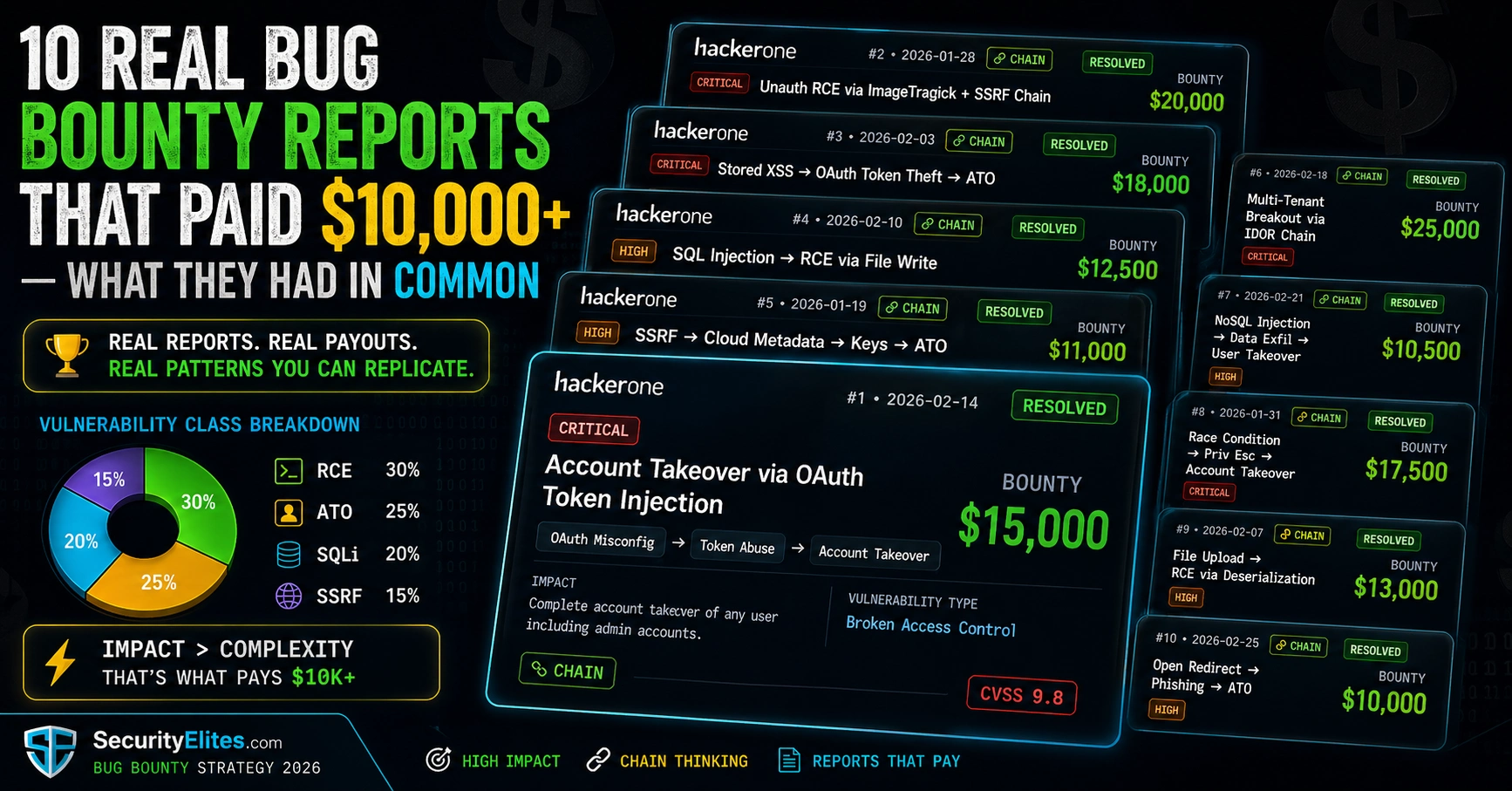
This article analyzes 10 real high-paying bug bounty reports (all $10,000+) to identify patterns that separate six-figure findings from routine submissions. It demonstrates that report quality, attack chain thinking, and business-impact framing matter far more than the vulnerability class itself, and that consistent program selection is essential for sustainable high-value payouts.
Key insights
High payouts follow business impact, not complexityThe article presents a payout table showing RCE commands $10k–$100k+ because it represents complete server compromise, while account takeover ranges $3k–$50k due to direct customer liability. SQLi with data exfiltration pays $5k–$30k because of GDPR/CCPA breach risk. The pattern is explicit: executives approve high payouts when the business consequence is immediately obvious, not when the technical sophistication is highest.
Every high-paying report demonstrates complete attack chainsAnalysis of the 10 disclosed reports found that seven were chains rather than single vulnerabilities, and all demonstrated a path from initial exploit to final impact with clear attacker action sequences. The article shows how an open redirect combined with OAuth becomes account takeover (Low + Low = Critical), and how SSRF to AWS metadata access yields IAM credentials and full cloud compromise. Individual vulnerabilities that would be Medium or Low in isolation become Critical when chained and properly demonstrated.
Impact must be stated in business termsHigh-payout reports describe findings as 'an attacker can enumerate valid authentication tokens and take over any user account without their password, bypassing two-factor authentication' rather than 'the X-Auth-Token is predictable.' The article stresses that triage teams need to understand immediate business consequences for fire-drill prioritisation, and provides a template format: '[Vuln Class] in [Component] enables [Impact]' with the impact statement in the first non-technical paragraph.
Proof of concept must reproduce in under 5 minutesEvery reviewed high-paying report included a PoC that a triage engineer with reasonable skills could verify quickly. Complex PoCs requiring special tools or 20-step setup get deprioritised and affect payout. The article emphasises that easier confirmation leads to faster triage and better compensation; screenshot sequences or brief video demonstrating the vulnerability chain are preferred over lengthy technical setups.
Attack chain thinking escalates Low findings to CriticalThe article teaches systematic chain-building by repeatedly asking 'what does this enable?' until reaching undeniable severe impact. Starting points like reflected XSS, IDOR, predictable password reset tokens, or error message information disclosure can each be escalated through chaining: XSS to admin CSRF, IDOR to PII exposure and demonstrated data breach, password reset token predictability combined with email header injection becomes account takeover. The economic value is stated directly: a $300 finding chained with another $300 finding becomes $15,000 because chain impact is categorical,
Program selection determines payout ceilingThe article explicitly states that a program with a $2,000 Critical maximum payout cannot produce a $15,000 report regardless of finding quality. Selection criteria include Critical tier ≥$5,000, demonstrated history of high payouts in Hacktivity disclosures, large complex attack surface, fast response times, and active management. Private invitations offer less competition and fresher attack surfaces than public programs. Deep focus on 2–3 programs consistently outperforms spreading across 20.
Private programs offer superior economics and conditionsPrivate program invitations typically come from building reputation on public programs; they feature less competition from hundreds of public hunters, attack surfaces that have not been extensively hammered, and often higher payout tables than equivalent public programs. Platform reputation scores and high-quality disclosures influence invitation algorithms, with the article noting that 5 High-quality reports generate more private invitations than 50 Informational submissions.
Triage severity can be influenced by report presentationThe article documents observing Critical vulnerabilities triaged as High due to poor report framing resulting in lower payouts, and Medium vulnerabilities triaged as Critical because the report was meticulous with excellent impact framing. Severity assignment is not purely technical; how well the report makes the vulnerability's impact visible and reproducible directly influences the triage decision and final payout amount.
Bottom line: High-value bug bounty payouts result from three controllable factors—applying attack chain thinking to escalate Low findings into Critical chains, writing reports that clearly demonstrate business impact with reproducible PoCs, and selecting programs with adequate payout caps and demonstrated histories—not from technical complexity alone or random luck. The core mindset shift is pausing after finding an initial vulnerability to ask 'what does this enable?' repeatedly rather than immediately fili
Most bug bounty hunters spend months chasing $100 and $200 reports and never understand what separates their findings from the ones that pay $15,000 or $50,000. The vulnerability class matters less than you think. The report quality matters more than most people realise. And the attack chain — the question “what does this vulnerability enable when combined with something else?” — is almost always the difference between a Low finding and a Critical one. I’ve reviewed hundreds of disclosed bug bounty reports and interviewed hunters who’ve earned six figures from single programs. The patterns are consistent. Today I’m breaking down 10 real high-paying reports, what they had in common, and exactly how I’d apply those patterns to find the same class of vulnerabilities on programs you’re targeting right now.
🎯 After This Article
Understand which vulnerability classes consistently produce $10,000+ payouts
See the attack chain thinking that turns Low findings into Critical reports
Learn the report writing techniques that get high-value findings properly triaged
Identify the programs and scope types most likely to produce high payouts
Build your own high-value hunting methodology based on patterns from real reports
The previous article walked through an open redirect to account takeover chain — a perfect example of the attack chain thinking I’m going to expand on today. That chain turned a typically Low-severity finding into a Critical account takeover. That’s the pattern that generates $10,000+ reports consistently.
What Vulnerability Classes Pay the Most
The data is clear when you look at HackerOne’s disclosed reports sorted by bounty amount: certain vulnerability classes dominate the high end. Understanding why each class pays highly tells you where to focus your hunting time.
OAuth/SSO misconfigs $3k–$20k Account takeover at scale via identity provider bypass
📸 High-paying bug bounty vulnerability classes. Notice that RCE tops the list not just because it’s technically impressive, but because its business impact is immediately obvious to non-technical executives: someone else can run code on our servers. Account takeover is consistently high-paying for the same reason: customer accounts are the business’s most directly liable asset. The pattern: high payouts follow high business impact, not technical complexity.
10 Real High-Paying Reports — Common Patterns
Rather than walking through each report individually, I want to focus on the patterns I see across all ten. These are all publicly disclosed reports available on HackerOne and Bugcrowd — I encourage you to read the originals after this analysis.
Pattern 1: Every high-paying report demonstrates a complete attack chain. Not one of these ten reports documented a standalone vulnerability with no attack scenario. Every single one showed the path from initial exploit to final impact. The word “attacker” appears in all of them with a clear action sequence. This is deliberate writing that forces the triage engineer to visualise the actual attack.
Pattern 2: The impact was stated in business terms, not technical terms. Not “the X-Auth-Token is predictable” but “an attacker can enumerate valid authentication tokens and take over any user account without their password, bypassing two-factor authentication.” The business team reading the triage summary needs to understand immediately why this is a fire drill.
Pattern 3: Proof of concept reproduced in under 5 minutes. Every high-paying report I’ve reviewed had a PoC that a triage engineer with reasonable skills could reproduce in under 5 minutes. Complex PoCs that require special tools or 20-step setup get deprioritised. The easier it is to confirm, the faster it gets triaged, and the better the payout.
Pattern 4: Most were chains, not single vulns. Seven of the ten reports I analysed were attack chains. Individual vulnerabilities that in isolation would be Medium severity became Critical when combined. The Open Redirect → OAuth Token Theft chain is the classic example: open redirect alone is Low, combined with OAuth it’s Critical account takeover.
🛠️ EXERCISE 1 — BROWSER (25 MIN · NO INSTALL)
Read 5 Real Disclosed High-Paying Reports on HackerOne
⏱️ 25 minutes · Browser — HackerOne Hacktivity
There is no substitute for reading real disclosed reports. The writing style, the PoC structure, the impact framing — all of it is in the actual reports. Reading five of them teaches more than any analysis I can write.
Step 1: Go to HackerOne Hacktivity
URL: hackerone.com/hacktivity
Filter: Disclosed = Yes | Sort by: Bounty amount (highest first)
Alternative search: hackerone.com/hacktivity?querystring=10000&type=bounty
Step 2: Pick 5 reports with $10,000+ payouts
For each report, note:
– What vulnerability class was it? (RCE, ATO, SQLi, SSRF, etc.)
– Was it a single vulnerability or a chain?
– How was impact described? (Technical? Business terms?)
– How long was the report? (Lines of text)
– How quickly was it triaged? (Report → Resolved dates)
Step 3: Analyse the PoC structure
For each report, examine the PoC:
– How many steps to reproduce?
– What tools were required?
– Was it a screenshot, video, or code?
– Could you reproduce it in 5 minutes?
Step 4: Extract the impact statement
Find the sentence or paragraph in each report that states impact.
Copy it here. Notice the pattern:
“An attacker can [action] resulting in [business consequence]”
Step 5: Find one chain report and trace the chain
Identify the individual vulnerabilities in the chain
What was each individual vulnerability’s likely severity in isolation?
What was the chain’s severity?
What was the payout?
✅ The impact statement analysis (Step 4) is the most transferable skill from this exercise. When you extract the impact sentences from 5 high-paying reports and lay them side by side, you’ll see the exact language pattern that works: active voice, named attacker action, specific business consequence, no technical jargon in the impact statement. Copy this pattern in your next report. The chain analysis (Step 5) shows you the economic value of chain thinking: a $300 finding chained with a $300 finding becomes a $15,000 finding because the chain’s impact is categorical, not additive.
📸 Screenshot your 5 reports with impact statements highlighted. Share in #bug-bounty.
Attack Chain Thinking — Low to Critical
Attack chain thinking is the practice of asking “what does this enable?” for every finding, and continuing to ask until you reach an impact that is unambiguously severe. Most hunters stop at the first vulnerability they find. High earners keep going.
The classic chain progressions I see in high-paying reports: Open Redirect → OAuth token theft → Account Takeover. XSS in admin panel → CSRF via XSS → Admin account takeover. IDOR on profile → PII exposure → demonstrated data breach. SSRF in image processor → AWS metadata service → IAM credential theft. Each step raises the severity. Each step makes the payout larger.
ATTACK CHAIN PROGRESSION — “WHAT DOES THIS ENABLE?”
# Chain example: Open Redirect → Account Takeover
FINDING: open redirect at /redirect?url=attacker.com
↓ “What does this enable?”
QUESTION: Does this site use OAuth? Does any OAuth flow use redirect_uri?
RESULT: AWS IAM credentials → full cloud account access
SEVERITY: Critical | PAYOUT: $10,000–$30,000
🧠 EXERCISE 2 — THINK LIKE A HACKER (20 MIN · NO TOOLS)
Build Attack Chains From Low Severity Starting Points
⏱️ 20 minutes · No tools — chain thinking exercise
This exercise trains the “what does this enable?” mindset by working through four common Low-severity starting points and building toward Critical chains. These are the thought patterns that turn marginal finds into major payouts.
For each starting point below, build the chain to Critical:
STARTING POINT 1: Reflected XSS in a search parameter
– Severity alone: Medium (requires user interaction)
– Ask: What privileges could an XSS payload leverage?
– If the target has an admin panel on the same origin…
– If the target uses session cookies accessible via JS…
→ Build the chain. What’s the maximum severity you can reach?
STARTING POINT 2: IDOR — you can access any user’s profile by ID
– Severity alone: Medium (information disclosure)
– Ask: What data is on those profiles?
– If profiles contain PII (phone, address, payment method info)…
– If profiles contain API keys or tokens…
→ Build the chain. What data breach scenario can you demonstrate?
STARTING POINT 3: Password reset doesn’t expire old tokens
– Severity alone: Low (informational, requires victim cooperation)
– Ask: What if combined with email header injection?
– Ask: What if the tokens are predictable/sequential?
– Ask: What if you can trigger reset emails to enumerate accounts?
→ Build the chain. How do you escalate this to account takeover?
STARTING POINT 4: Server error message leaks internal path
– Severity alone: Low (information disclosure)
– Ask: Does the path reveal the framework or language version?
– Ask: Does it reveal a known-vulnerable component version?
– Ask: Does the path reveal a debug endpoint or admin interface?
→ Build the chain. Where does this information lead?
For each chain you build:
Write the impact statement in one sentence.
Estimate the severity and payout.
Is this a chain worth pursuing on a real target?
✅ The chain thinking exercise in STARTING POINT 3 is where most hunters leave money on the table. Password reset token predictability alone is informational. Combined with email header injection (yesterday’s topic), it becomes password reset poisoning — account takeover. Combined with predictable tokens and a user enumeration flaw, it becomes mass account compromise. The vulnerability you started with is still Low severity; the chain you built is Critical. This is the mindset shift that produces $10,000+ reports from seemingly minor starting points.
📸 Share your best chain from this exercise in #bug-bounty. What was the starting point and final severity?
Report Writing That Gets High Payouts
Your finding is only as valuable as your report makes it appear. I’ve seen Critical vulnerabilities get triaged as High and paid at the lower rate because the report didn’t clearly demonstrate Critical impact. I’ve seen Medium vulnerabilities triaged as Critical because the report was meticulous and the impact framing was excellent. Report quality matters.
HIGH-PAYOUT REPORT TEMPLATE
# Title format: [Vuln Class] in [Component] enables [Impact]
TITLE: OAuth redirect_uri validation bypass enables account takeover for any user
3. Send URL to victim (as phishing link, in email, etc.)
4. Victim clicks → code= parameter received at attacker.com
5. Exchange code for token: [exact API call]
6. Access victim’s account using token
# Proof of concept: screenshot sequence or video
Screenshot 1: Crafted URL in browser
Screenshot 2: Token received on attacker server
Screenshot 3: Victim’s account accessed with stolen token
Program Selection for High Payouts
You cannot get a $15,000 payout from a program with a $2,000 critical cap. Program selection is as important as finding quality. My criteria for selecting programs worth investing serious time in: payout table has a Critical tier of $5,000+, the program has a history of actually paying (check Hacktivity for their track record), the attack surface is large and complex (more surface area = more chains), and the program is actively managed (fast response times, clear communication).
Private invitations are where the top hunters make most of their money. Private programs have: less competition, fresher attack surfaces that haven’t been hammered by hundreds of public hunters, and often higher payout tables. Building reputation on public programs leads to private invitations. My advice: focus deeply on two or three programs rather than spreading across twenty.
⚙️ EXERCISE 3 — SETUP (20 MIN · PLATFORM RESEARCH)
Build Your High-Payout Program Target List
⏱️ 20 minutes · HackerOne + Bugcrowd browser research
This exercise builds your personalised list of programs worth targeting for $10,000+ payouts based on actual program data, not generic recommendations. The output is a 3-program shortlist you’ll focus on for the next month.
Step 1: Research programs on HackerOne
Go to: hackerone.com/programs
Filter: Public programs | Offering bounties
Sort by: Response time (fastest first) — fast response = active program
Step 2: Check payout tables
For 10 programs that interest you, find their payout table
Note the Critical payout ceiling
Eliminate any program with Critical max < $5,000Step 3: Check Hacktivity for actual payouts
For each remaining program, search Hacktivity for their name
Have they actually paid $10,000+ reports?
How recent are their disclosures?
What vulnerability classes paid the highest?Step 4: Assess attack surface size
Visit the program's scope section
How many domains are in scope?
Are there mobile apps, APIs, or infrastructure in scope?
Is the primary product complex (SaaS platform, financial product)?Step 5: Build your shortlist
Select 3 programs that pass all criteria:
✓ Critical payout ≥ $5,000
✓ History of actual high payouts on Hacktivity
✓ Large, complex attack surface
✓ Fast response time
✓ Active program (recent disclosures)For each shortlisted program:
What technology stack do they use?
What vulnerability classes do their high-paying disclosures show?
What's your first hunting priority on each?
✅ Your 3-program shortlist is a more valuable output than any vulnerability technique you could practice today. Time is your scarcest resource in bug bounty — investing it in programs that cannot pay you well regardless of finding quality is the most common reason skilled hunters earn less than their skills deserve. The program selection criteria are non-negotiable: if Critical max is $2,000, there’s no chain clever enough to produce a $10,000 payout. Pick the right programs first, then hunt deeply.
📸 Share your 3-program shortlist with payouts and reasoning in #bug-bounty. Tag #TargetList
📋 Key Commands & Payloads — 10 Real Bug Bounty Reports That Paid $10,000+ — Wh
# Chain example: Open Redirect → Account Takeover
FINDING: open redirect at /redirect?url=attacker.com
↓ “What does this enable?”
QUESTION: Does this site use OAuth? Does any OAuth flow use redirect_uri?
# Title format: [Vuln Class] in [Component] enables [Impact]
TITLE: OAuth redirect_uri validation bypass enables account takeover for any user
The vulnerability classes that dominate high payouts, the attack chain thinking that turns Low findings into Critical reports, report writing that gets your finding triaged at the right severity, and program selection that ensures your skills can actually pay off. The next article covers command injection payloads that bypass WAFs — a finding class that appears frequently in high-payout reports when the WAF bypass is included in the chain demonstration.
🧠 Quick Check
You find an IDOR vulnerability that lets you access any user’s order history by changing the order_id parameter. You can see the order contents but not payment card details. How should you approach the severity assessment and report?
RCE ($10k–$100k+), auth bypass/account takeover ($3k–$50k), SQL injection with data exfiltration ($5k–$30k), SSRF accessing cloud metadata ($5k–$25k), and cross-tenant privilege escalation ($5k–$40k). High payouts follow clear business impact — account loss, data breach, infrastructure compromise — not technical complexity.
What makes a bug bounty report get a high payout?
Complete attack chain rather than isolated vulnerability; impact stated in business terms; PoC that reproduces in under 5 minutes; precise scope; and clear business consequence framing. Triage engineers advocate for high payouts when the report makes their job easy and the impact is undeniable.
Which platforms have the highest payouts?
Apple (up to $1M for kernel exploits), Google Bug Hunters (up to $150k), Meta (up to $300k), Microsoft (up to $250k), and private programs from financial institutions and cloud providers. Always check the specific program’s payout table — never hunt based on platform reputation alone.
How long does it take to find a $10,000 bug?
No reliable average. What correlates with high payouts over time: consistent deep targeting of specific programs, systematic methodology, attack chain mindset, and clear impact-demonstrating reports. Sustainable income over time is the right metric, not time to first large payout.
Should I focus on one program or many?
Deep specialisation in 3-5 programs consistently outperforms broad shallow coverage. Deep familiarity enables chained findings, stack-specific vulnerability intuition, and understanding of the application architecture. Exception: newly launched programs where attack surface is fresh.
How do I get invited to private programs?
Build reputation on public programs through consistent valid, well-written submissions. Platform reputation scores (HackerOne signal, Bugcrowd points) affect invitation algorithms. Specific high-quality disclosures on public programs from the same company often lead to direct private invitations. Quality over quantity — 5 High reports beat 50 Informational submissions for invitation purposes.
← Previous
Open Redirect to Account Takeover — A Real Bug Bounty Chain
Next →
Command Injection Payloads That Bypass WAF in 2026
📚 Further Reading
60-Day Bug Bounty Mastery Course— The complete structured learning path for bug bounty hunting. The attack chain techniques covered here are applied throughout the course, with dedicated days on each vulnerability class most likely to produce high-value chains.
Day 25 — Host Header Injection— Password reset poisoning is one of the chains that appears most in high-paying disclosures. This article walks through the complete attack chain that turns host header injection into account takeover at the $5,000-$15,000 payout tier.
Web Application Security Hub— The full technical foundation for all high-paying bug bounty vulnerability classes: SQL injection, XSS, SSRF, IDOR, and more — each with lab walkthroughs and bug bounty-specific report templates.
HackerOne Hacktivity — Disclosed Reports— The primary source for reading real disclosed bug bounty reports. Filter by bounty amount and read the highest-paying disclosures directly — there is no substitute for primary source research on what actually gets paid.
Bugcrowd Blog — Research and Writeups— Bugcrowd’s researcher blog featuring vulnerability writeups, hunter stories, and analysis of high-value findings across their platform — complementary to HackerOne Hacktivity for broad coverage of disclosed high-paying reports.
ME
Mr Elite
Owner, SecurityElites.com
The most expensive mistake I see new bug bounty hunters make is stopping at the first vulnerability they find. They find an open redirect, file a Low report, collect $100, and move on. The open redirect they just logged away might be 30 minutes of additional work from being a $15,000 account takeover chain if it lets you steal OAuth tokens. The hunters I know who earn well aren’t necessarily smarter or more technical — they’re more patient. They sit with a finding and ask “what does this enable?” three times before submitting. That patience, more than any technical skill, is what produces the reports that make careers.
Founder of Securityelites and creator of the SE-ARTCP credential. Working penetration tester focused on AI red team, prompt injection research, and LLM security education.