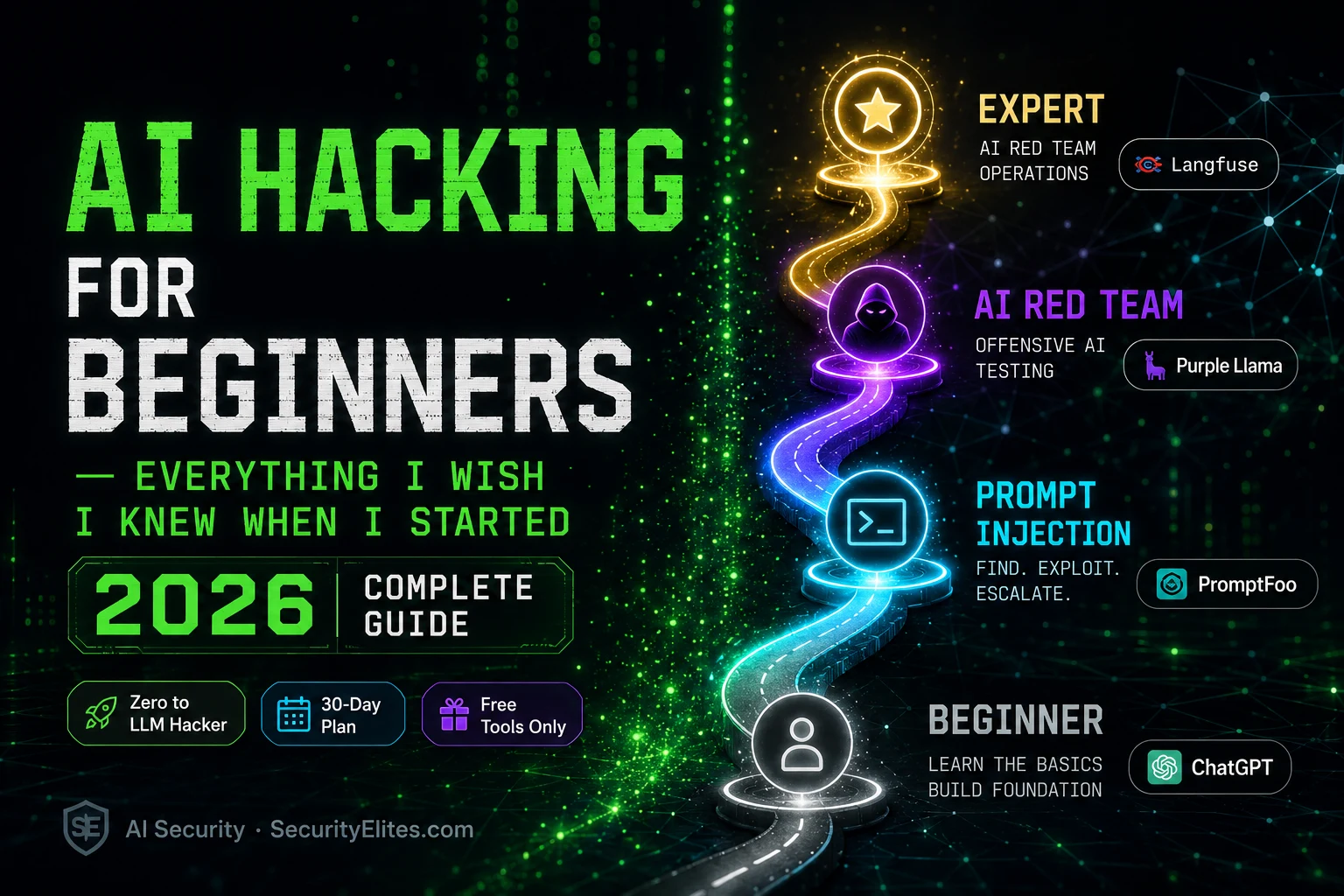
The biggest mistake I made when I started in security was waiting until I felt “ready.” I spent six months reading books before I ran my first Nmap scan. Six months of theory before a single hands-on test. I wasted a year of compounding skill development because nobody told me the truth: you learn this field by doing it, not by reading about it.
AI security is the area where I see this mistake happening most aggressively right now. Beginners are treating it like a PhD topic — reading every paper, watching every talk — when the reality is that prompt injection works the same whether you’ve read three papers or thirty. You need a browser, a free account, and a methodology. That’s it.
AI hacking for beginners in 2026 is more accessible than any previous security discipline at its start. There’s a free local LLM you can pull in five minutes. There are authorised practice platforms with thousands of challenges. There are real bug bounty programmes paying serious money for AI vulnerabilities. You have every resource you need. What most beginners are missing is a clear path through them.
🎯 What You’ll Get From This Guide
⏱ 22 min read · 3 exercises included
AI Hacking for Beginners — Complete Guide 2026
If you came here from the AI model hacking guide, you already know the attack surface map. This article is about the human side — how to go from knowing the theory to building skills you can demonstrate, document, and get paid for. The full range of what you’re working toward is mapped out in the AI Elite Hub. And when you’re ready to start choosing your tools, the AI hacking tools guide walks through every scanner and framework I use.
Why 2026 Is the Right Moment to Start AI Security
The AI security field right now reminds me of web application security in 2010. Everyone is deploying it. Almost nobody has tested it. The skills are scarce. The pay is exceptional. And the window for getting in as a ground-floor practitioner — before the field gets saturated and certifications become table stakes — is closing faster than most people realise.
Here are the numbers that tell me this is the right moment:
📸 The AI security market in 2026 — supply/demand gap, salary data, and market size. The window for ground-floor entry is open. The question is whether you’ll use it.
I’ve watched colleagues make career pivots from traditional web application pentesting to AI security and double their rate in under 18 months. The knowledge transfer is real — understanding how web apps work gives you the right mental model for understanding how LLM applications work. The specific technique set is different, but the adversarial thinking is identical.
The 3 Paths Into AI Security
There’s no single right entry point. I’ve seen people enter from pure red team, from defensive security, and from bug bounty hunting. Each path has different first steps and leads to different career outcomes.
Path 1 — AI Red Teaming (Offensive Research)
This is the path most people imagine when they hear “AI hacking for beginners.” You’re actively attacking AI systems — finding vulnerabilities, exploiting them in authorised environments, and documenting what you find. Day to day, this means prompt injection testing, jailbreaking research, model extraction attempts, and agentic attack simulation.
Who it’s right for: People from traditional pentesting, bug bounty, or CTF backgrounds. If you already understand how web applications fail, AI red teaming will feel like a natural extension. The income ceiling is the highest of the three paths — senior AI red teamers bill at $300–$600 per hour for enterprise engagements.
Path 2 — AI Defensive Security
Defensive AI security means building the detection and hardening that stops red teamers like me. You’re implementing prompt injection filters, designing guardrail architecture, monitoring model outputs for anomalous patterns, and writing the security requirements for AI system deployments.
Who it’s right for: People from blue team, SIEM operations, or security engineering backgrounds. If you like building things more than breaking them, this path leads to staff-level security engineering roles at AI companies. The NIST AI Risk Management Framework and MITRE ATLAS are your primary reference documents — learn them early.
Path 3 — AI Bug Bounty (Paid Research)
Multiple major AI companies run public vulnerability disclosure programmes. This is the path I recommend to beginners who want paid validation fast. You don’t need to land a contract — you just need to find a real vulnerability in a scoped programme and report it correctly. I’ve seen beginners with three months of AI security knowledge earn their first bounty before they’ve even updated their LinkedIn.
Who it’s right for: Self-starters who learn by doing and want clear, quantifiable proof of their skills. Start with the AI bug bounty programme guide to understand which programmes exist and what they’re paying for in 2026.
What You Actually Need to Know Before You Start
The prerequisite list for AI security beginners is shorter than most people think. Here’s what matters and what doesn’t:
What matters:
- Basic Python — enough to run a script, modify a payload, make an API call. You don’t need to build frameworks. You need to be able to read code and make small modifications.
- Understanding how HTTP works — requests, responses, headers, status codes. If you know how to use Burp Suite to intercept traffic, you have what you need for testing AI APIs.
- How LLMs work at a conceptual level — tokens, context windows, temperature, system prompts vs user prompts. This doesn’t require reading academic papers. I’ll cover everything practically in this series.
- The adversarial mindset — “how could this be abused?” This is the core cognitive skill in security. If you’re already in security, you have it. If you’re new, it develops fast through practice.
What doesn’t matter (yet):
- Machine learning theory — you don’t need to understand backpropagation to find prompt injection vulnerabilities
- Programming from scratch — basic scripting ability is enough to get started
- Certifications — there’s no equivalent of OSCP for AI security yet; demonstrated skill matters more
- Deep understanding of transformers — useful eventually, not required on day one
The 30-Day AI Security Learning Roadmap
I’m going to give you the exact sequence I’d follow if I were starting from zero today. This isn’t theoretical — it’s the compressed version of what took me 18 months figured out over time, now that I know which steps actually move the needle.
Week 1: Understand What You’re Attacking
Spend the first week building mental models, not attacking anything. Read the OWASP LLM Top 10 — not to memorise it, but to understand what categories of vulnerability exist and why each one happens. Set up Ollama and run a local Llama model. Have conversations with it. Change the system prompt. Watch how changing the instructions changes the behaviour. This isn’t hacking yet — it’s understanding your target before you attack it.
Week 2: Your First Prompt Injection Attacks
Move to the Gandalf challenge platform and work through all available levels. Then read through the HackAPrompt challenge dataset — it contains real prompts that worked against real models, categorised by technique. I want you at the end of week 2 to have personally confirmed 5 different prompt injection techniques that work, with notes on why each one succeeds and what the model’s failure mode is.
Week 3: Build Your Testing Environment
Install Garak and run it against your local model. Learn Burp Suite basics — specifically how to intercept an AI application’s API calls and replay modified requests. Pick one real-world AI application from within a bug bounty programme’s scope and map its attack surface. Document what you find, even if you find nothing exploitable. The methodology practice is what matters here.
Week 4: Your First Real Assessment
Take everything from weeks 1–3 and run a structured assessment against a scoped bug bounty target or against your own deployment. Use the attack surface map from the AI model hacking guide as your testing framework. Document every test you run, every payload you try, every response you get. Write it up as a simple report — even if the finding is just “no vulnerability confirmed.” The report matters as much as the finding for building a portfolio.
7 Mistakes That Kill Beginner Progress
I’ve watched beginners make these same mistakes repeatedly. I made most of them myself. Here they are so you can skip them:
1. Waiting until you’re “ready.” There’s no ready. There’s just doing the thing and iterating. The best AI security researchers I know started testing before they finished their first book on the topic.
2. Treating every refusal as a dead end. When a model refuses, that’s information. It tells you where the safety filter boundary is. Your job is to map the fence, not give up when you find it.
3. Testing without documentation. If you run 50 prompt injection attempts and don’t write down what you tried and what happened, you’ve learned almost nothing. Document everything. Your notes become your methodology, your portfolio, and your memory across sessions.
4. Using other people’s payloads without understanding them. Copy-pasting jailbreaks from Reddit doesn’t build skill. Understanding why a specific payload works — what cognitive bias or training gap in the model it exploits — is what lets you create new attacks when the old ones are patched.
5. Ignoring the application layer. AI model attacks get all the attention but the highest-value vulnerabilities I find are in the application built around the model — insecure API endpoints, missing authentication, exposed keys in JavaScript. Test the whole stack, not just the LLM.
6. Testing in isolation. Join communities. Share what you’re finding. Ask questions when you’re stuck. The AI security research community is small and collaborative right now. That won’t last — use the access while it exists.
7. Skipping the boring fundamentals. Understanding HTTP, reading API documentation, knowing how authentication tokens work — beginners who skip these fundamentals hit ceilings fast. The interesting AI attacks all live on top of boring infrastructure. Know the infrastructure.
Before you learn how to attack AI systems, understand what it feels like to be a victim of a credential exposure. Run your email through the SecurityElites Password Breach Checker — it shows you exactly what data from your accounts has appeared in known breaches. That victim perspective is something I require every student to have before they start attacking anything. Security is easier to take seriously when it’s personal.
Free Resources That Outperform Paid Courses
I’ve spent money on AI security training that taught me less than free platforms I discovered later. Here’s what I actually use and recommend:
Gandalf (gandalf.lakera.ai): Free, addictive, immediately useful. Progressive jailbreaking challenges. I go back to this whenever I want to test a new injection technique against a resistant target.
HackAPrompt Dataset: Open-source collection of prompt injection challenges with solutions. Reading through the solutions with the mindset of “why did this work?” is one of the best ways to build technique vocabulary.
OWASP LLM Top 10: The definitive categorisation of LLM vulnerabilities. Free. Authoritative. Updated regularly. Read it once, reference it constantly.
Garak GitHub: The source code and probe library for the best AI security scanner in existence. Reading the probes tells you exactly what attack patterns researchers have codified — it’s a practical attack pattern library disguised as a tool.
MITRE ATLAS: The threat framework for adversarial AI. Every major attack technique is documented with real-world examples. I use it as my reference for naming and categorising findings in client reports.
This series: Everything in the AI Elite Hub is built specifically for practitioners — not academics. Each article covers one technique deeply, with hands-on exercises on authorised platforms. Work through it in sequence and you’ll have a complete AI security skill set by the time you finish.
I want you to find an active AI bug bounty programme and map exactly what they’re looking for. This isn’t about finding a vulnerability today — it’s about understanding what “in scope” means for AI security research and what kinds of findings earn bounties. This is your first step toward getting paid.
- Go to hackerone.com/programs and filter by “Artificial Intelligence” in program categories
- Open three programmes and read their scope documentation carefully
- For each programme, document: What AI systems are in scope? What vulnerability types do they specify? What’s the minimum bounty for a critical finding?
- Look for programmes that explicitly mention prompt injection, jailbreaking, or model manipulation — these are the ones most likely to reward AI-specific research
- Note one programme you could realistically test in your first 30 days and what specific AI system their scope covers
📸 Screenshot the scope page of the most interesting AI programme you found and share it in Discord #ai-hacking-lab. Tell us why it caught your attention.
I want you to prioritise your 30-day learning roadmap based on your actual background. Not the generic roadmap — your version, given where you’re starting from. This is how practitioners think: adapt the plan to the context.
Scenario: You have 1 hour per day for 30 days to get to your first confirmed AI security finding. Choose your background:
Background A: You’re from web app pentesting (know Burp, HTTP, OWASP). Which week 1 focus gives you the fastest path to a real finding?
Background B: You’re a developer who has built AI apps but has no security background. Which week 1 focus is right?
The principle: Your fastest path to a real finding always starts from your existing knowledge base. Web app people should attack the application layer first — they’ll find vulnerabilities there faster than anywhere else. Developers should attack the code they know — they understand where the injection points live because they’ve written them.
📸 Write your personalised 30-day plan in the Discord #ai-hacking-lab — what’s your week 1 focus given your background?
The HackAPrompt challenge is the best prompt injection learning resource that exists right now. You’re going to work through the first 10 challenges and document not just what worked, but the specific technique each successful payload uses. Technique vocabulary is what separates beginners from practitioners.
- Go to huggingface.co/datasets/jailbreak-bench/HackAPrompt or search “HackAPrompt challenges” for the interactive version
- Start at Challenge 1 — the simplest injection scenario
- For each challenge you attempt, write down: (a) your payload, (b) whether it worked, (c) the technique name (role switch, instruction override, context injection, token confusion, etc.)
- Work through at least 5 challenges
- At the end, review your notes and identify which technique category you found most effective — that’s where you have natural aptitude and should develop first
📸 Share your top 3 working payloads and the technique category for each in the Discord — the most creative technique wins a SecurityElites shoutout.
Key Takeaways
- 2026 is genuinely the best time to enter AI security — supply/demand gap is extreme, salaries are high, and the field is accessible to practitioners from any technical background.
- Three clear paths exist: offensive AI red teaming, defensive AI security engineering, and AI bug bounty research. Your existing background determines which gives you the fastest ramp to real skill.
- The minimum technical prerequisites are lower than almost every beginner assumes — basic Python and HTTP knowledge is enough to find real vulnerabilities.
- The 30-day roadmap works: week 1 understanding, week 2 first attacks, week 3 tools and methodology, week 4 first real assessment. Don’t deviate by reading more instead of doing more.
- Documentation turns random experimentation into a methodology. Keep notes from day one — your notes are your technique library and portfolio.
- Free resources (Gandalf, HackAPrompt, OWASP LLM Top 10, Garak, MITRE ATLAS) are genuinely better for building practical skill than most paid courses in 2026.
Frequently Asked Questions
Do I need a computer science degree to get into AI security?
No. The AI security researchers I respect most have diverse backgrounds — electrical engineering, web development, penetration testing, even non-technical careers. What they share is systematic thinking and willingness to document their work. Degrees matter for R&D roles at AI labs but not for practical security testing work.
How long before I can get my first paid AI security work?
With focused daily practice, most beginners can submit their first legitimate bug bounty report within 60–90 days. Getting paid depends on finding something valid, which is partly skill and partly luck of which programmes you choose. First consulting or freelance AI security work takes longer — usually 6–12 months to build enough demonstrated skill to charge for engagements.
Should I learn traditional penetration testing before AI security?
It helps significantly but isn’t required. Understanding web application security, network fundamentals, and basic exploitation concepts gives you better intuition for finding vulnerabilities in AI applications. But if AI is specifically what interests you, starting with AI security now and picking up traditional pentesting concepts alongside it is a perfectly valid path.
Which programming language should I prioritise for AI security?
Python, without question. Every major AI security tool is Python-based. The LLM API SDKs are Python-first. Garak, PyRIT, LangChain, TextAttack — all Python. You don’t need to be a Python expert, but you need to be comfortable reading, running, and modifying Python scripts from day one.
What’s the difference between AI security and AI safety?
AI safety is about ensuring AI systems behave according to human values and intentions as they become more capable — it’s a research problem about long-term AI development. AI security is about protecting AI systems and the people who use them from adversarial attacks and exploitation — it’s a practitioner discipline like any other security domain. The fields have overlap but different methodologies, communities, and career paths.
Are there certifications specifically for AI security in 2026?
The certification landscape is still forming. CEH has added AI security modules. Several vendors offer AI security certificates but none have the industry-wide recognition of OSCP or CISSP yet. My recommendation: build a portfolio of documented AI security research and real bug bounty findings before investing in certifications. Demonstrated skill gets you further than any certificate in this field right now.
Continue Learning
- How to Hack AI Models — The technical attack surface map to back this guide up
- 15 AI Hacking Tools — Every tool you’ll need for your first real assessment
- AI Elite Series Hub — Complete index of all AI security articles
- OWASP LLM Top 10 — Free, authoritative vulnerability classification
- MITRE ATLAS — AI adversarial threat framework with real-world case studies