I got asked to run an “AI red team” for a financial services client last year. Their definition of what they wanted was, roughly: “hack our AI and tell us if it’s safe.” My definition, developed over a dozen prior engagements, was something considerably more structured than that. By the time we finished the initial scope call, we’d uncovered a gap in their understanding that was more important than any technical finding — they had no idea what an AI red team engagement actually looked like, what it produced, or what “safe” even meant in the context of an LLM deployment.
That gap is everywhere right now. Executives are asking their security teams to “AI red team” things without understanding what the term means. Security professionals are taking on AI red team work without a clear methodology. And the definition used in academic AI safety research — which is about testing for dangerous capability thresholds — is completely different from what happens in a commercial AI security engagement.
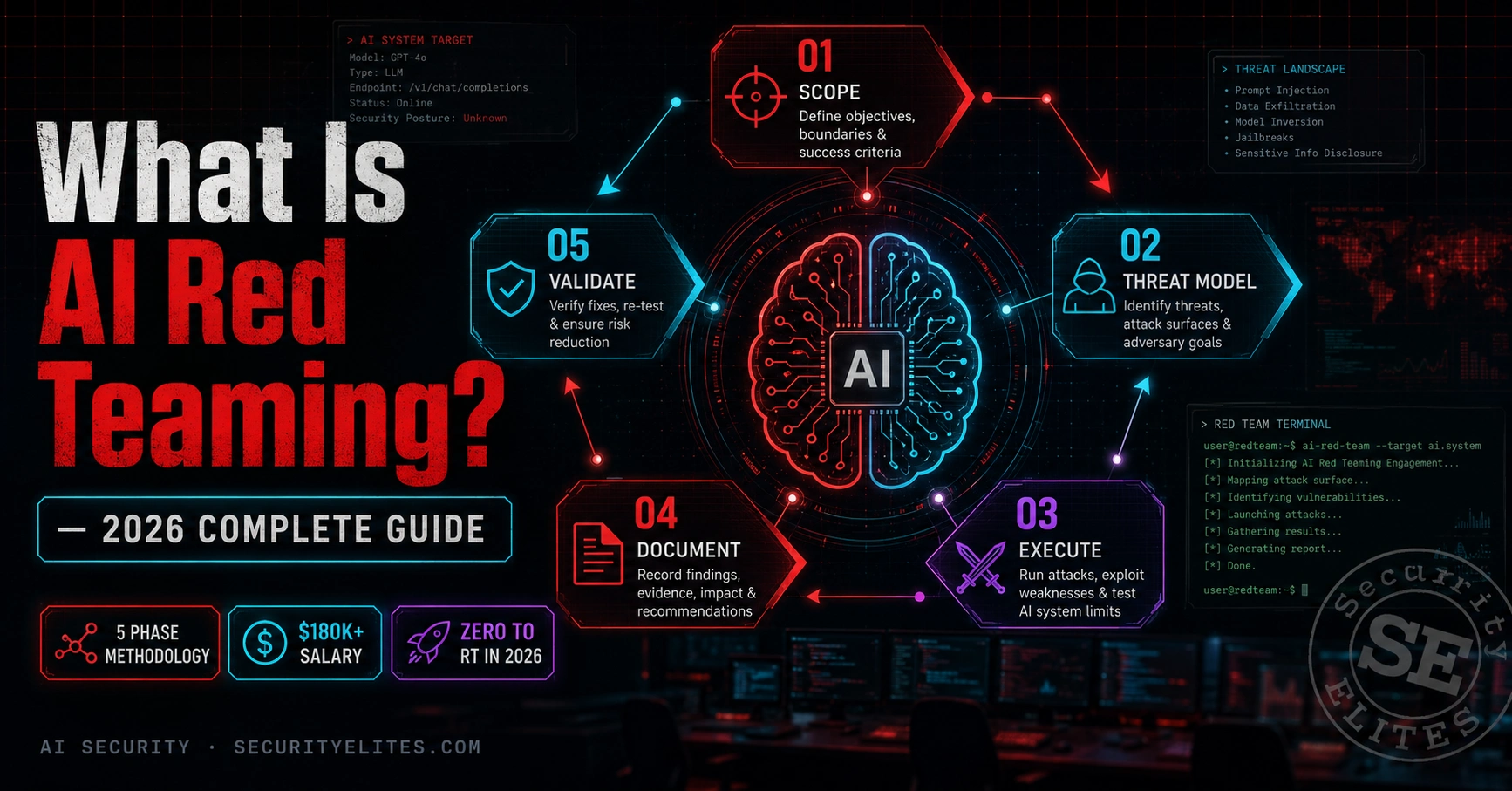
What is AI red teaming in practical terms, as it’s actually done in 2026? I’m going to tell you exactly what it is, how it differs from everything else in security, and what the five phases of a real engagement look like from inside the work.
🎯 What You’ll Learn Here
⏱ 24 min read · 2 exercises included
What Is AI Red Teaming — Full Guide
This article is the conceptual foundation for everything else in the AI Elite Series. If you’ve read how to hack AI models and understand the attack surface, this fills in the professional methodology that sits around those techniques. And if you want to see the tools that practitioners use to run these engagements, the AI hacking tools guide covers every tool in the stack.
The Definition That Actually Holds Up
AI red teaming is the structured, adversarial assessment of AI systems by authorised security researchers with the goal of identifying failure modes, vulnerabilities, and misuse risks before they’re exploited in production.
Every word in that definition matters. Structured — not random testing, but a systematic methodology with documented scope, phases, and deliverables. Adversarial — the tester actively attempts to make the system fail, using the full range of techniques an attacker would use. Authorised — always with explicit written permission. Failure modes — not just security vulnerabilities in the traditional sense, but any way the system can behave in a way its designers didn’t intend, including generating harmful content, leaking private data, being manipulated into taking unintended actions, or being used to harm end users.
The last phrase — “before they’re exploited in production” — is the entire reason this work has value. An AI red team finds problems in a controlled environment so the client can fix them before attackers find them in a live deployment with real users and real data.
Why AI Red Teaming Is Different From Everything Else
Traditional penetration testing works against deterministic systems. You send a specific input, you get a specific output. A buffer overflow either works or it doesn’t. SQL injection either extracts data or it doesn’t. The same exploit, run twice against the same target, produces the same result.
AI systems are non-deterministic. The same prompt sent twice to the same model can produce meaningfully different responses. Safety filters are probabilistic — a jailbreak that works 7 out of 10 times is real. A vulnerability that appears in one conversation context might not reproduce in another. I’ve spent hours trying to reproduce a finding that I clearly saw happen once, only to eventually realise I needed to rebuild the exact conversation context to trigger it reliably.
This non-determinism changes everything about how testing works:
- You need statistical confirmation, not binary pass/fail. I run every test multiple times and report success rates, not just “worked/didn’t work.”
- Context matters enormously. What I ate for breakfast doesn’t affect whether SQL injection works. What’s in the conversation history absolutely affects whether a prompt injection works.
- The “vulnerability” is often emergent, not embedded. Prompt injection vulnerabilities emerge from the interaction between the model’s training, the application’s system prompt, and the user’s input — you can’t point to a line of code that “has the bug.”
- Scope requires new categories. Traditional scope includes IP ranges, web applications, and API endpoints. AI scope must also include: the model itself, its training data, its retrieval sources, its tool integrations, and its output handling.
The other major difference is the threat model. Traditional pentesting asks “can an attacker take control of this system?” AI red teaming asks a broader question: “can an attacker make this system behave in a way that harms the people using it or the people it’s making decisions about?” That framing opens up entirely new categories of risk that don’t exist in traditional pentesting.
📸 AI red teaming vs traditional penetration testing — the fundamental methodology differences. Understanding these distinctions is what separates an AI red teamer from a traditional pentester who starts testing AI applications without adapting their approach.
How This Field Came to Exist
The term “red team” in security came from military wargaming — the practice of having a team play the adversary to stress-test operational plans. In corporate security, it evolved to mean adversarial testing of systems and processes by teams explicitly trying to defeat them.
AI red teaming as a distinct discipline emerged from two directions colliding. First, AI labs — Anthropic, OpenAI, and DeepMind — began establishing internal red teams to test their models for harmful capability thresholds before public deployment. Second, traditional security researchers started testing AI applications the same way they tested any other application, and found a completely new class of vulnerability: prompt injection, jailbreaking, model extraction.
The MITRE ATLAS framework — published in 2021 — was the first serious attempt to codify adversarial AI attacks in the way that MITRE ATT&CK codified traditional cyberattacks. It gave the field a taxonomy. OWASP followed with the LLM Top 10. What had been informal research became a structured discipline with documented attack patterns, assessment frameworks, and professional practice standards.
By 2024, the executive order on AI safety in the United States made red teaming requirements for certain AI systems near-mandatory for government use, and the EU AI Act included red teaming requirements for high-risk AI systems. AI red teaming went from a specialised research practice to a compliance requirement in under three years.
The 5 Phases of a Real AI Red Team Engagement
Every AI red team engagement I run follows the same five phases. The specific techniques change based on the target, but the structure doesn’t. Here’s how it works in practice.
Phase 1 — Scoping and Asset Identification
Before any testing starts, I need to know exactly what I’m testing and what success looks like. The scope document for an AI red team engagement should specify: which AI systems are in scope, what data the systems have access to, what actions the systems can take, what user populations are affected, and what the most critical failure modes look like for this specific deployment.
Scope failures on AI engagements are different from traditional pentesting scope failures. I’ve seen clients include “our AI chatbot” in scope without realising the chatbot has access to their entire document management system through a RAG integration. Understanding the full blast radius before testing starts prevents both under-testing and over-testing.
Phase 2 — Threat Modeling
The threat model answers: who would attack this system, what would they want to achieve, and what attack techniques would they use? For a customer-facing AI assistant at a bank, the threat actor profile looks completely different than for an internal AI coding assistant.
I use MITRE ATLAS as the primary taxonomy for AI threats and cross-reference against the OWASP LLM Top 10 to ensure I’m covering all relevant vulnerability categories. The threat model becomes the testing plan — each threat scenario maps to specific tests I’ll run in Phase 3.
Phase 3 — Attack Execution
This is the technical testing phase. I run automated scanners (Garak, PyRIT) first for broad coverage, then manual testing for targeted exploitation of specific threat scenarios. The non-deterministic nature of AI means I run every test multiple times — typically 10+ repetitions for any finding I want to confirm — and document success rates, not just binary results.
The test categories I always cover in Phase 3: prompt injection (direct and indirect), system prompt extraction, jailbreaking, model extraction attempts, data leakage via crafted queries, agentic exploitation (if the system has tool use), and API/infrastructure review. Additional categories are added based on the specific deployment architecture.
Phase 4 — Documentation and Reporting
Every confirmed finding gets a structured write-up including: attack technique used, success rate, prerequisites, data accessed or action achieved, MITRE ATLAS mapping, severity rating, reproduction steps, and recommended remediation. The report format I use mirrors enterprise penetration testing reports — it has to be readable by both technical teams and executives.
Phase 5 — Remediation Validation
After the client implements fixes, I re-test every confirmed finding to verify the remediation worked. This is the phase most commercial AI security engagements skip — but it’s the one that actually confirms the client’s security posture improved as a result of the engagement. Without re-testing, you’re trusting that the fix worked. In AI systems, where fixing one vulnerability sometimes introduces others, always re-test.
📸 A real AI red team finding report format. This is what gets delivered to the client after Phase 3 testing. Every field matters — the ATLAS mapping connects the finding to industry framework categories, the success rate quantifies risk, and the reproduce steps let the development team replicate the issue in their own environment.
Who Does AI Red Teaming in 2026
The AI red teaming ecosystem in 2026 has three distinct segments, and knowing where each one sits matters for career planning.
Internal AI safety teams at major AI labs: Anthropic, OpenAI, Google DeepMind, and Meta all have internal red teams that test their models before deployment. These roles focus heavily on capability evaluation — testing whether models can help design weapons, generate CSAM, or assist in large-scale harm. The work is classified at a higher level than commercial red teaming and requires deep alignment with AI safety research goals. Salaries range from $200K to $450K+ at these organisations.
Enterprise AI security consultancies: Security consultancies — from Big 4 firms to boutique AI security specialists — provide AI red team services to enterprises deploying LLMs. This is the commercial engagement model I described in the five phases above. Billable rates run $300–$600 per hour for senior practitioners. Full engagement costs range from $30K to $300K+ depending on scope.
Independent researchers and bug bounty hunters: Individual researchers testing publicly available AI systems through official bug bounty programmes. This segment has the lowest barrier to entry — you don’t need a firm behind you to find and report AI vulnerabilities. Several researchers are earning $100K+ annually from AI bug bounty work alone in 2026.
How to Get Into AI Red Teaming Without Prior Experience
The fastest credentialed path into AI red teaming in 2026 is through documented research and public bug bounty work — not certifications and not job applications before you have evidence of skill. Here’s the sequence I’d follow:
Step 1: Build a working AI security lab (Ollama + Garak + Burp Suite — the setup from the tools guide). Document your setup process. Write it up publicly on GitHub or a personal blog.
Step 2: Work through every level of Gandalf and HackAPrompt. Document your methodologies — not just “I tried X and it worked” but “I tried X because of Y reasoning, it worked because Z mechanism.” This shows thinking, not just execution.
Step 3: Pick one AI bug bounty programme and spend a week doing structured reconnaissance and testing. Even if you find nothing reportable, write up your methodology as a research report. The process is the portfolio piece.
Step 4: Use the Google Dork Generator to surface AI deployment documentation, exposed configuration files, and public AI API endpoints that might indicate how production AI systems are configured — this is how I do OSINT on AI infrastructure before any active testing begins.
Part of every AI red team engagement starts with OSINT on the target’s AI infrastructure. I use the SecurityElites Google Dork Generator to surface exposed AI API configurations, leaked LLM prompts in public repositories, and visible AI deployment documentation that clients didn’t realise was publicly indexed. OSINT findings often produce the most impactful report items because they reveal what attackers can find without ever touching the target.
Step 5: Apply for junior roles at AI security consultancies with your documented research portfolio. You don’t need to have found a $50K bounty. You need to show that you understand the methodology, think adversarially, and document your work professionally. That combination is rare enough in 2026 that it gets noticed.
I want you to read a real AI security case study from MITRE ATLAS and map it to the five-phase engagement structure. This is how I brief myself before every new engagement type — I read documented real-world cases to understand how similar attacks played out and what they produced as findings.
- Go to atlas.mitre.org/studies — this is MITRE’s library of real-world AI attack case studies
- Choose any case study from the list (the “Backdoor Attack on ML Models” or “Evasion of Deep Learning Detector for Malware” are good starting points)
- As you read, map the case study to the 5 phases: Where was the scope? What was the threat model? What attacks were executed? How was it documented? Was remediation validated?
- Identify which MITRE ATLAS technique IDs are referenced in the case study
- Write 3 sentences explaining what the finding was, why it mattered, and how the 5-phase framework would have caught it in a red team engagement before it was exploited
📸 Post your 3-sentence case study summary and the ATLAS technique IDs in X #ai-red-team — I’ll respond to every summary with what I’d have added to the engagement scope if I’d been running it.
You’re going to build a mini AI red team report for a public practice target. This combines every technique covered above — scope, threat model, findings, and documentation. Professional AI red teaming is only as good as its documentation, and most beginners skip this step entirely.
- Go to gandalf.lakera.ai — your test target for this exercise
- Write a 3-line scope statement: what system are you testing, what data does it hold, what’s the potential impact of a breach?
- Write a threat model: who would attack this, what would they want (the password), what technique would they use?
- Test 5 different prompt injection techniques. For each one, record: technique name, payload used, model response, success/fail
- Write up your top finding as a formatted report entry including: Finding title · Severity · Attack technique · Success rate · Reproduction steps · Recommended fix
- Total document should be readable by someone who didn’t do the testing — write as if you’re handing it to a client
📸 Post your mini report in X #ai-red-team — I’ll give personalised feedback on the first 10 reports submitted. This is the closest thing to free mentorship I can offer.
Key Concepts From This Article
Key Takeaways
- AI red teaming is structured adversarial testing of AI systems by authorised researchers — not random jailbreaking, and not the same as AI safety capability evaluation at the lab level.
- The key methodological difference from traditional pentesting is non-determinism: AI vulnerabilities require statistical confirmation, context-sensitive reproduction, and a broader threat model that includes non-traditional harm categories.
- Five phases define every real engagement: scoping, threat modeling, attack execution, documentation, and remediation validation. Skipping any phase produces a worse outcome.
- The ecosystem in 2026 has three segments: internal lab safety teams, enterprise security consultancies, and independent bug bounty researchers. Each has different entry requirements and compensation structures.
- The fastest entry path is documented research — build a portfolio of methodologies, findings, and mini-reports before applying for jobs or pitching engagements.
- MITRE ATLAS is the fundamental framework — use it to classify every finding and to do pre-engagement research. Every AI red teamer should know it the way traditional pentesters know MITRE ATT&CK.
Frequently Asked Questions
How long does a typical AI red team engagement take?
In my experience, a focused AI red team assessment of a single AI application takes 3–7 business days of active testing, plus 1–2 days for reporting. Full enterprise AI security programmes — covering multiple AI systems, agentic workflows, and infrastructure — can run 3–6 weeks. The biggest variable is scope complexity: a simple chatbot with no tool integrations is a different engagement than a multi-agent system with database access and external API connections.
Is AI red teaming the same as AI safety research?
Related but different. AI safety research — as conducted at AI labs — focuses primarily on whether AI systems will remain aligned with human values as they become more capable, testing for catastrophic capability thresholds. AI red teaming in the commercial security sense is about finding exploitable vulnerabilities in deployed AI systems that could be abused by attackers right now. Both are important; they require different skill sets and serve different purposes.
What qualifications do I need to work as an AI red teamer?
There’s no mandatory qualification — the field is too new for that. What consistently gets people hired is a combination of demonstrated technical skill (evidenced through public research, bug bounty findings, or documented practice work), familiarity with AI security frameworks like MITRE ATLAS and OWASP LLM Top 10, and traditional security fundamentals. Traditional security certifications (OSCP, CEH) are valued because they signal methodology discipline, not because they teach AI-specific content.
Can I do AI red teaming without a traditional security background?
Yes — I’ve seen researchers from software development, data science, and even non-technical backgrounds enter the field successfully. What they brought was either deep knowledge of how AI systems are built (developers) or analytical thinking about how systems fail (data scientists). The specific security technique set is learnable quickly. What takes longer to develop is the adversarial mindset — but that comes from practice, not background.
How do I price an AI red team engagement?
Senior practitioners charge $300–$600 per hour for AI red team work. For fixed-price engagements, I scope based on testing days and multiply by my day rate. A simple single-application assessment might be £15K–£25K fixed price. A complex multi-system enterprise programme is typically £80K–£200K+. For beginners, the best approach is to undercut market rates initially to build a track record — documented successful engagements are worth more in the medium term than maximising your day rate before you have proof of results.
What’s the difference between an AI red team and an AI security audit?
An AI security audit is typically a compliance-driven review — checking configurations against frameworks, reviewing documentation, assessing processes. An AI red team is adversarial — active exploitation attempts against the live system. Audits produce a checklist of findings. Red teams produce confirmed vulnerabilities with proof of concept. Many engagements combine both: the audit establishes the baseline and the red team stress-tests it. For organisations new to AI security, I recommend starting with an audit to understand the current state, then following with a red team to test how well the controls actually hold up.
Continue Learning
- How to Hack AI Models — The attack techniques that fuel every AI red team engagement
- 15 AI Hacking Tools — The complete toolkit for running AI red team assessments
- AI Red Teaming Certification — Register for upcoming certification on AI Security and AI Red Team Engagement
- AI red teaming guide 2026 — how security teams stress-test LLM applications for prompt injection, data leakage, misuse, and unsafe outputs. Methodology, tools, and real findings.
- MITRE ATLAS — The definitive adversarial AI threat framework
- OWASP LLM Top 10 — Vulnerability classification for all AI red team findings