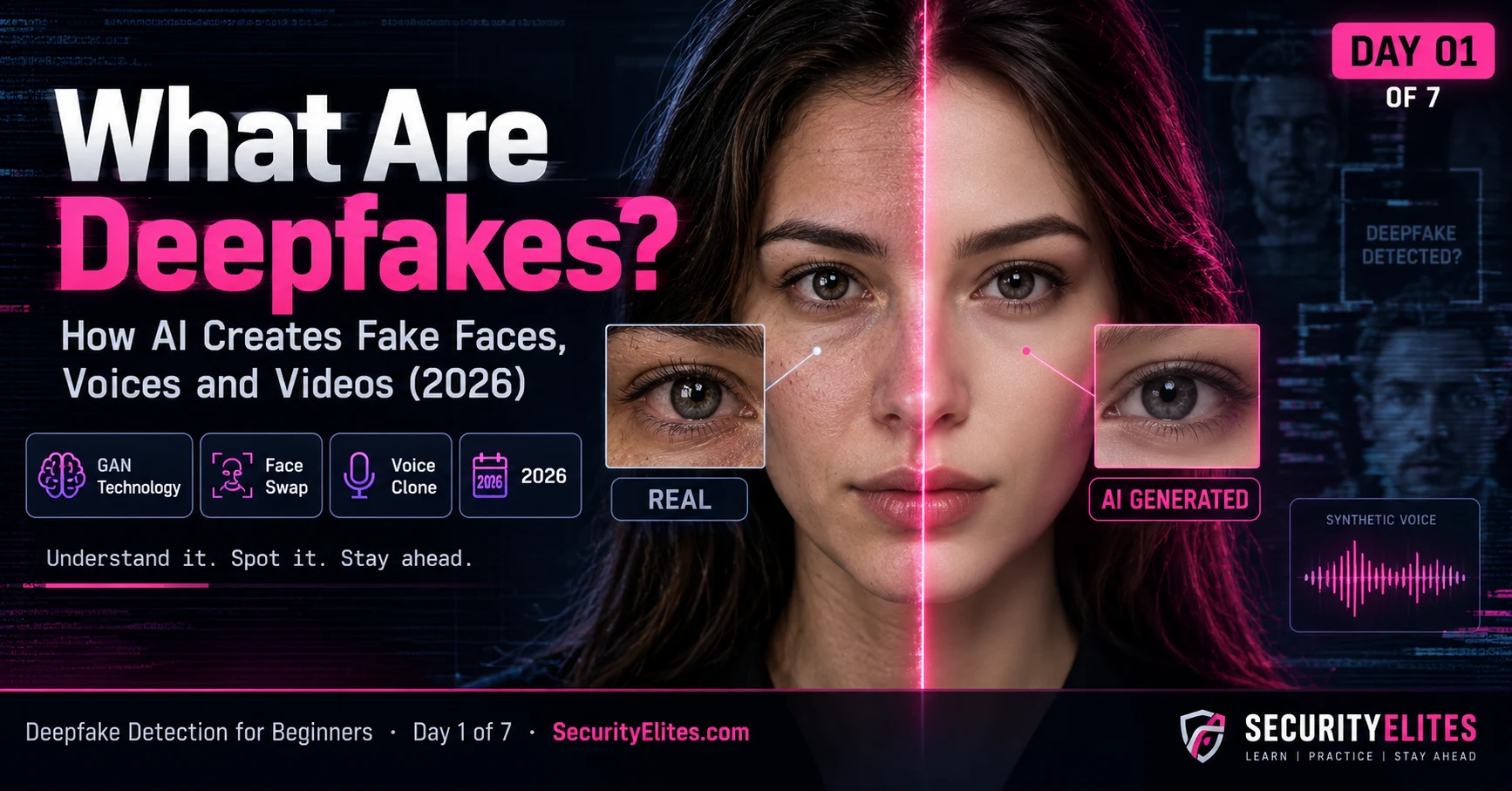
This article is the first day of a seven-day beginner's course on deepfake detection that explains what deepfakes are, how AI creates them, and why they represent an escalating security threat in 2026. It grounds the topic in a real $25 million fraud case from February 2024 where a finance employee in Hong Kong was deceived by AI-generated video of a CFO and voice clone asking him to approve a wire transfer. The article argues that understanding how deepfakes are technically created is the foundation for spotting them reliably, rather than memorizing detection checklists.
- Deepfakes require AI generation, not manual editingThe article defines deepfakes specifically as synthetic media generated by algorithms that has altered, replaced, or entirely generated a person's appearance, voice, or words—distinct from manual pixel editing like Photoshop. This distinction matters because detection techniques are completely different: Photoshop leaves one set of artifacts while AI generation leaves another set entirely. Deepfakes fall into three subcategories: altered (real media changed), reenacted (expressions transferred to preserved faces), and entirely synthetic (people or recordings that never existed).
- GANs and diffusion models work through fundamentally different mechanismsThe article explains GANs (Generative Adversarial Networks) as a two-network counterfeiter-versus-detective system where a Generator creates fake faces and a Discriminator scores them for realism, iterating millions of times until the Discriminator cannot distinguish fakes from real photos. Diffusion models work oppositely: they learn to denoise images by starting from random visual noise and progressively refining it toward a coherent image matching target characteristics. Diffusion models now dominate AI-generated faces in 2026 because they produce higher-quality output with more control tha
- Four deepfake types target different attack surfacesThe article identifies face swap (replacing one person's face with another in video, used for non-consensual intimate imagery and fraudulent documents), face reenactment (transferring expressions and lip movements while preserving the target's face, dangerous for political misuse), full synthesis (entirely AI-generated people used for fake social profiles and romance scams), and voice clone (replicating voice from as little as three seconds of audio, most dangerous for financial fraud). Each type requires different detection approaches and has different real-world prevalence—full synthesis fac
- The Hong Kong fraud followed a repeatable five-phase attack sequenceThe article details how attackers identified a finance employee with wire authority, collected public OSINT on the CFO and other executives through interviews and webinars, trained face-swap and voice-clone models in approximately 48 hours, and delivered the attack through a video call with multiple deepfaked participants. The critical insight is that a single 60-second out-of-band callback verification—where the target would have hung up and called the real CFO on a saved phone number—would have stopped the entire $25 million attack, but this protocol was never used. This demonstrates that de
- The creation pipeline has five weak points where detection signals originateThe article maps the pipeline through training data collection (quality and quantity matter—ten single-angle photos produce weaker output than a hundred multi-angle photos), model selection (different architectures have characteristic failure modes), generation (rendering produces physics-based signal failures like incorrect eye reflections), quality review (even the best attempts leave temporal and boundary artifacts), and delivery (metadata and compression reveal creation tools). Every weak point in this pipeline becomes a detection signal: voice clones from three seconds have audible artifa
- Detection has shifted from obvious to subtle artifacts over 2020-2026The article explains that 2020-era deepfakes had obvious tells like wrong blinking, smeared hairlines, mismatched skin tones, and geometric failures beyond frontal angles—detectable in under a second by trained analysts. By 2023, obvious frame-level artifacts were mostly closed and required formal checklists to catch reliably. By 2026, the highest-quality deepfakes pass casual visual inspection by security professionals because diffusion models replaced GANs, tools became consumer software runnable on gaming laptops, and social media provided abundance of training data. However, detection rema
- No single tool catches everything; layered defense is essentialThe article states clearly that the best free detection tools catch roughly 60 to 85 percent of deepfakes depending on quality, and the highest-quality deepfakes currently evade all automated detection. The course teaches a four-layer approach: visual inspection using 8-point checklists (Days 2-4), tool analysis using free tools (Day 6), provenance verification using C2PA standards when available, and behavioral verification using out-of-band protocols (Day 7). The article notes that tools require you to already be suspicious before using them—the Hong Kong fraud succeeded not because detectio
- Training data scarcity drives all detection effectivenessThe article emphasizes that because AI models learn from training data, anywhere training data is thin—ears in profile, unusual head angles, complex physics like eye reflections—the output is weaker. This principle explains why detection works: every detection signal taught in the course traces back to a place where the AI pipeline is mathematically thin. The article notes that public social media users have unknowingly provided excellent training datasets through hundreds of photos and videos, making them more vulnerable to deepfakes than less-public individuals, but also enabling the detecti
Bottom line: Deepfakes are now sophisticated enough to fool security professionals at first glance, but they remain detectable through understanding how the underlying AI systems work and applying a layered defense combining visual inspection checklists, automated tools, metadata analysis, and critically, out-of-band behavioral verification protocols—the single most effective defense demonstrated by the Hong Kong fraud case is simply calling the supposed caller back on a known phone number before complying w
Let me start with a situation that sounds like something from a movie, because I want you to understand just how real this problem has become.
In February 2024, a finance employee in Hong Kong joined a video call with what appeared to be his CFO. He knew the face. He recognised the voice. Even the mannerisms looked right. Then the “CFO” asked him to approve an urgent $25 million wire transfer.
He approved it.
There was only one problem: the CFO wasn’t actually on the call.
The face had been generated by AI in real time. The voice had been cloned from publicly available interviews. Even other people appearing on the call were reportedly fake. The employee discovered what had happened only after contacting the real CFO afterward.
Now pause for a second and think about that.
What are deepfakes? If you’re new to this subject, that’s exactly the question I want to answer with you in this series. A deepfake isn’t simply a funny face swap or an obvious fake video. Modern AI can manipulate faces, clone voices, generate people who don’t exist, and create convincing videos of real people saying things they never said.
And here’s the part that matters most: you don’t need a Hollywood studio to create one anymore.
Tools that were once expensive and difficult to use have become remarkably accessible. A short voice sample can be enough to create a convincing voice clone. Face-swapping tools can produce results in minutes. Generative AI can create entirely synthetic people and increasingly realistic video.
So when I teach deepfake detection, I don’t want you to memorise a list of “AI tells” and hope for the best. I want you to understand why a deepfake looks or sounds the way it does. Once you understand how the technology creates the fake, the weaknesses become much easier to recognise.
That’s exactly what we’re going to do over the next seven days.
Today, I’m starting from zero. I’ll show you what a deepfake actually is, the four major types you’re likely to encounter, how the underlying AI works in plain English, and why deepfakes have become such a serious security problem in 2026.
By the end of this lesson, you won’t be an expert deepfake detector yet. But you’ll have something much more useful: a mental model for understanding what you’re looking at.
🎯 What You’ll Master in Day 1
⏱ 22 min read · 3 exercises · Just a browser needed
- No technical background required — this is the absolute-beginner entry point
- You’ve heard about deepfakes in the news or seen AI-generated images somewhere
- Optional but useful: AI Basics Day 1 — the AI foundations that power everything covered here
What Are Deepfakes? — Day 1 of 7
- What a Deepfake Actually Is — The Real Definition
- How AI Creates Fake Faces — GAN and Diffusion Explained Simply
- The Four Deepfake Types You’ll Encounter
- The $25 Million Fraud — What a Real Attack Looks Like
- The Creation Pipeline — From Target to Fake
- Why Detection Is Getting Harder in 2026
- The Arms Race — Where Detection Stands Today
- Questions and Answers
Deepfake defence starts before any tool. It starts with understanding what you’re defending against, and the honest answer is that most people I meet — including security professionals — carry an outdated mental model of what current AI can produce. Today closes that gap. Before we cover any detection techniques on Days 2 through 4, I want you to know exactly how the fakes are made and what makes them dangerous. If you haven’t yet checked your own attack surface, run your email through the Email Breach Checker — the data attackers use to train deepfakes of you starts with the identity data already exposed in breaches. This course lives inside the AI Deepfake Hub alongside my How to Spot AI Deepfakes 2026 reference guide, and everything ties back to the LLM Hacking Hub as the master AI security cluster.
What a Deepfake Actually Is — The Real Definition
I get the same first question in every deepfake awareness training I run: “is a Photoshop edit a deepfake?” The answer is no, and understanding why draws the line that matters for the rest of this course.
A deepfake is synthetic media in which AI has altered, replaced, or entirely generated a person’s appearance, voice, or words. The key word is synthetic: it looks real, sounds real, feels real, but was generated or manipulated by an algorithm — not by a camera capturing actual reality or by a microphone recording an actual person speaking.
Three sub-categories sit under that umbrella. First: altered — something real was changed. A video of a politician has been subtly edited so the words come out differently, or a photo has had a face swapped in. Second: reenacted — someone’s expressions or lip movements have been transferred onto their face while the face itself is preserved. This is the “put words in their mouth” category. Third: entirely synthetic — the person never existed, or the recording never happened. This is the most dangerous category in the real world, because it means the video or audio of a real named person saying or doing something they never said or did.
Here’s where the Photoshop question gets its answer. Photoshop is manual pixel editing — a human moves and modifies specific pixels one by one, or with brushes and filters, to change what an image shows. A deepfake is generated. The AI model has learned the target’s appearance from thousands or millions of images and produces new images that are statistically consistent with that appearance. This distinction matters enormously because the detection techniques are completely different. When I check a suspicious image for Photoshop editing I look for one set of artifacts. When I check it for AI generation I look for another set entirely. Day 2 covers both — and I always run both checks when I’m not sure which type of manipulation happened.
How AI Creates Fake Faces — GAN and Diffusion Explained Simply
I always explain GANs the same way when I’m training analysts new to the space — as a counterfeiter working against a detective, both getting better at their job at the same time.
The GAN — Generative Adversarial Network — is a two-network system. The Generator’s job is to create fake faces. The Discriminator’s job is to detect whether faces are fake. They train against each other. The Generator produces a face. The Discriminator scores it: “That was 73% convincing.” The feedback flows back to the Generator: “Improve these specific features.” Millions of iterations later, the Generator produces faces so realistic that the Discriminator — a network specifically trained to detect fakes — can no longer reliably distinguish them from real photographs. That is the whole story of how sites like thispersondoesnotexist.com produce convincing faces of people who don’t exist.
Diffusion models take a completely different approach. They learn to denoise images — starting from random visual noise and progressively refining it toward a coherent image that matches target characteristics. Give a diffusion model the description “portrait of a young woman with brown hair, professional lighting” and it starts from noise and denoises step by step until a face appears. Diffusion models produce higher-quality output with more control than GANs, which is why they dominate AI image generation in 2026 — Stable Diffusion, Midjourney, DALL-E 3 are all diffusion architectures. Most of the AI-generated faces you’ll encounter in the wild in 2026 came from diffusion models, not GANs.
Face-swap deepfakes work differently again. The system extracts the source face’s landmarks — the exact positions of eyes, nose, mouth, chin, jaw. It then warps a target face to match those landmarks, and blends the warped face into the source video frame by frame. Modern tools like DeepFaceLab and its commercial successors do this in real time, at video frame rates, which is exactly what enabled the Hong Kong fraud we’re about to unpack.
Both architectures share one weakness that becomes the foundation of everything we do on Days 2 through 4: they learn from training data, so anywhere the training data is thin — ears in profile, unusual head angles, complex physics like eye reflections — the output is weaker. Every detection signal I teach you traces back to a place where the pipeline is thin.
The Four Deepfake Types You’ll Encounter
In every investigation I’ve been part of, the deepfake in question falls into one of exactly four categories. Knowing which type you’re looking at tells you where to look for the tells.
Face Swap. AI replaces one person’s face with another’s, typically in video. The target’s face is extracted, another person’s face is warped to match the target’s landmarks and lighting, and the result is composited back into the video frame by frame. Primary real-world use: non-consensual intimate imagery (NCII) — celebrity or civilian faces attached to intimate content the target never appeared in. Second most common use: fraudulent identity content — a real person’s face used in fake documents, fake job applications, or fake video call attendance.
Face Reenactment. The face stays the target’s, but the expressions and lip movements are transferred from someone else. Also called “puppet-mastering.” The most dangerous political use case sits here: making a real politician’s face appear to say words they never said, with their real face and lighting preserved. The reenactment attack is harder to spot than face swap because the face itself is authentic — only the motion is synthetic.
Full Synthesis. The person never existed. Every face on thispersondoesnotexist.com is full synthesis — an AI-generated portrait of nobody real. This category powers fake LinkedIn profiles used to build attacker networks, fake dating profiles used in romance scams, and fake social media personas used to spread disinformation. In 2026, the majority of newly-created fake social profiles use full synthesis faces because the technology is fast, free, and produces unique faces that can’t be reverse-image-searched to a real person.
Voice Clone. AI replicates a person’s voice from audio samples. Modern systems produce convincing clones from as little as three seconds of audio. Voice clone is the most dangerous category for personal financial fraud in 2026 because it happens in real time during phone calls, requires no video, and exploits the deep evolutionary trust humans place in familiar voices. The Hong Kong fraud combined video face-swap with voice clone. The voice component was arguably more convincing than the video.
Four types, four different attack surfaces, four different detection approaches — which is why this course spends a separate day on each modality. Day 2 handles faces. Day 3 handles video. Day 4 handles voice. Day 5 puts all three into the attack chains criminals actually use.
The $25 Million Fraud — What a Real Attack Looks Like
When the Hong Kong fraud hit the news in February 2024, I sat down with the details for two hours and mapped the attack chain step by step. What I found was not a technical breakthrough — it was a repeatable process using tools already available to anyone.
Here’s the sequence as it unfolded. Attackers identified the target: a finance employee at a multinational firm in Hong Kong, someone with authority to approve significant wire transfers. Standard reconnaissance told them who the CFO was and who reported to him. Then came the OSINT phase — the attackers collected publicly available video and audio of the CFO from company presentations, media interviews, and internal webinars that had leaked online. Enough training data for both face and voice.
Model preparation took a day or two. A face-swap model was tuned on the CFO’s face at multiple angles. A voice clone was generated. Critically, the attackers didn’t just prepare one deepfake — they prepared several, of multiple people the target would recognise from the same organisation. This is what made the attack devastating.
The delivery: the target received a video call invitation, ostensibly from the CFO, with several other executives attending. He recognised the CFO’s face and voice immediately. He also recognised the other people on the call — because they were also deepfaked. Every single participant in that meeting except him was AI-generated in real time. The CFO explained an urgent, confidential acquisition situation requiring immediate wire transfer approval. The other attendees confirmed the plan in the way real colleagues would. Contextual plausibility overwhelmed the target’s initial scepticism. He approved the $25 million transfer.
The detection opportunity was there the entire time. Before approving the transfer, the target could have hung up and called the CFO directly on a phone number he already had saved. Sixty seconds of out-of-band verification would have stopped the entire attack, because the real CFO would have answered and said “I never asked for that.” Sixty seconds. That verification protocol — which we cover in depth on Days 4 and 7 — is the single most important defence in this entire course. And it works regardless of how convincing the deepfake is.
The Creation Pipeline — From Target to Fake
I teach the creation pipeline in every deepfake awareness class because understanding it reveals exactly where detection is strongest. You cannot spot what you do not understand.
The pipeline runs through five stages. Training data collection — the attacker gathers images, video, or audio of the target from public sources. Quality and quantity both matter enormously here. Ten photos from one angle produces a much lower-quality deepfake than a hundred photos from multiple angles and lighting conditions. Three seconds of audio produces a viable voice clone; three hours produces a near-perfect one. Model selection — the attacker picks the right architecture for the goal. Full synthesis of a new face? A diffusion model. Swapping an existing face into video? A face-swap model like DeepFaceLab. Real-time video call impersonation? A dedicated real-time face conversion tool. Generation — the model runs. This can take seconds (for a still image) to hours (for a video sequence at high quality). Quality review — the attacker checks the output for obvious artifacts and iterates. A skilled attacker will regenerate multiple times, picking the best output, and may specifically test against known detection tools. Delivery — the deepfake reaches the target through the chosen channel: video call, WhatsApp voice message, social media post, direct email attachment.
Every stage of that pipeline has weak points, and every weak point becomes a detection signal. Voice clone from three seconds of audio has audible artifacts that voice clone from three hours doesn’t. Face swap trained on twenty single-angle photos fails at unusual head poses. Real-time video generation has temporal lag that pre-rendered video doesn’t have. These are not accidents — they’re the mathematical consequences of a pipeline running with limited resources. When you look for the tells on Days 2 through 4, you’re really looking for the fingerprints the pipeline leaves behind.
Time cost matters for defenders too. A basic voice clone attack can be assembled in a few hours by someone with no technical background. A high-quality face-swap video call attack like the Hong Kong fraud takes days to weeks. The barrier to entry keeps dropping. Tools that were research prototypes in 2022 are consumer apps in 2026. The gap between what’s technically possible and what’s practically available to attackers has closed dramatically.
The fastest way to build detection intuition is to generate AI faces yourself and examine them with fresh eyes. thispersondoesnotexist.com generates a completely new AI-generated face every time you refresh. None of these people exist. All of them look real at a glance. I want you to spend twenty minutes with these faces — not to prove they look fake, but to find the specific things that don’t sit right, before Day 2 gives you the formal checklist.
- Open thispersondoesnotexist.com in a browser. No login, no account, nothing to install.
- Refresh 10 times. For each face, spend 30 seconds examining it. Where does your eye go first? What looks slightly off? Screenshot the 3 faces that made you most uneasy and 2 that looked most convincing.
- Compare your 5 saved faces. What do the 3 “unnerving” ones have in common? What makes the 2 “convincing” ones look more real?
- Zoom in specifically on: the eyes (light reflections, whites, eyelashes), the hairline (how does hair meet the background?), the ears (often only one is visible — why?), and the teeth if they’re visible (do they look natural?).
- Write down 3 observations — the things that appeared in multiple faces and didn’t look quite right. These are your first detection signals. Day 2 explains exactly why each one appears and how to look systematically.
Why Detection Is Getting Harder in 2026
I always show my students the same before-and-after: a 2020 deepfake next to a 2026 one. The difference is not just quality — it is the specific artifacts that used to give it away and no longer do.
A 2020-era deepfake was obvious. Blinking was wrong or absent entirely — early face-swap systems didn’t model eye closure well. Hairlines smeared visibly into backgrounds. Skin tones didn’t match between the face and the neck. Head poses beyond straight-frontal produced dramatic geometric failures. You could spot a 2020 deepfake in under a second if you knew what to look for. A trained analyst didn’t even need a checklist.
A 2023-era deepfake required trained inspection. Most of the obvious artifacts had been closed by model improvements. Blinking looked normal. Hairlines were much cleaner. Skin tones matched. You needed the 8-point checklist you’ll learn on Day 2 to catch them reliably.
A 2026-era deepfake, at the highest quality level, passes casual visual inspection by security professionals. This is not hyperbole and it’s not fear-mongering — it’s the honest state of the technology. Three things changed. First, diffusion models replaced early GANs for most creation, and diffusion produces dramatically higher-quality output. Second, the tools became consumer software. What required a GPU cluster and a PhD in 2020 runs on a gaming laptop in 2026 with a downloadable app. Third, social media provided abundance of training data. Every public YouTube video, podcast, and Instagram post fed the training datasets that make current voice clones and face swaps so convincing.
But detection has not stopped being possible. It has shifted. The obvious frame-level artifacts are mostly gone. What remains: temporal inconsistency across video frames (covered Day 3), physiological signals like the blood-flow colour changes in skin that AI cannot yet fake (also Day 3), metadata forensics that reveal what tool generated the file (Day 3 again), audio prosody tells that voice clones still get wrong (Day 4), and cryptographic content provenance via the C2PA standard (Day 6). The detection game in 2026 is a layered game — no single tool catches everything, but the combination catches most of what matters.
The Arms Race — Where Detection Stands Today
I want you to leave Day 1 with a realistic view of where we actually stand — neither the panicked headlines nor the reassurances from AI companies.
On the detection side: AI companies are building detection tools, sometimes because it’s the right thing to do and sometimes because regulation is starting to demand it. Adobe, Microsoft, Google, and camera manufacturers like Nikon, Sony, and Leica have adopted C2PA content credentials — a cryptographic standard that lets authentic content prove its authenticity rather than trying to detect the fake. The EU AI Act, which entered force in 2026, requires disclosure when AI has generated or significantly altered a human likeness in publicly distributed media. Journalism organisations have professional verification workflows built on tools like WeVerify and Hive Moderation.
On the creation side: creation tools improve faster than detection tools. Every new generation of image or video model is specifically trained against the previous generation’s detection signatures — an adversarial process that closes the artifact gaps. Consumer tools become more powerful every quarter. Real-time face and voice conversion, which barely worked in 2023, works well enough in 2026 to run entire fraudulent video calls.
The honest summary: current defenders can catch most current attackers most of the time, if the defenders know what to look for. That’s a real “if.” Most people don’t know what to look for. This course closes that specific gap for beginners in seven days.
The detection “win” in 2026 isn’t a single tool. It’s a layered approach: visual inspection using the checklists you’ll learn on Days 2 through 4, tool analysis using the free stack you’ll build on Day 6, provenance verification using C2PA when available, and — most importantly — behavioural verification using the out-of-band protocol you’ll write into your personal defence plan on Day 7. That full stack is what this course teaches. By the end of Day 7 you have all four layers.
GAN // Generative Adversarial Network — Generator vs Discriminator, trained against each other
Diffusion model // Generates images by denoising from random noise toward target characteristics
Face swap // Replacing one person’s face with another’s in image or video
Face reenactment // Transferring expressions/lip movements to an existing face
Full synthesis // Entirely AI-generated person who never existed
Voice clone // AI replication of voice from audio samples — viable from 3 seconds
Training data // Images/video/audio the AI learns from to generate fakes
rPPG // Remote photoplethysmography — blood-flow colour changes in skin, absent in deepfakes
C2PA // Content Provenance and Authenticity — cryptographic media origin standard
Understanding the attacker’s decision points is what makes detection skills reliable rather than reactive. I want you to design a deepfake fraud attack from scratch — not to commit one, but to see exactly where the plan is fragile. Every attacker weakness is a defender opportunity.
- Choose a target for your hypothetical attack: a small business owner who wires money to suppliers regularly. Think about who they trust and how they communicate.
- Decide the deepfake type: face swap, reenactment, full synthesis, or voice clone. Why did you pick that one? Consider the target’s typical communication channel — do they take video calls with suppliers, or is it usually phone and email?
- Plan the training data collection: what do you need, and where would you collect it publicly? LinkedIn photos? YouTube interviews? Podcast appearances? What are the gaps you’d face?
- Design the social engineering hook: what makes the target comply? Is it urgency (“must transfer before end of business today”)? Authority (“this comes direct from the CEO”)? Familiarity (“we discussed this yesterday, remember”)?
- Identify the single weakest point in your attack — the one step where a careful victim could detect that something is wrong. That weak point is your detection opportunity as a defender.
Detection skill comes from comparison at volume — training your eye across many examples until real-versus-fake becomes a pattern you recognise instantly rather than reason through. This exercise gives you that volume in a structured way, and gives you a baseline number to measure your improvement against as you progress through the course.
- On Google Images, search “portrait photo professional headshot” and save 5 results that look like real people. Try to pick photos where the subject is clearly identifiable and well-lit.
- On thispersondoesnotexist.com, generate 5 AI faces by refreshing. Save all 5 to the same folder.
- Mix all 10 images randomly and number them 1 through 10. Examine them as a set without knowing which is which — this is important, don’t peek at filenames.
- Rate each image 1 to 10 on “how real does this look?” Write down your ratings. Then reveal which is which and mark correct/incorrect.
- For every AI face you correctly identified: what specifically gave it away? For every one you got wrong: what misled you into thinking real was fake or fake was real? Write the patterns down — this is your personal detection profile.
Questions and Answers
Are deepfakes illegal?
It depends heavily on jurisdiction and intent. Creating a deepfake for personal experimentation or research is generally legal. Using one to defraud someone is fraud, full stop — the technology used doesn’t change the underlying crime. Creating non-consensual intimate deepfakes (NCII) is explicitly criminalised in an increasing number of jurisdictions, including the UK, Australia, Canada, and several US states like California, Texas, and Virginia. Political deepfakes in electoral contexts face increasing regulation — the EU AI Act 2026 requires explicit disclosure when AI-generated or altered media depicts a real person. Weaponised deepfakes carry serious legal risk under existing fraud, defamation, and impersonation laws in almost every developed legal system.
Do I need technical skills to spot deepfakes?
After this course, no. The techniques covered are observational — what to look for — and tool-based — which free browser tools to use. No coding, no AI knowledge, no special software required. The goal is a practitioner skill set any reasonably careful person can apply. If you can use a search engine and follow a 5-minute checklist, you can detect the majority of deepfakes in the wild by the time you finish Day 6. The remaining skill — the out-of-band verification protocol on Day 7 — is not technical at all. It’s a habit.
Can detection tools catch every deepfake?
No tool catches everything, and any honest detection product will tell you the same. Detection accuracy varies significantly by deepfake quality, tool training data freshness, and the specific deepfake type being detected. The best free tools catch roughly 60 to 85 percent depending on quality. The highest-quality deepfakes currently evade all automated detection. This is why Day 7 teaches a multi-layer approach: automated tools plus human judgment plus behavioural verification. No single tool is the answer — the layered stack is.
If deepfake detection tools exist, why are attacks still succeeding?
Because tools require you to already be suspicious before you use them. The Hong Kong fraud succeeded not because the employee lacked a detection tool — it succeeded because he was on a video call in a high-pressure business context where stopping to run an AI detection analysis wasn’t part of his mental model. Detection tools help you verify content you’re already suspicious of. The harder problem — which Days 5 and 7 address — is building the habits and protocols that trigger your suspicion in the first place, before urgency and social pressure override caution.
Can my own face be deepfaked from social media photos?
Yes. Any publicly visible photos or videos of you are potential training data. Quantity matters: 5 photos from one angle produces a lower-quality deepfake than 100 photos from multiple angles and lighting conditions. Active social media users have unknowingly provided excellent training datasets. This doesn’t mean you should delete everything — but it means understanding your exposure is the first step in managing it. Day 5 walks you through an OSINT audit of your own digital footprint, and Day 7 covers exactly what to protect and what to change.
How long until I can reliably spot deepfakes after this course?
For still images: measurable improvement by the end of Day 2, typically 20 to 30 percent accuracy gain. For video and audio: measurable improvement by the end of Days 3 and 4. Full multi-modal fluency with protocol backup: end of Day 7. But “reliably” has a ceiling — the highest-quality current deepfakes will still fool trained humans. What you gain in seven days is: ability to detect the vast majority of deepfakes you’ll encounter in the wild, plus the protocol layer that protects you even when a deepfake defeats your detection.
Further Reading
- How to Spot AI Deepfakes 2026 — the reference article that complements this course
- AI Scams: How Criminals Use AI 2026 — the broader AI fraud landscape
- AI Deepfake Penetration Testing 2026 — the professional testing angle
- Content Authenticity Initiative — the C2PA standard driving cryptographic content provenance
- MIT Detect Fakes Project — academic research on how humans detect deepfakes