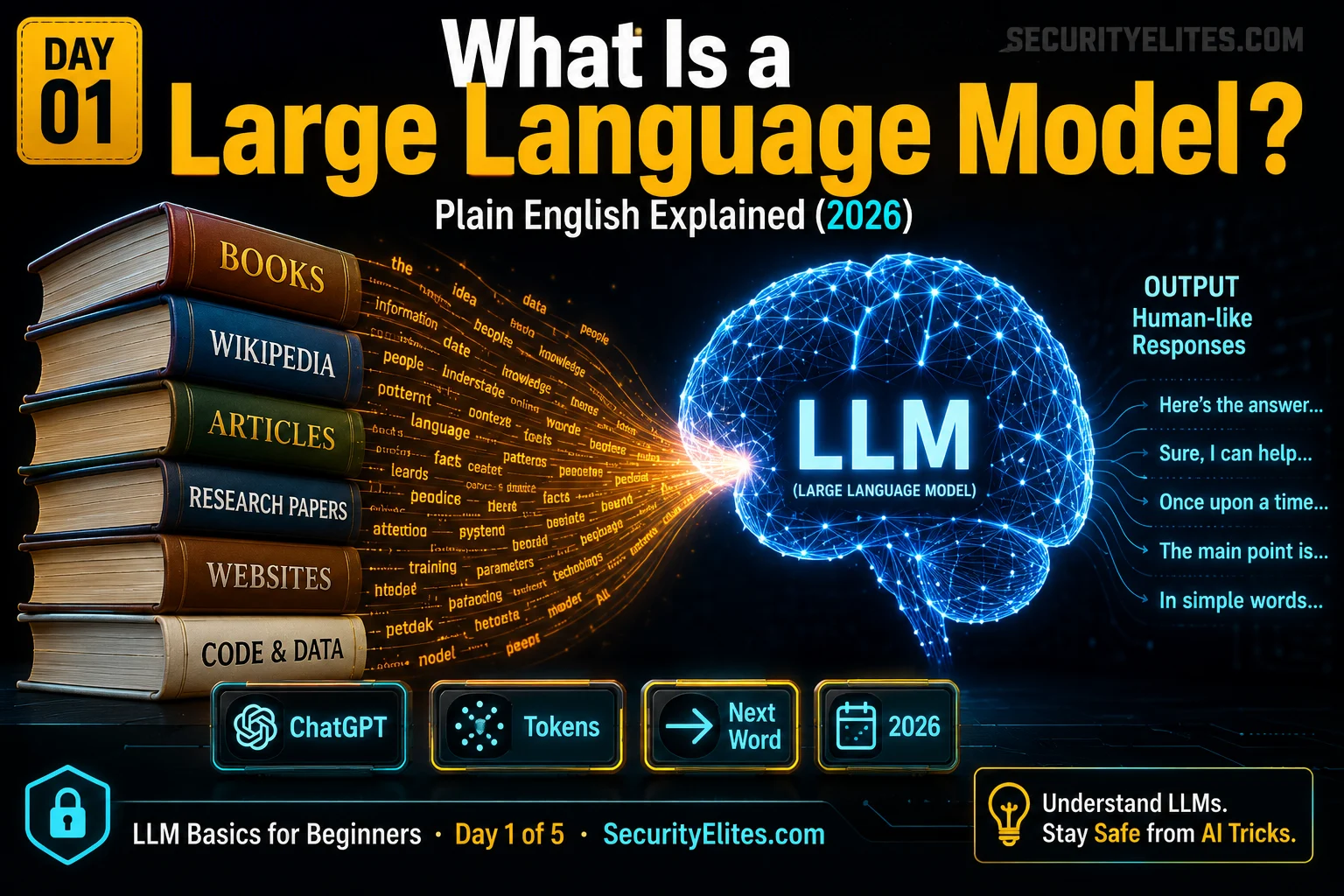
You’ve probably used ChatGPT or heard someone talk about it. Maybe you’ve seen Gemini or asked Siri a question. But here’s something most people can’t actually explain: what is a large language model, and how does it produce answers that sound so human?
I remember the first time I really understood how LLMs work. I was reading a research paper at 2am, and suddenly something clicked. These systems aren’t thinking. They’re not conscious. They’re doing something much simpler — and much more impressive. They’re predicting the next word. Perfectly. Over and over. Billions of times. And the result sounds like a person wrote it.
Once you understand that one idea, everything about LLMs — how they’re useful, how they make mistakes, and how people trick them — starts to make complete sense. That’s Day 1. Let’s build the foundation.
🎯 What You’ll Learn in Day 1
⏱ 20 min read · 3 fun exercises · Just a browser needed
- No coding or tech background needed — we start from zero
- You’ve heard of ChatGPT before — that’s genuinely all you need
- Optional: finished AI Basics Day 1 first? Great — but not required
What Is a Large Language Model? — Day 1 of 5
Welcome to LLM Basics — the five-day course that explains large language models the way I wish someone had explained them to me when I first started working in AI security. This zooms in on LLMs specifically. The LLM Hacking hub is where this course leads when you’re done. And the CEH practice exam has AI security questions you’ll be able to answer properly after just five days here.
What “LLM” Actually Stands For
LLM stands for Large Language Model. Three words. Let me explain each one.
“Large” — This means enormous. Like, unimaginably enormous. We’re talking about systems trained on more text than any human could read in thousands of lifetimes. The training data includes large chunks of the internet, millions of books, articles, code, conversations, and more. And the model itself has billions of numbers inside it storing everything it learned. “Large” is doing a lot of work in that name.
“Language” — This means it works with text. Words, sentences, paragraphs. It was trained on human language, and it produces human language. Not images. Not music. Not video (some systems do those things, but they’re different models). An LLM is specifically about text.
“Model” — This means it’s a mathematical representation. A model is a system that takes input and produces output based on patterns it learned during training. It’s software — a very specific kind of software that learned to work with language by studying examples.
Put it all together: a large language model is an enormous software system that learned how language works by reading billions of examples, and now it can produce language itself. That’s it. That’s the whole definition.
The One Idea That Explains Everything
Here’s the single most important thing I can tell you about LLMs. Everything else about them — why they’re useful, why they make mistakes, how people trick them — flows from this one idea:
That’s the whole mechanism. Predict the next word. Pick it. Repeat.
Let me make it super concrete. Say you ask an LLM: “What is the capital of France?” Here’s literally what happens:
It has your question. It starts generating a response. First word? Probably “The” — because most factual answers start with “The.” Second word? “capital” — because that’s what the question was about. Third word? “of” — because “capital of” is a very common phrase pattern. Fourth word? “France” — obviously. Fifth word? “is” — the sentence needs a verb. Sixth word? “Paris” — because billions of examples of this type of sentence in training data end with “Paris.” Done.
The result: “The capital of France is Paris.” It sounds like knowledge. It sounds like the AI knows the answer. But mechanically, it was just predicting the most probable next word at every step — and those predictions happened to be correct.
Here’s why this is the most important thing to understand: the LLM is always predicting. Even when there’s no right answer. Even when it doesn’t know. Even when the answer doesn’t exist. It still predicts the next most-probable word. And sometimes that word is wrong. Confidently, fluently wrong. This is why LLMs can make things up — a problem called “hallucination” that we cover in depth on Day 3.
Why LLMs Sound So Human
The most common question I get when explaining LLMs to beginners: “But it sounds so real! How can it just be predicting words?”
The answer is that human writing is actually very patterned. We don’t realise it because we’re inside the pattern, but from the outside, the way humans string words together follows very consistent rules. Grammar patterns. Topic patterns. Tone patterns. Conversation patterns. Response patterns. We learned them all as children by listening and reading.
An LLM learned those same patterns — but from billions of examples instead of a few thousand. It’s seen so many conversations, so many articles, so many explanations, that it learned every pattern humans use when they write. When it predicts the next word, it’s drawing on all those patterns simultaneously. The result is text that doesn’t just follow grammar correctly — it follows the subtle patterns of how a knowledgeable person would write about a specific topic in a specific style.
Think of it this way. You can tell a good chef’s cooking from a bad one, even if they used the same recipe. The good chef has cooked thousands of times and developed intuition about exactly how things should taste and feel. An LLM is like a chef who has “tasted” billions of pieces of writing and developed deep intuition about exactly how language should flow. The intuition is real. The billions of examples of human writing really are in there, compressed into billions of numbers.
But — and this is critical — the chef analogy has a limit. A good chef understands food. An LLM doesn’t understand language. It predicts language. There’s no understanding happening. There’s pattern matching at an enormous scale. When the patterns run out or get confused, the output stops sounding human. That’s why very specific questions about recent events or very unusual topics sometimes produce weird, wrong, or made-up answers.
ChatGPT vs Claude vs Gemini — What’s the Difference?
People use “ChatGPT” and “LLM” interchangeably, and that’s a bit like using “Google” and “the internet” interchangeably. One is a product built on top of the other.
Here’s the structure:
An LLM is the raw engine. It’s the trained model — the billions of numbers that represent everything it learned. You can’t really talk to a raw LLM directly. It’s like a car engine sitting on a bench. Powerful, but you need the rest of the car to do anything useful with it.
ChatGPT is a product built on an LLM. OpenAI trained an LLM called GPT-4 (and its successors). Then they built ChatGPT — the website you chat with — on top of that LLM. ChatGPT adds things like: the chat interface, memory of your conversation, safety filters, the system prompt that tells it to be helpful, and the infrastructure to serve millions of users. ChatGPT is the whole car. GPT-4 is the engine inside it.
Claude, Gemini, and Copilot work the same way. Claude is built on Anthropic’s Claude LLM. Gemini is built on Google’s Gemini LLM. Microsoft Copilot is built on GPT-4 (licensed from OpenAI). Each product wraps a different LLM engine with different instructions, interfaces, and safety systems.
Why does this matter? Because the same underlying LLM can power very different products depending on how it’s configured. A “helpful customer service chatbot” and a “creative writing assistant” might both use the same raw LLM — just with different instructions wrapped around it. Understanding this separation is key to understanding how LLMs can be manipulated through those instructions — something we explore properly in our Prompt Engineering course.
Claude.ai
Gemini
Copilot
Claude 3.5
Gemini 1.5
Llama 3.1
The Most Important Thing: It’s NOT Thinking
I want to be really clear about something before Day 1 ends. This is the thing most people get wrong, and it matters for everything else in this course.
An LLM is not thinking. It is not understanding. It has no idea what any of it means.
When ChatGPT writes you a paragraph about the French Revolution, it has not retrieved a memory of the French Revolution, thought about what’s important to say, and decided what to write. It has predicted the most probable sequence of words that follows your question, based on patterns in billions of training examples. The output looks like understanding. It is not.
Here’s my favourite analogy to make this real. Imagine a huge library with every book ever written on history. Now imagine someone who has read every single one of those books and can recite them perfectly — but who has never lived a single day in history themselves and has absolutely no experience of the world. Ask them a question about history and they can produce a perfect-sounding answer from memory. But they don’t actually know what any of it felt like. They can’t judge what’s important and what isn’t. They’re pattern-matching their memory, not reasoning.
That’s an LLM. The pattern matching is phenomenal. The depth of knowledge is astounding. But the understanding? Zero. None. Not happening.
Why does this matter? Because once you know this, the weirdness of LLMs starts to make sense. Why does it sometimes confidently make things up? Because it’s predicting probable words, not recalling true facts. Why can it be tricked with strange questions? Because tricky questions break the pattern-matching in ways that reasoning would handle. Why does it sometimes answer differently if you rephrase the same question? Because different words activate different patterns.
The fastest way to understand what an LLM actually is — not just read about it — is to use one and pay attention to what’s happening mechanically. Most people use LLMs casually and just take the output. I want you to use one deliberately, watching for the “predicting words” mechanism behind the answers. You’ll see things you’ve never noticed before.
- Open any free LLM — ChatGPT, Claude, or Gemini. Start a fresh conversation.
- Ask a very simple factual question where there’s clearly one right answer. Example: “What is the capital of Japan?” Notice how it responds. The answer comes word by word (or chunk by chunk). That’s the prediction engine running live.
- Ask it something that happened very recently — something from the last few weeks. What happens? Does it know? Does it make something up? Does it admit it doesn’t know?
- Ask it something about yourself — something only you would know. Example: “What is my favourite colour?” What does it do? Remember: it has no idea. It can only predict probable words.
- Ask the same factual question two different ways. “What year did World War II end?” vs “Tell me when World War II ended.” Do you get the same answer? Different wording?
- Write down one thing that surprised you about how it responded.
Why Understanding This Makes You Safer
You might be wondering why a cybersecurity website is teaching you LLM basics. Here’s my answer.
LLMs are everywhere now — and most people using them don’t understand them. That creates risks. Risks to you personally, and risks in the systems being built with them.
People who understand LLMs know: don’t trust it without checking. People who don’t understand LLMs often just believe whatever the confident-sounding text says. Hallucinations get shared as facts. Medical advice from a predicting machine gets followed without a doctor’s input. Legal advice gets acted on. Financial decisions get made.
From a security angle: I’ve seen phishing emails written by LLMs that were polished, personalised, and convincing — because LLMs are excellent at writing text that sounds legitimate. I’ve seen customer service chatbots manipulated into revealing information they weren’t supposed to share — because attackers understood the “predicting words” mechanism better than the chatbot’s designers did.
Understanding what an LLM is — really understanding it, not just knowing the buzzword — gives you a filter. When you read an LLM’s output, you know to ask: is this a reliable prediction or a made-up prediction? When you interact with a chatbot, you know what it can and can’t do. When someone tries to trick you using AI-generated content, you’re less likely to be fooled.
That’s why we’re here. Five days from now you’ll understand LLMs well enough to use them wisely and protect yourself from the ways they’re misused. Today was the foundation. Let’s keep building.
Next-token prediction // The core mechanism: pick the most probable next word, repeat
Training data // All the text the LLM read to learn — the internet, books, everything
Parameters // The billions of numbers inside the LLM that store what it learned
Product vs engine // ChatGPT/Claude = product. GPT-4/Claude 3.5 = the LLM engine inside
Hallucination // When LLM confidently produces wrong info — still predicting, not knowing
Now that you know LLMs are predicting words rather than actually knowing things, I want you to think about what that means for the information they give you. This exercise builds the critical thinking habit that keeps you safe when using AI tools.
- Think about your own life — things you know that nobody else could know. Make a list of 5 personal facts: your pet’s name, your favourite food, what you had for breakfast, your best friend’s name, something embarrassing from last year.
- For each one, ask yourself: could an LLM ever know this? Why or why not?
- Now think about types of information where an LLM’s “confident prediction” might actually be wrong without you realising:
- Medical symptoms — could a wrong confident answer cause harm?
- Legal rules in your country — do these change? Is the training data current?
- News from last week — is this inside or outside the training cutoff?
- Local information — your city’s bus schedule, local laws?
- Design your personal rule for when you’ll verify an LLM’s answer and when you’ll just use it directly. Write it in one sentence.
One of the most revealing things you can do when learning about LLMs is compare how different ones answer the same question. Different companies trained their LLMs on different data, with different instructions, and different safety rules — so the same question sometimes gets surprisingly different answers. Let’s see that difference for yourself.
- Pick one question that requires real knowledge — not a simple fact. Example: “What are the risks of using AI chatbots for homework?” or “What is the best way to stay safe online?” Something that requires judgment, not just recall.
- Ask the exact same question to three different LLMs: ChatGPT (chat.openai.com), Claude (claude.ai), and Gemini (gemini.google.com). All three have free tiers.
- For each answer, note: How long was it? Was it confident or cautious? Did it mention things the others didn’t? Did any of them refuse or add extra warnings?
- Ask all three: “Are you ever wrong?” See how each responds to a question about its own limitations.
- Which one’s answer did you find most useful? Which felt most honest about its limitations?
Questions and Answers
Is an LLM the same as artificial intelligence?
An LLM is a type of AI — specifically a type called a “generative AI” that produces text. But AI is a much bigger category. Image recognition systems, spam filters, recommendation engines, fraud detection — all of these are AI, but none of them are LLMs. LLMs are the AI type that’s gotten the most attention since 2022 because they’re the first kind that most normal people interact with directly through natural conversation. But they’re one family in a big AI ecosystem. The AI Basics course covers the full family if you want the broader picture.
How does predicting words produce useful answers?
Because human writing is incredibly consistent and patterned. When an expert answers a question, the words they use follow recognisable patterns that other experts also use. An LLM trained on millions of expert answers has learned those patterns deeply. When it predicts “which words come next after this question,” it draws on all those expert-answer patterns simultaneously. The result is an answer that matches the pattern of how experts answer that type of question — which is usually a pretty good answer. The limitation is that pattern-matching and actual knowledge are different things. When the pattern runs out, wrong predictions happen.
Does ChatGPT remember our previous conversations?
By default, ChatGPT has a “memory” feature that can store some things between conversations — but this is a product-level feature, not how the underlying LLM works. The raw LLM has no memory between conversations at all. Each conversation starts fresh. The “memory” in ChatGPT is a separate system that stores summaries and retrieves them to add context — it’s not the LLM remembering. This is why switching to a new conversation loses context, why the LLM can be confused by things you “told it before” in a different session, and why privacy-conscious users turn memory off.
Can LLMs learn new things after they’re trained?
The base LLM weights are frozen after training — it doesn’t update its core knowledge from conversations. You can’t “teach” an LLM by telling it something in a chat. It might incorporate what you told it for the rest of that conversation (because your message is in its context window), but the next conversation starts fresh with the same frozen knowledge. Companies retrain or fine-tune their models periodically — that’s when the LLM’s actual knowledge gets updated. The gap between training cutoff and when you’re using the model is where knowledge goes stale.
How big are LLMs? Do they run on my phone?
Full-size LLMs like GPT-4 or Claude 3.5 are enormous — the model files are hundreds of gigabytes, requiring dedicated server infrastructure with specialised hardware (GPUs) to run. When you use ChatGPT or Claude.ai, your message travels over the internet to company servers that run the model, and the response comes back. Nothing AI is running on your device. However, smaller “distilled” versions of LLMs do run on phones — Apple Intelligence, the AI features in recent Samsung phones, and some offline apps use small models optimised to fit on device. These are less capable but private, since nothing leaves your phone.
Why should someone interested in cybersecurity learn about LLMs?
Three reasons I give to everyone I train. First: LLMs are being used to attack — AI-generated phishing, AI-powered social engineering, AI-written malware are all real threats right now. Understanding LLMs helps you recognise and defend against AI-powered attacks. Second: LLMs are embedded in security tools — SIEM platforms, email filters, code analysis tools all have AI components; understanding what those tools actually do makes you better at using them. Third: LLMs themselves are attack targets — applications built on LLMs can be manipulated in ways specific to how LLMs work. All three of these are covered as this course progresses.
Further Reading
- AI Hacking for Beginners — where this course leads on the security side
- How LLMs Work — Hacker’s Guide — the technical deep-dive after this course
- LLM Hacking Hub — the full advanced series this course feeds into
- OWASP LLM Top 10 — the official list of LLM security vulnerabilities
- MITRE ATT&CK — includes LLM-specific attack techniques