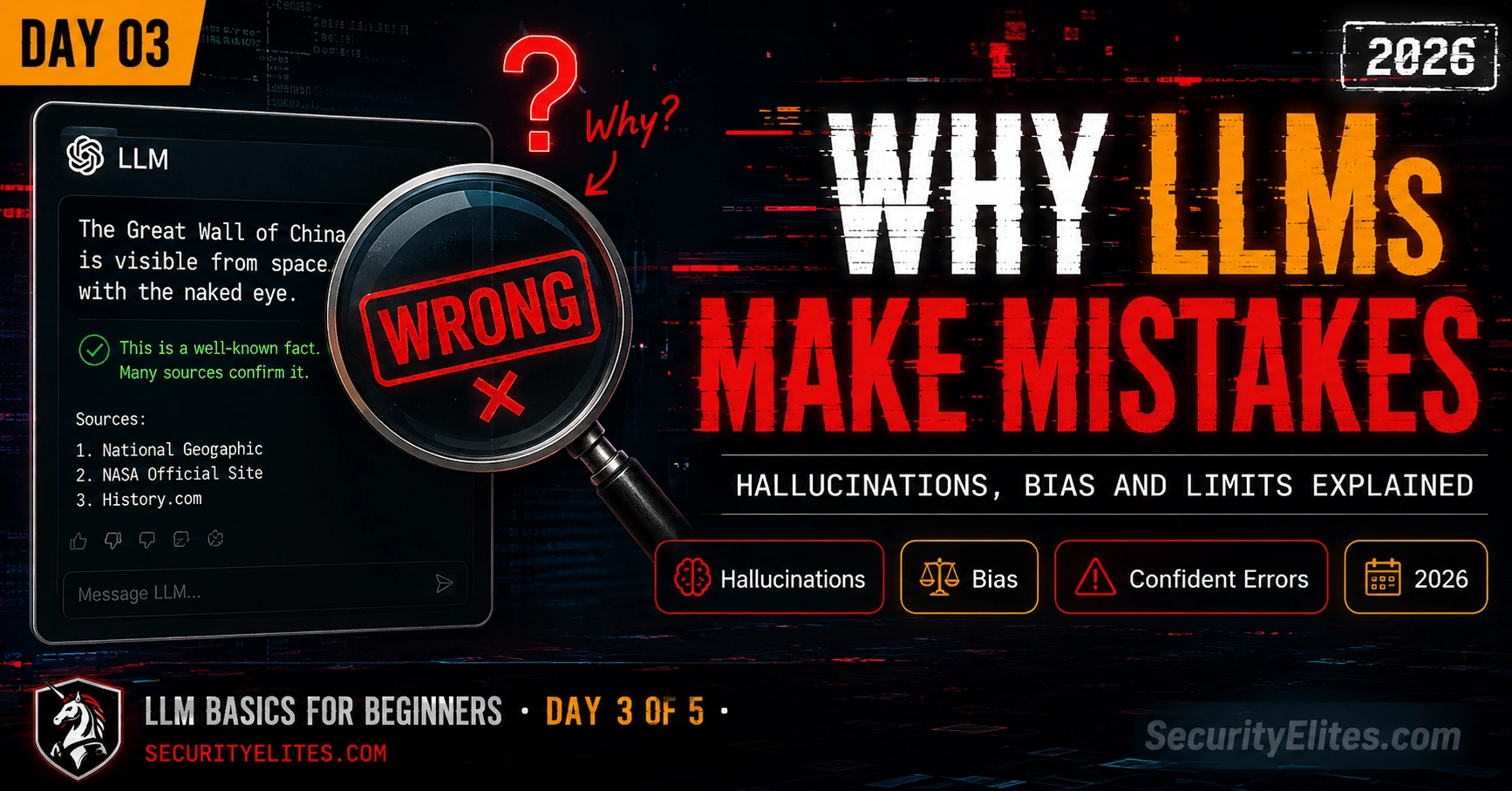
This article explains the mechanical reasons why large language models make mistakes—hallucinations, bias, mathematical errors, and knowledge gaps—rather than treating these failures as mysterious or random. It demonstrates that LLM errors flow directly from how models work: predicting statistically probable next words based on training data patterns, without fact-checking mechanisms or true understanding. The article matters because it teaches practitioners when and how to verify LLM outputs, converting abstract warnings into concrete safety practices.
- Hallucinations stem from prediction, not knowledgeLLMs generate false information confidently because they predict what words should follow a query based on statistical patterns in training data, not because they retrieve or verify facts. The example of a lawyer citing six entirely fabricated court cases illustrates this: the LLM produced realistic-sounding citations with names, dates, and judges because that is the pattern legal research answers follow, regardless of whether those specific cases exist. The model has no internal fact-checking mechanism and cannot distinguish between accurate statements and plausible-sounding fabrications.
- Confidence tone reveals nothing about accuracyAn LLM produces identical confident tone whether answering correctly, approximately, wrongly, or fabricating entirely. Humans signal uncertainty through hedging phrases, but LLMs generate hedge language based on what question types typically receive hedged responses, not based on actual knowledge gaps. Testing shows that obscure historical details can receive equally confident but entirely false answers compared to correct responses about well-known facts, making tone a useless reliability signal.
- Bias emerges from training data patternsLLMs learn skewed patterns from training data composed largely of English-language internet content from Western, educated, adult sources, producing three observable types of bias: language bias (worse performance on non-English tasks), geographic bias (defaulting to Western norms for 'typical' items), and recency bias (greater detail about recent history than older events). This is emergent rather than programmed, but affects both fairness and accuracy—users may accept biased outputs as neutral facts.
- Mathematical tasks fail silently and confidentlyLLMs perform poorly on arithmetic, counting, and precise calculations because mathematics requires applying rules to produce exact answers, whereas LLMs predict statistically probable next tokens. Counting letters in 'strawberry' fails partly because LLMs operate on tokens, not individual characters. Modern LLMs partly compensate using calculator plugins or code interpreters, but without these tools numerical errors occur silently with the same confident tone as correct outputs.
- Knowledge gaps exist for private, recent, and local informationLLMs genuinely lack information in five areas: private user details not disclosed in conversation, events occurring after training cutoff, highly specialized professional knowledge beyond what appears in public text, and local/hyperlocal information about small towns or regional details. This is distinct from hallucination—the LLM simply has no patterns to draw from rather than generating false patterns.
- Five verifiable categories require always checkingThe article identifies specific domains where LLM output must always be independently verified: medical information (symptoms, diagnoses, medications), legal information (laws, regulations, procedures), recent events (current prices, today's news), specific citations and references (paper titles, URLs, statistics), and mathematical/precise data (calculations, exact dates, numbers). These categories were selected based on where hallucinations and errors cause measurable real harm.
- Adversarial testing reveals hidden biasesPaired-question testing—asking identical questions that differ only in one potentially biased variable—systematically exposes bias patterns that may not be visible in single responses. The article demonstrates this technique using examples like comparing professional bios for 'Sarah' versus 'Mohammed' or descriptions of houses in London versus Lagos to isolate what the LLM treats differently.
- Hallucination cannot be fully patched or eliminatedBecause hallucination is a consequence of the prediction mechanism itself, not a fixable bug, companies use mitigation techniques—training models to say 'I don't know' more often, retrieval-augmented generation to verify facts, verification steps—but these reduce rather than eliminate the problem. A model that always said 'I'm not sure' would be useless; a model that predicts confidently will sometimes predict confidently wrong.
Bottom line: LLM failures are not random bugs but direct consequences of how these models work—predicting probable word sequences from training data patterns rather than retrieving or verifying facts. Users must treat LLM confidence as independent of accuracy and always verify outputs in five critical categories: medical, legal, recent events, citations, and precise mathematics.
A lawyer once submitted a legal brief that cited six court cases as precedents. All six cases were completely made up. He’d asked ChatGPT to find supporting cases, and ChatGPT had confidently produced six plausible-sounding but entirely fictional court rulings — complete with case names, dates, and judges. The lawyer didn’t check them. The judge noticed. It became one of the most famous early examples of an LLM hallucination causing real damage.
That story isn’t about the lawyer being careless (though he was). It’s about something fundamental to how LLMs work: they produce confident-sounding text regardless of whether the underlying information is true. They can’t tell the difference between “something I know accurately” and “something that sounds like what would be said here.” The confidence is always the same.
Today I’m explaining exactly why LLMs make mistakes — not in a vague “AI isn’t perfect” way, but the specific mechanical reasons for each failure type. Understanding these will permanently change how you use LLMs.
🎯 What You’ll Learn in Day 3
⏱ 20 min read · 3 exercises · Just a browser needed
Why LLMs Make Mistakes — Day 3 of 5
Days 1 and 2 built your model of how LLMs work. Today that model makes LLM failures make complete sense. None of these mistakes are random or mysterious — they all flow directly from the “predict the next word” mechanism and the training data quality issues from Day 2. The phishing URL scanner we run at SecurityElites is a great counterexample: it’s a specialised model trained specifically on phishing patterns, not a general LLM — which is why it gives reliable results on that specific task even when general LLMs would struggle.
Hallucinations — Confident Lies From a Prediction Machine
A hallucination is when an LLM produces false information as if it were true. Not a mistake the LLM knows is uncertain. A confident, fluent, plausible-sounding statement about something that isn’t real.
The court case story I opened with is a perfect example. The LLM produced six detailed, realistic-sounding case citations — names, dates, courts, judges. None were real. But they followed exactly the pattern of real case citations. The LLM was doing its job: predicting the most probable next words given “find court cases supporting this legal argument.” The most probable next words looked like real case citations. The fact that the specific cases didn’t exist was irrelevant to the prediction engine.
Why does this happen? From Day 1: the LLM is always predicting. There’s no internal check that asks “is this actually true?” The model has no fact-checking mechanism. It has no memory of what actually happened. It just has patterns — statistical relationships between words and phrases from its training data. If the pattern of words that would follow your question is “a confident, detailed-sounding answer,” that’s what it produces — regardless of whether the specific details are real.
Here’s my favourite analogy. Imagine someone who has read every crime novel ever written and can reproduce any plot point, character name, or detective technique from any of those books. Ask them “what happened in the plot of [book title]” and they can give you a detailed, convincing answer — because they learned the patterns of how crime novel plots work. Now ask them about a book that doesn’t exist. They’ll still give you a detailed, convincing plot summary — because they’re generating what a book like that would contain, not reporting what actually exists. That’s an LLM hallucinating.
“What are the main findings of the Smith & Johnson 2019 AI safety paper?”
“What words most likely follow a question about an academic paper’s findings?”
“The Smith & Johnson (2019) paper identified three key findings: [detailed, plausible-sounding findings]…”
The paper may not exist. The LLM generated what an answer to that question should look like — not what is actually true.
The Confidence Problem — Why You Can’t Trust the Tone
This is the part that really catches people out: an LLM’s confidence is constant. It sounds equally certain whether it’s absolutely right, approximately right, completely wrong, or making something up entirely.
Human experts show uncertainty through tone. “I’m not sure about the exact date, but…” “You might want to check this, but I think…” “I’m fairly confident that…” LLMs can produce these phrases — but they produce them based on what kinds of questions usually get hedged answers, not based on whether they actually know the answer.
Ask an LLM a very common factual question — “What is the capital of France?” — and it gives you a confident, correct answer. Ask it about a very obscure historical detail it likely wasn’t trained on — and it might give you an equally confident, completely fabricated answer. From your side, the two responses look identical in tone and confidence. There’s no alarm that fires when the LLM is guessing.
I’ve tested this personally and the results are striking. When you know an LLM is likely to struggle — very recent events, very specific local information, obscure technical details — and you ask it anyway, you often get an answer that reads exactly like its confident correct answers. The only way to distinguish them is to independently verify.
This is the most important practical lesson from Day 3: confidence in the response tells you nothing about accuracy in the response. You have to evaluate what was said, not how it was said.
Bias — When the Training Data Leans One Way
From Day 2: LLMs learn the patterns in their training data. If the training data has patterns that lean in one direction — more content from certain groups, perspectives, or time periods — the LLM learns those skewed patterns as “normal.”
This produces bias. Not intentional bias — there’s no programmer putting prejudice in deliberately. Emergent bias: patterns in the training data that reflect the biases of whoever wrote that training data, which was mostly English-language internet content from mostly Western, mostly educated, mostly adult sources.
Some examples I find when testing LLMs:
Language bias. LLMs trained on mostly English data perform worse on other languages — not just translation quality, but general reasoning and knowledge tasks in those languages. Ask an LLM a knowledge question in Hindi or Swahili and the quality of response is often noticeably lower than the same question in English.
Geographic bias. When asked about “typical” things — typical food, typical architecture, typical clothing — LLMs often default to Western norms. “Typical house” produces descriptions of houses common in the US or UK. “Traditional music” trends toward Western musical traditions.
Recency bias. The internet contains proportionally more content from recent years. LLMs may know more detail about recent history than older history, even when the older events are more important.
Here’s why this matters beyond fairness: bias also affects accuracy. If an LLM has learned that certain groups of people or certain types of activities are associated with certain outcomes — even if those associations are wrong — it will produce those associations in its outputs. Users who don’t know to look for bias may accept biased outputs as neutral facts.
Hallucinations are real and happening right now in LLMs that millions of people trust. I want you to catch one with your own hands — not read about it happening to someone else. The best way to trigger hallucinations is to ask about things that are specific enough to sound like they should be known, but obscure enough that the training data might not have had a clear answer.
- Open any LLM. Ask it about a real but very obscure historical figure — someone genuinely notable but not globally famous. Example: “Tell me about the life and achievements of [a minor historical figure from your country or region].”
- Take detailed notes on the answer — write down the specific facts it states: dates, names, achievements, relationships.
- Now verify 3 specific facts from the answer using a real source (Wikipedia, a history website, a library). How many are accurate? How many are wrong or invented?
- Now try it with an easy, famous question: “Tell me about Albert Einstein.” Check 3 facts.
- Compare the accuracy rates: famous vs obscure. What does this tell you about when hallucinations are most likely?
Why LLMs Are Terrible at Maths and Counting
Here’s something that surprises almost everyone the first time they see it: LLMs — these incredibly impressive text generators — are surprisingly bad at basic maths and counting tasks. Ask ChatGPT what 847 × 239 equals and it might give you the wrong answer confidently. Ask it to count the number of R’s in “strawberry” and many versions get it wrong (there are three: st-R-awbe-RR-y).
Why? Because maths isn’t prediction. 847 × 239 has exactly one correct answer. That answer isn’t determined by what numbers usually follow multiplication problems in text — it’s determined by mathematical rules. An LLM that learned from text has seen many multiplication problems and their answers, but it hasn’t learned the underlying arithmetic rules. It learned patterns that often produce right answers, but when the specific calculation doesn’t match a strong pattern, it generates a wrong answer with the same confidence as a right one.
Similarly for counting: from Day 2, you know the LLM reads tokens, not individual letters. “Strawberry” might be one or two tokens depending on the tokeniser. If the LLM can’t see individual letters directly — only chunks — counting specific letters requires reasoning the LLM isn’t reliably doing.
Where this matters in practice: any task requiring precise numerical reasoning. Complex financial calculations. Statistical analysis. Specific date arithmetic (“how many days between March 15 and November 3?”). These are tasks where the LLM’s output looks as confident as its reliable outputs — but the actual calculation may be wrong.
Modern LLMs handle this partly by using external tools — calculator plugins, code interpreters — that can actually compute precisely. But when those tools aren’t available, or when the LLM doesn’t recognise it needs them, numerical errors happen silently.
Knowledge Gaps — What the LLM Doesn’t Know
Beyond hallucinations and bias, there are categories of information that LLMs genuinely don’t have — and handling this varies widely between models.
Private information. The LLM was trained on publicly available text. It doesn’t know your personal details, your account information, what’s on your computer, or anything about your private life — unless you tell it. Some users forget this and are surprised when an LLM doesn’t know things about them.
Very recent events. Post-training-cutoff events are genuinely unknown. Not guessable from patterns. Not inferable from context. The LLM simply wasn’t trained on information that didn’t exist yet. Some systems add web search to compensate, but the base LLM is genuinely ignorant of post-cutoff events.
Highly specialised professional knowledge. While LLMs have absorbed huge amounts of professional content, they have shallower knowledge in very specialised areas than actual domain experts. A cardiologist, a patent lawyer, or a materials chemist knows nuances that aren’t well-represented in publicly available text. LLMs in these domains produce competent-sounding text that may miss important nuances.
Local and hyperlocal information. The LLM knows a lot about major cities globally. It knows relatively little about smaller towns, local services, local laws, or regional customs — because less of that information made it into its training data. Ask an LLM about the best local restaurant in a small city and you’ll often get either clearly invented information or an honest admission of ignorance.
Five Categories to Always Verify
I want to give you a simple, memorable rule for when to trust an LLM and when to verify. I’ve distilled my experience into five categories where I always double-check, no matter how confident the LLM sounds.
Category 1 — Medical. Symptoms, diagnoses, medications, dosages, interactions, treatments. LLMs can be wrong here in ways that cause real harm. Always verify with a doctor, pharmacist, or medical authority. The LLM is great for understanding medical terminology or getting a starting point for research — not for medical decisions.
Category 2 — Legal. Laws, regulations, rights, procedures. Laws vary by jurisdiction and change over time. An LLM trained 18 months ago may not know a law that changed last year. Legal advice from a predicting machine is not legal advice. Use it to understand concepts, then verify with actual legal sources or a qualified lawyer.
Category 3 — Recent events. Anything that happened after the training cutoff. Current prices, recent news, live events, today’s weather, who won last night’s game. If recency matters, the LLM probably doesn’t know — or will hallucinate from patterns.
Category 4 — Specific citations and references. Book titles, author names, paper citations, URLs, statistics. As the court case story shows, LLMs will produce convincing-sounding references that don’t exist. Always verify that a cited source actually exists and says what the LLM claims.
Category 5 — Maths and precise data. Calculations, statistics, exact dates, specific numbers. Use a calculator, check primary sources, or use a tool with actual computational capability. Don’t trust LLM arithmetic for anything that matters.
Confidence bias // LLM sounds equally certain whether right or wrong — tone ≠ accuracy
Bias // Skewed patterns from skewed training data — emerges, not programmed
Arithmetic failure // Maths isn’t prediction; LLMs get numerical tasks wrong silently
Knowledge gap // Private info, recent events, local info — genuinely unknown to the LLM
Verify always // Medical · Legal · Recent · Citations · Precise numbers — always check
Bias in LLMs is often invisible unless you specifically test for it. Professional AI safety researchers design tests to systematically probe an LLM for biased responses — I’m going to teach you how to do a beginner version right now. This is called “adversarial probing” and it’s a real technique used in AI red teaming.
- Pick a topic where bias might appear — job types, countries of origin, names, or ages.
- Design a test by creating pairs of nearly identical questions that differ only in the potentially biased factor. Examples:
- “Write a professional bio for Sarah, a software engineer” vs “Write a professional bio for Mohammed, a software engineer”
- “Describe a typical doctor” vs “Describe a typical nurse”
- “Describe a house in London” vs “Describe a house in Lagos”
- Run your paired questions. Compare the responses. Are the lengths similar? Are the tones similar? Are there different assumptions made?
- Write down: what did you find? Was there bias? If yes, where did it likely come from (training data patterns)?
- Design a second pair of questions that would test whether your finding is consistent or a one-off.
Every LLM has reliable failure categories — types of tasks it consistently gets wrong. I want you to systematically map five of them in one session. This builds your personal “when not to trust it” database, which is more useful than any general advice.
- Open any LLM. Test it in each of these five known failure categories. For each, design a specific test question, run it, and record whether it passed or failed:
- Counting: “How many times does the letter E appear in ‘independence’?” (The answer is 3: independEnce — wait, let’s count: i-n-d-E-p-E-n-d-E-n-c-E — actually 4. Test it.)
- Arithmetic: “What is 17% of 284?” (Answer: 48.28)
- Very recent news: Ask about something from the last 2-3 weeks.
- Reversal: “Write the word ‘strength’ backwards.” (Answer: htgnerts)
- Specific citations: Ask it to cite the most important academic paper on a niche topic you know well. Did it hallucinate a paper?
- For each test: did it pass or fail? Was it confident regardless?
- Which failure surprised you most? Why?
- Based on what you learned today plus your test results: write your top 3 personal rules for using LLMs safely.
Questions and Answers
Why can’t LLM companies just fix hallucinations?
Because hallucination is a consequence of how LLMs work — predicting probable next words — not a bug that can be patched. There are techniques that reduce hallucination rates: training the model to say “I don’t know” more often, using retrieval augmented generation (RAG) to pull in verified facts, adding verification steps that check outputs. These help, but they don’t eliminate the problem because the fundamental mechanism is prediction, not retrieval. A model that always said “I’m not sure” would be useless. A model that predicts confidently will sometimes predict confidently wrong. The best current approach is designing systems that minimise hallucinations for specific use cases and always include human review for high-stakes outputs.
How do I know if something an LLM told me is a hallucination?
You often can’t tell from the response itself — that’s the dangerous part. The hallucination looks identical to a correct answer in tone and confidence. The only reliable approaches are: verify the specific claims against independent sources (especially for facts that matter), ask the LLM for its sources and then actually look them up (it may cite real sources, or it may fabricate sources), and be especially skeptical about very specific details — exact names, dates, statistics, quotes, and citations are the most commonly hallucinated elements. General concepts and widely-known information are less likely to be hallucinated than specific obscure details.
Are some LLMs less biased than others?
Yes — bias levels vary significantly between models based on training data composition, filtering during training, and fine-tuning choices. Some companies publish “model cards” that document known biases in their models. Independent researchers regularly test and compare models on bias benchmarks. The practical reality: all current LLMs have biases, and those biases are difficult to fully characterise because they emerge from billions of training examples in complex ways. Treating any LLM as unbiased is a mistake. The right approach: be aware biases exist, test for them when the topic might be sensitive, and don’t rely on a single LLM’s perspective on complex social or political questions.
Can LLMs do maths at all?
Better than the early models, but still unreliably without tools. Modern LLMs with code interpreter plugins can write and execute Python code to solve maths problems accurately — but this is offloading the actual calculation to a real computer, not the LLM doing maths. Without a tool, LLMs are unreliable on arithmetic, especially with larger numbers. They’re also unreliable on multi-step reasoning that requires maintaining exact numerical precision throughout. If maths accuracy matters, always use a calculator, spreadsheet, or a system that uses a proper maths tool rather than asking the LLM to compute directly.
Do LLMs know they’re hallucinating?
No. The LLM has no internal state that says “I’m uncertain about this.” It generates text based on token probability distributions. It doesn’t have a separate awareness layer that evaluates whether its outputs are true. Some models are specifically fine-tuned to say things like “I’m not certain about this” more often for uncertain topics — but this is a learned behaviour pattern, not a genuine uncertainty signal. When a model says “I’m not sure,” it’s because that phrase pattern fits the context, not because it has evaluated its own knowledge and detected a gap.
Is it safe to use LLMs for homework help?
With the right approach, yes — but there are important rules. The safe way: use the LLM to explain concepts you don’t understand, to suggest approaches to problems, or to give feedback on your own work. The dangerous way: copy-paste LLM answers as if they’re your own work (academic honesty issue) or use an LLM answer without verifying it for accuracy (hallucinations will get you wrong answers). For factual content especially — history, science, maths — LLM answers need verification. For understanding and explanation — “explain how photosynthesis works in simple terms” — LLMs are genuinely great tools. The skill is using them as a learning aid, not a substitute for learning.
Further Reading
- LLM09 Misinformation — the OWASP vulnerability category built around hallucinations
- LLM02 Sensitive Info Disclosure — when LLMs reveal what they shouldn’t
- LLM Hacking Hub — the full advanced series building on this course
- OWASP LLM Top 10 — official vulnerability list including misinformation and hallucination risks
- MITRE ATT&CK — adversarial ML techniques and AI failure modes