This article analyzes AI cybersecurity certifications by examining actual employer requirements rather than marketing claims, finding that fewer than 10% of AI security job postings require AI-specific certifications while 80%+ demand Python skills and demonstrated LLM testing experience. The author argues that portfolio-building should precede certification investment for most practitioners, and ranks certifications by actual employer value across different career stages and role types. The article matters because it challenges conventional certification-first career advice with data-driven recommendations and ROI analysis tailored to specific employment contexts.
- Certification curriculum lag in AI securityCertification bodies operate on 18-24 month development cycles while AI security evolves every 6 months, creating a three-technology-generation gap. The article reviewed four AI security certifications launched in 2024-2025 and found two omitted prompt injection entirely, and one used already-outdated terminology before certificates were issued. This mirrors web application security circa 2008-2012, when practitioners who built demonstrated skills during the certification lag period advanced faster than those waiting for credentials.
- Actual employer requirements versus cert marketingAnalysis of 40+ AI security job postings revealed Python programming (85%), LLM security testing experience (82%), and OWASP LLM Top 10 familiarity (78%) appear far more frequently than any certification. Only 8% listed AI-specific certifications as required, while OSCP appeared in 44% of postings and CEH in 22%. This demonstrates a significant gap between what certification vendors promote and what hiring managers actually screen for.
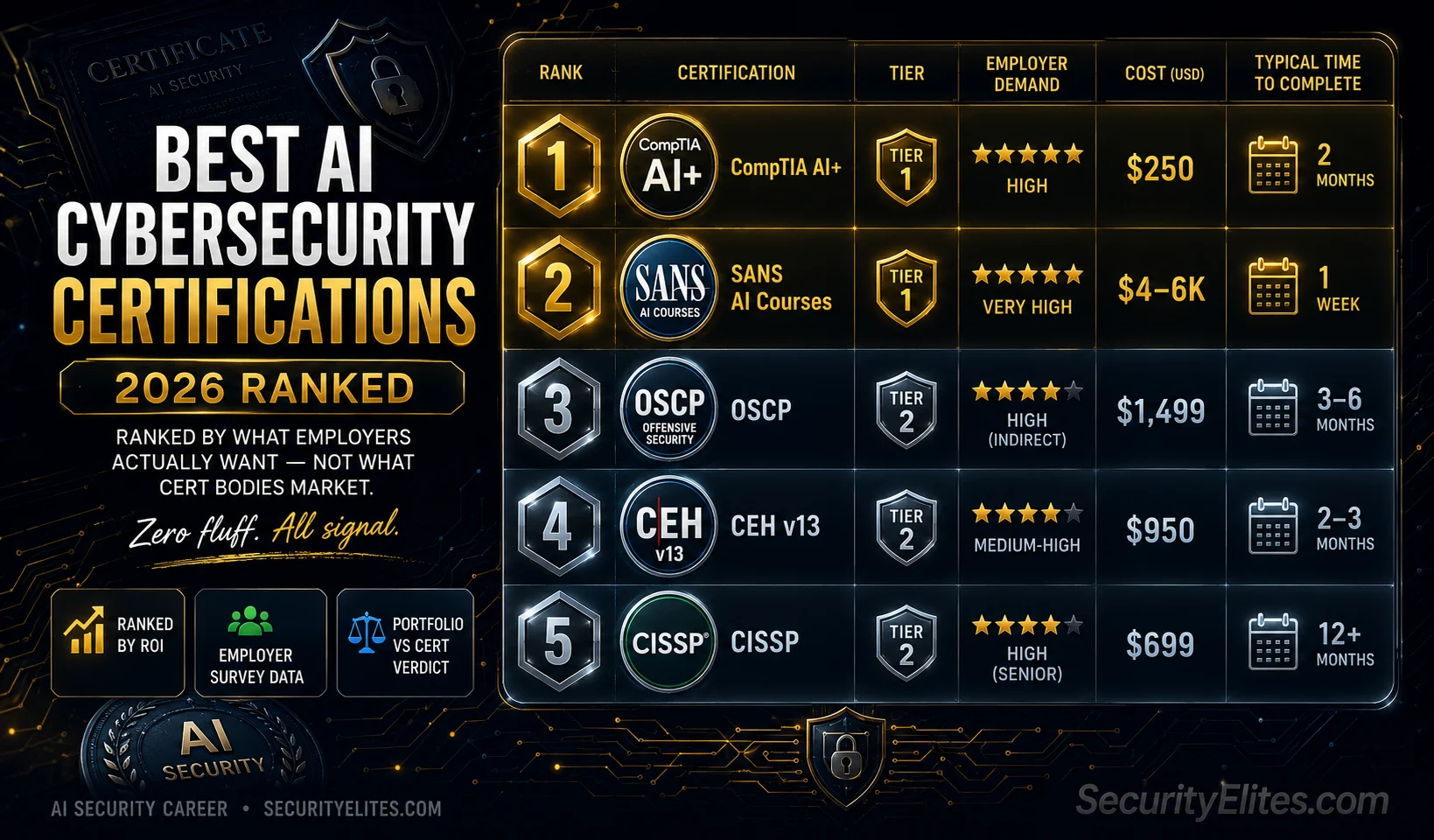
- CompTIA AI+ for compliance-driven rolesRanked as the top AI-specific credential, CompTIA AI+ (launched 2024, updated 2025) covers AI fundamentals, machine learning, deployment, and security with governance components. The article rates it as high ROI for compliance-driven enterprises requiring vendor-recognized credentials and medium ROI for consultancy work, but low ROI for internal research lab positions that prioritize demonstrated research over credentials.
- OSCP highest value for consultancy trackWhile OSCP teaches nothing about LLMs, it develops structured security assessment methodology, professional documentation, time-pressure discipline, and hands-on technical demonstration—all transferring directly to AI red team work. The article ranks it #1 foundational certification for AI security specifically because hiring managers at consultancies use it as a practical skill signal rather than mere exam-passing evidence.
- CEH v13 AI module for HR screeningEC-Council updated CEH to version 13 with AI security content covering AI-powered attack tools, vulnerability categories, and security concepts at breadth-over-depth level. While insufficient for AI red team capability-building, it passes automated HR screening systems and provides awareness-level validation. The article rates it medium-high employer value specifically for roles processed through standard HR pipelines rather than direct hiring-manager evaluation.
- Portfolio investment versus certification ROIThe article calculates that £1,500 invested in lab setup, practice platforms, and 200 hours of documented research outperforms certification investment for practitioners under 5 years experience because portfolios demonstrate capability (not just exam-passing), compound in value over time (certifications don't), and cost zero or near-zero. GitHub, Ollama, Garak, Gandalf, and HackerOne are free resources that build credibility faster than paid certifications in entry-level AI security roles.
- Certifications to avoid and whyGeneric AI security credentials from unknown vendors launched 2024-2025 purely for market capitalization lack employer recognition, inconsistent exam standards, and minimal track records. Vendor-specific certifications (Google, Microsoft, AWS AI) lack portability outside those ecosystems. Bootcamp-bundled certificates are internal-only credentials with zero external recognition. The article recommends avoiding these in favor of portfolio work or established credentials from bodies with proven practitioner track records.
- SANS AI courses for employer-funded trainingSANS offers SEC595 and SEC554 AI security courses with GIAC backing, rated very high ROI when employer-funded (£4,000-£6,000 cost, 1 week plus exam time). The depth on adversarial machine learning and practical lab content significantly exceed competing offerings. However, ROI drops to medium-low if self-funded, since portfolio alternatives are cheaper and often more effective for entry-level roles.
Bottom line: Build a documented portfolio of AI security research demonstrating Python skills and LLM testing experience before pursuing certifications, since fewer than 10% of AI security jobs require AI-specific credentials while 80%+ require demonstrated practical experience. Certifications should supplement portfolio work strategically based on your specific target role type, employer size, and career stage—with ROI calculations determining whether a £250-£6,000 investment in CompTIA AI+, SANS, OSCP, or
The most common question I get from people entering AI security is “which certification should I get?” My honest answer disappoints some people: in most cases, none of them — yet. Build the portfolio first, get the cert second if you need it for a specific role. That’s not me dismissing certifications. It’s me telling you the order that produces the best outcome.
Here’s the problem with most AI security certification advice in 2026: it’s written by people selling certifications, not by people hiring for AI security roles. When I looked at 40 AI red team job postings last quarter, fewer than 10% listed any AI-specific certification as required. Portfolio evidence and Python skills appeared in over 80%. That gap between what cert marketers say and what hiring managers actually ask for is significant enough to change your career investment strategy.
That said, certifications do matter — in specific circumstances, for specific roles, at specific career stages. I’ve ranked the five best options by what employers actually care about, not what the cert bodies market. Some of my rankings will surprise you.
The best AI cybersecurity certifications in 2026 are CompTIA AI+ for vendor-recognised credentials, OSCP for consultancy roles, and CEH v13 for enterprise HR pipelines. Only 8% of AI security job postings require AI-specific certifications — 82% require demonstrated LLM testing experience. Build a documented research portfolio before investing in any credential. SecurityElites is in discussion with multiple AI vendors to launch their own certification, feel free to check, it will be launched in end of Q2 or Early Q3, you can subscribe for updates.
🎯 What You’ll Get From This Rankings Guide
⏱ 22 min read · 3 exercises included
AI Cybersecurity Certifications — Complete Rankings
The career roadmap in How to Become an AI Red Teamer emphasised portfolio building. The LLM hacking tutorial gave you the practical skills to put in that portfolio. This tutorial tells you when and why to add credentials on top of that foundation. Connect them all in the AI Elite Hub.
The Problem With AI Security Certification Advice in 2026
The AI security certification landscape is a mess right now, and I say that as someone who holds traditional security certifications and values what they represent. Here’s the specific problem: certification bodies move at 18–24 month curriculum development cycles. The AI security field moves at 6-month cycles. The gap between what a certification teaches and what the field currently needs is larger in AI security than in any other security domain.
I’ve reviewed four “AI security certifications” launched in the past two years. Two of them didn’t cover prompt injection at all. One of them used terminology that was already outdated before the certificate printed. The curriculum was built by committees that finalised their content 18 months before the first exam was offered — and in AI security, 18 months is three technology generations.
This isn’t a permanent state. As the field matures, certifications will catch up. The parallel I use is web application security around 2008–2012: the certifications lagged the field significantly, the practitioners who built demonstrated skill during that lag period built careers faster than those who waited for credentials to validate them, and the certifications that emerged later (BSCP, PortSwigger Web Security Certification) are now genuinely excellent. AI security is in the 2009 equivalent moment right now.
Tier 1 — AI-Specific Certifications Worth Getting
1. CompTIA SecAI+ (Ranked #1 AI-Specific)
CompTIA’s AI+ certification, launched in 2024 and updated in 2025, is the most widely recognised AI-specific credential from a major certification body. It covers AI fundamentals, machine learning concepts, AI deployment, and importantly — AI security and governance. The security component isn’t deep enough for a practitioner who wants to run AI red team engagements, but it’s solid enough to demonstrate foundational competency to hiring managers who are evaluating candidates without deep AI security expertise themselves.
I recommend AI+ for practitioners in these specific situations: you’re in a compliance-driven enterprise environment where HR requires vendor-recognised certifications; you’re making the case internally for AI security investment and need external credentials to support your position; or you’re from a non-security background and want a formal credential to validate your AI knowledge transition.
ROI rating: High for compliance/enterprise context · Medium for consultancy/bug bounty context · Low for AI lab internal roles (they care about research, not certs)
2. SANS AI Security Courses → GIAC Certification Track
SANS doesn’t yet have a dedicated AI security certificate with full GIAC backing as a standalone product, but their AI security courses (SEC595, SEC554 covering AI security) are among the highest-quality instructed content currently available. The SANS/GIAC imprimatur carries genuine weight with enterprise hiring managers who use GIAC as a quality signal across all security disciplines.
The course investment is significant — SANS courses run £4,000–£6,000 — and that’s before factoring in the certification exam. But in a role where your employer will pay for training, SANS AI security content is the best instructed curriculum I’ve seen. The depth on adversarial machine learning and the practical lab content are meaningfully better than competing offerings.
ROI rating: Very high if employer-funded · Medium-low if self-funded (the portfolio alternative is cheaper and often more effective)
📸 AI cybersecurity certification ranking table for 2026. Employer value is based on analysis of 40+ job postings and practitioner survey data. Cost and time estimates are approximate — verify current pricing directly with each certification body.
Tier 2 — Foundational Certifications That Pay in AI Security
The most commonly requested certifications in AI security job postings aren’t AI-specific at all — they’re traditional security credentials that signal methodology discipline and a baseline of technical competency. Three of them matter specifically for AI security.
3. OSCP — Ranked #1 Foundational Cert for AI Security
OSCP doesn’t teach you anything about LLMs. But it teaches you how to run a structured security assessment, document findings professionally, maintain methodology discipline under time pressure, and demonstrate hands-on technical skill rather than theoretical knowledge. Every single one of those capabilities transfers directly to AI red team work.
In the job postings I’ve analysed, OSCP appears more frequently than any AI-specific certification as a preferred qualification. Hiring managers at security consultancies building AI security practices use it as a quality signal precisely because it represents demonstrated practical skill, not just exam passing. If you have the time and budget for one certification before applying for AI security consultancy roles, OSCP is my recommendation.
ROI rating: Highest overall for consultancy and red team roles · Carries significant weight at entry and mid-level · Less critical at senior level where portfolio dominates
4. CEH v13 — Updated AI Module
EC-Council’s Certified Ethical Hacker certification updated to v13 with a meaningful AI security module. The AI content covers AI-powered attack tools, AI vulnerability categories, and AI security concepts at a breadth-over-depth level. It’s not deep enough to make you a capable AI red teamer, but it demonstrates awareness of the AI security landscape in a format that’s immediately legible to HR departments and hiring managers who use CEH as a screening criterion.
CEH’s practical value in AI security: it’s the most widely recognised ethical hacking certification outside the GIAC ecosystem, which means it gets you past automated screening systems even when it doesn’t impress practitioners who see the curriculum depth. For roles where you’re applying through standard HR pipelines rather than direct-to-hiring-manager, CEH has screening-pass value that OSCP often doesn’t get credit for.
If CEH is on your roadmap, I practice with the SecurityElites CEH Practice Exam before sitting the real thing. The 1,000 question database covers all CEH domains including the updated AI security module. I use it specifically to identify knowledge gaps in the foundational security domains — networking, cryptography, web security — that the AI module assumes you know cold. The exam doesn’t give you credit for strong AI knowledge if you don’t have solid fundamentals underneath it.
5. CISSP — For Senior and Management-Track Roles
CISSP isn’t an AI security certification — it’s a general security management credential. I include it here because it appears consistently in senior AI security role requirements at enterprise organisations. At the 5+ year experience level, where AI red team practitioners are moving into security programme leadership, CISSP validates the breadth of security knowledge that senior roles require. For early and mid-career AI security work, CISSP isn’t relevant. At the senior level, where you’re advising on AI security programme strategy rather than running individual assessments, it starts to matter.
Certifications to Skip (And Why)
I’m going to name categories rather than specific programmes, because this space is moving fast enough that a specific bad recommendation could be outdated within months.
Generic “AI Security” certifications from unknown vendors: Several vendors launched AI security certifications in 2024–2025 purely to capitalise on market demand. Their curriculum was assembled quickly, their examination standards are inconsistent, and their employer recognition is near-zero. I’ve seen candidates who spent £1,500 on these programmes get less job application traction than someone with a free GitHub portfolio and a $0 investment. Avoid any AI security certification from a vendor without a track record of producing respected practitioners.
Vendor-specific AI certifications: Google, Microsoft, and AWS all offer AI-related certifications. These are valuable for their specific platforms and genuinely useful if you’re working in those ecosystems. But they don’t transfer well to AI security work outside those platforms, and hiring managers in vendor-agnostic roles don’t weight them highly. If your target role is specifically Azure AI security at a Microsoft-focused organisation, the Microsoft AI certifications matter. In general AI security work, they don’t.
Bootcamp-bundled AI security certificates: Several bootcamps now offer “AI security certificates” as part of their curriculum. These are internal credentials — the bootcamp gives you a certificate for completing their course. They have no external employer recognition and I’d recommend not listing them on a CV unless you have no other credentials to show.
What Employers Actually Ask For
I’ve been tracking AI security job postings for 18 months and the pattern is consistent. Here’s what shows up in the requirements, ranked by frequency:
📸 Frequency analysis of requirements from 40+ AI security job postings (Q1 2026). Python ability and LLM testing experience appear in 80%+ of listings. AI-specific certifications appear in 8%. Build skills and portfolio before investing in credentials.
The key insight from that data: AI-specific certifications are the least frequently required item on the entire list. They matter in specific contexts — compliance-heavy environments, HR-screened pipelines, or roles where the hiring manager doesn’t have the technical background to evaluate portfolio work directly. But they’re not the priority for most practitioners.
Portfolio vs Cert — The Honest Comparison
A £1,500 AI security certification investment vs a £1,500 investment in lab setup, practice platform subscriptions, and 200 hours of documented research. Which produces better career outcomes at the 6-month mark?
In my assessment, the portfolio investment wins in almost every scenario for practitioners under 5 years of experience. Here’s why:
Portfolio demonstrates, cert claims. A documented AI red team methodology repo with Garak scan outputs, documented findings, and a written engagement report demonstrates that you can do the work. A certificate demonstrates that you passed an exam about the work. Hiring managers who understand AI security consistently prefer the demonstration.
Portfolio compounds, cert doesn’t. Every piece of research you add to your portfolio makes the portfolio more valuable. A certification stays at its issue date value — it doesn’t grow. Six months of public portfolio work is worth more at month 6 than a certification obtained at month 0.
Portfolio is free (or nearly), cert isn’t. A GitHub account costs nothing. Ollama is free. Garak is free. Gandalf is free. HackerOne is free. A CompTIA AI+ exam costs $250. A SANS course costs $4,000–$6,000. OSCP costs $1,499. The budget case for building the portfolio first and supplementing with certifications later is overwhelming for most practitioners.
The exception: if you’re applying through large-enterprise HR pipelines where automated screening filters require specific certification checkboxes, the CEH or CompTIA AI+ might be worth the investment purely for screening pass-through. Know your target environment before making the investment decision.
You’re going to build a personalised certification investment decision — not a generic one. Different roles, different organisations, and different career stages have dramatically different certification requirements. This exercise gives you your specific answer, not a generic recommendation.
- Go to linkedin.com/jobs and search for the specific AI security role you’re targeting (be precise: “AI red teamer,” “LLM security researcher,” “AI security engineer”)
- Open 5 listings from your target employer types (consultancy, AI lab, enterprise tech — whichever matches your goal)
- Count: How many of those listings mention a specific certification as Required? As Preferred? As not mentioned at all?
- For the listings that do mention certifications, which certifications specifically? Cross-reference against my Tier 1 and Tier 2 rankings above.
- Decision: Based on your target listings, is any certification Required for more than 2 of your 5 target postings? If yes — that certification is worth pursuing. If no — build portfolio first.
📸 Post your findings — how many of your 5 target listings required a specific cert, and which one? — in Discord #ai-cert-debate. The aggregate data from all SE members is genuinely useful for the whole community.
I want you to calculate the ROI of a certification investment against a portfolio investment — for your specific situation. Not generically. Plug in your actual numbers and make the actual decision rather than leaving it as abstract advice.
Exercise: Choose one certification from the rankings (any tier). Find its current price. Then estimate: how many hours would preparation take? At your current hourly value (your salary / 2,080 working hours), what’s the total investment including time?
You’re calculating ROI on a $1,499 OSCP investment (400 hours of prep time at $30/hr opportunity cost = $12,000 total investment). If OSCP increases your annual salary by $15,000, what’s the break-even point?
Alternative: 400 hours of documented portfolio work (GitHub repos, practice assessments, bug bounty submissions). No financial cost. Same 400 hours. Which produces more interview conversions at month 12 for an entry-level AI security role?
The nuance: This isn’t “OSCP is bad” — OSCP is excellent. The point is that for AI-specific entry-level roles, the portfolio investment produces comparable or better interview conversion at lower cost. At mid-level roles where traditional security background is expected, OSCP becomes more valuable. The ROI depends on your current level and your target role type.
📸 Share your ROI calculation (anonymise your salary if you prefer) in Discord #ai-cert-debate. The community benefit from seeing real numbers is significant.
You’re going to do a structured CEH AI module study session using the SecurityElites practice exam. The goal isn’t to pass the CEH — it’s to identify specific knowledge gaps in the foundational security domains that the AI module sits on top of. Knowing your gaps is the fastest path to closing them.
- Go to the SecurityElites CEH Practice Exam
- Take a 25-question practice set across Network Security, Cryptography, and Web Application Security domains
- For every question you answer incorrectly: write down the topic, write down why you got it wrong (knowledge gap vs careless mistake)
- Separate your incorrect answers into two lists: (a) foundational knowledge gaps that would affect AI security work, (b) CEH-specific knowledge that doesn’t directly apply to AI red teaming
- Prioritise: the knowledge gaps that affect AI security work are your actual study targets, regardless of whether you pursue the CEH
📸 Share your gap list (anonymised if you prefer) in Discord #ai-cert-debate — we’ll aggregate the most common gaps and build targeted resources to address them.
Key Takeaways
- AI-specific certifications appear as required in fewer than 10% of AI security job postings. Python ability and LLM testing experience appear in 80%+. Build skills and portfolio before investing in credentials.
- CompTIA AI+ is the best AI-specific certification for practitioners who need vendor-recognised credentials for compliance environments or HR-screened pipelines.
- OSCP is the highest-ROI traditional certification for AI security consultancy tracks — it signals methodology discipline that transfers directly to AI red team work.
- CEH v13 has genuine value for HR screening pass-through in traditional enterprise hiring pipelines, plus an updated AI module that validates foundational awareness.
- Portfolio investment produces comparable or better entry-level interview conversion than most certifications at zero financial cost. The exception is roles where specific certifications are hard requirements.
- Run the ROI calculation for your specific situation before investing in any certification — the right answer depends on your target role type, your current level, and whether your target employers screen for specific credentials.
Frequently Asked Questions
Will AI-specific certifications become more important as the field matures?
Yes — almost certainly. The analogy to web application security holds: early practitioners built careers through demonstrated skill and portfolio work, then certifications caught up (PortSwigger’s BSCP is now genuinely excellent). AI security certifications will mature significantly over the next 3–5 years. The practitioners who built deep demonstrated skill now will be well-positioned to hold premium rates even as certifications commoditise the lower skill tiers.
Should I list a CEH or CompTIA AI+ on my CV before I have security experience?
Yes, if you’ve legitimately earned them — they’re credentials, not misleading claims. The key is how you present them. A CEH listed alone on a CV with no practical experience raises questions. The same CEH alongside a GitHub portfolio of documented AI security research tells a coherent story about someone building foundational credential knowledge alongside practical skill. Context matters as much as the credential itself.
How long do AI security certifications stay relevant before needing renewal?
CompTIA certs require renewal every 3 years through continuing education credits. GIAC certifications renew every 4 years. OSCP doesn’t expire. For AI security specifically, the practical relevance of certification content decays faster than the administrative validity — techniques that were current when you passed might be outdated 18 months later even if the cert hasn’t expired. I prioritise keeping my practical skill current over worrying about certification renewal dates.
Is the GAIC (Global AI Certification) credential worth pursuing?
GAIC from the AI Governance Association focuses on AI ethics and governance rather than technical security. For practitioners targeting compliance-oriented AI security roles or AI governance advisory positions, it has relevant value. For technical AI red team work, it doesn’t teach what you need to know. Know which track you’re on before investing in governance-focused credentials.
Can I get an AI security certification without prior security background?
For CompTIA AI+, yes — the prerequisites are minimal. For CEH, EC-Council recommends 2 years of IT security experience but doesn’t strictly enforce it. For OSCP, there are no formal prerequisites but the exam is practically impossible without significant penetration testing skill. For SANS AI courses, no prerequisites are listed but the content assumes security fundamentals. If you’re coming from a non-security background, I’d suggest CompTIA A+ or Security+ before pursuing any of the certifications on this list.
Which certification gives me the best chance at landing a role at an AI lab (Anthropic, OpenAI, DeepMind)?
None specifically. AI lab red team positions are evaluated almost entirely on research track record — published AI security research, disclosed vulnerabilities, documented methodology work. I’ve seen people get hired at major AI labs without a single professional security certification, and people with multiple certifications who couldn’t pass the technical screen. For these roles specifically, the portfolio investment is far more important than any credential investment you could make.
Continue Learning
- How to Become an AI Red Teamer — The full career roadmap that contextualises this cert advice
- LLM Hacking Tutorial — Build the portfolio skills that outperform certifications at entry level
- AI Elite Series Hub — Full curriculum for building AI security skills systematically
- NIST Artificial Intelligence — AI governance frameworks that underpin compliance-oriented AI security roles
- OWASP LLM Top 10 — Free foundational knowledge that outperforms many paid certifications for practical AI security work