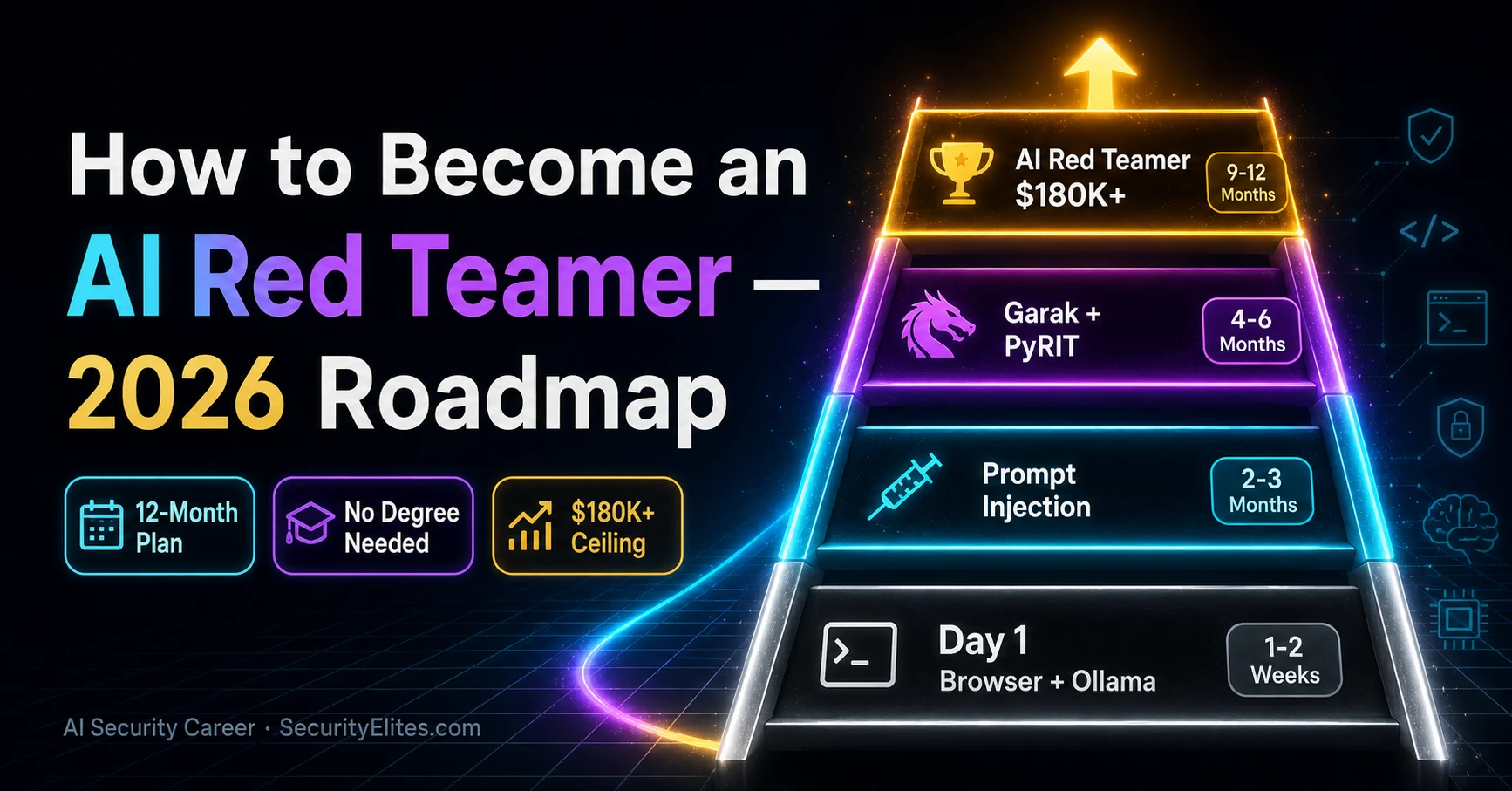
This article provides a comprehensive career roadmap for entering AI red teaming in 2026, demonstrating that high market demand currently outpaces the supply of practitioners with demonstrated skill. The author argues that becoming an AI red teamer requires systematic learning, documented practice, and a portfolio proving capability before employment—not a PhD or extensive traditional security background. The guide addresses why this career matters: companies deploy AI faster than they secure it, creating immediate hiring urgency and exceptional compensation for qualified practitioners.
- AI red teaming differs fundamentally from traditional securityThe article identifies seven key differences: AI systems are probabilistic (requiring statistical success rates rather than binary pass/fail outcomes), vulnerabilities use MITRE ATLAS rather than CVEs, scope is relational not spatial, proof of concept requires 10+ repetitions, fixes are architectural not code patches, harm includes non-technical AI-specific categories, and the attack surface is emergent. These differences shape the entire professional methodology and skill requirements.
- Four distinct career entry profiles with different advantagesTraditional pentesters ramp fastest (60–90 days) because they already have methodology discipline and client communication skills; bug bounty hunters find vulnerabilities faster due to production system intuition; AI/ML developers understand the whole stack and catch implementation vulnerabilities pure security researchers miss; and security engineers understand operational context and detection blind spots. Each profile has a different starting advantage and specific gap to fill.
- The 12-month roadmap uses three capability layersFoundation (months 1–3) focuses on lab setup, understanding eight major attack categories, confirming five prompt injection techniques, and running Garak scans. Technique (months 3–6) involves running complete assessments, submitting bug bounty reports, exploiting RAG systems, and testing agentic AI. Professional (months 6–12) requires three documented GitHub research pieces, at least one paid engagement, ability to price engagements, and a defensible methodology statement. The article emphasizes these are capability milestones, not strict calendar targets.
- Portfolio construction solves the experience catch-22The article breaks the circular requirement of needing experience to get hired by demonstrating that authorised public research documentation on platforms like GitHub and bug bounty programmes counts as portfolio material. An effective month-6 portfolio includes: a lab setup guide with screenshots, a detailed methodology walkthrough on one attack category with real practice results, and a practice engagement report written as a client deliverable. All go on GitHub formatted in Markdown, and hiring managers contact candidates directly when portfolios demonstrate systematic methodology.
- Real hiring happens through networks, not job boardsThe article identifies the actual hiring pipeline: AI lab internal red teams at Anthropic, OpenAI, Google DeepMind, Meta, and Microsoft consistently ask for evidence of independent AI security research in applications; security consultancies (Trail of Bits, NCC Group, Nettitude) actively build AI practices with mentorship structures; enterprise security teams at AI-shipping companies increasingly require AI security knowledge; and independent consulting becomes viable at 12–18 months. Job board positions are secondary to network-driven hiring for top roles.
- Job market requires demonstrated skill over credentialsAnalysis of 40+ real job postings from Q1 2026 shows Python scripting ability and demonstrated LLM security testing experience appear in 80%+ of listings as required, while CS/ML degrees appear in only 15% and AI-specific certifications in under 10%. Traditional pentesting credentials (OSCP, CEH) and bug bounty reputation appear in 40–60% of listings as preferred, not required. The article concludes that proof of skill through portfolio work should take priority over certifications for early-career progression.
- Compensation reflects severe supply-demand imbalanceEntry-level AI red teamers (0–2 years) earn £60K–£90K UK or $80K–$130K US; mid-level (2–5 years) earn £90K–£140K UK or $130K–$200K US; senior practitioners (5+ years) earn £140K–£200K+ UK or $200K–$400K+ US at major labs. Independent consulting rates range $80–$600 per hour by seniority. Bug bounties range from median $2K–$10K per finding to top findings of $50K–$150K. The article notes entry-level AI security positions are competitive with senior traditional security roles and senior practitioners at major AI labs are among the highest-paid security professionals anywhere.
- Work reality emphasizes documentation over technical theatreThe article describes actual engagement days as one-third testing (running Garak scans, prompt injection sequences, system prompt extraction, API testing), one-third documentation (structured format write-ups of every test and payload), and one-third research (staying current on emerging techniques). Standard engagements run two weeks; enterprise assessments run 4–6 weeks. The author emphasizes that clients pay for actionable findings with professional write-ups, not for impressive-sounding payloads without documentation, contradicting the perception that AI red teaming is 'furiously typing pr
Bottom line: Start building a public GitHub portfolio immediately rather than waiting for formal employment—dated, documented research on authorised platforms like HackerOne generates organic hiring inbound from managers faster than traditional job applications, and demonstrated systematic methodology through portfolio work matters more for early-career hiring than degrees or traditional security credentials. The market demand currently exceeds available practitioners, making this the optimal time to enter t
Six months ago I posted my AI red team portfolio on GitHub — a documented methodology, three practice assessments, and a write-up of my first real bug bounty finding on an AI system. Within three weeks, I had four inbound messages from hiring managers. Not recruiters. Hiring managers. That’s the market right now.
The demand for people who can break AI systems ethically has outrun the supply of practitioners who’ve actually done it. Companies are deploying AI faster than they’re securing it, and the number of professionals with genuine, demonstrated AI red team skill is still small enough that a well-built portfolio gets you noticed immediately.
Becoming an AI red teamer in 2026 doesn’t require a PhD. It doesn’t require years of traditional security background — though it helps. What it requires is systematic learning, documented practice, and the discipline to build a portfolio that proves you can do the work before anyone asks you to do it professionally. I’m going to show you exactly how that path looks, start to finish.
AI red teaming differs from traditional red teaming in 7 key ways: AI systems are probabilistic (requiring statistical success rates, not binary pass/fail), vulnerabilities use MITRE ATLAS not CVEs, scope is relational not spatial, proof of concept requires 10+ repetitions, fixes are architectural not code patches, harm categories include non-technical AI-specific harms, and the attack surface is emergent.
🎯 What You’ll Get From This Roadmap
⏱ 24 min read · 3 exercises included
How to Become AI Red Teamer — Full Roadmap
This roadmap sits alongside AI Hacking for Beginners — that guide covers the learning sequence, this one covers the career architecture around it. Together they’re the two documents I wish I’d had when I started. The full index of what to learn is in the AI Elite Series Hub. And if you want to understand how this career differs from traditional security work, the AI vs traditional red team comparison is the next article in this series.
What AI Red Teamers Actually Do Day-to-Day
I’ve noticed a huge gap between how people imagine AI red teaming and what the job actually looks like. The Hollywood version has someone furiously typing prompt injections in a dark room. The real version involves a lot more documentation, client communication, and systematic methodology than that fantasy suggests.
On an active engagement, my day breaks roughly into thirds. The first third is testing — running Garak scans, executing manual prompt injection sequences, trying to extract system prompts, poking at tool integrations and API endpoints. The second third is documentation — every test, every payload, every response, every confirmed finding gets written up in structured format as I go. The final third is research — reading what’s new in AI attack techniques, updating my payload library, reviewing relevant case studies, staying current in a field that moves faster than any other I’ve worked in.
When I’m not on active engagements, the work is client development, report writing, and building out my testing infrastructure. Larger consultancy teams have dedicated tool developers building automation frameworks. Independent practitioners spend more time on business development. AI safety teams at labs do more structured capability evaluation work. The specifics vary by employer type but the core skill — systematic adversarial assessment of AI systems — stays constant.
📸 A typical AI red team engagement week. Testing is roughly one-third of the time — documentation and methodology are just as important as the technical work. Clients pay for findings they can act on, not for impressive-sounding payloads with no write-up.
The 4 Background Profiles That Enter This Field
I’ve watched four distinct background profiles make successful transitions into AI red teaming. Each has a different starting point, a different ramp time, and different natural strengths. Knowing which profile matches you tells you exactly where to start and what gaps to fill first.
Profile 1 — Traditional Pentester or Red Teamer
This is the fastest ramp to professional AI red team work. You already have the methodology discipline, the documentation habits, the client communication skills, and the adversarial mindset. What you need to add is the AI-specific technique set — prompt injection, jailbreaking, model extraction, agentic exploitation. I’ve seen experienced pentesters become proficient at AI-specific testing within 60–90 days of focused practice.
Your natural advantage: you already know how to scope an engagement, run structured tests, and write findings that clients can act on. These are skills that take years to develop from scratch. You’re adding a technique set onto an existing professional foundation.
Profile 2 — Bug Bounty Hunter
The bug bounty background brings a different but equally valuable asset: demonstrated ability to find real vulnerabilities in production systems under competitive conditions. What I find with bug bounty-background researchers is that they often find vulnerabilities faster than engagement-background people because they’re comfortable with ambiguity and self-direction. They’re less comfortable with the structured methodology and documentation that engagements require — that’s the gap to fill.
Your natural advantage: you know how production systems actually fail. You’ve seen real vulnerabilities in live environments, not just in lab setups. That intuition for where to look — developed through thousands of hours of unstructured hunting — is genuinely hard to teach.
Profile 3 — AI or ML Developer
This is an increasingly common path as more AI engineers recognise that their development background gives them a unique position in security. You understand the frameworks, the deployment patterns, the failure modes at the code level. Prompt injection vulnerabilities that confuse security researchers coming from traditional backgrounds make immediate sense to you because you’ve implemented the systems that are being attacked.
Your natural advantage: you understand the whole stack. When I work with developer-background red teamers, they consistently find vulnerabilities in application-layer implementation that pure security researchers miss because they don’t know the framework well enough to know where the implementation gaps are.
Profile 4 — Security Engineer or Blue Teamer
Defence experience is more transferable to AI red teaming than most people from this background realise. You understand detection, response, and system architecture. Knowing what defenders can see — and what they can’t — informs more realistic threat modelling. The shift from defensive to adversarial thinking is the gap to bridge, and it’s primarily a mindset shift, not a technical one.
Your natural advantage: you understand the operational security of AI systems from the inside out. That knowledge of how logging, monitoring, and detection work gives you insight into which attack patterns are likely to go undetected — which is exactly what attackers care about.
The 12-Month Skills Roadmap
I’ve broken the skill development path into three layers. Don’t treat these as strict monthly targets — treat them as capability milestones. Some people move through the foundation layer in six weeks; others take four months. What matters is completing each layer before moving to the next, not the calendar.
Foundation Layer (Months 1–3)
The foundation layer is about understanding what you’re attacking and confirming your first hands-on techniques. By the end of this layer, you should be able to: set up a local AI security lab (Ollama + Garak + Burp Suite), explain the 8 major AI attack categories to someone unfamiliar with the field, confirm at least 5 prompt injection techniques personally on an authorised platform, and run a Garak scan and interpret its output.
Technique Layer (Months 3–6)
The technique layer deepens your attack capability and starts building the professional workflow. By the end of this layer: you can run a complete assessment against a scoped AI application from kickoff to findings report, you’ve submitted at least one bug bounty report on an AI target (result doesn’t matter — the process matters), you understand and can execute indirect prompt injection via RAG systems, and you’ve tested agentic AI exploitation in a local multi-step tool-use environment.
Professional Layer (Months 6–12)
The professional layer is about packaging skill as deliverable service. By the end of month 12: your GitHub portfolio has at minimum 3 documented AI security research pieces, you’ve had at least one paid AI security engagement (could be a small internal engagement for a company you have a relationship with), you can price and scope an AI red team engagement proposal, and you have a clear methodology statement you’d be comfortable defending to a senior client.
Building Your Portfolio Without Prior Experience
The portfolio question stops more people than the skill development does. The common objection is: “I can’t build a portfolio without experience, and I can’t get experience without a portfolio.” That’s a real loop but it has a straightforward exit.
The exit is authorised public research documentation. No client required. No engagement required. Every piece of documented AI security research you produce on authorised platforms is portfolio material. Here’s what an effective portfolio looks like at month 6:
Document 1: Your AI security lab setup guide. Screenshot the setup, document the tools, show your first Garak scan. This proves you have a working environment and can document technical processes clearly.
Document 2: A methodology walkthrough. Pick one attack category — say, system prompt extraction — and write a complete technical piece on how it works, what techniques you’ve tested, what the success/failure patterns look like. Reference real authorised practice (Gandalf, your local Ollama). This proves you understand technique at depth, not just at the surface.
Document 3: A practice engagement report. Run a structured assessment against Gandalf or HackAPrompt following the 5-phase methodology from the AI red teaming guide. Write up the report as if it were a real client deliverable. This is the single most impactful portfolio piece — it shows you can produce professional output, which is what clients actually pay for.
All three go on GitHub, formatted cleanly in Markdown. I’d add a fourth piece — your bug bounty submission write-up — as soon as you have one, regardless of whether it was valid or rewarded. The process documentation shows methodological thinking.
While I think practical portfolio work beats certifications for early career AI security, the CEH’s updated AI security module is genuinely useful as a structured knowledge framework. Use the SecurityElites CEH Practice Exam to identify gaps in your foundational security knowledge before you go deep on AI-specific techniques. CEH questions covering network security, cryptography, and web application attacks are all directly applicable to the infrastructure layer of AI security assessments.
Where the Jobs Actually Are in 2026
The job boards are not where AI red team roles get filled first. Most of the best positions I’ve seen get filled through professional networks before they’re ever posted publicly. Here’s where the actual hiring pipeline is:
AI lab internal red teams: Anthropic, OpenAI, Google DeepMind, Meta AI, and Microsoft all have published job listings for AI red team roles. These are competitive but they do hire externally. The application process consistently asks for evidence of independent AI security research — this is where your portfolio document from month 6 pays off directly.
Security consultancies with AI practices: Trail of Bits, NCC Group, Nettitude, and several boutique AI security firms are actively building AI security practices. These roles often come with a mentorship structure that accelerates learning — working alongside practitioners is the fastest way to compress that 12-month roadmap significantly.
Enterprise security teams at AI companies: Any company building AI products at scale needs AI security capability. Security engineering roles at companies like Salesforce, Atlassian, Notion, or any other organisation that’s shipping AI features are increasingly requiring AI security knowledge specifically.
Independent consulting: Several practitioners I know went independent at the 12–18 month mark. The market rate for independent AI red team work is high enough that even small engagement volume produces serious income. The challenge is business development — building a client pipeline is a separate skill from doing the security work.
📸 Compiled AI red team job requirements from 40+ postings analysed in Q1 2026. Notice what’s required vs preferred: demonstrated skill and Python ability appear in 80% of listings. Degrees appear in 15%. Build proof of skill first.
Salary Reality Check
The numbers I’m about to share are real but they have significant variance based on location, employer type, and seniority level. I’m giving you the range so you understand the ceiling, not a guaranteed outcome.
Entry level (0–2 years AI security experience): £60K–£90K in the UK, $80K–$130K in the US. These roles typically sit within a broader security team that’s adding AI capability. The work is supervised, the scope is narrower, and the learning is rapid.
Mid-level (2–5 years): £90K–£140K UK, $130K–$200K US. At this level you’re running engagements independently, writing client-facing reports, and beginning to scope work without supervision. Most mid-level practitioners I know have completed 20+ AI security assessments at this point.
Senior / principal level (5+ years or exceptional early achievement): £140K–£200K+ UK, $200K–$400K+ US for staff-level roles at major AI labs. Independent practitioners billing at $400–$600 per hour can exceed these figures. The ceiling in this field is genuinely exceptional compared to most security disciplines.
Bug bounty income: The highest-paid AI security bounties in 2026 reach $50K–$150K for critical findings at major AI companies. The median AI bug bounty finding pays $2K–$10K. Volume matters — practitioners earning six figures from bounties alone are typically submitting 10–20 valid reports per year.
📸 AI red team salary bands for 2026. Entry-level positions are competitive with senior traditional security roles. Senior AI red team practitioners at major AI labs are among the highest-paid security professionals anywhere. The gap between supply and demand is still driving extraordinary compensation.
You’re going to analyse three real AI red team job listings and extract exactly what the market is asking for in 2026. This isn’t theoretical career research — this is competitive intelligence that directly shapes what to build in your portfolio. The listings tell you exactly what to demonstrate.
- Go to linkedin.com/jobs and search: “AI red team” OR “LLM security researcher” OR “AI security engineer”
- Open three listings at different companies (try to mix one AI lab, one consultancy, one enterprise tech company)
- For each listing, note: What technical skills are listed as required? What tools are mentioned by name? Is prior security background required or preferred? Is a degree listed as required?
- Across all three listings, identify: What appears in all three? What appears in only one? What’s mentioned most frequently?
- Compare your current skills against the “Required” list from each posting. Write down your top 3 skill gaps.
📸 Post your top 3 skill gaps and the company type that listed them in Discord #ai-red-team-career — I’ll give personalised advice on the fastest way to close each gap.
I want you to think through your portfolio from a hiring manager’s perspective. The question isn’t “what can I put in my portfolio?” — it’s “what would make me want to interview this person immediately?” That framing changes everything about what you include and how you present it.
Scenario: You’re hiring for a mid-level AI red team role at a consultancy. You have 200 applications. You’re spending 45 seconds per application before deciding to read further or discard. What makes you read further?
Which portfolio item makes you click through in those 45 seconds?
A candidate has no prior security employment but shows: 3 HackerOne AI programme submissions (1 valid, 2 informational), a documented Garak methodology repo, and a write-up of a practice AI red team engagement. Does this candidate get an interview?
Portfolio principle: Specific always beats general. “I know AI security” is a claim. “I ran a Garak scan against Llama 3.1, found these 3 vulnerability categories, and here’s how I confirmed each one manually” is evidence. Hiring managers make a binary decision: “can I trust this person to run an engagement?” Everything in your portfolio should answer that question with a yes.
📸 Write your current top portfolio item and the specific claim it evidences in Discord #ai-red-team-career. I’ll give feedback on how to strengthen the evidence signal.
You’re going to create the skeleton of your AI security portfolio on GitHub right now — not later, not when you have more to put in it. The skeleton creates the container that gets filled over the next 90 days. Starting now, even with minimal content, is always better than a perfect portfolio three months from now.
- Go to github.com and create a new public repository named
ai-security-research - Create a
README.mdwith these sections: About · Research Pieces (placeholder) · Tools & Lab Setup · Methodology - In the Methodology section, write 3–5 sentences describing how you approach an AI security assessment — in your own words, first-person. This is your methodology statement.
- Create a
lab-setup.mdfile and document your current lab setup: what you’ve installed, what models you have locally, what tools you’ve configured. Screenshot a successful Garak run output and include it. - Commit and push. Pin this repo on your GitHub profile.
📸 Post your GitHub repo link in Discord #ai-red-team-career. We’re tracking how many SecurityElites members have live AI security portfolios — yours counts.
Key Takeaways
- Four distinct background profiles enter AI red teaming: traditional pentester (fastest ramp), bug bounty hunter (best real-world intuition), AI developer (deepest stack knowledge), security engineer (best operational context). Each has a different starting advantage and different gap to fill.
- The 12-month roadmap has three layers: foundation (understand + first techniques), technique (complete assessments + first bounty submission), professional (portfolio + first paid work + scoping capability).
- Portfolio beats credentials for early career AI security work. Three specific GitHub documents produce more interview inbound than most certifications.
- The hiring pipeline is primarily through professional networks, not job boards. Building a visible public portfolio creates organic inbound from hiring managers faster than applications.
- Entry salary range is genuinely competitive with senior traditional security roles. Senior practitioners at major AI labs are among the highest-paid security professionals in the industry.
- Start the portfolio now — not when you have more to put in it. Dated public work compounds in professional value over time in a way that private practice never does.
Frequently Asked Questions
Do I need a computer science degree to become an AI red teamer?
No. Looking at the job requirements data I collected, degrees are mentioned as required in fewer than 15% of AI red team job postings. What appears in 80%+ of listings is demonstrated technical skill — specifically, Python ability and evidence of LLM security testing. Build a portfolio, not a degree, if you’re optimising for employment speed.
How long does it take to become an AI red teamer with no prior experience?
With daily focused practice, most people following this roadmap land their first paid work between month 8 and month 14. The variance is significant based on prior background, starting skill level, and how aggressively you build your public portfolio. I’ve seen practitioners with strong traditional security backgrounds land paid AI engagements at month 4. I’ve also seen people with no security background take 18 months. The quality of your portfolio documentation is the biggest single variable.
Should I get OSCP before pivoting to AI security?
If you have it or you’re close to completing it, yes — finish it. OSCP signals methodology discipline that transfers directly to AI red team work and is genuinely valued by hiring managers in the field. But if you’re starting from zero with no security background, going directly into AI security practice without a traditional security credential is viable. The field is new enough that demonstrated AI security skill is often weighted more heavily than traditional credentials.
What’s the best programming language to learn for AI red teaming?
Python, unambiguously. Every major AI security tool runs on Python. The LLM API SDKs from OpenAI, Anthropic, and Google are Python-first. The attack frameworks — Garak, PyRIT, LangChain, TextAttack — are all Python. You need enough Python to run scripts, modify payloads, and make API calls. Deep Python mastery is useful but not required to start.
Is AI red teaming a good career choice in 2026?
My view: the specific techniques will commoditise as more automated tooling emerges, but the judgement layer — knowing what to test, how to scope, what findings mean for a specific business context — won’t commoditise at the same pace. The practitioners who build both deep technical skill and strong business communication are the ones who will sustain premium rates as the field matures. Start building both now.
What does an AI red teamer actually do each day?
AI lab internal red teams focus more heavily on capability evaluation — testing whether models will assist with mass casualty attack planning, CSAM generation, or destabilising critical infrastructure at increasing capability thresholds. It’s more research-oriented and less engagement-oriented than consultancy work. The methodology is rigorous but the output is often internal rather than client-facing. Consultancy work is more commercially structured, more client communication-heavy, and covers a broader range of AI deployment types than lab red team work.
Continue Learning
- AI Red Team vs Traditional Red Team — Understand how this career differs from what you may already know
- What Is AI Red Teaming — The methodology foundation this career roadmap builds on
- AI Elite Series Hub — Complete 400-article index organised by topic and difficulty
- HackerOne AI Bug Bounty Programs — The market that pays for your early-career AI security work
- MITRE ATLAS — The framework every AI red team professional needs to know cold