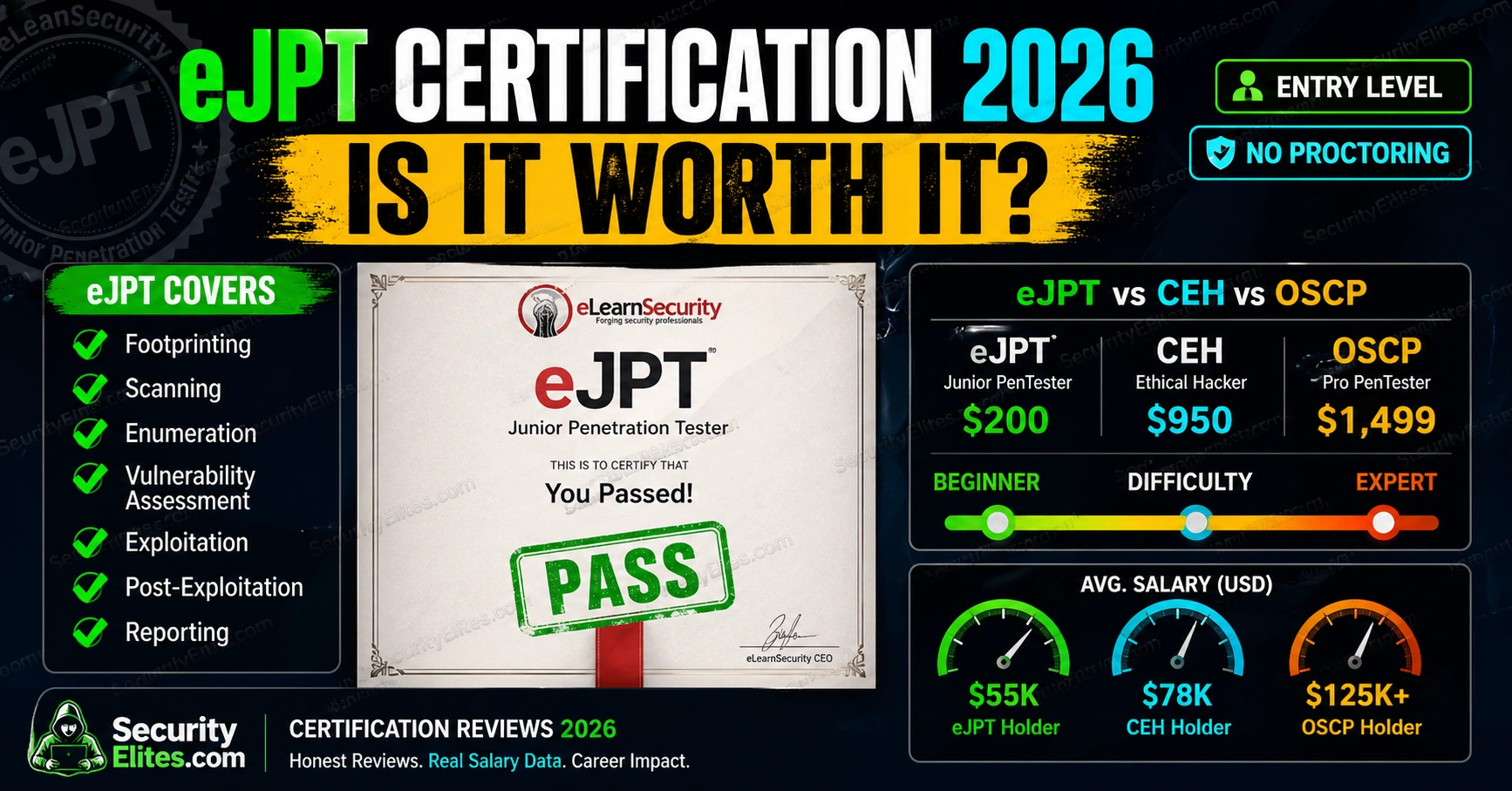
This article assesses the eJPT (eLearnSecurity Junior Penetration Tester) certification for 2026, examining what it covers, exam format, difficulty level, employer recognition, and whether it fits specific career stages. The author argues that eJPT's value is highly context-dependent: it serves as a legitimate entry-level credential for career changers and junior role seekers, but may be unnecessary for candidates already possessing foundational skills or targeting mid-level positions where OSCP is expected. The article matters because certification decisions involve significant time and financial investment, and the wrong choice at the wrong career stage wastes both.
Key insights
eJPT exam format emphasizes applied methodologyThe eJPT is a 72-hour hands-on lab without proctoring or multiple-choice questions. Candidates receive a VPN connection to a network of virtual machines, must compromise systems to extract flags and information, and answer questions about their findings. The exam is open-notes and open-internet, testing whether candidates can apply pentesting methodology (reconnaissance, scanning, enumeration, exploitation, post-exploitation) rather than memorize syntax, mirroring real-world pentesting conditions.
Beginner difficulty requires foundational skills firstThe article characterizes eJPT as genuinely beginner-level, not dismissively but calibratively. It becomes accessible after completing the INE PTS course and 20-30 TryHackMe rooms with solid understanding of Nmap, Metasploit, and basic web vulnerabilities. Most successful candidates finish in 8-16 hours of the 72-hour window. The primary struggle for beginners is not exploitation itself but methodology discipline—thorough enumeration before jumping to exploitation, understanding pivoting, and patient debugging when tools malfunction.
Employer recognition limited to entry-level positionsThe eJPT demonstrates moderate employer value but only in the entry-level market. It is valuable for junior pentester and SOC analyst roles at SMEs and mid-market security firms, where it signals hands-on lab experience most entry-level candidates lack. However, for enterprise roles and senior positions, OSCP is the expected credential and eJPT is merely a nice-to-have addition. The article explicitly states eJPT is not a tier-1 credential in the same way OSCP or CISM are.
Clear progression pathway toward OSCP existsThe article presents eJPT as a stepping stone toward OSCP rather than an end goal. The recommended progression is eJPT → optional CEH if sector-required → OSCP. Importantly, the author states there is no certification scenario where eJPT is valuable but OSCP is not; OSCP is the superior credential for all scenarios where eJPT matters. Candidates with foundational skills already established should skip eJPT entirely and invest directly in OSCP preparation.
Self-assessment determines whether eJPT is appropriateThe article provides specific self-assessment criteria across technical and career-stage dimensions. Technical readiness questions address Nmap interpretation, machine compromise experience, Metasploit usage, TCP fundamentals, and SQL injection knowledge—answering no to 3+ suggests eJPT is appropriate. Career-stage questions target career transitions, experience level, and target roles. If neither set of criteria align with the candidate's situation, eJPT may waste time and money better invested in OSCP or alternative paths.
Cost and accessibility make eJPT practical first credentialThe eJPT costs approximately $200 standalone or via INE Starter Pass (~$50/month or $200/year, which includes the PTS course). This is significantly cheaper than OSCP ($1,499 including lab access) or CEH ($950-1,500). The lifetime credential with no renewal requirements and open-notes exam format reduce barriers to initial certification attempts. The lower financial barrier makes eJPT practical for transitioning professionals building resume credentials while saving for costlier certifications.
Four-week study plan leverages existing resourcesThe article provides a structured 4-6 week preparation plan (assuming 2-3 hours daily) combining INE PTS course completion, TryHackMe Jr Penetration Tester path progression, and methodology practice. The plan emphasizes full network enumeration before exploitation—identified as the most common point where struggling candidates diverge from successful approaches. Exam day guidance stresses reading all questions before starting to understand which machines must be compromised and shape prioritization accordingly.
Target market research shapes certification decisionsThe article argues certification value depends entirely on what target employers actually require, not generic advice. It directs readers to research job listings on LinkedIn and Indeed for specific role titles, noting how frequently eJPT versus OSCP actually appears in postings, and checking penetration testing firm career pages. This evidence-based approach replaces assumption-driven certification choices with data reflecting actual market demand in the reader's geography and target roles.
Bottom line: eJPT is a legitimate practical entry-level credential valuable specifically for career changers and junior role seekers at firms using certifications as hiring filters—but is not a substitute for OSCP at any career level, and may waste time and money for candidates already possessing foundational skills or targeting mid-level positions. Make your certification decision based on self-assessment against specific technical and career criteria, research of actual job listing requirements in your tar
The eJPT is the certification question I get asked about more than any other from people just entering cybersecurity. Is it worth the time? Will it help with job applications? Is it actually harder than it looks, or just a rubber stamp? I’ve had students pass it after two weeks of preparation and struggle to land jobs, and I’ve had students use it as the credibility boost that got them their first security interview. The ejPT certificate itself isn’t magic — but for the right person at the right stage, it’s genuinely useful. Here’s my honest assessment of the eJPT certification in 2026: what it actually teaches, how hard the exam is, what employers think of it, and whether it makes sense for where you are right now.
🎯 After This Article
Understand exactly what the eJPT covers and how the exam works
Assess whether the eJPT is right for your current skill level and career stage
Know the honest employer perception of the eJPT vs OSCP and other certifications
Build a study plan to pass the eJPT if you decide to pursue it
Understand the full certification progression from eJPT toward OSCP
I’ve watched the cybersecurity certification landscape shift significantly over the past few years. The eJPT has carved out a specific niche: a genuinely practical entry-level exam that tests hands-on skills rather than memorised textbook answers. That distinction matters more than it might seem. Let me explain exactly what you’re buying.
What’s your current cybersecurity certification status?
What Is the eJPT?
The eJPT (eLearnSecurity Junior Penetration Tester) is a practical penetration testing certification developed by INE (which acquired eLearnSecurity). Unlike CompTIA Security+ or CEH’s multiple-choice format, the eJPT is a hands-on exam: you get a VPN into a network of virtual machines and have to actually compromise them. You answer questions about what you find — flags, service versions, credentials, network topology.
The certification was specifically designed for people at the beginning of their penetration testing journey. It covers the full methodology — reconnaissance, scanning, enumeration, exploitation, and basic post-exploitation — at an accessible difficulty level. The course material is INE’s Penetration Testing Student (PTS) course, which is included with their Starter Pass subscription.
Beginner — accessible after 2-4 weeks of dedicated study
Validity
No expiry (lifetime credential)
Employer recognition
Moderate — good for entry-level, less valued at senior level
📸 eJPT key facts for 2026. The 72-hour exam with no proctoring is a significant differentiator — you work at your own pace in a realistic lab environment rather than under surveillance answering multiple choice questions. The lifetime credential means no renewal fees. Check ine.ninja for current pricing as INE adjusts promotion pricing frequently.
Exam Format — What Actually Happens
The eJPT exam is a 72-hour hands-on lab. When you start the exam, you receive a VPN configuration file to connect to the exam network. The network contains multiple machines — some directly accessible, some requiring pivoting through other hosts to reach. You’re given a set of questions to answer about the network (flags hidden on machines, service versions, discovered credentials, network structure).
Crucially, the exam is open-notes and open-internet. You can use any tool, read any documentation, and use any resource. This is how real-world pentesting works — the test is whether you can apply skills and methodology, not whether you’ve memorised syntax. Most successful candidates complete the exam in 8-16 hours spread across the 72-hour window, taking breaks when stuck rather than grinding continuously.
use post/multi/manage/shell_to_meterpreter # Upgrade shell
# All tools allowed — this is open notes/open internet
Difficulty — Honest Assessment
The eJPT is genuinely beginner-level. I say this not to dismiss it, but to help you calibrate: if you’ve completed the INE PTS course, done 20-30 TryHackMe rooms, and have a solid understanding of Nmap, Metasploit, and basic web vulnerabilities, you’ll pass it comfortably. The exam tests whether you can apply the methodology rather than whether you can solve novel exploitation challenges.
Where beginners struggle is usually not in the exploitation itself but in the methodology discipline — doing thorough enumeration before jumping to exploitation, understanding what pivoting means when the answer is on a host that isn’t directly accessible, and patient debugging when tools don’t immediately work as expected. These are learnable with practice.
🧠 EXERCISE 1 — THINK LIKE A HACKER (20 MIN · ANALYSIS)
Assess Whether the eJPT Is Right For Your Career Stage
⏱️ 20 minutes · No tools — honest self-assessment
The most expensive mistake in certification choices is taking the wrong certification at the wrong time. Work through this honest assessment to determine whether eJPT is your right next step.
Self-Assessment Questions (answer honestly):
TECHNICAL SKILLS:
□ Can you explain what Nmap does and interpret its output?
□ Have you rooted at least 5 machines on TryHackMe or HackTheBox?
□ Can you use Metasploit to exploit a known CVE?
□ Do you understand what happens in a TCP three-way handshake?
□ Can you explain SQL injection and demonstrate it on a lab target?
If you answered NO to 3+ above:
→ eJPT is RIGHT for you — it builds exactly these foundations.
Study plan: INE PTS course → TryHackMe Jr Pentester path → eJPT
If you answered YES to all 5:
→ You may be past eJPT’s value threshold — consider jumping to:
→ CEH if employer requires it, or OSCP for real-world credibility
CAREER STAGE QUESTIONS:
□ Are you currently in a non-security role looking to transition?
□ Do you have less than 1 year of hands-on security experience?
□ Are you targeting junior SOC analyst or junior pentester roles?
□ Do you need something on your resume NOW while building skills?
If you answered YES to 2+ above:
→ eJPT provides tangible value for your situation
ALTERNATIVES TO CONSIDER:
□ Is TryHackMe/HackTheBox free practice sufficient without a cert?
□ Can you spend 6 months building to OSCP directly?
□ Does your target employer list required certifications?
✅ This self-assessment is the most important exercise here. The certificate doesn’t make you a pentester — the skills do. The certificate signals skills to employers who don’t have time to evaluate them through other means. If you’re targeting junior roles where employers use certifications as a filter, eJPT clears that filter while you build toward OSCP. If you’re targeting mid-level roles or companies with strong technical hiring processes, your demonstrated skills matter more than the certificate. Know which situation you’re in before investing the time and money.
📸 Write your assessment result and certification plan. Share in #career-advice.
Employer Value in 2026
I’m going to be direct about this: the eJPT is not a tier-1 employer certification in the same way OSCP or CISM are. But that comparison isn’t fair — eJPT was never designed to be. Its employer value is in the entry-level market, and there it’s quite useful.
For junior pentester and SOC analyst roles at SMEs and mid-market security firms, eJPT demonstrates practical hands-on competency that most entry-level candidates lack. It says: this person has actually compromised systems in a lab environment, not just read about it. For enterprise roles and senior positions, OSCP is the expected credential and eJPT is a nice-to-have at best.
eJPT vs OSCP vs CEH
The comparison that matters most for career planning: where does eJPT sit relative to the other main certifications?
CERTIFICATION COMPARISON 2026
# Difficulty spectrum
eJPT ────────── CEH ────────────────── OSCP
Beginner Intermediate Advanced
# Cost comparison (approx 2026)
eJPT: ~$200 exam / ~$200/year course+exam = $200–400 total
CEH: ~$950-1,500 exam (varies by path)
OSCP: ~$1,499 (includes 90-day lab access)
# Employer recognition
eJPT: Good for junior/entry, limited at senior
CEH: Government/compliance required in some sectors
OSCP: Industry gold standard for penetration testing
# Recommended progression
eJPT → [optional CEH if sector requires it] → OSCP
Who Should Take It — And Who Shouldn’t
Take the eJPT if: you’re transitioning into cybersecurity from a non-technical or non-security background, you want practical certification before committing to OSCP’s difficulty level and cost, you’re targeting entry-level junior pentester or SOC analyst roles, or you need something concrete on your resume while building deeper skills. The eJPT gives you hands-on credentials without the months of preparation OSCP demands.
Skip the eJPT if: you already have the foundational skills it covers and can route that time and money toward OSCP preparation directly, you’re targeting mid-level or senior roles where OSCP is expected, or you’re in a sector (government contracting, some enterprise environments) where CEH specifically is required and eJPT doesn’t satisfy it. There’s no certification path where eJPT is valuable but OSCP isn’t — OSCP is simply the superior credential for all scenarios where eJPT is valuable.
🧠 EXERCISE 2 — THINK LIKE A HACKER (15 MIN · RESEARCH)
Research Job Listings and See What Certifications Are Actually Required
⏱️ 15 minutes · Browser
The best way to understand certification value is to look at what employers actually ask for. Spend 15 minutes on this research exercise before making any certification decisions.
Step 1: Search for junior pentester jobs
Go to LinkedIn Jobs, Indeed, or CyberSN
Search: “junior penetration tester” OR “associate penetration tester”
Filter to your target location or remote
Check 10 job listings — note what certifications each requires/prefers
Step 2: Check for eJPT mentions
Search: “eJPT” on LinkedIn Jobs
How many listings mention eJPT specifically?
Compare to search for “OSCP” — how many listings?
Step 3: Find SOC analyst listings
Search: “SOC analyst tier 1” OR “junior SOC analyst”
What certifications do these commonly ask for?
Does eJPT appear in any listings?
Step 4: Look at actual penetration testing firm websites
Go to 3-5 penetration testing firms and look at their careers pages
What certifications do they list for junior/associate pentesters?
Step 5: Synthesise
Based on your research: which certifications actually appear in job listings
for the specific roles you’re targeting?
Does eJPT show up in those listings?
What is the most common certification requirement?
✅ This research exercise is what separates evidence-based career planning from following generic advice. The answer to “is eJPT worth it” depends entirely on what your target employers ask for. If 7 out of 10 junior pentester listings in your target market list OSCP as preferred and none list eJPT, that’s data. If SOC analyst listings frequently mention CompTIA Security+ but not eJPT, that tells you where to focus. Your certification investment should follow the job market data, not generic recommendations.
📸 Share your certification research findings in #career-advice. What does your target market actually require?
Study Plan to Pass
If you’ve decided eJPT is the right move, here’s the 4-6 week study plan I’d give you. This assumes 2-3 hours per day:
⚙️ EXERCISE 3 — SETUP (30 MIN · ENROL AND PLAN)
Build Your eJPT Study Plan and Set Up Your Learning Environment
⏱️ 30 minutes · Browser + Kali Linux setup
If you’ve decided to pursue the eJPT, this exercise gets you set up and into structured preparation from today. Don’t drift between resources — a focused 4-week plan beats 3 months of scattered study.
DECISION POINT: Only proceed if the self-assessment in Exercise 1 confirmed
eJPT is the right step for your current situation.
Week 1-2: Foundation
□ Subscribe to INE Starter Pass (ine.ninja)
□ Begin PTS (Penetration Testing Student) course
□ Complete through Section 3: Penetration Testing
□ Parallel: TryHackMe “Pre-Security” path if networking is weak
Week 3: Hands-on Labs
□ Complete PTS lab sections in the course
□ TryHackMe: Complete “Jr Penetration Tester” learning path first 5 rooms
□ Practice Nmap scanning methodology against TryHackMe targets
□ Complete one full TryHackMe room using Metasploit
Week 4: Full Methodology Drill
□ Complete remaining PTS course sections
□ TryHackMe: 10 more “Jr Pentester” path rooms
□ Practice pivoting concepts (set up Metasploit route, auxiliary/scanner)
□ Time yourself: how long to enumerate a 3-machine network from scratch?
Week 5 (exam prep):
□ Review weak areas from practice labs
□ Ensure fluency with: Nmap, Metasploit, Hydra, Burp Suite basic
□ Read exam instructions carefully at ine.ninja
□ Book exam attempt
EXAM DAY:
□ Read ALL questions before starting
□ Enumerate FULLY before exploiting anything
□ Document everything (screenshots, flags, credentials) as you go
□ If stuck on one machine: move on, come back later
✅ The “enumerate fully before exploiting” discipline in the exam week is the single most common advice from people who struggled on the eJPT. New hackers jump to exploitation the moment they spot a vulnerability and miss other machines that are actually easier to compromise. Read all the questions first — some questions point you toward machines you might not have prioritised, and knowing where you need to get to shapes your methodology. Your 4-week study investment is well-spent if the certificate opens doors at your current career stage.
📸 Screenshot your INE course enrollment or TryHackMe progress. Share in #career-advice. Tag #eJPT
📋 Key Commands & Payloads — eJPT Certification 2026 — Is It Worth It, How Hard
# Phase 1: Network discovery and enumeration
nmap -sn 10.x.x.0/24 # Host discovery
nmap -sV -sC -p- [discovered hosts] # Service enumeration
# Difficulty spectrum
eJPT ────────── CEH ────────────────── OSCP
Beginner Intermediate Advanced
✅ eJPT Review Complete — Career Guide 2026
Exam format, honest difficulty assessment, employer value, the eJPT vs OSCP comparison, who should take it, and a 4-week study plan. The bottom line: eJPT is a legitimate entry-level credential that demonstrates practical skill, valuable for transitioning into security and targeting junior roles, and a sensible stepping stone toward OSCP. It’s not a substitute for OSCP at mid-level and above. Make your decision based on what your target market actually asks for.
🧠 Quick Check
You’re a network administrator with 2 years of experience targeting a career change into penetration testing. You have solid networking fundamentals, have completed 15 TryHackMe rooms, and can use Nmap and basic Metasploit. You’re targeting both junior pentester roles at security firms and associate roles at mid-market companies. Should you take the eJPT first or go directly to OSCP preparation?
❓ Frequently Asked Questions — eJPT 2026
What is the eJPT certification?
An entry-level practical penetration testing certification from INE (formerly eLearnSecurity). 72-hour hands-on lab exam testing foundational pentesting skills — enumeration, exploitation, web attacks, Metasploit, and basic pivoting. No multiple choice, no proctoring — you compromise virtual machines and answer questions about what you find.
How hard is the eJPT exam?
Beginner difficulty — accessible after completing the INE PTS course and 20-30 TryHackMe rooms. Tests whether you can apply methodology rather than solve novel challenges. Most candidates complete it in 8-16 hours out of 72. Methodology discipline (thorough enumeration before exploitation) is where beginners most often struggle.
Is the eJPT worth it for job applications?
Moderate employer recognition — good for entry-level junior pentester and SOC analyst roles at SMEs, limited value at senior levels where OSCP is expected. Demonstrates practical hands-on skill over purely theoretical candidates. More valuable when your target market explicitly lists it or when you need credentials while building toward OSCP.
How much does the eJPT cost in 2026?
~$200 standalone exam voucher, or INE Starter Pass (~$50/month or ~$200/year, includes PTS course and exam attempt). Check ine.ninja for current pricing — INE runs frequent promotions. Significantly cheaper than OSCP ($1,499) or CEH ($950-1,500).
eJPT vs OSCP — which should I get?
OSCP is the industry standard and significantly more valuable for employment. eJPT is the right first step for complete beginners or those needing something on their resume while building skills. Typical progression: eJPT → OSCP. If you have the skills and budget, go directly to OSCP preparation.
What topics does the eJPT cover?
Networking fundamentals (TCP/IP, routing, subnetting), pentesting methodology, Nmap scanning, web attacks (XSS, SQLi, directory traversal), system attacks (brute force, hash cracking), Metasploit framework basics, simple post-exploitation, and pivoting concepts. Broad coverage at beginner depth appropriate for new entrants to ethical hacking.
← Related
Day 14: Social Engineering Scripts 2026
Next →
Day 16: Directory Traversal — How Hackers Find It
📚 Further Reading
Free Ethical Hacking Course — 112 Days— The free course that builds the practical skills the eJPT tests. Completing this course alongside the INE PTS material gives you two complementary approaches to the same foundational knowledge.
60-Day Bug Bounty Mastery Course— Bug bounty is the most accessible entry into paid security work without certifications. Understanding both paths — certifications for employment, bug bounty for income — helps you prioritise your learning time effectively.
CEH Practice Exam — 1,000 Questions— If the eJPT path leads you toward CEH, this free practice exam tool covers all 10 CEH domains and helps you identify knowledge gaps before committing to the exam.
INE — eJPT Course and Certification— Official INE page for the Starter Pass, PTS course, and eJPT exam voucher. Current pricing and promotion details — check here for the most accurate cost information before purchasing.
TryHackMe — Jr Penetration Tester Path— The TryHackMe learning path that best aligns with eJPT preparation content. Free tier covers many rooms; the subscription accelerates access to the complete path.
ME
Mr Elite
Owner, SecurityElites.com
I get frustrated when I see people online dismiss the eJPT as “not a real certification.” It’s a real exam that tests real skills at a level appropriate for beginners. The question is never whether a certification is legitimate — the question is whether it’s the right tool for where you are and where you’re going. The eJPT is the right tool for someone who needs to demonstrate practical capability to employers who won’t give them a chance without credentials, and who isn’t yet ready for OSCP’s difficulty and cost. That’s a real and common situation. If that’s you, take it seriously, prepare properly, and use it as the first step in a longer journey. If that’s not you — if you already have the skills and the runway — go directly to OSCP. The certificate doesn’t make you a pentester. It opens doors that let you show people you already are one.
Founder of Securityelites and creator of the SE-ARTCP credential. Working penetration tester focused on AI red team, prompt injection research, and LLM security education.