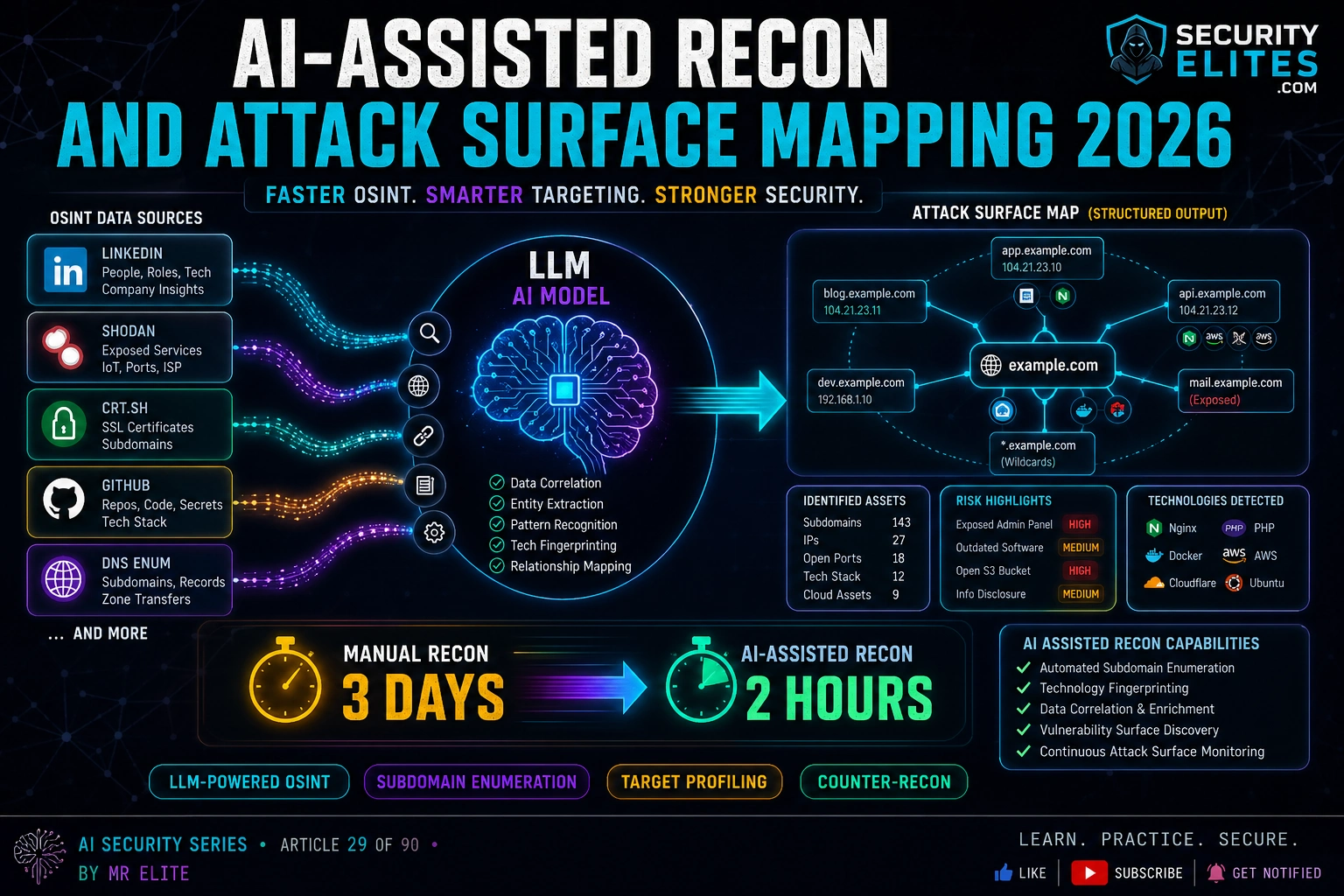
This article examines how large language models accelerate reconnaissance in penetration testing and bug bounty work by synthesizing and prioritizing data rather than collecting it, demonstrating that AI-assisted recon reduces analysis time from hours to minutes while introducing hallucination and scope risks that demand verification discipline. The article argues that AI's value lies in the analysis layer—interpreting subdomain lists, correlating OSINT sources, and generating vulnerability hypotheses—not in replacing traditional data collection tools like Amass, Subfinder, and Shodan.
Key insights
AI accelerates analysis, not data collectionTraditional recon tools (Amass, Subfinder, Shodan, Nuclei, crt.sh) continue to perform data collection by querying DNS, scanning ports, and harvesting certificates. AI sits atop this layer to interpret and prioritize the results. A penetration tester's recon phase compressed from three hours to forty minutes because AI now handles in thirty minutes what manual analysis took two hours—reading 2,000 subdomains, correlating Shodan banner data across 40 hosts, and ranking high-value targets. The data collection phase remained unchanged.
Pattern recognition across subdomain listsSubdomain enumeration produces raw lists requiring manual triage to identify dev/staging environments, admin panels, and internal tool patterns. AI applies pattern recognition at scale to spot dev prefixes suggesting weaker authentication, internal hostnames indicating single-sign-on bypass opportunities, and certificate SANs revealing unintended infrastructure. Specific prompting discipline determines output quality: asking 'What's interesting about this list?' produces generic observations, while asking 'Which 5 subdomains most likely correspond to authentication interfaces?' produces action
Shodan and OSINT synthesis produces significant gainsManual analysis of a /24 IP range with 40 active hosts requires reading hundreds of lines of banner data looking for version anomalies and misconfigurations; AI analysis of the same export takes minutes, identifying Apache 2.4.49 running with modern PHP (indicating CVE-2021-41773 vulnerability), FTP services on web hosts (typically misconfigured), and SSL certificate SANs revealing internal hostnames. OSINT correlation—connecting job postings, LinkedIn technology mentions, GitHub repositories, and public code—shows AI's cross-source synthesis capability, surfacing connections (like a job posti
Vulnerability hypothesis generation with CVE verificationProviding AI with technology stack fingerprints from httpx, WhatWeb, or Wappalyzer output and asking for vulnerability hypotheses produces prioritized research lists in minutes. For well-known technology combinations like Apache version X plus PHP version Y plus WordPress version Z, AI has extensive CVE history and produces reasonably accurate hypotheses. However, verification against the NVD is non-negotiable before including any CVE in testing scope or reports; the article illustrates this through a scenario where active testing confirmed an AI-flagged vulnerability, but emphasizes that CVE
Hallucination creates professional and legal liabilityAI can fabricate subdomains that don't exist, invent CVEs for identified technologies, or misattribute technology stack components. Hallucinated findings misdirect testing effort and, in professional assessments, can lead to reports containing findings that don't exist—a significant professional and legal liability. The article emphasizes that every AI-generated finding must be verified against primary sources, and that verification overhead (20-50% additional time for NVD cross-reference, subdomain validation, and OSINT source confirmation) must be included in time calculations to achieve act
Scope risk from autonomous AI recon toolsManual testers check scope before testing an interesting finding; autonomous AI tools with internet access may follow interesting leads across scope boundaries without checkpoints. For professional assessments using agentic AI tools, explicit scope boundaries in the AI's system prompt and per-action human authorization for active scanning are non-optional. The article distinguishes between AI assistance in the analysis layer (high value, manageable risk) and autonomous data collection by AI (scope violation risk requiring explicit authorization like any active scanning tool).
Practical prompting patterns for recon analysisThe article provides three concrete prompt templates: subdomain prioritization asking for five highest-priority targets with reasoning (focusing on dev/staging, admin panels, API endpoints, internal tool patterns); Shodan banner analysis identifying outdated versions with known CVEs, unusual port/service combinations, and inappropriately exposed services; and tech stack vulnerability hypothesis requesting three highest-priority CVEs with IDs for verification from httpx output. Each template emphasizes specificity and explicit output format to produce actionable triage rather than generic obser
Speed gains compound with workflow refinementThe article demonstrates consistent productivity gains of 5-10x on synthesis tasks through concrete time comparisons: subdomain triage from 45-90 minutes to 5-10 minutes, Shodan export analysis from 30-60 minutes to 5-8 minutes, multi-source OSINT correlation from 2-4 hours to 15-30 minutes. However, the first few AI-assisted recon runs are slower than manual analysis while prompts are tuned. As practitioners build a library of refined prompts calibrated to their specific tool outputs and target types, the speed advantage becomes substantially faster, but only if verification discipline remain
Bottom line: AI-assisted recon achieves 5-10x speed gains by synthesizing and prioritizing existing data through structured prompting, not by replacing traditional collection tools, but this acceleration only materializes when every AI-generated finding undergoes verification against primary sources (NVD for CVEs, domain resolution for subdomains, active fingerprinting for OSINT) as a non-negotiable workflow discipline. Scope boundaries and explicit human authorization for any autonomous scanning remain mand
A senior penetration tester I know used to spend three hours on the recon phase of an assessment: running Amass, processing the subdomain list, checking Shodan for the scope’s IP ranges, correlating the results, identifying the five or six most interesting targets before starting active testing. Now it takes forty minutes. The data collection phase takes the same time. The analysis and prioritisation — what used to take two hours — is thirty minutes of structured AI prompting and verification which we refer AI-Assisted Recon.
That’s the actual shape of AI’s impact on offensive security reconnaissance. The tools that collect data — Amass, Subfinder, Shodan, Nuclei — aren’t being replaced. The analyst time spent interpreting, correlating, and prioritising large datasets is being compressed. And that compression matters: a tester who reaches the high-value targets in forty minutes instead of three hours has more time for the exploitation phase where skill actually makes the difference.
🎯 After This Tutorial
Where AI actually accelerates recon — synthesis and prioritisation, not data collection
Practical prompting patterns for subdomain analysis, Shodan synthesis, and OSINT correlation
Vulnerability hypothesis generation from technology fingerprints — and when to trust it
The hallucination risks specific to AI recon workflows and how to build in verification
The authorisation and scope considerations when AI tools conduct or assist reconnaissance
⏱️ 20 min read · 3 exercises
📋 AI-Assisted Recon and Attack Surface Mapping – Contents
The AI assistance I find most valuable in recon isn’t discovery — it’s synthesis of what the tools already found. The productivity gain I measure from LLM-assisted recon over pure-manual approaches is consistently 5-10x on synthesis tasks. The AI recon workflow is a layer on top of traditional recon tools, not a replacement for them. Amass, Subfinder, Shodan, crt.sh, and Nuclei still do the data collection — querying DNS, scanning ports, harvesting certificates, checking services. What changes with AI in the loop is the analysis layer: what you do with that data once it’s collected.
A 2,000-subdomain Amass output used to require manual triage — scrolling through the list looking for interesting patterns, dev environments, unusual subdomains that might indicate internal tooling. AI reads the full list in seconds and surfaces the most interesting candidates with reasoning. A Shodan export for a /24 with 40 live hosts has banner data across dozens of services. AI identifies the version anomalies, the unusual port configurations, the service combinations that suggest specific vulnerability classes. The analysis that takes an experienced tester twenty minutes to do manually takes two minutes to prompt and verify.
AI RECON PROMPTING PATTERNS — PRACTICAL TEMPLATES
# Pattern 1: Subdomain prioritisation
PROMPT: “Here is a list of subdomains for [target].com. Identify the
5 highest-priority targets for web application testing and explain
why each is interesting. Look for: dev/staging environments, admin
panels, API endpoints, internal tool patterns, unusual naming.
[SUBDOMAIN LIST]”
# Pattern 2: Shodan banner analysis
PROMPT: “Analyse this Shodan export for [IP range]. Identify:
1) Services running outdated versions with known CVEs
3) Services that shouldn’t be internet-exposed for this target type
[SHODAN EXPORT]”
# Pattern 3: Tech stack vulnerability hypotheses
PROMPT: “Based on this technology fingerprint from httpx output:
Server: Apache/2.4.49, PHP/7.4.3, WordPress 6.0
What are the 3 highest-priority CVEs or vulnerability classes to
investigate first? Include CVE IDs for verification.”
# ALWAYS VERIFY: treat AI hypothesis as starting point, not finding
Cross-reference every CVE against NVD before including in report
AI-Assisted Subdomain and Asset Analysis
Subdomain analysis is where I get the most productivity gain from AI assistance — pattern recognition across large datasets. Subdomain enumeration produces raw lists. The analysis question — which of these 2,000 subdomains represents a high-value target worth active testing within a limited time window — is where AI provides the most direct speed improvement. The AI applies pattern recognition at scale: spotting dev/staging prefixes that often have weaker authentication, identifying internal tool hostnames that suggest single-sign-on bypass opportunities, flagging certificate SANs that reveal internal infrastructure not intended for external discovery.
The key prompting discipline is specificity. “What’s interesting about this subdomain list?” produces generic observations. “Which 5 subdomains most likely correspond to authentication or admin interfaces based on naming patterns, and what vulnerability class would you test first on each?” produces actionable prioritisation that translates directly to a testing plan.
securityelites.com
AI Recon — Speed Comparison vs Manual Analysis
Task Manual AI-assisted AI advantage
Triage 2,000 subdomains 45–90 min 5–10 min Pattern recognition at scale
Shodan export analysis (50 hosts) 30–60 min 5–8 min Version/CVE cross-reference
Multi-source OSINT correlation 2–4 hours 15–30 min Cross-source pattern matching
Tech stack vuln hypotheses 20–45 min 3–5 min CVE database synthesis
⚠️ Verification overhead not included: AI-generated findings require verification — add 20–50% time for NVD cross-reference, subdomain validation, OSINT source confirmation.
📸 AI recon time comparison vs manual analysis. The speed advantage is real and significant — but the verification overhead is not optional. An AI analysis that surfaces 8 high-priority subdomains in 5 minutes, 2 of which are hallucinated or misinterpreted, wastes more time than it saves if those 2 false positives redirect testing effort. The net time saving only materialises when verification is built into the workflow as a non-negotiable step.
🛠️ EXERCISE 1 — BROWSER (15 MIN · NO INSTALL)
Research AI Recon Tools and Methodology
⏱️ 15 minutes · Browser only
Understanding which AI recon tools exist and how professional bug bounty hunters and pentesters actually use them tells you what’s practically deployable vs what’s still experimental research.
Step 1: Find AI-enhanced recon tools
Search: “AI bug bounty recon tools 2025 subdomain enumeration”
Search: “GPT-4 Shodan analysis reconnaissance security”
What tools exist that specifically combine AI with recon data analysis?
Which are open-source vs commercial?
Step 2: Find practical workflows from bug bounty hunters
Search: “bug bounty AI recon workflow 2025 site:medium.com OR site:hackerone.com”
How are top hunters using AI in their recon phase?
What specific AI prompts or workflows have they published?
Step 3: Find the ReconFTW tool (AI-integrated recon framework)
Search: “ReconFTW AI integration 2025”
Does it include AI analysis of collected data?
What components does it use for asset discovery?
Step 4: Research Shodan + AI integration patterns
Search: “Shodan API + ChatGPT Claude recon workflow”
What’s the standard workflow for feeding Shodan results to AI?
What data format works best for AI analysis of banner data?
Step 5: Find published recon AI prompts
Search: “prompt injection recon AI pentest awesome prompts GitHub”
What community-contributed prompts exist for AI-assisted recon?
Which ones focus on vulnerability hypothesis from tech stack data?
✅ The practical workflows from bug bounty hunters (Step 2) are the most immediately applicable findings — these are people who’ve actually run these workflows against real targets and discovered what produces value vs what’s hype. The Shodan + AI integration pattern (Step 4) gives you the specific data format question that most practitioners initially struggle with: Shodan’s banner data is rich but unstructured, and feeding it to AI in a format that produces actionable analysis requires some prompt engineering. The community prompts (Step 5) give you a starting point library — not a substitute for developing your own tailored to your specific use cases, but a foundation to iterate from.
📸 Share the most interesting AI recon workflow or prompt you found in #bug-bounty.
Shodan and OSINT Synthesis
When I run Shodan + OSINT pipelines with AI synthesis, the output quality improvement over pure-manual analysis is consistently significant. Shodan queries for a target’s IP ranges produce banner data for every exposed service — server software versions, configuration details, SSL certificate information, and protocol responses. Manual analysis of a /24 with 40 active hosts means reading through hundreds of lines of banner data looking for version anomalies and unusual configurations. AI analysis of the same export takes minutes: it spots the Apache 2.4.49 running alongside a modern PHP stack (CVE-2021-41773 path traversal, one of the most exploited CVEs), the FTP service on a web host (almost always a misconfiguration), the internal hostname revealed in an SSL certificate SAN that wasn’t in the subdomain enumeration.
OSINT correlation — connecting job postings, LinkedIn technology mentions, GitHub repository contents, and public code to the target’s actual technology stack — is where AI’s cross-source synthesis capability is most pronounced. A human analyst correlating four sources manually misses intersections that appear obvious when all four sources are presented together. AI holds all four sources in context simultaneously and surfaces the connections: the job posting mentioning “Kubernetes on EKS” correlates with the subdomain pattern suggesting containerised microservices, which correlates with the GitHub repo containing an EKS configuration with an S3 bucket ARN that’s in scope.
Vulnerability Hypotheses from Tech Stack Fingerprints
Vulnerability hypothesis generation is the AI capability I find most useful in late-stage recon — it connects the enumeration output to the test plan. Providing an AI with technology stack fingerprints from httpx, WhatWeb, or Wappalyzer output and asking for vulnerability hypotheses produces a prioritised research list in minutes. For well-known technology combinations — Apache version X + PHP version Y + WordPress version Z — the AI has extensive CVE history to draw on and produces reasonably accurate hypotheses that align with what a manual NVD search would find.
The verification discipline is non-negotiable here. Every CVE the AI mentions needs to be cross-referenced against NVD before being included in testing scope or a report. The time saving is in the initial triage — AI surfaces the five most likely hypotheses so you start with the highest-probability targets rather than working through every CVE for every component alphabetically. The verification step ensures the five hypotheses are real.
RECON DATA → AI ANALYSIS → VERIFIED FINDINGS WORKFLOW
Only include verified CVEs and confirmed subdomains in scope
Hallucinated findings disqualified — no exceptions
🧠 EXERCISE 2 — THINK LIKE A HACKER (15 MIN · NO TOOLS)
Identify Where AI Recon Adds Value vs Where It Creates Risk
⏱️ 15 minutes · No tools — analysis only
The most common mistake in AI-assisted recon is applying AI where it adds noise and not applying it where it genuinely accelerates. Work through the evaluation for each recon phase.
For each recon activity below, rate AI assistance value (HIGH/MEDIUM/LOW)
and identify the primary risk. Then determine: at what point does AI
involvement cross from “analysis aid” to “active scanning risk”?
RECON ACTIVITY 1: Reading certificate transparency logs (crt.sh)
– Data volume: typically 50–500 subdomains
– Verification difficulty: easy (check if domain resolves)
– AI hallucination risk: what could AI confabulate here?
– AI value rating: ?
RECON ACTIVITY 2: Analysing 500-entry Shodan export for a /24
– Data volume: 500 entries, unstructured banner text
– Verification difficulty: moderate (check each finding)
– AI hallucination risk: what specific type of hallucination is most dangerous?
– AI value rating: ?
RECON ACTIVITY 3: Correlating 3 job postings + LinkedIn data for tech stack
– Data volume: ~5,000 words of unstructured text
– Verification difficulty: difficult (requires active fingerprinting to confirm)
– AI hallucination risk: AI may invent or misattribute technology usage
– AI value rating: ?
RECON ACTIVITY 4: Interpreting Nmap scan results for 50 open ports
– Data volume: structured, precise
– Verification difficulty: easy (data is factual)
– AI hallucination risk: low for data interpretation, higher for CVE claims
– AI value rating: ?
RECON ACTIVITY 5: Autonomous AI agent conducting DNS brute force
– Data volume: generates its own
– Scope risk: HIGH — AI may follow leads outside authorised scope
– Authorisation question: does your scope cover this?
– AI value rating: ?
SYNTHESIS QUESTION:
At what point in the recon workflow should a human checkpoint
be required before AI assistance continues?
What triggers the need for explicit human authorisation?
✅ The critical boundary revealed by this analysis: AI assistance in the analysis layer (reading existing data, correlating OSINT sources) has high value and manageable risk. AI assistance that generates or directs active data collection (DNS brute force, port scanning, vulnerability probing) crosses into territory requiring explicit authorisation — because the AI may follow interesting leads outside the defined scope boundary. For professional assessments, this means AI is appropriate for analysis tasks under human direction, and any autonomous data collection by AI tools requires the same scope confirmation as any active scanning tool. The human checkpoint should occur before any active scanning, regardless of whether a human or AI tool initiates it.
📸 Share your ratings for all 5 activities in #bug-bounty. Any disagreements with others?
The Hallucination and Scope Risks in AI Recon
The ethical and legal risks I enforce boundaries around in AI-assisted recon are non-negotiable regardless of the engagement scope. Two risks dominate AI recon workflows. The first is hallucination: AI fabricating subdomains that don’t exist, inventing CVEs for identified technologies, or misattributing technology stack components. Hallucinated findings misdirect testing effort and, in a professional assessment, can lead to reports containing findings that don’t exist — a significant professional and legal liability. Every AI-generated finding must be verified against primary sources.
The second risk is scope: autonomous AI recon tools following interesting leads outside the authorised target boundary. A manual tester who finds an interesting subdomain checks scope before testing. An autonomous AI tool with internet access may follow a link chain across scope boundaries without any checkpoint. For professional assessments using agentic AI tools, explicit scope boundaries in the AI’s system prompt and per-action human authorisation for active scanning are not optional.
🛠️ EXERCISE 3 — BROWSER ADVANCED (15 MIN · NO INSTALL)
Build an AI-Assisted Recon Workflow for a Bug Bounty Target
⏱️ 15 minutes · Browser + AI assistant access
Designing the workflow before running it is the discipline that separates productive AI-assisted recon from unfocused thrashing. Work through the complete design for a real bug bounty target.
Step 1: Pick a public bug bounty target with a known scope
Go to hackerone.com/programs or bugcrowd.com/programs
Find a program with a clearly defined scope (specific domains, not *.*)
Note the exact in-scope assets.
Step 2: Design the data collection phase (no AI)
Which tools would you run to collect recon data within scope?
(Subfinder, httpx, crt.sh, Shodan — within authorised scope only)
What outputs would you have after data collection?
Step 3: Design the AI analysis phase
For each data source you’d collect: write the specific AI prompt you’d use.
Be specific: what format would you provide the data in?
What specific output do you want from the AI? (List, ranked priorities, CVE IDs?)
Step 4: Design the verification phase
For each type of AI output: what verification step comes next?
Subdomain flagged as interesting → verify it resolves and is in scope
CVE hypothesis → verify against NVD before testing
OSINT correlation → verify by active fingerprinting (if in scope)
Step 5: Estimate time savings
Manual recon for this target (no AI): how long?
AI-assisted recon with verification: how long?
What’s the net time saving after verification overhead?
✅ The workflow you just designed has the three phases that make AI-assisted recon actually faster in practice: structured data collection with traditional tools (no shortcuts here), specific AI prompting with explicit output format requests (vague prompts produce vague analysis), and verification as a mandatory non-optional step. The time estimate in Step 5 is the most honest self-assessment: if your verification overhead erases the AI speed gain, the prompt engineering needs improvement. In practice, AI-assisted recon becomes significantly faster as you build a library of well-refined prompts for your specific tool outputs and target types — the first few runs are slower than manual while you tune the workflow, then substantially faster once the prompts are calibrated.
📸 Share your AI prompt designs (Steps 3 and 4) in #bug-bounty. Tag #AIRecon
Where AI accelerates recon, the prompting patterns that produce actionable output, vulnerability hypothesis from tech fingerprints, and the hallucination and scope risks that require verification discipline. Next Tutorial closes Day 6 with prompt injection in agentic workflows — when AI systems with autonomous execution capabilities become the target and the weapon simultaneously.
🧠 Quick Check
A penetration tester uses AI to analyse a Shodan export for their target’s IP range. The AI identifies Apache 2.4.49 on one host and flags CVE-2021-41773 (path traversal / RCE). Without NVD verification, the tester immediately tests for the vulnerability and confirms it. Should they have verified the CVE first?
❓ Frequently Asked Questions
How do ethical hackers use AI for reconnaissance?
Primarily to synthesise and prioritise large recon datasets — not to collect data. AI accelerates analysis of subdomain lists, Shodan result interpretation, OSINT correlation across multiple sources, vulnerability hypothesis generation from technology stack fingerprints, and attack path identification. The data collection phase still uses traditional tools (Amass, Subfinder, Shodan, httpx).
What are the risks of using AI in recon workflows?
Hallucination producing false intelligence (fabricated CVEs, non-existent vulnerability descriptions, misattributed technology stack components), over-reliance causing genuine findings to be missed, and scope risk from autonomous AI tools following leads outside authorised boundaries. All AI-generated findings require primary source verification before inclusion in assessments.
Can AI tools conduct reconnaissance autonomously?
Technically yes, but only within explicitly authorised scope. The risk of autonomous AI recon is scope creep — the AI following interesting leads outside the authorised target boundary without a human checkpoint. For professional assessments, use AI in the analysis layer with human-controlled data collection, not autonomous agents operating without per-action authorisation.
What recon tools integrate well with AI analysis?
Tools producing structured, text-exportable output: Amass and Subfinder (JSON/CSV subdomain output), Shodan CLI (structured banner data), httpx (web server enumeration with technology detection, JSON), Nuclei (structured vulnerability output), crt.sh (queryable API). The pattern: collect with specialised tools, feed structured output to AI for analysis and prioritisation.
Does using AI for recon require special authorisation?
Authorisation requirements depend on the activity (passive OSINT vs active scanning), not the tooling. Passive OSINT generally doesn’t require explicit authorisation. Active scanning requires it regardless of whether a human or AI tool initiates it. AI tools that autonomously conduct active scanning create additional scope violation risk if they follow leads without per-action human authorisation.
How accurate is AI-generated vulnerability hypothesis from recon data?
Variable — better for well-documented technology stacks with extensive CVE history, worse for newer or less common technologies. Treat AI vulnerability hypotheses as triage and prioritisation starting points requiring NVD verification before testing or reporting. The value is speed of surfacing likely candidates, not accuracy as a standalone source.
← Previous
LLM Fuzzing Techniques 2026
Next →
Prompt Injection in Agentic Workflows
📚 Further Reading
Kali Linux Day 21 — Recon-ng Tutorial— The traditional recon framework that AI analysis builds on — understanding the data sources Recon-ng queries helps you feed better structured data to AI analysis prompts.
Subdomain Enumeration Tools 2026— The data collection layer of AI-assisted recon: Amass, Subfinder, Assetfinder, and crt.sh — the tools that produce the subdomain lists AI analysis triages.
AI Hallucination Attacks 2026— the hallucination risk that makes verification discipline non-optional in AI recon workflows, including the specific CVE fabrication pattern most dangerous in security contexts.
OWASP Amass on GitHub— The primary open-source subdomain enumeration tool that generates the raw data AI recon analysis works on — JSON output format integrates cleanly with AI analysis prompting.
Shodan Explore— Shodan’s explore interface for understanding the types of internet-exposed service data available — the source material for AI-assisted service analysis and vulnerability hypothesis generation.
ME
Mr Elite
Owner, SecurityElites.com
The first AI recon workflow I built that actually saved time wasn’t the one I ran against large subdomain lists. It was the OSINT correlation step — feeding a target’s recent job postings, their GitHub org, their LinkedIn technology mentions, and their Shodan exposure into one analysis prompt. What came back was a technology stack profile that connected details I’d have taken two hours to manually correlate: specific Kubernetes version mentioned in a job posting, a config file in a public repo mentioning an internal S3 bucket ARN, a Shodan banner confirming the same cloud provider. Together they pointed directly at the attack surface to prioritise. The AI didn’t find anything that wasn’t in the public data. It just held all four sources in context simultaneously in a way that manual analysis over two hours doesn’t replicate.
Founder of Securityelites and creator of the SE-ARTCP credential. Working penetration tester focused on AI red team, prompt injection research, and LLM security education.