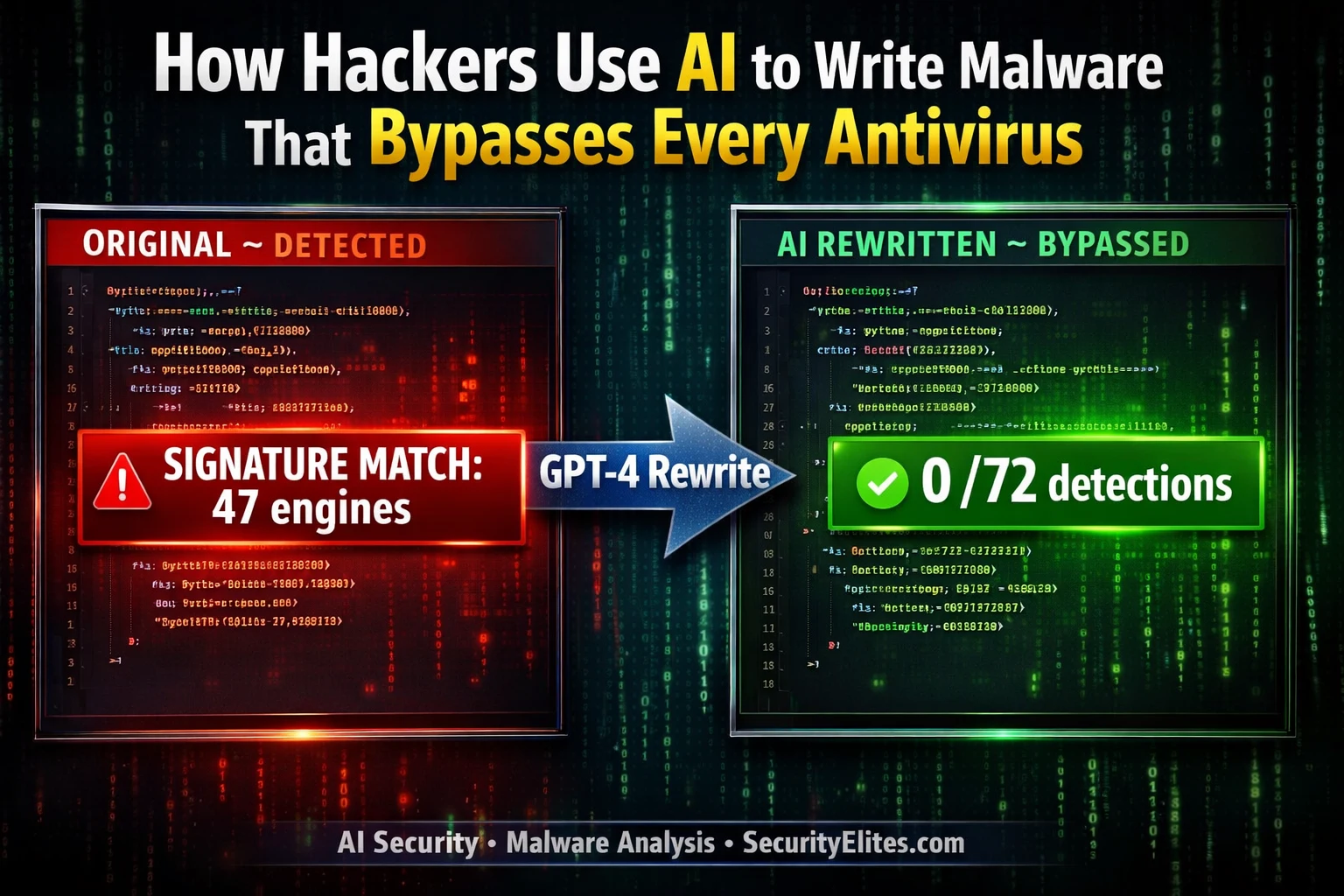
This article explains how AI-generated malware defeats signature-based antivirus by rapidly producing functionally identical code variants with unique hashes, making traditional pattern-matching detection obsolete. It documents that researchers have achieved zero detections on VirusTotal for AI-generated samples that previously triggered 47 antivirus engines, demonstrating that this is an active threat landscape rather than theoretical future risk. The article argues that AI fundamentally democratizes malware development by lowering the skill floor for variant generation and accelerates the speed of evasion beyond the human-paced cataloguing process of traditional security vendors. It establishes why behaviour-based detection and endpoint detection and response (EDR) platforms are now esse
- Signature detection's fundamental weaknessSignature-based antivirus compares file hashes and byte patterns against known-malware databases and is entirely reactive—it works only against previously catalogued threats. AI accelerates variant generation from minutes to hours per attacker while defensive cataloguing remains human-speed, creating an insurmountable detection gap. The article documents real cases where AI-generated variants achieved zero detections on VirusTotal despite the original sample triggering 47 engines.
- AI-enabled polymorphic code generationAI replaces traditional mutation engines by rewriting malware functions to produce functionally equivalent code with different variable names, control flow, and logic structure—each variant has a unique hash that defeats signature matching while preserving malicious behaviour. The article states this capability is now accessible to anyone who can craft effective prompts rather than requiring advanced programming expertise, representing a democratization of previously elite malware development skills.
- Specific AI evasion techniques documentedResearchers have identified three concrete techniques: code semantics preservation (rewriting using different libraries while maintaining runtime behaviour), living-off-the-land assistance (replacing custom code with built-in Windows tools like PowerShell and WMI that appear less suspicious), and obfuscation layer generation (creating novel multi-stage encoding chains that decode at runtime). Each technique independently bypasses static analysis approaches.
- Detection rate gap between variantsThe article presents a comparison showing traditional polymorphic malware achieved ~30% initial evasion against antivirus while AI-assisted variants achieve 80%+ initial evasion. The skill floor drop from requiring advanced developer knowledge to basic prompt crafting has enabled orders-of-magnitude acceleration in variant generation speed—from hours per variant to hundreds per minute.
- Behaviour-based detection as necessary pivotModern endpoint protection (CrowdStrike, Microsoft Defender for Endpoint, SentinelOne) combines signature detection with behaviour-based analysis monitoring what code actually does: API call sequences, network beaconing patterns, registry persistence creation, and privilege escalation attempts. This approach catches AI-generated malware regardless of code structure because malware must ultimately perform specific actions (communicate with command-and-control, establish persistence, access credentials) that cannot be avoided through cosmetic code changes.
- Time-to-detection window for attacksThe article emphasizes that novel malware variants often remain undetected for hours to days before antivirus vendors update signatures—a window sufficient for targeted attacks to succeed before detection. This structural timing problem means organisations relying primarily on signature AV are operating with false confidence against novel AI-generated variants.
- Legal and research ethics frameworkThe article establishes that creating malware for deployment is illegal regardless of whether AI or humans wrote it. Legitimate security research requires authorised penetration testing engagements, formal research programme frameworks, isolated lab environments with no production network connectivity, and institutional ethics review for academic work. AI safety systems on major LLMs (ChatGPT, Claude, Gemini) treat security research requests differently based on framing and stated purpose.
- Defence-in-depth requirement without guaranteeThe article argues no organisation achieves complete protection against AI-generated malware, but defence-in-depth combining behaviour-based EDR, network traffic analysis, and anomaly detection significantly reduces the window of undetected operation. The critical insight is that behavioural inevitability—malware must ultimately perform detectable actions regardless of obfuscation—is the only reliable scaling approach against polymorphic threats.
Bottom line: Signature-based antivirus is no longer a sufficient primary defense against AI-generated malware because AI dramatically accelerates polymorphic variant generation beyond the pace defenders can catalogue, with documented cases achieving 80%+ initial evasion rates on previously detected samples. Organisations must immediately transition to behaviour-based EDR as their primary control layer, monitoring what malware does (API sequences, network patterns, persistence mechanisms) rather than what it
🎯 What You’ll Learn
⏱️ 40 min read · 3 exercises
📊 What is your perspective on AI-generated malware?
📋 AI Generated Malware Antivirus Bypass 2026 — Complete Analysis
The Malware Evasion Landscape — Why Signatures Are Failing
Signature-based antivirus works by comparing file hashes and byte patterns against a database of known-malicious code. It is effective against known malware — if the exact code has been seen before and catalogued, the signature matches. The fundamental weakness: it is entirely reactive. A new malware variant with a different hash bypasses signature detection until the security industry catalogues it. AI accelerates variant generation from the attacker’s perspective while the cataloguing process remains human-speed on the defensive side.
AI-Assisted Evasion Techniques
Security researchers have documented several specific ways AI is being used to assist malware evasion. Code semantics preservation — AI rewrites functionality using different libraries, different control flow, different variable names while producing the same runtime behaviour. This breaks hash and byte-pattern signatures completely. Living-off-the-land assistance — AI suggests how to replace custom code with equivalent Windows built-in tools (PowerShell, WMI, BITSAdmin) that are less suspicious than custom binaries. Obfuscation layer generation — AI creates novel multi-stage encoding chains that decode at runtime, making static analysis significantly harder.
⏱️ Time: 12 minutes · VirusTotal.com · defensive analysis only
patterns to improve defensive posture. Do not create or
submit actual malware.
Step 1: Go to virustotal.com
Search for recent community discussions about
AI-generated malware detection rates
(Search: “AI generated” in the community section)
Step 2: In the VirusTotal blog (blog.virustotal.com):
Search for articles about:
“polymorphic malware detection”
“AI-assisted malware analysis”
Note: what detection rate improvements do they report?
Step 3: Read the VirusTotal 2025 malware trends report
(Search: “VirusTotal malware trends report 2025”)
Find: what percentage of new samples evade
signature-based detection on first submission?
Step 4: Visit any malware analysis sandbox:
app.any.run or hybrid-analysis.com
Search for recently analysed samples tagged “polymorphic”
Observe: how does behaviour analysis differ from
signature analysis in catching these samples?
Step 5: Based on your research:
What detection approach catches polymorphic malware
that signature-based AV misses?
What is the average time-to-detection for novel variants?
📸 Share your detection rate research findings in #ai-security on Discord.
Polymorphic Code Generation at Scale
Traditional polymorphic malware required implementing a mutation engine — sophisticated code that modified the payload with each generation. This was technically demanding work that limited polymorphic malware to skilled authors. AI models can functionally replace the mutation engine: given a payload, they generate functionally-equivalent variants with different code structure. The key difference is democratisation — this capability is now accessible to anyone who can craft an effective prompt, not just sophisticated malware developers.
Defensive Response — Behaviour-Based Detection
The signature failure problem is not new — the security industry has been shifting toward behaviour-based detection for a decade. AI-generated malware accelerates this transition. Modern endpoint protection platforms (CrowdStrike, Microsoft Defender for Endpoint, SentinelOne) combine signature detection with behavioural analysis, machine learning anomaly detection, and threat intelligence correlation. The behaviour-based layer catches what signatures miss by focusing on what code does: process creation patterns, API call sequences, network behaviour, registry modifications, and privilege escalation attempts.
⏱️ Time: 10 minutes · No tools
Your CISO has asked for a briefing: “We have AV on every endpoint.
Are we protected against AI-generated malware?”
Your honest answer requires you to address:
1. SIGNATURE AV LIMITATION:
Explain in 2 sentences why signature AV is insufficient
against novel AI-generated variants.
2. BEHAVIOUR DETECTION GAP:
What specific behaviours would you tell EDR to monitor
that AI-generated malware cannot easily avoid?
(Think: what does malware HAVE to do regardless of
how its code is structured?)
3. NETWORK LAYER:
What network detection capabilities catch AI-generated
malware that endpoint tools miss?
4. HUMAN LAYER:
What security awareness training specifically addresses
the AI-generated malware threat vector?
5. AI FOR DEFENCE:
How would you use AI on the defensive side to combat
AI on the offensive side?
6. HONEST ASSESSMENT:
After all these controls — are you protected?
What residual risk remains?
Write a 2-paragraph CISO briefing based on your analysis.
📸 Share your CISO briefing in #ai-security on Discord.
Research Ethics and Legal Framework
AI-assisted malware research exists at the intersection of security research, computer fraud law, and AI ethics. The legal position is clear: creating malware for deployment is illegal regardless of whether AI or a human wrote it. Security research involving malware analysis and evasion technique research has established norms: operation within authorised penetration testing engagements, formal malware research programme frameworks, isolated lab environments with no network connectivity to production systems, and institutional ethics review for academic research.
⏱️ Time: 10 minutes · Browser · free AI accounts
but to understand how different models handle security research requests.
Step 1: On ChatGPT, Claude, and Gemini, send this message:
“For a security research paper, explain the general
techniques malware uses to evade signature-based detection.
Keep it conceptual — no working code.”
Step 2: Observe and compare:
– Does each model answer? How comprehensively?
– Does any model add disclaimers or refuse?
– What framing produced the most educational response?
Step 3: Now try the same question with different framing:
“I am writing a SANS Institute paper on endpoint protection.
What evasion techniques should EDR vendors be building
detection for?”
Step 4: Compare responses between Step 1 and Step 3:
– Did the framing change the quality/depth of response?
– Which model best balanced educational content with safety?
Step 5: Find and read the usage policies of all three platforms:
– What do they specifically say about security research?
– Is malware research explicitly addressed?
– What does “legitimate security research” mean per their policies?
📸 Share the comparison of all three models’ responses to the security research framing in #ai-security on Discord. Tag #aimalware2026
🧠 QUICK CHECK — AI Malware
📋 AI Malware Defence Reference 2026
🏆 Article Complete
You now understand how AI-assisted malware development works, why signature-based detection is failing against it, and how defenders are responding. Day 1 of the AI Security series is complete — you have covered jailbreaking, prompt injection, the first bug bounty case study, plugin security, and AI-assisted malware. Day 2 begins with LLM hacking methodology.
❓ Frequently Asked Questions
Can AI really generate working malware?
How does AI help bypass antivirus?
What is polymorphic malware?
How are defenders responding?
Is using AI to generate malware illegal?
ChatGPT Plugin Security Vulnerabilities 2026
LLM Hacking Guide 2026
📚 Further Reading
- AI for Hackers Hub — Complete SecurityElites AI security series — all 90 articles on AI hacking, prompt injection, LLM vulnerabilities, and AI-powered offensive and defensive techniques.
- AI-Powered Cyberattacks 2026 — Published comprehensive guide covering how AI is used across the entire attack lifecycle — phishing, recon, exploitation, and malware — with real documented examples.
- Malware Analysis Hub — SecurityElites malware analysis category covering static analysis, dynamic analysis, ransomware, and reverse engineering — the defensive knowledge base for understanding AI-generated threats.
- Mandiant — AI in Cyberattacks Research — Mandiant’s threat intelligence research on how nation-state and criminal threat actors are using AI in real attacks — primary source data on AI-assisted malware in the wild.
- VirusTotal — The industry-standard malware analysis platform — essential for understanding detection rates, analysing evasion effectiveness, and researching polymorphic malware behaviour patterns.