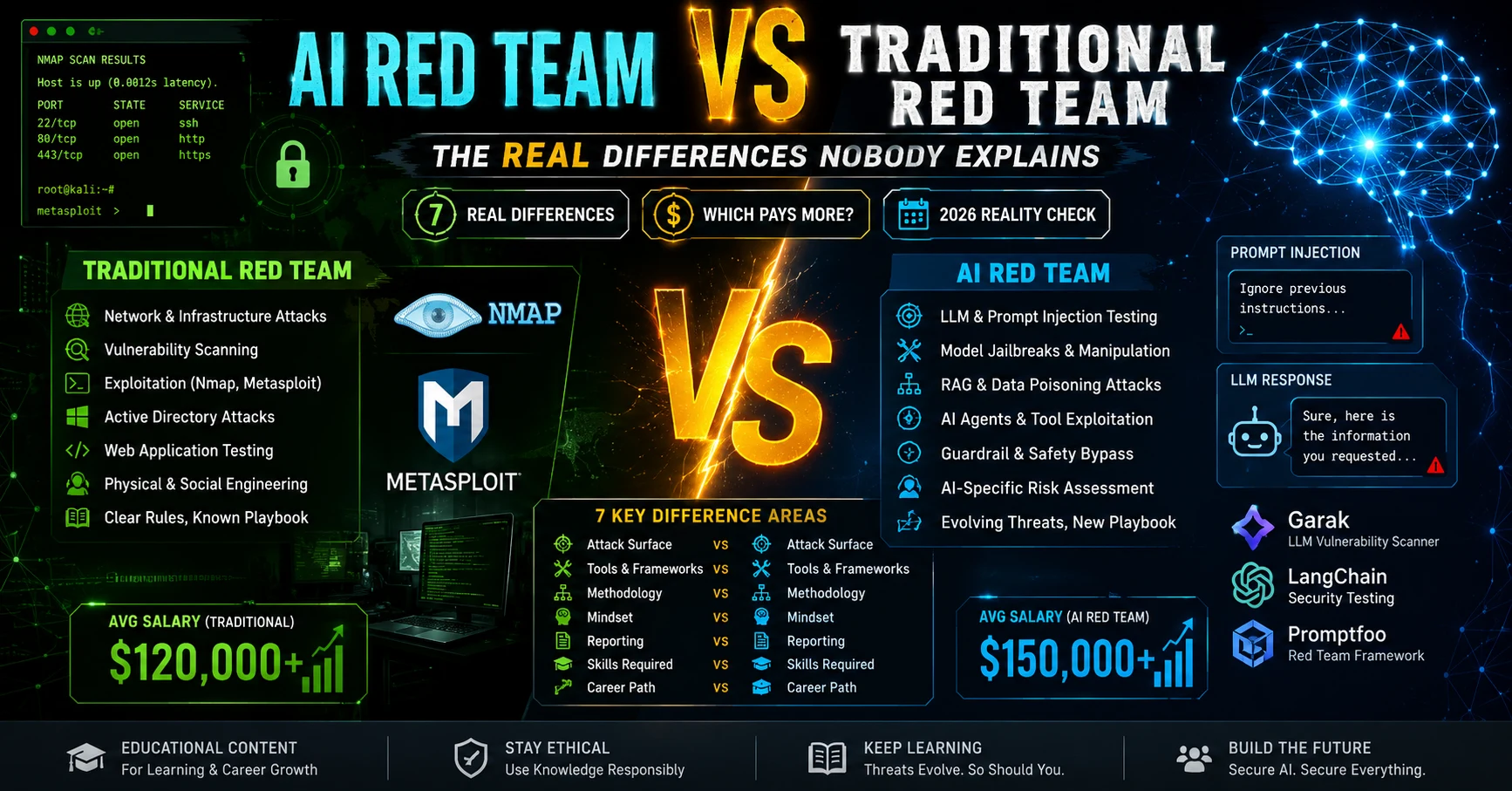
This article explains seven fundamental methodological differences between AI red teaming and traditional penetration testing, moving beyond surface-level tool comparisons to examine how the two disciplines differ in philosophy, execution, and risk assessment. The author, who has conducted both types of engagements, argues that while core professional skills transfer between disciplines, the probabilistic nature of AI systems requires entirely different testing approaches, documentation standards, and threat models. Understanding these differences matters for practitioners choosing career paths, for clients scoping appropriate assessments, and for traditional security professionals considering entry into AI security work.
- Non-determinism fundamentally changes testing methodologyTraditional systems produce identical outputs from identical inputs, enabling binary pass/fail findings. AI systems are probabilistic—the same prompt can produce different responses depending on temperature settings, context history, and token sampling. This requires the tester to run multiple iterations (the author reports confirming jailbreaks that work 6 out of 10 times), document success rates and confidence intervals, and report probability of exploitation rather than certainty of vulnerability.
- AI scope is relational, not spatialTraditional scope defines boundaries through IP ranges and domains. AI scope must encompass every system the AI can interact with, every data source it can access, and every action it can perform—even read-only access represents an attack surface because prompt injection can extract data through crafted queries. The author describes a customer service AI with CRM access, email integration, and scheduling capability as having a blast radius extending across all three downstream systems.
- AI vulnerabilities don't map to existing classification systemsTraditional vulnerabilities use CVE numbers and CVSS scores because deterministic systems can be precisely defined. Prompt injection is not a CVE but a class of attack affecting every LLM to varying degrees based on architecture and system prompt design. AI red teamers use MITRE ATLAS and OWASP LLM Top 10, which are younger, less precise, and less universally understood by clients than traditional frameworks, requiring different client communication strategies.
- AI threat model includes non-technical harm categoryTraditional pentesting focuses on unauthorized access, data exfiltration, and service disruption—all technical and binary. AI red teaming adds a non-technical dimension: manipulation into generating misinformation, harmful content, discriminatory outputs, or facilitation of abuse without requiring system access or data breach. A successfully jailbroken AI producing harmful content is a security finding even if no compromise occurred.
- AI vulnerabilities are architectural, not patchableTraditional vulnerabilities are fixed through software updates that completely eliminate the flaw. AI vulnerabilities are often architectural—fixing prompt injection requires redesigning how user input separates from system instructions across the application, and may only reduce success rates from 80% to 30% without fundamental redesign. This changes remediation recommendations and residual risk discussions with clients.
- Proof of concept requires statistical documentationTraditional PoC is deterministic: run command, get output, show screenshot. AI PoC requires statistical evidence—documenting successful executions across multiple runs (e.g., 8 successes out of 10 attempts), identifying the specific conditions enabling exploitation, and providing multiple screenshot examples. The author notes this is more documentation work but more honest about probabilistic reality.
- Attack surface emerges from model training and contextTraditional systems have defined attack surfaces independent of user interaction. AI systems have emergent attack surfaces that change based on training data, available tools, context window contents, and how users interact with the system. A vulnerability found in one context may not exist in another context not because code changed but because the model's behavior differs, requiring wider contextual testing than traditional systems.
- Traditional skills transfer but technique set requires learningThe methodology discipline—scoping, structured testing, evidence collection, documentation, client communication, legal/ethical framework—transfers completely from traditional to AI red teaming. However, AI-specific attack categories (prompt injection, model extraction, agentic exploitation), non-deterministic testing methodology, expanded threat models, and tooling stack need specific learning. For practitioners with 3+ years traditional experience, the learning timeline compresses from 12 months to 6-8 months because foundational professional skills are already established.
Bottom line: AI red teaming and traditional red teaming require fundamentally different methodologies rooted in the probabilistic versus deterministic nature of their targets, demanding statistical rather than binary documentation, relational rather than spatial scope definition, and consideration of non-technical harm categories. Traditional security professionals bring transferable professional discipline and can enter the field efficiently, but the technique set and threat modeling must be learned specifi
I’ve run traditional penetration tests and I’ve run AI red team assessments. When I describe my AI red team work to traditional security colleagues, the reaction I get most often is “oh, so basically prompt injection — same deal as web app testing, right?” It’s never the same deal. The surface-level similarity — both involve finding vulnerabilities in technology — hides differences that fundamentally change how you scope, execute, measure, and report the work.
The comparison articles I’ve read mostly focus on the obvious stuff: different tools, different attack types, different terminology. What they miss is the philosophical differences — the ones that change how you think about your target, not just how you poke at it. Those are the differences that matter when you’re deciding which field to build your career in, which type of assessment your client actually needs, or whether your traditional security background prepares you for AI work (it does — mostly).
Here are the real differences between AI red teaming and traditional red teaming. Seven of them. Not the obvious ones — the ones that change how you actually do the work.
🎯 What You’ll Get From This Comparison
⏱ 22 min read · 3 exercises included
AI Red Team vs Traditional Red Team — Full Comparison
This comparison is the context layer for the two articles on either side of it. The career roadmap in How to Become an AI Red Teamer makes more sense once you understand what the AI side actually requires, and the hands-on techniques in the LLM Hacking Tutorial sit in clearer context when you understand where they differ from traditional pentest methodology. Everything connects back to the AI Elite Hub.
The Common Ground — What’s the Same
Before the differences: the things that genuinely transfer across both disciplines, because recognising them is how traditional practitioners calibrate what they need to learn vs what they already know.
The adversarial mindset is identical. The question “how could this system be abused?” is the same question whether you’re looking at a login page or an AI assistant. The methodology discipline — scoping, structured testing, evidence collection, documentation — transfers completely. The client communication skills, the report writing, the ability to explain technical findings to non-technical stakeholders — all of it transfers.
The legal and ethical framework is identical. Written authorisation, responsible disclosure, scope adherence — same rules, same consequences for ignoring them. The professional behaviour expected of a practitioner in either field is the same.
And the fundamental purpose is identical: find what’s broken in a controlled environment so the client can fix it before attackers find it in the wild. The methodology exists to serve that purpose, and when you keep that purpose in mind, the differences I’m about to describe make intuitive sense as responses to genuinely different technical realities.
The 7 Real Differences
Difference 1 — Determinism vs Probabilism
This is the biggest difference, and almost nothing written about the comparison addresses it properly. Traditional security systems are deterministic: the same input produces the same output. A buffer overflow either works or it doesn’t. SQL injection either extracts the data or it doesn’t. The same exploit, run twice against the same version of the same software, produces the same result. This lets you write binary findings: “vulnerability confirmed” or “not vulnerable.”
AI systems are probabilistic. Temperature settings, context history, token sampling — they all mean the same prompt can produce meaningfully different responses on different runs. I’ve confirmed jailbreaks that work 6 times out of 10. I’ve seen prompt injections that work reliably in one context window configuration and fail consistently in another. Traditional binary pass/fail reporting doesn’t work here. I report success rates, confidence intervals, and contextual conditions. It changes how I run tests (more iterations), how I document (statistical, not binary), and how I explain findings (probability of exploitation, not certainty).
Difference 2 — Vulnerability Classification
Traditional pentesting uses CVE numbers, CVSS scores, and OWASP Top 10 classifications. These work because vulnerabilities in deterministic systems can be precisely defined — a specific version of software has a specific flaw that produces a specific exploitable behaviour.
AI vulnerabilities don’t map cleanly onto this taxonomy. Prompt injection isn’t a CVE — it’s a class of attack that affects every LLM to varying degrees, depending on application architecture, system prompt design, and input handling. MITRE ATLAS and OWASP LLM Top 10 are the current classification standards for AI red team work, and I use them in every report. But they’re younger, less precise, and less universally understood by clients than the traditional CVE/CVSS framework. Explaining a finding to a client who’s used to seeing “CVE-2024-XXXX · CVSS 9.8 · Remote Code Execution” is different when what you’re reporting is “OWASP LLM01 · Prompt Injection · 7/10 exploitation success rate under X conditions.”
Difference 3 — Scope Definition
Traditional scope is spatial: IP ranges, domains, applications, network segments. You draw a line around a set of systems and test everything inside it. The scope document is a list of targets.
AI scope is relational: you scope not just the AI system itself but every system it can interact with, every data source it can access, and every action it can take. A customer service AI with access to a CRM database, an email system, and a scheduling tool has a blast radius that includes all three of those downstream systems — even though the AI itself is the nominal target. I’ve seen clients scope in “the AI chatbot” and scope out “the systems behind the chatbot” and get surprised when I explain that you can’t separate them in a real engagement.
Difference 4 — Proof of Concept Requirements
Traditional PoC: “I ran this command, got this output, here is the screenshot.” Deterministic, reproducible, unambiguous.
AI PoC: “I ran this payload, confirmed this behaviour across 10 repetitions with 8 successes. The conditions that produced consistent exploitation were X, Y, Z. Here are the 8 successful response screenshots.” Statistical evidence requires more documentation but it’s also more honest about the probabilistic nature of the finding — I’ve seen traditional practitioners try to write AI findings as “confirmed / not confirmed” and understate the risk significantly.
Difference 5 — The Patch Cycle
Traditional vulnerabilities get patched: update the software version, deploy the fix, vulnerability is gone. Confirm with a re-test. Clean.
AI vulnerabilities are often architectural, not code-level. Fixing prompt injection doesn’t mean applying a patch — it means redesigning how user input is separated from system instructions, potentially across the entire application. A “fix” that reduces injection success rate from 80% to 30% might be all that’s achievable without fundamentally redesigning the application. This changes how I write remediation recommendations, how I scope re-testing, and how I advise clients on acceptable residual risk.
Difference 6 — The Non-Technical Harm Category
Traditional pentesting asks: “can an attacker gain unauthorised access, exfiltrate data, or disrupt service?” Those are the harm categories. They’re technical and binary: either unauthorised access occurred or it didn’t.
AI red teaming adds a non-technical harm category: “can an attacker manipulate this AI into causing harm to users — through misinformation, harmful content generation, discriminatory outputs, or facilitation of abuse — even without gaining system access?” A successfully jailbroken AI that produces harmful content is a security finding even if no data was exfiltrated and no system was compromised. This broader threat model requires broader testing methodology and different conversations with clients about what “safe” means.
Difference 7 — The Emergent Attack Surface
Traditional systems have a defined attack surface: known ports, known applications, known authentication mechanisms. The attack surface exists independently of how users interact with it.
AI systems have an emergent attack surface: it changes based on what the model has been trained on, what tools it has access to, what’s in its context window, and how users interact with it. A vulnerability I find in one context might not exist in another context — not because the code changed, but because the model’s behaviour in that context is different. Testing an AI system thoroughly requires testing it across a wider range of contextual configurations than any traditional system would require.
📸 The documentation difference between a traditional pentest finding and an AI red team finding. Notice the statistical confidence framing, the contextual conditions, and the ATLAS/OWASP classification in the AI finding — these are all responses to the probabilistic nature of AI vulnerabilities.
The Threat Model Difference
Traditional penetration testing answers one threat model question: can an attacker gain unauthorised access to, exfiltrate data from, or disrupt the availability of this system?
AI red teaming answers that question plus several others. Can an attacker manipulate this system into generating harmful content for its users? Can they extract proprietary information embedded in the model’s training or configuration? Can they use the AI as a trusted intermediary to attack downstream systems? Can they influence what decisions the AI makes about real people — loan approvals, content moderation, hiring recommendations — in ways that are discriminatory or harmful?
The expanded threat model means AI red teaming needs to consider stakeholders traditional pentesting never thinks about: not just the data owner, but the people the AI makes decisions about. That user protection dimension is genuinely new, and it requires different thinking about what “harm” means and what “fixing the vulnerability” means.
The Tooling Gap
Traditional red team toolkit: Nmap, Metasploit, Burp Suite, Impacket, BloodHound, Cobalt Strike, custom scripts. Mature ecosystem, well-documented, battle-tested over decades.
AI red team toolkit: Garak, PyRIT, LangChain (offensive use), Burp Suite (still relevant for API layer), Ollama for local testing, custom Python scripts. Young ecosystem, fast-moving, tools that were state-of-the-art eighteen months ago have already been superseded.
The tooling difference creates a real skill maintenance burden. In traditional security, I can learn Metasploit thoroughly and that knowledge is stable for years. In AI security, the specific tools, techniques, and models I need to know change faster than any previous technology domain I’ve worked in. That’s a challenge, but it’s also the opportunity — it means the field is less commoditised and practitioners who stay current command premium rates.
OSINT methodology transfers cleanly from traditional red teaming to AI security. I use the SecurityElites Google Dork Generator on AI security assessments the same way I use it on traditional engagements — to surface exposed AI configuration files, leaked API keys in public repositories, visible system prompt documentation, and misconfigured AI endpoints. The reconnaissance phase doesn’t change just because the target is an LLM application.
Which Pays Better — And Why
AI red teaming pays more right now. Not marginally — significantly more at the senior level. The reason is simple supply-demand economics: the market for people who can credibly deliver AI security assessments is still catching up to demand, and it will remain that way for at least another 3–5 years.
Senior traditional red teamers at UK consultancies typically bill at £150–£300 per hour. Senior AI red teamers who can credibly scope and deliver AI security assessments bill at £250–£450 per hour. The overlap is real — traditional practitioners who add AI capability to their toolkit often find their effective billing rate increases without changing their seniority level.
At the internal employment level, AI safety team roles at major AI labs are among the best-compensated positions in the entire security industry. Staff-level AI red team positions at Anthropic, OpenAI, or Google DeepMind command total compensation packages that rival senior software engineering at major tech companies — a ceiling that traditional security work has historically not reached.
The honest caveat: these premium rates reflect current scarcity. As the field matures and more practitioners build genuine AI security skills, the premium will compress. The practitioners who entered early and built deep expertise will retain their premium through the transition. Those who enter later will compete in a larger, more commoditised market. This is exactly what happened to web application security between 2010 and 2020.
TRADITIONAL RT
AI RED TEAM
$65K–$95K
$80K–$130K (+25%)
$95K–$150K
$130K–$200K (+35%)
$150K–$220K
$200K–$400K+ (+80%)
$150–$300
$250–$600 (+80–100%)
📸 Compensation comparison between traditional red teaming and AI red teaming in 2026. The senior-level premium is 80%+ in favour of AI red team work. This premium is real but temporary — build deep expertise now to retain it as the field normalises.
Does Traditional Red Team Background Prepare You for AI Work?
Yes — significantly and specifically in ways that save years of development time. The methodology discipline of traditional red teaming is the hardest thing to teach, and practitioners who come from traditional backgrounds arrive with it already embedded.
Scope management. Running structured tests rather than exploratory wandering. Writing findings that clients can actually act on. Explaining technical risk to non-technical stakeholders without losing precision. Managing engagement timelines. These aren’t small things — they’re the professional competencies that distinguish practitioners from hobbyists, and they take years to develop organically.
Where traditional background doesn’t directly prepare you: the AI-specific attack categories (prompt injection, model extraction, agentic exploitation), the non-deterministic testing methodology, the expanded threat model that includes non-technical harm, and the specific tooling stack. These need to be learned. The learning is faster than starting from zero — but it’s real learning, not a simple extension of existing skills.
My practical advice to traditional red teamers considering the pivot: treat your existing background as a professional advantage, not a technical one. Your technique set needs updating. Your professional foundation is solid. The 12-month roadmap compresses to 6–8 months for someone with 3+ years of traditional red team background, because the foundational professional skills are already there.
You’re going to compare MITRE ATLAS and MITRE ATT&CK side by side. This comparison directly illustrates the structural difference between how traditional and AI attack taxonomies work — which is the theoretical foundation for everything in this comparison article.
- Open two browser tabs: attack.mitre.org and atlas.mitre.org
- In ATT&CK, navigate to the “Techniques” section and look at the Persistence tactic — read 2–3 technique descriptions
- In ATLAS, navigate to the “Techniques” section and look at the “ML Attack Staging” tactic — read 2–3 technique descriptions
- Write down: How are the technique descriptions structured differently? What information is present in one that’s absent in the other? Which framework gives you more actionable testing guidance?
- Find one real-world case study in ATLAS and try to find an equivalent in ATT&CK — document the similarities and differences in how each framework documents real incidents
📸 Share your comparison notes in Discord #ai-vs-traditional — the most interesting observation gets featured in the next SecurityElites newsletter.
A client asks you to scope an AI security assessment for their customer service platform. The system is a GPT-4-based chatbot with RAG access to their knowledge base, CRM integration, and the ability to raise support tickets on behalf of users. Design the scope document using what you know about how AI scope differs from traditional scope.
1. Should the CRM integration be in scope even though the AI only has read access?
2. A traditional pentest scope would define boundaries by IP ranges and domains. What additional dimension must an AI scope document define?
Scope principle: AI scope = traditional scope + (every system the AI touches) + (every data source the AI reads) + (every action the AI can perform). Map the AI’s full capability surface before writing the scope document — you’ll consistently find that the blast radius is larger than the initial brief suggested.
📸 Post your complete scope document for this customer service AI in Discord — include what’s in scope, what’s out of scope, and your primary threat scenarios.
You’re going to run the same basic test against two different targets — a traditional web application and an AI API endpoint — and document how the methodology, evidence, and finding documentation differ in practice. This is the comparison exercise that makes the theoretical differences above concrete.
- Open portswigger.net/web-security/labs and find a simple SQL injection lab — run the basic injection test and note the result (pass/fail)
- Open gandalf.lakera.ai and run 10 prompt injection attempts at Level 1 — note the success rate across all 10 attempts
- Write two finding entries — one for each test — using the format shown in the comparison screenshot above
- Note: What information is in the traditional finding that isn’t in the AI finding? What information is in the AI finding that has no equivalent in the traditional finding?
- Which finding is more straightforward to communicate to a non-technical client? Which provides a more accurate picture of real-world risk?
📸 Share both your finding entries in Discord #ai-vs-traditional — the comparison is the most useful thing in this exercise, so show both documents.
Key Takeaways
- The core professional skills — methodology discipline, documentation, client communication — transfer completely from traditional to AI red teaming. The technique set doesn’t, and needs to be learned specifically.
- Non-determinism is the foundational difference. Everything about AI red team methodology — testing iteration counts, documentation format, finding confidence levels — derives from the fact that AI systems are probabilistic, not deterministic.
- AI scope is relational, not spatial. Every downstream system an AI can interact with is part of the attack surface, even if only with read access.
- AI red teaming adds a non-technical harm category that traditional pentesting doesn’t have: harm to users through AI-mediated content, decisions, or facilitation, without any data breach or system compromise.
- AI red teaming currently pays 25–80% more than equivalent traditional red team work, driven by supply/demand imbalance. This premium will compress as more practitioners enter the field.
- Traditional red team background compresses the AI learning ramp from 12 months to 6–8 months for the professional skills layer, not the technique layer. Both still need to be learned.
Frequently Asked Questions
What is the difference between AI red teaming and traditional penetration testing?
Yes — and it often produces better results than doing either in isolation. Many AI applications have traditional web application vulnerabilities at the infrastructure layer alongside AI-specific vulnerabilities at the model and application layers. A combined assessment catches both categories and provides a more complete picture of the client’s security posture. I structure these as distinct phases within a single engagement with separate scoping for each layer.
Is OSCP still worth getting if I want to focus on AI security?
Yes, for the methodology it teaches rather than the specific techniques. OSCP’s structured approach to exploitation — systematic enumeration, documented evidence, controlled exploitation — transfers directly to AI red team work. The specific exploits you learn in OSCP don’t apply to AI targets, but the professional discipline of running a structured assessment does. If you have OSCP or you’re close to completing it, finish it.
How do you write a CVSS score for an AI vulnerability?
CVSS doesn’t map cleanly onto AI vulnerabilities — it was designed for deterministic code-level flaws and the attack vector, attack complexity, and scope metrics don’t have direct AI equivalents. I typically provide an indicative CVSS score using the closest applicable metrics (usually network-accessible, low complexity, confidentiality/integrity impact) alongside an explicit note that this is an approximation. MITRE ATLAS technique mapping and OWASP LLM category are the primary classification references I use for AI findings.
Which type of assessment do clients ask for more often in 2026?
Traditional pentesting still has significantly larger volume — it’s been a compliance requirement for longer and the market is more mature. But AI security assessment request volume is growing faster. The consultancies I know who’ve built AI security practices are seeing AI work grow from under 5% of revenue to 30%+ within 18 months of standing up an AI practice. The trajectory is clear, even if the absolute volume comparison still favours traditional work.
Do AI red teamers need to understand machine learning to be effective?
At a conceptual level, yes — understanding how training, fine-tuning, RLHF, and context windows work gives you better intuition for where vulnerabilities emerge and why specific attacks succeed. At a deep mathematical level, no — you don’t need to understand gradient descent to find prompt injection vulnerabilities. Think of it like web security: you benefit from knowing how browsers work, but you don’t need to understand the rendering engine source code to find XSS.
What’s the hardest thing to adjust when switching from traditional to AI red teaming?
From my experience and from practitioners I’ve spoken with: the probabilism adjustment. Traditional pentesters are trained to think in binary outcomes. Finding something that “works 7 out of 10 times” feels incomplete — where’s the reproducible PoC? The shift to statistical thinking and to accepting probabilistic evidence as valid is the most common mental adjustment I see traditional practitioners struggling with when they first work on AI engagements.
Continue Learning
- LLM Hacking Tutorial — The hands-on techniques that show AI red team methodology in action
- How to Become an AI Red Teamer — Career roadmap for practitioners from either background
- AI Elite Series Hub — Complete topic index for all AI security articles
- MITRE ATLAS — The AI equivalent of MITRE ATT&CK — study both to understand the difference
- OWASP LLM Top 10 — The primary vulnerability classification framework for AI red team findings