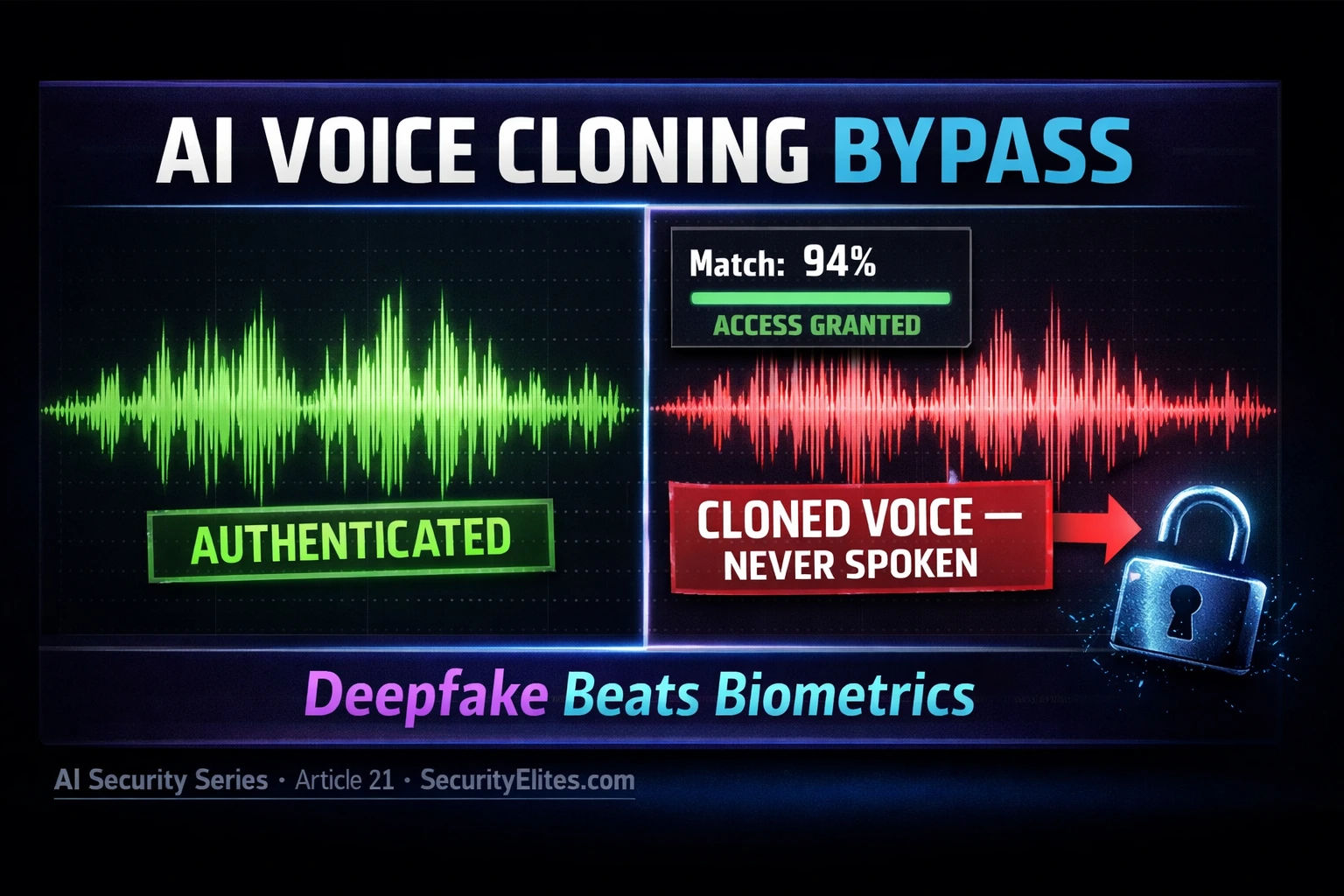
This article examines how modern AI voice cloning technology defeats voice biometric authentication systems used in banking and enterprise security. It documents real fraud cases where attackers obtained voice samples from public sources, generated high-quality clones using commercial tools like ElevenLabs, and successfully bypassed authentication to gain account access. The article explains the technical mechanisms enabling these attacks, identifies why existing defenses fail, and specifies which security controls actually prevent voice cloning fraud.
- Voice cloning requires minimal training audioElevenLabs generates usable clones from 30 seconds of audio; published research shows Microsoft's VALL-E achieves ~60-70% speaker similarity from just 3 seconds. Training data is abundant and publicly accessible: YouTube videos, podcasts, earnings calls, conference presentations, and social media provide clear audio samples for virtually any identifiable person. The article notes that most public figures and executives have hours of clean, recorded speech available online without any collection effort.
- Voice biometrics extract features clones reproduceVoice biometric systems measure fundamental frequency, formant frequencies, speaking rate, and spectral envelope—the exact acoustic characteristics that voice cloning models are trained to replicate. A voiceprint is fundamentally a mathematical fingerprint of these features. The article states that systems comparing a cloned utterance to a genuine voiceprint are comparing two representations designed by systems trained to make them as similar as possible, creating an inherent architectural vulnerability.
- Documented fraud cases show real-world exploitationThe article references cases from 2023-2024 where attackers successfully bypassed voice biometric authentication at financial institutions by calling contact centres, playing pre-generated cloned audio during authentication, and gaining full account access with automatic approval and no human review. A 2019 case involved attackers using cloned voice to impersonate a UK energy company CEO and successfully request a €220,000 wire transfer. The article notes that voice cloning quality has improved significantly since 2019, lowering the barrier to similar attacks.
- Legacy anti-spoofing models lack current threat detectionMany deployed voice biometric systems contain anti-spoofing classifiers trained on 2019-2020 synthetic speech artifacts, designed to detect the 'characteristic robotic artifacts' of older TTS technology that modern neural systems have eliminated. The article cites a demonstration showing a 2022 voice clone scoring 71% on voice biometric comparison while a 2024 clone from the same three-second source audio scored 94%—illustrating the gap between systems defending against outdated threat models and current clone quality.
- Multi-layer detection remains incomplete against real-time conversionThe article describes four defense layers: challenge-response phrases (defeated by real-time voice conversion), anti-spoofing classifiers (must be continuously retrained), liveness detection (effective against replay but less so against real-time conversion), and voiceprint comparison. High-quality clones can score 85-95% on voiceprint matching. The residual gap is real-time voice conversion—processing live audio through a voice transformation pipeline with low latency—which the article identifies as 'not fully solved by current detection' and the 'emerging frontier' of attack capability.
- Voice samples vary by target profile accessibilityThe article structures voice collection effort by target profile: public figures require minutes of effort from earnings calls and YouTube; semi-public individuals (LinkedIn profiles, small business owners) require hours from social media and Zoom recordings; private individuals require significant effort or social engineering. For banking fraud against private customers, collection is 'higher effort but not infeasible' given accessible voice traces. Phone banking IVR systems vulnerable to lower-quality audio samples increase feasibility even for private targets.
- Independent 2FA is the primary recommended defenseThe article states that the design principle most reliably addressing voice cloning risk is 'not relying on voice as the sole authentication factor for high-risk actions.' Voice biometrics is appropriate as a frictionless identifier or one factor in MFA, but not as sole authentication for wire transfers, account changes, or sensitive data access. For organizations retaining voice as primary authenticator, specific improvements include continuously retraining anti-spoofing classifiers against current neural TTS, generating unique session-specific challenge phrases, integrating caller ID metadat
- Vendor anti-spoofing model vintage is critical questionThe article advises security architects to ask voice biometric vendors two specific questions: (1) When was the anti-spoofing component last retrained and on what training data? (2) What is the tested bypass rate against modern neural TTS systems? The article explains that a vendor's reported 0.1% false accept rate describes performance against legitimate human impostors but may say nothing about synthetic voice attack performance. Voice clones specifically designed to match an enrolled voiceprint may achieve 50-80% accept rates against outdated anti-spoofing models.
Bottom line: Voice biometric authentication is fundamentally broken as a sole security factor in 2026 because high-quality voice clones require only seconds of publicly available audio and defeat systems still running outdated anti-spoofing models. Organizations must immediately implement independent multi-factor authentication (such as SMS or app-based verification) for any high-risk action, verify their voice biometric vendor's anti-spoofing model was trained on current neural TTS attacks, and understand t
Here’s what nobody tells you about this: the attack doesn’t need a sophisticated lab. ElevenLabs costs $5 a month. The voice sample is on LinkedIn’s conference recordings. The bank’s IVR number is on their website. The entire attack chain is available to anyone motivated enough to follow a tutorial. I’ve watched this demonstrated live. It’s as simple as it sounds.
What I want to give you in this article is the technical understanding of exactly how the cloning works, exactly where voice authentication fails, and — most importantly — the specific controls that actually stop this class of attack. Because there are controls that work. They’re just not being deployed fast enough.
🎯 What You’ll Learn
⏱️ 35 min read · 3 exercises · Article 21 of 90
📋 AI Voice Cloning Authentication Bypass 2026
How Modern AI Voice Cloning Works
Let me explain exactly what’s happening technically so you understand why this is hard to defend against. Modern voice cloning works in two stages. First: a universal TTS model trained on large corpora of speech data that understands how to produce natural-sounding speech, and a speaker adaptation mechanism that takes a short sample of the target voice and modifies the model’s output to match that speaker’s characteristics.
ElevenLabs’ voice cloning requires approximately 30 seconds of clean audio. Microsoft’s VALL-E (published research) demonstrated reasonable speaker similarity from 3 seconds of audio. Open-source implementations including Coqui TTS and Bark produce clones from similarly minimal samples. The quality improvement curve has been steep — clones that would have fooled only naive listeners in 2022 now pass human evaluation studies with high consistency. The sources of training audio are publicly available and abundant: recorded interviews, video content, podcasts, earnings calls, conference presentations, social media video — any source where the target speaks clearly for a few seconds.
| Training Audio | Speaker Similarity (Human eval) | Naturalness Score | Biometric Risk |
| 3 seconds | ~60-70% | Moderate | Medium |
| 30 seconds | ~80-88% | High | High |
| 5+ minutes | ~90-95% | Very High | Critical |
How Voice Biometric Authentication Works — and Where It Fails
To understand why voice cloning defeats biometrics, you need to know how the authentication actually works. The system stores a mathematical fingerprint of your voice — called a voiceprint — and compares it against every call. The voiceprint captures speaker-specific characteristics: fundamental frequency (the base pitch of the voice), formant frequencies (the resonant peaks that give voices their characteristic timbre), speaking rate, and spectral envelope shape. These characteristics are extracted using signal processing algorithms that produce a compact numerical representation of the speaker’s vocal identity.
The vulnerability is that these same features — the ones voice biometric systems measure — are exactly what voice cloning systems reproduce. High-quality voice clones closely match the original speaker’s fundamental frequency, formant structure, and spectral characteristics because that is precisely what the cloning model is trained to optimise for. A voice biometric system comparing a cloned utterance to the genuine voiceprint is comparing two representations that were produced by systems trained to make them as similar as possible.
The systems most vulnerable to voice cloning are those that rely solely on voiceprint comparison without anti-spoofing layers. Legacy telephone-based voice biometric systems in banking and insurance were designed to detect synthetic speech from older TTS technology that produced characteristic robotic artifacts — artifacts that modern neural TTS systems have largely eliminated. Systems that have not been updated to include classifiers specifically trained against current neural voice synthesis output operate with a fundamentally outdated threat model.
Voice Cloning Attack Scenarios Against Real Systems
Banking IVR authentication bypass. Several documented fraud cases involve attackers calling bank contact centres that use voice biometric authentication. The attacker obtains a voice sample of the target from a phone call or social media video, generates a clone using a commercial or open-source voice synthesis tool, and plays the pre-generated audio during the authentication phase of the IVR call. Cases documented in 2023-2024 showed this approach succeeding against financial institutions that had not updated their anti-spoofing classifiers since deploying their voice biometric systems.
Executive impersonation in business communications. A documented attack pattern involves cloning a senior executive’s voice and using it in phone calls or voicemails to subordinates requesting urgent wire transfers or credential sharing — a voice-based variant of business email compromise (BEC). A documented 2019 case involving the CEO of a UK energy company involved attackers using cloned voice to impersonate the parent company’s CEO and successfully request a €220,000 wire transfer. The quality of voice cloning technology has improved significantly since 2019, lowering the barrier to similar attacks.
Smart device activation. Consumer voice assistants (Amazon Echo, Google Home, Apple HomePod) authenticate users by voice in some configurations. Research has demonstrated that voice clones can trigger device wake words and commands in laboratory conditions, with results varying significantly based on device model, microphone quality, and room acoustics. The threat to consumer smart devices is lower than enterprise voice biometrics due to limited command scope, but smart home devices that control physical access (locks, security systems) warrant attention.
⏱️ 15 minutes · Browser only
Search: “voice cloning fraud bank 2023 2024”
Search: “AI voice deepfake authentication bypass case”
Find 2-3 documented real-world cases.
What authentication system was targeted?
What was the outcome?
Step 2: Research the ASVspoof challenge
Search: “ASVspoof challenge voice anti-spoofing 2024”
This is the academic challenge driving voice spoofing detection research.
What attack types does it cover?
How are current detection models performing?
Step 3: Find the NIST voice biometric evaluation results
Search: “NIST speaker recognition evaluation SRE 2023 2024”
What detection methods performed best against synthetic speech?
What is the gap between academic detection rates and real-world deployment?
Step 4: Test your own deepfake audio detection ability
Go to: ai-voice-detector.com or similar public tools
Listen to paired audio samples (real vs cloned).
Can you reliably identify the synthetic voice?
What auditory cues do you use?
Step 5: Assess the current threat level
Based on your research:
What percentage of current voice biometric deployments have
specifically updated to defend against modern neural TTS clones?
What is the expected fraud trajectory over 2026?
📸 Screenshot one documented fraud case summary. Share in #ai-security on Discord.
Anti-Spoofing Detection Technology
Anti-spoofing detection for voice authentication operates as a separate classifier layer that analyses submitted audio for indicators of synthetic origin before passing to the biometric comparison. The ASVspoof challenge series (the primary academic benchmark for voice anti-spoofing) has driven significant improvement in detection models — the best systems in ASVspoof 2024 achieve sub-5% equal error rates against known attack types in laboratory conditions. The gap between laboratory performance and production deployment effectiveness is the operational challenge.
Liveness detection approaches analyse temporal patterns in audio that indicate whether speech was produced by a human vocal tract in real time. Pre-recorded audio — regardless of whether it is a synthetic clone or a genuine recording — shows different micro-temporal patterns than live speech. This includes absence of room acoustic signatures, different noise floor characteristics, and temporal regularity that differs from spontaneous live speech. Challenge-response protocols that ask unpredictable phrases require real-time generation — effective against pre-recorded replay attacks but less effective against real-time voice conversion systems that can process live audio through a voice conversion pipeline in near real time.
Where Attackers Find Voice Samples
The barrier to a voice cloning attack is not technical — it is obtaining sufficient audio of the target. For most identifiable people, this barrier is surprisingly low. YouTube videos, podcast interviews, earnings call recordings, conference presentations, TED talks, social media videos, company promotional content, news interviews — any of these containing even 30 seconds of clear audio from the target is sufficient training material for a high-quality clone. For senior executives at public companies, hours of clear audio are typically available from investor relations recordings.
For private individuals (typical banking customers), the sources are more limited but still accessible: voicemail greetings, social media video posts, phone call recordings (which some services provide), and audio from video conferencing platforms that may be shared or recorded without the speaker’s awareness. An attacker targeting a specific individual has plausible means to obtain voice samples across multiple contexts. The effort required scales with the target’s public profile — publicly prominent individuals require essentially zero collection effort, while truly private individuals require social engineering or technical means to obtain audio.
Authentication Design Resistant to Voice Cloning
The design principle that most reliably addresses voice cloning risk is not improving voice biometric detection — it is not relying on voice as the sole authentication factor for high-risk actions. Voice biometrics is appropriate as a frictionless identifier (establishing who is calling) and as one factor in multi-factor authentication. It is not appropriate as the sole authentication gate for wire transfers, account changes, or sensitive data access in 2026 threat model conditions.
For organisations that must retain voice as a primary authentication mechanism, the security improvements with highest impact are: continuous retraining of anti-spoofing classifiers against current neural TTS output (not 2020-era models), challenge-response phrases that are generated per session and not repeated, integration of caller ID metadata anomaly detection (voiceprint match from a number with no prior association to that caller is anomalous), and explicit high-risk action verification via an independent channel (SMS, app notification, or callback to a registered number).
⏱️ 15 minutes · No tools required
– Customers enrol by calling in and speaking their passphrase 3 times.
– Authentication: caller says their name + passphrase.
– System checks voiceprint match at 90% threshold.
– If authenticated, agent can access account and process transfers.
– Voiceprint model was last updated in 2022.
THREAT MODEL QUESTIONS:
1. ATTACK FEASIBILITY
What is the minimum publicly available audio needed for this attack?
Where would an attacker find customer voice samples?
(hint: most people leave voice traces in many places)
2. ATTACK EXECUTION
Outline the attack steps end-to-end.
What is the single hardest step for the attacker?
What is the time investment?
3. DETECTION GAPS
What does the 2022 anti-spoofing model NOT detect?
What anomaly signals would a security-aware analyst notice?
Would anything in this system catch the attack?
4. IMPACT ASSESSMENT
If authentication succeeds, what can the attacker request?
What is the maximum financial impact from one call?
5. REMEDIATION PRIORITY
Rank these remediations by effectiveness:
– Update anti-spoofing model to 2025 training data
– Add challenge-response (unpredictable phrase)
– Require independent 2FA for high-value transactions
– Add human review flag for voiceprint matches < 95%
- Add caller ID anomaly detection
📸 Share your threat model and remediation ranking in #ai-security on Discord.
⏱️ 15 minutes · Browser only
Search: “ASVspoof 2024 results anti-spoofing voice”
Find the top-performing detection models.
What architectures perform best?
What attack types remain hardest to detect?
Step 2: Research commercial voice biometric vendors’ responses
Search: “Nuance voice biometric deepfake protection 2024”
Search: “voice biometrics anti-spoofing update 2024 2025”
Which vendors have explicitly updated for neural TTS threats?
What claims do they make about detection rates?
Step 3: Research the real-time voice conversion frontier
Search: “real-time voice conversion low latency 2024”
How fast can current systems convert voice in real time?
What detection window does this create for liveness detection?
Step 4: Find responsible disclosure on voice biometric vulnerabilities
Search: “voice biometric bypass responsible disclosure 2024”
Have researchers formally disclosed bypass findings to vendors?
What was the vendor response?
Step 5: Design your voice authentication security standard
If you were writing a security standard for a financial institution
using voice biometrics, what minimum requirements would you specify?
(consider: model vintage, anti-spoofing layers, MFA requirements,
high-risk action verification)
📸 Screenshot your voice authentication security standard requirements. Post in #ai-security on Discord. Tag #voicebiometrics2026
🧠 QUICK CHECK — Voice Cloning Authentication
📋 Voice Cloning Authentication Risk Quick Reference 2026
🏆 Mark as Read — AI Voice Cloning Authentication Bypass 2026
Article 22 covers AI jailbreaking research — how researchers study LLM safety robustness and what the findings mean for AI security practitioners.
How to Red Team Voice Authentication Systems
Here’s what I actually do when I’m testing a client’s voice authentication. First thing: I don’t start with cloning tools. I start by recording the target’s voice from public sources — earnings calls on YouTube, conference recordings, podcast appearances. Most executives have several hours of clean audio publicly available without ever touching the phone system.
The second thing I check is whether the authentication system uses dynamic challenges or static verification. “What’s your mother’s maiden name?” is not authentication in 2026 — it’s a knowledge factor that can be found on LinkedIn, a genealogy site, or a data breach dump. The combination of OSINT plus voice cloning makes static knowledge factors near-useless.
Third: I test the liveness detection directly. Most commercial voice biometric systems have a documented threshold for anti-spoofing detection. What they don’t document publicly is how that threshold performs against 2024 and 2025-era neural synthesis. When I run ElevenLabs output through a system trained on 2019 synthetic speech patterns, the failure rate is sobering.
The key point for any red team engagement involving voice systems: you need explicit written authorisation covering the specific voice authentication channel, the specific account identifiers being tested, and the specific synthetic audio generation tools you plan to use. “General pentest scope” does not cover this. Get it in writing, in detail.
❓ Frequently Asked Questions — AI Voice Cloning Authentication 2026
Can AI really clone someone’s voice from a short recording?
How do voice biometric systems work?
What is the success rate of voice cloning against biometric systems?
What are the highest-risk contexts?
How can voice biometric systems detect synthetic speech?
Is voice cloning for authentication bypass illegal?
Article 20: Autonomous AI Agent Attack Surface
Article 22: AI Jailbreaking Research
📚 Further Reading
- Article 20: Autonomous AI Agent Attack Surface — Voice cloning enables the social engineering attack vector that often precedes agentic AI compromise — an executive voice clone requesting credential sharing triggers the initial access.
- AI-Powered Cyberattacks 2026 — Voice cloning is one of several AI capability classes being operationalised in offensive security tools and criminal fraud operations.
- AI Security Series Hub — Full 90-article AI security curriculum — Articles 21-25 form the AI capability attack block.
- ASVspoof Challenge — Anti-Spoofing Research — The academic benchmark driving voice anti-spoofing technology — results, datasets, and top-performing detection models.
- NIST Speaker Recognition Evaluation — NIST’s comprehensive speaker recognition and spoofing evaluation programme — the standard reference for voice biometric security assessment.