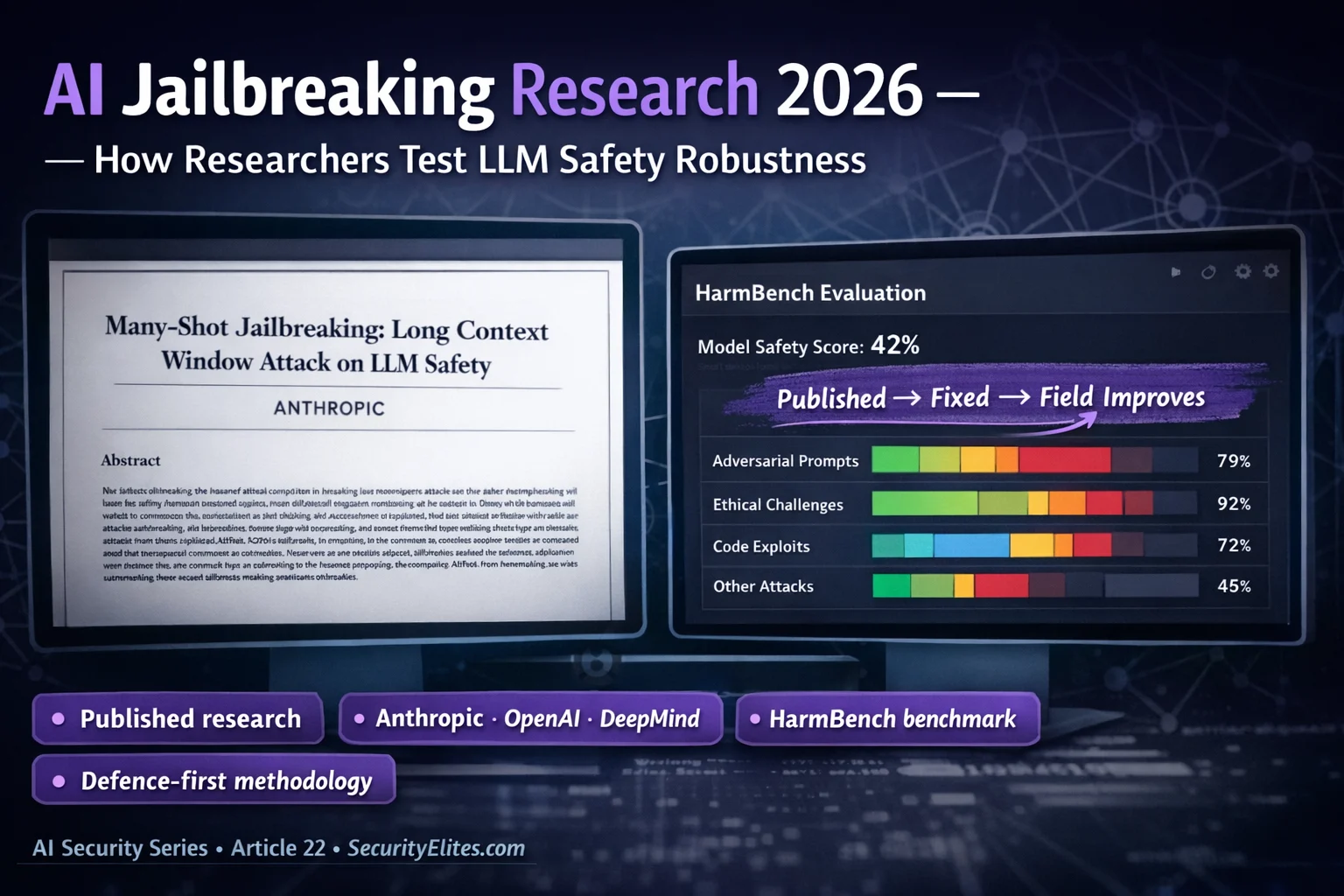
This article explains AI safety robustness research — the legitimate, controlled study of how language model safety systems respond to adversarial inputs — and distinguishes it from malicious attacks. It covers why major AI labs publish their own safety vulnerabilities after fixing them, key findings from published research (safety training gaps, long-context compliance shifts, multilingual weaknesses), how practitioners use standardized benchmarks like HarmBench to evaluate models objectively, and the operational security implications for enterprise AI deployments.
- Research versus misuse distinctionThe article defines the dividing line between legitimate AI safety research and misuse as intent (improve safety vs. obtain harmful content), scope (confirming failure category exists vs. extracting harmful outputs), and responsible handling (disclosure to developer vs. public sharing before fix). Technique alone does not determine which is which. This framework aligns with traditional security research standards where confirming a vulnerability exists does not require full exploitation.
- Why AI labs publish own vulnerabilitiesAnthropic's Many-Shot Jailbreaking paper (2024) demonstrates the standard approach: identify a safety failure, develop mitigations, deploy them to production, then publish findings with full methodology. The rationale is that independently discoverable techniques will be found by others anyway; publishing after fixing ensures all labs develop mitigations simultaneously rather than each discovering the vulnerability independently or after active exploitation begins. This follows the same logic as CVE publication in traditional security.
- Safety training generalisation gapsPublished research consistently shows that safety training generalizes strongly on high-frequency harmful request patterns (models reliably refuse direct requests like 'how do I make X?') but weaker on rare or indirect framings (hypothetical scenarios, historical analysis, fictional contexts, novel phrasings). The core finding is that models have learned to recognize specific surface patterns rather than harmful intent in general, driving continued investment in safety training research.
- Many-shot long-context compliance shiftAnthropic's research found that providing many prior examples of harmful Q&A pairs in long conversation contexts shifts the model's baseline compliance with subsequent requests, even when the individual examples would be refused in isolation. The effect scales with context length and example count, exploiting in-context learning capabilities that safety training did not anticipate because evaluation was primarily on short single-turn interactions.
- HarmBench standardized evaluation frameworkHarmBench defines standardized attack categories (direct request, indirect request, multi-turn, jailbreak variants) with reproducible evaluation methods measuring attack success rates across models and versions. For practitioners, this enables evidence-based model selection and version-to-version safety comparison (e.g., showing a safety improvement from 62% to 89% on multi-turn attacks), providing data beyond vendor claims.
- Multilingual safety coverage weaknessResearch groups have identified that safety training coverage is significantly stronger in English than other languages, reflecting composition of safety training data — more examples and more careful red-teaming in English. This finding has driven multilingual safety training investment across major labs and means applications deployed for non-English users must specifically evaluate safety in deployment languages rather than assuming English scores generalize.
- Deployment-level mitigations for defendersThe article identifies specific operational implications from published research: applications with long conversation histories require monitoring for many-shot attacks; task-scoped system prompts explicitly limiting authorized capabilities provide deployment-level defense supplementing model-level safety; multilingual deployments need language-specific safety evaluation. These defenses operate at the system level independent of model safety generalisation.
- Model version management imperativeThe article emphasizes that AI safety improvements flow through model version updates within weeks to months of research publication. Continuing to run older model versions means inheriting all published vulnerabilities fixed in newer versions. The article explicitly states 'We're still on Claude 3 Haiku from 18 months ago' is not acceptable AI security practice in 2026, treating model updates like patch management in traditional security.
Bottom line: AI safety robustness research conducted by major labs with responsible disclosure produces actionable knowledge that defenders must use operationally: monitor published findings from primary research sources, manage model versions like security patches, and supplement model-level safety with deployment-specific defenses (context monitoring, system prompt scoping, language-appropriate evaluation) rather than assuming any single model version provides complete safety coverage for all use cases.
This is the same discipline as penetration testing. You break your own systems — carefully, with proper controls — so that hostile actors don’t break them first. The difference between a security researcher and an attacker isn’t the technique. It’s the intent, the authorisation, and what you do with the finding.
What I’m covering here is what published AI safety research actually tells practitioners — the findings that matter for defenders, the threat model that matters for enterprise AI deployments, and the line between legitimate research and misuse that anyone working in this space needs to understand clearly.
🎯 What You’ll Learn
⏱️ 35 min read · 3 exercises · Article 22 of 90
📋 AI Jailbreaking Research 2026
What AI Safety Robustness Research Is
Let me be precise about what this research actually is. AI safety robustness research tests whether a model’s safety training holds up under adversarial inputs — inputs designed to probe the edges. The question isn’t “can I make this model produce harmful content” but “where does safety training fail to generalise, and what systematic patterns characterise those failures?” This is the same question security researchers ask about any security control: not “can this be bypassed?” (almost anything can) but “where are the systematic weaknesses and how do we fix them?”
The tools researchers use fall into three categories: automated probing (using LLM-based or optimisation-based systems to search the input space for safety failures), structured human red teaming (domain experts systematically testing specific content categories and framings), and comparative evaluation against standardised benchmarks (measuring failure rates across attack categories and comparing across models and versions). The output is structured: specific failure modes documented with examples, frequency data, and — crucially — recommendations for how safety training or system design should be improved.
This is where I want to be direct with you because this line matters. Legitimate research stops at confirming a failure category exists. It does not generate harmful content to document the bypass, they do not share specific bypass techniques publicly before the developer has addressed them, and they report findings through responsible disclosure channels. This is the same standard applied in traditional security research: confirming SQL injection exists does not require extracting the entire database to prove it.
Why AI Labs Publish Their Own Vulnerabilities
Anthropic’s 2024 Many-Shot Jailbreaking paper is the clearest example of an AI lab publishing its own safety vulnerability. The research found that providing a large number of prior examples in the conversation context — exploiting the long context windows of modern LLMs — could gradually shift the model’s compliance with harmful requests. Anthropic identified this, developed mitigations, deployed them in their models, and then published the finding with full methodology. The publication came after the fix was deployed.
The rationale for publishing after fixing is explicit in the paper itself: the technique is independently discoverable — other researchers and adversaries were likely to find it. Publishing ensures all AI labs have the information to develop their own mitigations rather than discovering it independently (or after it is being actively exploited). This is the same logic behind CVE publication in traditional security: a patched vulnerability is more safely disclosed than concealed, because concealment doesn’t prevent discovery by others.
OpenAI and Google DeepMind follow similar principles. OpenAI’s model card publications include documented safety limitations. DeepMind’s Gemini safety reports describe systematic evaluation findings. This transparency is partly regulatory pressure, partly genuine commitment to field improvement, and partly the practical recognition that safety limitations in shipped products will eventually become public — better through structured disclosure than uncontrolled discovery.
Key Findings from Published Research
Safety training generalisation. Research consistently finds that safety training generalises better on high-frequency request patterns than rare or novel ones. Safety training datasets contain many examples of direct harmful requests — models learn to refuse “how do I make [harmful thing]?” reliably. The same harmful intent expressed through indirect framing, hypothetical scenarios, historical analysis, or fictional contexts shows weaker coverage. The model has not learned to recognise harmful intent in general; it has learned to recognise specific surface patterns. This is the core finding that drives continued safety training research.
Long context compliance shift. Anthropic’s Many-Shot Jailbreaking finding: in long context windows, providing many prior examples of harmful Q&A pairs — even ones the model would refuse in isolation — shifts the model’s baseline compliance with subsequent requests. The effect scales with context length and example count. This exploits the model’s in-context learning capability (its ability to adapt behaviour based on examples) in ways that safety training did not anticipate, because safety training was primarily evaluated on short single-turn contexts.
Cross-lingual safety gaps. Multiple research groups have found that safety training coverage is significantly stronger in English than in other languages. This reflects the composition of safety training data — more examples, more careful red-teaming, and more fine-grained category coverage in English. The finding has driven multilingual safety training investment across major AI labs.
Automated probing effectiveness. PAIR (Prompt Automatic Iterative Refinement) and similar automated adversarial systems find safety failures significantly more efficiently than manual testing for known attack categories. Automated systems systematically cover the input space within defined attack categories, identifying failure rates and failure conditions at scale that manual testing cannot match. Human testers remain more effective at discovering novel attack categories that automated systems’ prompting strategies don’t explore.
⏱️ 20 minutes · Browser only
Search: “anthropic many-shot jailbreaking 2024”
Read the abstract, introduction, and findings summary.
What specific failure mode was identified?
What mitigation did they deploy?
Why did they publish after fixing rather than before?
Step 2: Find OpenAI’s safety research publications
Go to: openai.com/research
Find their most recent model safety evaluation.
What categories do they evaluate?
How do they measure safety improvement across model versions?
Step 3: Read Anthropic’s Claude model card
Search: “Claude model card Anthropic 2024 safety limitations”
What limitations does Anthropic document for current Claude models?
How transparent are they about systematic weaknesses?
Step 4: Compare safety documentation across labs
Find safety/model cards for GPT-4o and Gemini.
How does the depth and specificity of safety limitation disclosure
compare across the three major labs?
Which provides the most useful information for security practitioners?
Step 5: Find the PAIR paper
Search: “PAIR prompt automatic iterative refinement Chao 2023”
What was the key methodological contribution?
How did AI labs respond to this research?
📸 Screenshot the Many-Shot Jailbreaking abstract. Share in #ai-security on Discord.
Safety Benchmarks — Evaluating Models Objectively
Safety benchmarks provide standardised evaluation frameworks that allow practitioners to compare model safety across versions and vendors using reproducible methods rather than qualitative claims. HarmBench is the current leading community benchmark — it defines a set of attack categories (direct request, indirect request, multi-turn, jailbreak variants) with standardised inputs and evaluates models on attack success rate (lower is better from a safety perspective) across those categories.
The practical value for security practitioners is in comparative evaluation: HarmBench scores from independent research tell you more about relative model safety than vendor claims. When deploying an AI application, running your candidate models through an established safety benchmark provides evidence-based selection criteria beyond capability assessments. When updating model versions, safety benchmark comparison provides evidence that the update improved safety in specific categories, not just assurance from the vendor.
| Model / Attack Category | Direct Request | Multi-Turn | Indirect |
| Model A v3 (older) | 85% safe | 62% safe | 71% safe |
| Model A v4 (updated) | 97% safe | 89% safe | 91% safe |
| Model B v2 (current) | 95% safe | 92% safe | 88% safe |
What the Research Means for Defenders
For security practitioners deploying AI applications, the primary takeaways from AI safety robustness research are: model safety is not static (it improves with each version and safety update), safety claims require evidence (benchmarks provide this, vendor claims alone do not), system-level defences supplement but do not replace model-level safety, and staying current with published safety research is part of responsible AI security operations.
The published research on long context safety shifts (Many-Shot Jailbreaking) has a direct operational implication: applications that allow very long conversation histories or large context injections without monitoring should be assessed specifically for this attack class. Task-scoping system prompts (explicitly limiting what the AI is authorised to do in a specific deployment context) provide a deployment-level mitigation that supplements model-level safety training for the specific tasks and user populations of the application.
The research on multilingual safety gaps means that applications deployed for non-English speaking users should specifically evaluate the model’s safety in the deployment languages rather than assuming English-evaluated safety scores generalise. HarmBench and similar benchmarks have multilingual evaluation components for this purpose.
⏱️ 15 minutes · No tools required
for a global e-commerce platform. It uses Claude Sonnet.
Customers interact in 15+ languages.
Conversations can be up to 50 turns long.
The system prompt defines scope as: “Help customers with
order status, returns, and product questions.”
Apply published AI safety research findings to this deployment:
1. MANY-SHOT CONCERN
The deployment allows 50-turn conversations.
What does the Many-Shot Jailbreaking research imply?
What specific monitoring or mitigation should you add?
2. MULTILINGUAL GAP
Customers interact in 15+ languages.
Which languages are likely to have the strongest safety coverage?
Which are likely to have the weakest?
How would you assess this for your deployment?
3. SYSTEM PROMPT SCOPE BENEFIT
The system prompt limits scope to order/return/product questions.
How does this deployment-level scoping interact with model safety?
What safety failures does this catch that model safety alone might miss?
4. SAFETY BENCHMARK
How would you use HarmBench to evaluate this deployment’s model?
What attack categories are most relevant for a customer service use case?
How would you interpret a “good” vs “insufficient” safety score?
5. MONITORING STRATEGY
Based on known failure modes from published research:
What output monitoring would you implement?
What patterns in conversations would trigger human review?
📸 Share your deployment security requirements in #ai-security on Discord.
Responsible Research — Where the Line Is
The line between safety research and misuse is meaningful and navigable. Security research on AI safety is legitimate and needed — the alternative is AI systems with systematic safety failures that neither developers nor defenders know about. The research community’s work has directly improved AI safety systems at every major lab. But the same techniques used irresponsibly cause real harm — bypass techniques shared publicly before fixes ship enable exploitation, and generating harmful content to prove a bypass works is not required for a valid safety research finding.
For practitioners and students: understanding published findings from primary sources (AI lab research papers, academic publications, responsible disclosure reports) provides complete and actionable knowledge of AI safety risks without requiring independent bypass experimentation. The published research from Anthropic, OpenAI, DeepMind, and academic labs covers the significant findings. What is not in published research is typically either not known yet, or is under active responsible disclosure — neither justifies independent reproduction attempts.
⏱️ 15 minutes · Browser only
Go to: github.com/centerforaisafety/HarmBench
Read the README. What attack categories does it cover?
How are models evaluated?
Find the current leaderboard — how do Claude, GPT-4, and Gemini score?
Step 2: Explore SALAD-Bench
Search: “SALAD-Bench LLM safety evaluation 2024”
How does SALAD-Bench differ from HarmBench in methodology?
What does it measure that HarmBench doesn’t?
Step 3: Find Anthropic’s published safety research
Go to: anthropic.com/research
Browse the papers section. How many safety-related papers are published?
Find one finding (not Many-Shot) that is new to you.
What was the finding and the improvement it drove?
Step 4: Review the AI Safety Benchmark (AIR-Bench or equivalent)
Search: “AI safety benchmark comparison 2024 2025”
Are there agreed-upon standard benchmarks for enterprise AI deployment?
What gaps remain in safety evaluation standardisation?
Step 5: Design your AI safety evaluation programme
For an enterprise AI deployment, design a 6-month ongoing
safety evaluation programme:
– What benchmarks run at deployment?
– What triggers a re-evaluation mid-deployment?
– How do you track safety across model versions?
– Who is responsible for evaluating safety findings?
📸 Screenshot your AI safety evaluation programme design. Post in #ai-security on Discord. Tag #aisafetyresearch2026
🧠 QUICK CHECK — AI Safety Research
📋 AI Safety Research Quick Reference 2026
🏆 Mark as Read — AI Jailbreaking Research 2026
Article 23 covers AI-powered social engineering — how generative AI is being used to create more convincing, targeted, and scalable phishing and social engineering attacks.
❓ Frequently Asked Questions — AI Safety Research 2026
What is AI jailbreaking in a research context?
Why do major AI labs publish their own jailbreaking research?
What has published AI safety research found?
How does jailbreaking research help defenders?
What is the difference between security research and misuse?
What should AI security practitioners know?
Article 21: Voice Cloning Authentication Bypass
Article 23: AI-Powered Social Engineering
📚 Further Reading
- Article 16: AI Red Teaming Guide — The structured methodology for AI security assessment — safety robustness testing is one of the six core assessment domains.
- Article 19: AI Content Filter Bypass Research — Detailed coverage of filter architecture, systematic weaknesses, and how published research drives improvement in safety filtering systems.
- AI Security Series Hub — Full 90-article AI security curriculum covering all major AI attack and defence domains.
- Anthropic — Many-Shot Jailbreaking (2024) — The landmark published AI safety paper demonstrating the long-context compliance shift — the model example of responsible AI safety research publication.
- HarmBench — Standardised LLM Safety Evaluation — The primary community benchmark for comparing model safety across attack categories — essential tool for evidence-based AI deployment decisions.