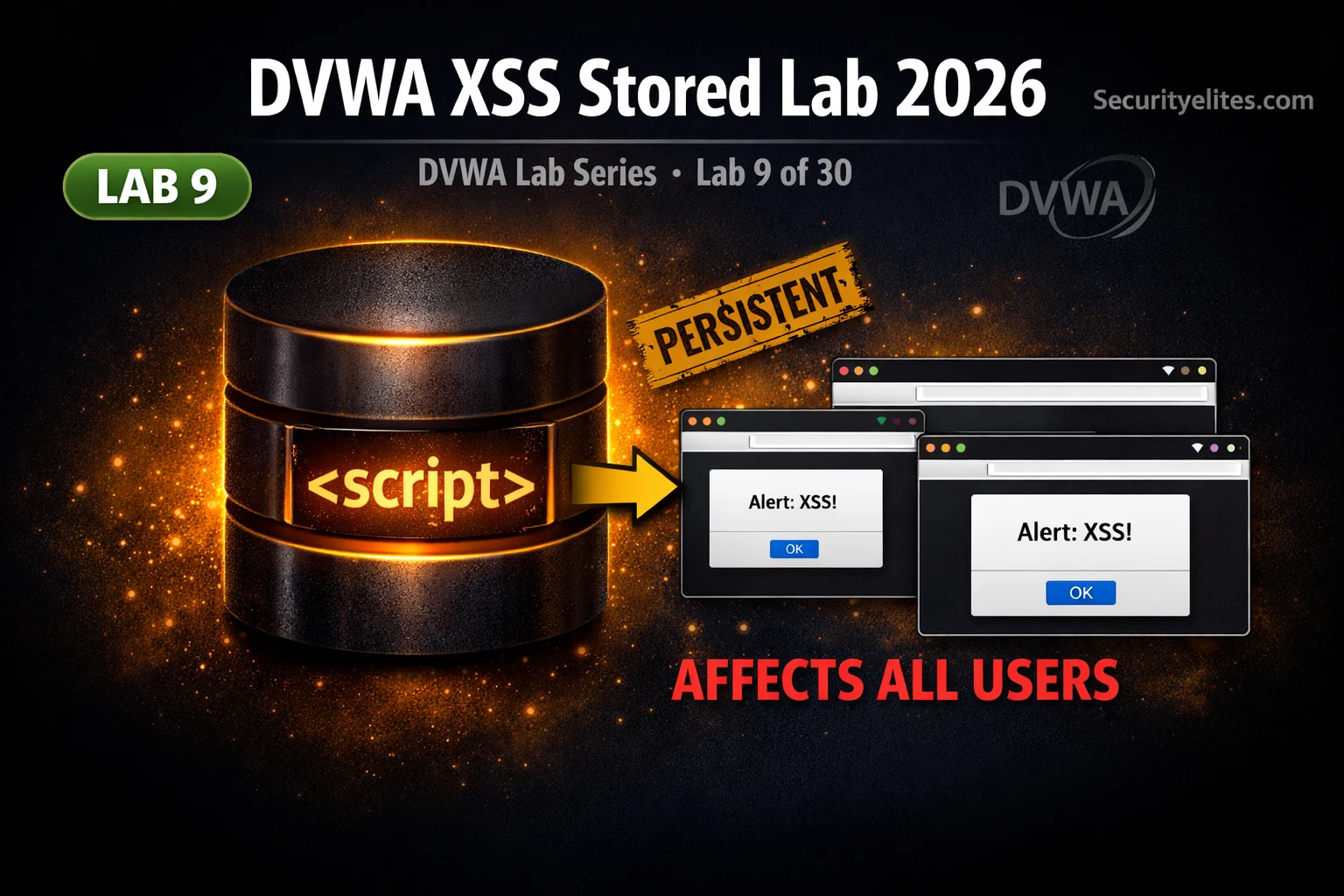
This article is a hands-on educational guide to exploiting and understanding stored XSS vulnerabilities in DVWA (Damn Vulnerable Web Application). It demonstrates how stored XSS differs fundamentally from reflected XSS by persisting in a database and automatically executing for every user who visits an affected page, then provides three progressive exercises showing exploitation techniques across Low, Medium, High, and Impossible security levels. The article emphasizes why stored XSS receives higher severity ratings than reflected XSS in bug bounty programs due to its multi-user impact and lack of required victim interaction.
- Stored versus reflected XSS mechanicsReflected XSS requires a crafted URL and victim click, affecting only that one user in one session. Stored XSS requires only a single injection into an input field that saves to the database without encoding; the payload then executes automatically for every subsequent visitor indefinitely without any further attacker action. The article illustrates this by showing a payload injected into DVWA's guestbook fires for different user accounts on page reload without them clicking any malicious link.
- Multi-user impact justifies severity elevationBug bounty frameworks like HackerOne and CVSS rate stored XSS higher than reflected specifically because stored XSS eliminates the victim interaction requirement. A cookie-theft payload in a public comment section silently compromises thousands of authenticated users per day; the application appears completely normal with no failed requests or error logs from victims' perspective, making it undetectable to standard monitoring.
- Low security direct script injectionAt Low security, DVWA's guestbook stores and reflects all input without filtering. Injecting `` into the message field causes the alert to fire on every page reload and for every logged-in user, confirming persistence. Escalating to cookie theft by injecting `` with a netcat listener silently exfiltrates session cookies from all visiting users.
- Burp Repeater bypasses client-side length limitsMedium security applies a client-side `maxlength="50"` attribute and strips script tags. Burp Intercept bypasses the length limit because it operates at the network layer after the browser's form validation, allowing longer payloads to reach the server. The script tag filter is bypassed by using event handlers like `` which are not filtered.
- Event handler tags defeat blacklist filtersMedium and High security levels use blacklists that target script tags but ignore other event-handler-capable HTML elements. Payloads using ``, ``, or `` work because HTML contains dozens of tag-handler combinations, making complete blacklist coverage impractical. The article demonstrates these alternative bypasses work at both Medium and High security levels.
- Output encoding is the only complete solutionImpossible security uses `htmlspecialchars()` with ENT_QUOTES on all input before database storage, converting dangerous characters (`< > " ' &`) to HTML entities before saving. Viewing page source reveals injected payloads as `` rendered as literal text rather than executable HTML, which is why encoding-based approaches cannot be bypassed by tag variation or encoding tricks.
- XSS worm self-replication mechanismAn XSS worm like the 2005 Samy worm uses injected JavaScript to automatically POST the same payload back to the application using the victim's authenticated session and CSRF token extracted from the page DOM. This transforms a single injection into exponential spread—the Samy worm infected one million MySpace profiles in under 24 hours by having each victim's browser automatically spread it to their own profile.
- Real-world impact demonstrationThe article includes an author anecdote describing discovery of stored XSS in a product review field that silently collected over 2,300 session cookies in six hours from normal users browsing reviews. No alerts or suspicious behavior appeared to users or administrators, illustrating why stored XSS in user-generated content features represents critical risk on real platforms with large user bases.
Bottom line: Stored XSS is fundamentally more dangerous than reflected XSS because it automatically affects every subsequent visitor after a single injection, with no victim interaction required, making it self-propagating and capable of silently compromising thousands of authenticated sessions. The only effective defense is output encoding of user input before storage, as all blacklist and filtering approaches can be bypassed through alternative HTML tags or event handlers.
🎯 What You’ll Master in Lab 9
⏱️ 55 min read · 3 hands-on exercises
📊 Have you completed the XSS Reflected lab (Lab 8)?
📋 What You’ll Master — DVWA XSS Stored Lab 2026 Complete Walkthrough
- Stored vs Reflected XSS — Why Persistence Changes Everything
- Low Security — Persistent Alert to Multi-User Cookie Theft
- The Multi-User Impact — Why Stored XSS Gets Higher Severity
- Medium Security — Burp Length Bypass and Event Handler Injection
- High and Impossible Security — Filter Analysis and the Correct Fix
- XSS Worm Concept — How Stored XSS Self-Propagates
In Lab 8 you exploited reflected XSS — a payload delivered through a crafted URL that executes once, in one victim’s session. Stored XSS removes both of those limitations. No crafted URL needed. Executes in every session. The DVWA lab series sequences these two labs deliberately — you need to understand reflected XSS mechanics before stored XSS impact fully registers.
Stored vs Reflected XSS — Why Persistence Changes Everything
Reflected XSS requires three things to work: a vulnerable parameter, a crafted URL containing the payload, and a victim who clicks that URL. The attack is one-time and targeted — the attacker must actively deliver the payload to each victim. If nobody clicks the URL, nobody is affected.
Stored XSS requires only one thing: a vulnerable input field that saves user data to the database without encoding. Once the payload is injected, it is stored permanently. Every subsequent request to the affected page retrieves the payload from the database and includes it in the HTML response. Every visitor — authenticated or not, targeted or not — executes the payload. The attacker does nothing after the initial injection.
2. Sends URL to victim
3. Victim clicks URL
4. Server reflects payload
5. One victim affected
2. Payload stored in DB
3. Any user visits page
4. DB returns payload
5. ALL users affected forever
Low Security — Persistent Alert to Multi-User Cookie Theft
⏱️ Time: 20 minutes · DVWA running, security level: Low
📸 Screenshot the netcat listener showing cookies received from two different user accounts and share in #dvwa-labs on Discord. Tag #storedxss2026
The Multi-User Impact — Why Stored XSS Gets Higher Severity
The severity difference between stored and reflected XSS comes down entirely to the user interaction requirement. Bug bounty severity frameworks — both HackerOne’s and CVSS — factor in whether an attack requires victim interaction. Reflected XSS requires a victim to click a link. Stored XSS requires nothing beyond the initial injection — every subsequent user is automatically affected.
In a real application, a stored XSS payload in a public comment section, product review, or forum post could silently steal session cookies from thousands of authenticated users per day without any suspicious links being sent to anyone. The application continues to look completely normal to users, administrators, and monitoring systems — there are no failed requests, no error logs, no anomalous traffic from the victims’ perspective. The payload executes as legitimate page content.
Medium Security — Burp Length Bypass and Event Handler Injection
⏱️ Time: 20 minutes · DVWA Medium security, Burp Suite running
📸 Screenshot the stored onerror payload executing and share in #dvwa-labs on Discord.
High and Impossible Security — Filter Analysis and the Correct Fix
High security in DVWA’s stored XSS module applies a more aggressive regular expression that strips a wider range of HTML tags. The bypass technique is the same as reflected XSS High — use tags not included in the filter’s blacklist. The <img src=x onerror=alert(1)> payload continues to work at High because the filter targets script tags specifically without covering all event-handler-capable HTML elements.
The Impossible security level uses htmlspecialchars() with ENT_QUOTES on all input before storing it — the same correct fix used in the reflected XSS Impossible level. With this encoding, any injected HTML characters (< > " ' &) are converted to their HTML entity equivalents before database storage, meaning they are rendered as literal text characters rather than parsed as HTML by the browser. This approach cannot be bypassed through tag variation or encoding tricks because it encodes the structural characters HTML requires, not just specific tag names.
⏱️ Time: 15 minutes · DVWA all security levels
📸 Screenshot the view source at Impossible level showing encoded characters and share in #dvwa-labs on Discord.
XSS Worm Concept — How Stored XSS Self-Propagates
An XSS worm is the ultimate demonstration of stored XSS impact. The classic example is the Samy worm — written by Samy Kamkar in 2005, it spread to over one million MySpace profiles in under 24 hours by exploiting a stored XSS vulnerability in the profile page. The payload, when executed in a victim’s browser, automatically sent an HTTP request (using the victim’s authenticated session) to add Samy as a friend and copy the payload to the victim’s own profile — which then infected every visitor to that profile.
The mechanism in DVWA terms: a worm payload in the guestbook would use JavaScript’s fetch() or XMLHttpRequest to POST the same payload back to the guestbook submission endpoint, using the victim’s own CSRF token (readable from the page DOM). This is theoretical in DVWA’s lab context — implementing it requires CSRF token extraction — but the concept is what bug bounty hunters and security teams need to understand when assessing the risk of stored XSS in any user-generated content feature.
🧠 QUICK CHECK — Lab 9
📋 Key Techniques — DVWA XSS Stored Reference Card
🏆 Mark Lab 9 as Complete
You now understand stored XSS at the level needed to find, exploit, and report it in real applications. The multi-user impact you demonstrated in Exercise 1 is exactly what justifies Critical ratings in bug bounty programmes with large user bases.
❓ Frequently Asked Questions – DVWA XSS Stored Lab 2026
Why is stored XSS more dangerous than reflected XSS?
What is the DVWA XSS Stored module testing?
How do you bypass the character limit on the DVWA stored XSS field?
What is an XSS worm?
How do you clean up stored XSS payloads in DVWA?
What comes after XSS Stored in the DVWA lab series?
Lab 8: DVWA XSS Reflected Lab 2026
Lab 10: DVWA Weak Session IDs Lab 2026
📚 Further Reading
- DVWA XSS Reflected Lab 2026 — Lab 8 covers reflected XSS — the prerequisite techniques for understanding stored XSS, including filter bypass methods and the cookie theft workflow.
- XSS Cross-Site Scripting Tutorial — The complete XSS guide covering all three types — reflected, stored, and DOM-based — with real-world examples and the CSP defence mechanism.
- DVWA Lab Series Hub — The complete 30-lab DVWA index covering every vulnerability class from brute force through advanced injection and cryptography.
- PortSwigger Stored XSS Labs — Official PortSwigger stored XSS training with five progressive labs covering basic stored injection, DOM sink contexts, and stored XSS in attribute and JavaScript contexts.
- OWASP XSS Attack Reference — Authoritative OWASP XSS documentation covering all three types, browser parsing behaviour, prevention techniques, and the Samy worm case study in detail.