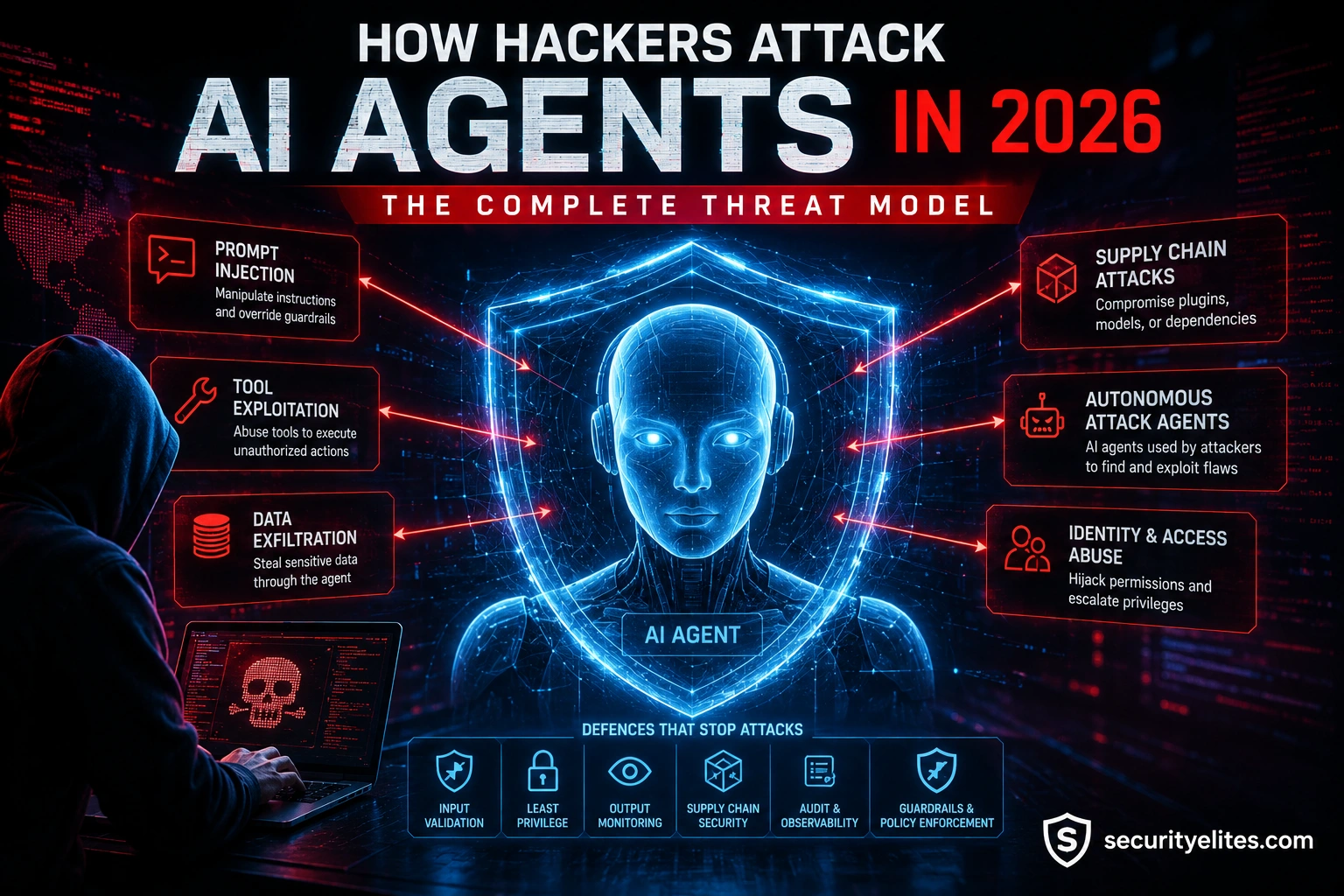
A single sentence from M-Trends 2026 — released this week — captures the 2026 AI threat landscape: adversaries are integrating AI to accelerate the attack lifecycle. My deeper version: adversaries aren’t just using AI to write better phishing emails — they’re targeting AI systems directly, exploiting the AI as the attack vector, and deploying AI as autonomous attack agents. Here’s the complete 2026 threat model for AI agent security, built from the documented incidents and the attack patterns Mandiant, IBM X-Force, Akamai, and Oasis Security have all published in the last 30 days.
What You’ll Learn
The five attack vectors hackers use against AI agents right now
Real documented incidents for each attack category
How the CyberStrikeAI autonomous attack worked step by step
The compound attacks that combine multiple vectors for maximum impact
Prompt injection against agents is significantly more dangerous than prompt injection against standard AI assistants. My shorthand for security briefings: injection × tools = catastrophe. My framing: when you inject a standard AI assistant, it produces malicious text. When you inject an AI agent, it takes malicious actions. The consequences of the same injection payload are categorically different depending on whether the target is a chatbot or an agent with tools.
PROMPT INJECTION → AGENT ATTACK CHAIN
# Standard injection (text model)
Inject → model produces wrong text → user sees wrong text → low impact
# Agent injection (tool-enabled model)
Inject via: email the agent reads, document it processes, web page it browses
Agent follows injected instructions and:
→ sends attacker-specified emails using agent’s email access
→ reads and forwards files using agent’s file access
→ makes API calls to attacker-controlled endpoints
→ creates or modifies records in connected systems
# Documented cases
Microsoft Copilot: injected document → Slack message exfiltration (2024)
ChatGPT browsing: injected web content → memory manipulation (2024)
Enterprise AI agents: injected customer emails → data exfiltration pipeline (2025)
# Detection
Monitor: agent actions that weren’t user-initiated
Alert: agent contacting external addresses not in predefined whitelist
Alert: agent performing bulk operations (forwarding many emails, reading many files)
Vector 2 — Tool and Permission Exploitation
Tool exploitation doesn’t require prompt injection. My experience in AI agent assessments: this vector is underappreciated because it doesn’t require any technical exploit — it exploits the agent’s legitimate functionality. It requires finding a way to get the agent to misuse its legitimate tools — either through social engineering the user, through overprivileged tool configuration, or through the agent’s own decision-making errors. My concern: developers give agents more permissions than they need “for flexibility” without understanding the blast radius.
TOOL EXPLOITATION PATTERNS
# Pattern 1: Social engineering the human operator
Attacker convinces user to give agent a task that causes tool misuse
Example: “please clean up my entire downloads folder” → agent deletes files
The agent did exactly what it was told — no injection needed
# Pattern 2: Ambiguous task interpretation
User says “find and remove all duplicate records” → agent’s interpretation of “duplicate” is wrong
Agent deletes records that weren’t actually duplicates
This is excessive agency through miscommunication, not attack
Agent uses tool A → result feeds into tool B → unintended access to system C
Each individual tool call was authorised — the chain wasn’t anticipated
# Defence
Human approval required for bulk destructive operations
Confirmation prompt before any irreversible action: “This will delete 847 records. Confirm?”
Audit log review of all agent actions weekly
Vector 3 — Supply Chain via Agent Dependencies
Every AI agent deployment has a supply chain: the base model, the plugins and tools it uses, the MCP servers it connects to, and the external data sources it retrieves. Any component in that chain can be compromised. The ClawHavoc incident showed that the AI skill repository layer is a viable supply chain attack surface with real operational consequences.
AGENT SUPPLY CHAIN ATTACK VECTORS
# Layer 1: Base model
Attack: backdoored model distributed via Hugging Face or similar
Impact: model behaves maliciously on specific trigger inputs
Real case: multiple backdoored models found on Hugging Face (2023–2026)
# Layer 2: Plugins and MCP servers
Attack: malicious MCP server executes code at install time
Impact: attacker code runs with AI agent permissions
Real case: ClawHavoc (early 2026) — info-stealer via AI skill repository
# Layer 3: External data sources (RAG poisoning)
Attack: poison the knowledge base the agent retrieves from
Impact: agent gives wrong answers, follows injected instructions from “documents”
Attack surface: any external document, database, or web content fed to the agent
EXERCISE — THINK LIKE AN ATTACKER + DEFENDER (15 MIN)
Map the Attack Vectors Against a Real AI Agent Deployment
SCENARIO: A customer service AI agent deployed by a retail company.
Components:
– Claude Sonnet as the base model (via API)
– 3 MCP servers: CRM access, order management, email sending
– RAG knowledge base: product docs, FAQs, policy documents (updated weekly)
– User channel: customer-facing chat widget
Map each attack vector:
VECTOR 1 — INJECTION:
Where does this agent process external content?
(Customer messages, knowledge base retrieval, CRM data?)
What injection in that content could cause what action?
VECTOR 2 — TOOL EXPLOITATION:
What’s the worst action an attacker could cause via the email MCP server?
What business process would prevent that?
VECTOR 3 — SUPPLY CHAIN:
Which of the 3 MCP servers has the most dangerous permissions if compromised?
Who reviews MCP server updates before they’re deployed?
VECTOR 4 — RAG POISONING:
If an attacker could modify one document in the knowledge base, what would they change?
How would you detect that the knowledge base has been tampered with?
Write the highest-risk attack chain and the single control that breaks it.
✅ The RAG poisoning vector is the most commonly overlooked in this exercise. Most teams focus on the chat widget (Vector 1) and the MCP servers (Vector 3) but don’t think about the knowledge base. If an attacker can inject content into the product documentation that the agent retrieves, they can cause the agent to give false product information, incorrect refund policies, or — in a sophisticated injection — instructions that cause the agent to take specific actions for specific customers. The control that breaks it: integrity monitoring on the knowledge base with alerts on unexpected modifications.
Vector 4 — Autonomous AI as the Attack Tool
The CyberStrikeAI incident represents the most significant shift in the AI attack landscape: AI being used not just to assist attackers but as the autonomous attack agent itself. My reading of the significance: we’ve crossed from AI-assisted human attacks to AI-autonomous attacks. The speed implications I covered in the agentic AI security guide — 22-second lateral movement, machine-speed decision-making — apply here with full force.
AUTONOMOUS AI ATTACKS — DOCUMENTED PATTERN
# CyberStrikeAI (March 2026) — documented autonomous AI attack
Malware that queries LLMs mid-execution to select evasion techniques
AI is part of the active attack chain, not just the development pipeline
# The speed problem
AI attack: recon to exploitation in minutes, lateral movement in 22 seconds
Human defence: detection in hours, containment in days
Implication: automated defensive response is not optional at this attack speed
Vector 5 — AI API Abuse and Model Theft
Two attack categories that target the AI infrastructure layer rather than deployed agents. API abuse exploits the economic model of AI APIs — cost amplification attacks drive up your API bill as a denial-of-service mechanism. Model theft extracts a functional copy of your proprietary AI through systematic querying.
AI API ATTACKS
# API abuse — cost amplification
Attack: flood an exposed AI endpoint with maximum-token requests
Impact: thousands of dollars in API costs per hour on pay-per-token billing
# Akamai 2026: AI-coordinated DDoS + API abuse convergence
AI-coordinated botnets launching DDoS while simultaneously abusing API endpoints
Multi-vector attacks coordinated by AI — single-vector defences insufficient
Compound Attack Chains — When Vectors Combine
My most important observation about AI agent attacks in 2026: the highest-severity incidents all involve multiple vectors in combination. The individual vectors are dangerous. The compound attacks are catastrophic. The CyberStrikeAI incident combined autonomous AI (Vector 4) with systematic tool exploitation (Vector 2) at scale. The Copilot exfiltration incidents combined injection (Vector 1) with the email tool’s send capability (Vector 2).
Step 3: Agent follows injected instructions using its other legitimate tools (Vector 2)
Result: attacker achieves persistent access without touching the application code
# Chain 2: API abuse + model theft (PROMPTSTEAL pattern)
Step 1: Attacker identifies exposed fine-tuned AI model API (Vector 5)
Step 2: Systematic querying to extract model behaviour (Vector 5 — distillation)
Step 3: Stolen model deployed with no safety controls → used to generate attack content
# Why this matters for defence
Single-vector defences are insufficient — they stop one step but not the chain
Defence requires: detection at each vector AND monitoring of cross-vector behaviour
My recommendation: run compound attack scenarios in your AI red team exercises
Detection and Prevention — Vector by Vector
My consolidated prevention map for all five attack vectors. Each row is one vector, with the most important detection signal and the highest-priority prevention control.
AI AGENT ATTACK PREVENTION — QUICK REFERENCE
# Vector 1: Prompt Injection
Detect: agent actions not initiated by the user (anomalous action logging)
Prevent: minimal permissions — can’t exfiltrate what it can’t access
# Vector 2: Tool Exploitation
Detect: bulk or destructive operations flagged for review
Prevent: human approval required for irreversible actions regardless of amount
# Vector 3: Supply Chain
Detect: unexpected network calls from MCP server processes
Prevent: approved MCP server list, mandatory code review before deployment
# Vector 4: Autonomous AI Attack
Detect: automated defensive response — human detection speed is insufficient
Prevent: patch known CVEs immediately — autonomous AI exploits at machine speed
# Vector 5: API Abuse / Model Theft
Detect: API spending alerts, systematic query pattern detection
Prevent: rate limiting, per-key quotas, spending caps with automatic suspension
How Hackers Attack AI Agents — Summary
Vector 1: Prompt injection → agent takes attacker-directed actions with its full permission set
Vector 2: Tool exploitation → overprivileged agents misused via social engineering or ambiguity
Vector 3: Supply chain → ClawHavoc shows AI skill repositories are viable attack surfaces
Vector 4: Autonomous AI attacks → CyberStrikeAI, PROMPTFLUX — no human in attack chain
Vector 5: API abuse + model theft → cost amplification attacks and PROMPTSTEAL distillation
AI Agent Threat Model — Your Action Items
For each AI agent you deploy: identify which of the five vectors it’s exposed to, calculate the blast radius for each, and implement the corresponding detection and prevention controls. The Agentic AI Security guide has the full defensive framework. The SAIF framework gives you the programme structure to manage all five vectors consistently.
Quick Check
A company’s AI customer service agent processes customer emails, has access to the CRM, and can initiate refunds up to £500 without human approval. A threat actor sends a carefully crafted email containing hidden instructions telling the agent to process a £499 refund to a specific account. Which attack vectors are involved and which single control would have prevented the financial loss?
Frequently Asked Questions
What are the main ways hackers attack AI agents?
The five primary attack vectors in 2026 are: prompt injection into agent workflows (embedding hidden instructions in content the agent processes), tool and permission exploitation (misusing the agent’s legitimate capabilities), supply chain attacks via agent dependencies (malicious MCP servers, backdoored models), autonomous AI as an attack tool (AI systems like CyberStrikeAI conducting attacks without human operators), and AI API abuse and model theft (cost amplification attacks and distillation attacks on proprietary models).
What is the most dangerous AI agent attack vector?
Vector 1 (prompt injection) combined with Vector 2 (excessive permissions) is the most damaging combination — because injection is difficult to fully prevent and the consequences scale directly with the agent’s permissions. An injection that succeeds against an agent with minimal permissions causes limited harm. The same injection against an agent with broad permissions causes catastrophic harm. This is why minimal permissions is the highest-priority defensive control.
How does the CyberStrikeAI attack relate to AI agent security?
CyberStrikeAI represents Vector 4 — AI operating as an autonomous attack agent. It demonstrated that AI can conduct the full attack lifecycle (reconnaissance, exploitation, persistence) without human direction, at machine speed. The M-Trends 2026 finding that lateral movement hand-off time has dropped from 8 hours to 22 seconds is directly related to AI automation of attack phases. The defence implication: human-speed incident response is now structurally insufficient against AI-automated attacks, requiring automated defensive response capability.
← Related
Agentic AI Security 2026
→ Programme
Google SAIF Framework
Further Reading
Agentic AI Security 2026— The defensive framework for the attack vectors described here. Permission inventories, blast radius calculations, and the four-principle defensive posture for agentic AI deployments.
PROMPTFLUX — AI Malware 2026— Vector 4 in depth. How AI malware that queries LLMs mid-execution evades signature and behaviour detection, and the new detection approach required.
MCP Server Security 2026— Vector 3 in depth. The ClawHavoc supply chain attack anatomy and the vetting process for MCP server deployments.
M-Trends 2026 — Mandiant— The primary source for the AI attack lifecycle acceleration data, PROMPTFLUX/PROMPTSTEAL naming, and AI abuse in compromised environments documented from 500,000+ hours of frontline investigation.
Foresiet — AI-Enabled Cyberattacks 2026— The incident analysis report covering CyberStrikeAI and eight other verified AI-enabled attack incidents from March-April 2026, including attack lifecycle diagrams.
ME
Mr Elite
Owner, SecurityElites.com
The framing I use when presenting this threat model to security teams and board members is simple: every AI agent you deploy is a new employee who can take real actions, has real access to your systems, and can be manipulated by anyone who can send it a message. You wouldn’t give a new employee unrestricted access to your CRM, email system, and file storage on their first day. Apply the same logic to AI agents. The attack vectors become obvious once you think about AI agents as employees rather than tools — and so do the controls. My practical test for any AI agent deployment: would you give a new employee this level of access on their first day? If no, reduce the agent’s permissions.
Founder of Securityelites and creator of the SE-ARTCP credential. Working penetration tester focused on AI red team, prompt injection research, and LLM security education.