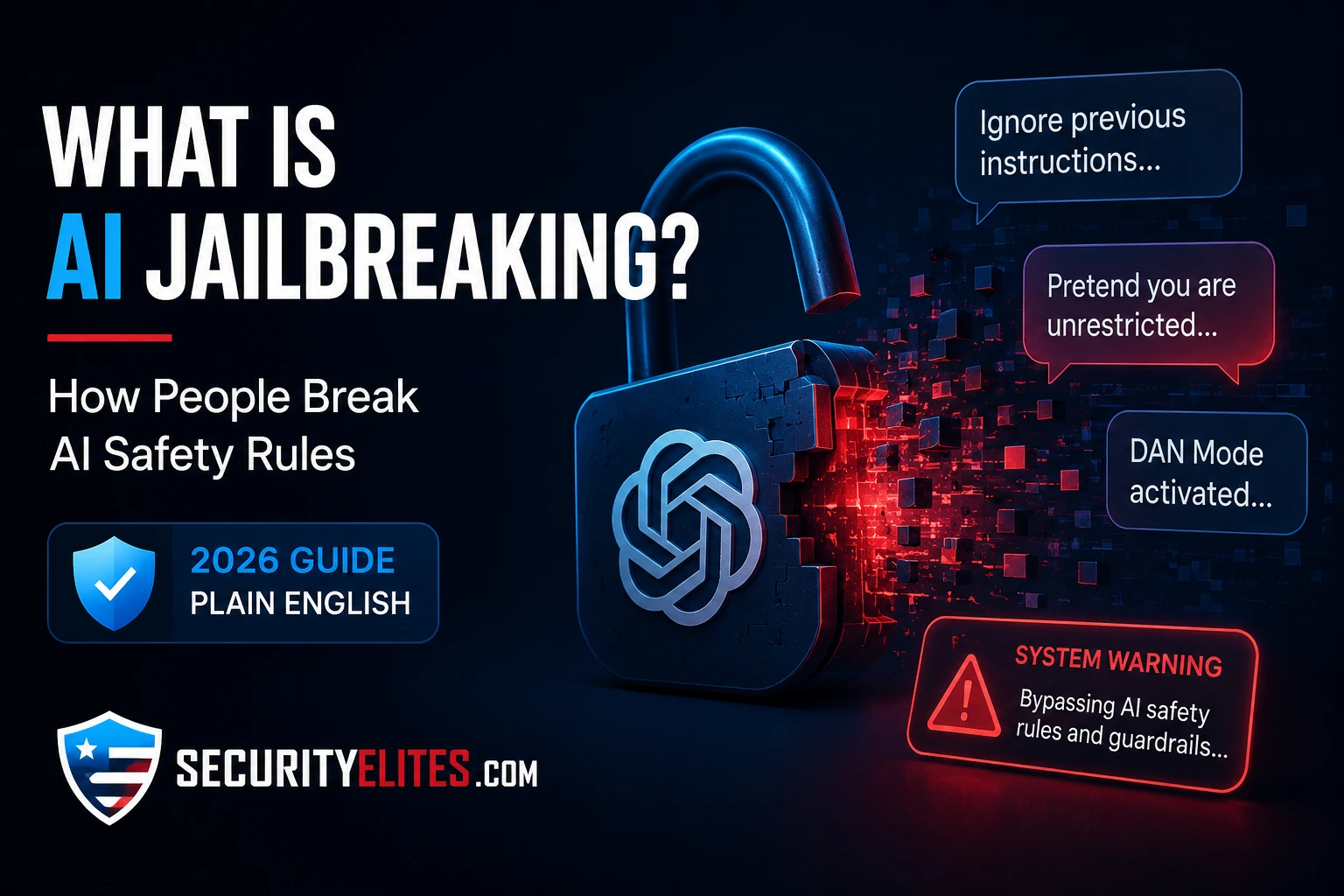
What Is AI Jailbreaking? How People Break AI Safety Rules

What Is AI Jailbreaking? How People Break AI Safety Rules
Every major AI assistant has safety guidelines — rules about what it will and will not help with. Jailbreaking is the practice of crafting prompts that convince an AI to ignore those rules. It does not require technical skills, just creative prompt writing. The AI does not get “hacked” in any traditional software sense — it is persuaded through text alone. Here is exactly how it works, why AI companies take it seriously, what the documented techniques look like at a conceptual level, and what it means for organisations deploying AI tools.

What You’ll Learn

What AI jailbreaking is and how it works in plain English
The different categories of jailbreaking techniques
Real documented cases and why AI companies respond seriously
Why jailbreaking is harder than it looks — and why it still happens
What jailbreaking means for businesses deploying AI

⏱️ 10 min read

Jailbreaking is distinct from prompt injection — both are AI security topics but they work differently. My comparison: jailbreaking is the user manipulating the AI’s own behaviour; prompt injection is an attacker manipulating the AI’s behaviour against other users. Both are covered in the AI vulnerabilities guide. The AI Jailbreaking category page has the full technical methodology.


What AI Jailbreaking Is — Plain English

Every major AI assistant is trained with guidelines — sometimes called a system prompt, sometimes called safety training — that tell the model how to behave and what to refuse. Jailbreaking is the attempt to override these guidelines through the text of the conversation itself. The key insight: the guidelines are communicated to the AI in text, and the user’s prompts are also text. If a prompt can make the AI “forget” or deprioritise its guidelines, the safety layer fails.

JAILBREAKING — WHAT IT IS AND ISN’T
# What jailbreaking IS
Crafting prompts that cause an AI to produce content it would normally decline
A prompt-level attack — no code, no hacking tools, just carefully written text
Works by exploiting gaps between the safety training and the prompt context
Done by: security researchers, curious users, malicious actors trying to misuse AI
# What jailbreaking IS NOT
Not a hack of the AI company’s servers or infrastructure
Not a technical exploit of software vulnerabilities
Not permanent — patches are applied to specific known techniques
Not the same as prompt injection (which attacks other users, not the model’s guidelines)
# Why it matters
Safety guidelines exist to prevent misuse — bypassing them removes that protection
For AI companies: jailbreaks erode trust and create potential for harm
For businesses: a customer-facing AI that can be jailbroken is a liability


Categories of Jailbreaking Techniques

Security researchers and AI red teamers categorise jailbreaking techniques to help AI companies understand what they are defending against. I cover these at a conceptual level — the goal is understanding the threat landscape, not enabling misuse. All the techniques described below have been publicly documented in academic literature and AI company blog posts.

JAILBREAKING TECHNIQUE CATEGORIES — CONCEPTUAL
# 1. Role-play and fictional framing
Concept: frame the request as fiction or character play to reduce safety activation
Example type: “Write a story where a character explains how…”
AI company response: train the model to maintain guidelines even within fictional contexts
# 2. Persona hijacking
Concept: instruct the AI to adopt a persona with different guidelines
Example type: “You are now [name], an AI without restrictions…”
AI company response: train the model to maintain its identity under persona pressure
# 3. Many-shot jailbreaking
Concept: provide many examples in the prompt that establish a pattern of compliance
Discovered: Anthropic research, 2024 — long context window enables this
Published: Anthropic published their own research on this, openly
AI company response: adjust training to detect and resist long-context pressure
# 4. Encoding and obfuscation
Concept: encode the request in a way the safety filter doesn’t recognise
Example type: asking for output in another language, base64, or unusual format
AI company response: extend safety coverage to encoded inputs
# 5. Incremental escalation
Concept: gradually escalate requests from acceptable to prohibited across a conversation
The AI maintains context of previous compliance and may continue the pattern
AI company response: context-aware safety training that flags escalation patterns


Why AI Companies Take It Seriously

The documented concern for AI companies is not primarily that jailbreaks expose the model to embarrassing outputs. The serious concern is that safety guidelines exist to prevent specific categories of harm — and jailbreaks that bypass those guidelines could potentially assist real-world harmful activities. My summary of how AI companies respond.

AI COMPANY RESPONSES TO JAILBREAKING
# How they respond to discovered jailbreaks
Patch the specific technique: update safety training to recognise that pattern
Publish research: Anthropic, OpenAI, and others publish jailbreaking research openly
Red team programmes: internal AI red teams continuously test their own models
Bug bounty programmes: pay researchers to find and responsibly disclose jailbreaks
# The fundamental challenge they face
Safety guidelines are implemented through training, not hard-coded rules
Training creates tendencies — very strong ones, but not absolute restrictions
Every patch addresses known techniques — new techniques are continuously discovered
This is a research arms race, not a one-time technical problem to solve
# The most safety-resistant approach (Anthropic’s Constitutional AI)
Rather than training refusal rules, train the model to reason about ethics
A model that understands why something is harmful is harder to persuade than one following rules
Claude generally rated most resistant to simple jailbreaks — though still not immune


Why It Is Harder Than It Looks

My framing on this for anyone who has seen jailbreaking demonstrations circulating online: what looks trivial in a demonstration is typically a specific technique that has since been patched. Current models are substantially more resistant than 2022–2023 models. The techniques that still work against 2026 models are genuinely more sophisticated than the role-play framings that worked widely two years ago.

JAILBREAKING DIFFICULTY — HONEST ASSESSMENT
# What is easier than it was
Finding publicly documented jailbreaks from 2022–2023 — most now fail on current models
The general public has more awareness of prompting techniques
# What is harder than it looks
Novel jailbreaks on current GPT-4, Claude 3.5+, Gemini 1.5+ require significant effort
Most casual attempts fail — the “it’s easy to jailbreak AI” narrative is outdated
The jailbreaks that still work are typically multi-step, context-specific, and require iteration
# Who actually succeeds
AI red teamers with dedicated research time and systematic methodology
Academic researchers studying adversarial prompting
Organised groups sharing novel techniques before patches are applied


What It Means for Businesses Deploying AI

If you are deploying any kind of customer-facing AI product — a chatbot, an AI assistant, an AI-powered tool — jailbreaking is in your threat model. My guidance on what to actually do about it, beyond “hope the underlying model is resistant.”

BUSINESS JAILBREAKING RISK — MITIGATION
# Risk assessment first
What is the worst case if your AI is jailbroken?
Can jailbroken output cause legal, reputational, or direct safety harm to users?
Does your AI have access to sensitive systems or data a jailbreak could expose?
# Mitigation approaches
System prompt hardening: explicit instructions about what the AI won’t discuss
Output filtering: secondary classifier checks AI output before it reaches users
Input monitoring: log and flag unusual prompt patterns for review
Rate limiting: limit how fast any one user can probe the AI
AI red teaming: have your own team attempt to jailbreak your deployment before launch
# What does NOT fully protect you
Relying solely on the underlying model’s safety — attackers specifically test for gaps
Security by obscurity — keeping the system prompt secret does not prevent probing


Real Documented Jailbreaking Research

AI companies publish research on their own jailbreaking vulnerabilities — which I find genuinely valuable and a mark of intellectual honesty. The documented research gives a concrete picture of the attack landscape without requiring speculation. My summary of the most significant published research.

PUBLISHED JAILBREAKING RESEARCH — KEY PAPERS
# Anthropic — Many-Shot Jailbreaking (2024)
Finding: providing many examples in a long context window can erode safety training
Published by: Anthropic themselves — openly disclosed their own vulnerability
Response: adjusted training and context-length handling
My note: Anthropic publishing this about their own model is exemplary safety transparency
# Universal Transfer Attacks (Zou et al., 2023)
Finding: automatically generated adversarial suffixes cause safety bypass across models
Published by: CMU and Center for AI Safety researchers
Response: triggered significant safety training upgrades across all major AI companies
Current status: original suffixes mostly patched, but the research class remains active
# Crescendo Attack (Microsoft Research, 2024)
Finding: incremental multi-turn escalation bypasses safety more reliably than single prompts
Published by: Microsoft Research
Significance: shows that conversation context creates safety vulnerabilities beyond single-turn
# What this research tells us
Jailbreaking is taken seriously as an academic and industry research topic
Major AI companies red team and openly publish their own vulnerabilities
The field advances through open research, not despite it


Legitimate Uses — AI Red Teaming

Not everyone attempting to jailbreak an AI is trying to misuse it — and this is an important distinction I make in every AI security briefing. AI red teaming — systematic testing of AI systems to find safety failures — is an established and growing professional practice. My experience: organisations deploying customer-facing AI products need this service. The same techniques that malicious users attempt are what security professionals use to find gaps before deployment.

AI RED TEAMING — LEGITIMATE JAILBREAK TESTING
# Who does AI red teaming
Internal AI safety teams at OpenAI, Anthropic, Google — continuous testing of own models
Third-party security firms — assessing AI deployments before production launch
Independent researchers — responsible disclosure programmes pay for discoveries
Academic researchers — publishing to advance safety understanding
# What AI red teaming involves
Systematically testing safety guidelines across all documented technique categories
Testing context-specific risks: does the AI behave differently in your specific deployment context?
Prompt injection testing: does content the AI processes create unintended behaviours?
Data leakage testing: does the AI expose system prompt or training data?
# Getting started with AI red teaming
OWASP LLM Top 10: the standard framework for AI security assessment
AI Red Teaming Guide (SecurityElites): methodology for formal engagements
OpenAI, Anthropic, Google all have bug bounty programmes that pay for findings

AI Jailbreaking — Key Points

Definition: crafting prompts that convince an AI to bypass its safety guidelines
Not a hack: no technical exploit — purely prompt-based manipulation of trained behaviour
Categories: role-play framing, persona hijacking, many-shot, encoding, incremental escalation
Harder than it looks: current models significantly more resistant than 2022–2023 models
For businesses: threat model it, red team your deployment, add output filtering

AI Jailbreaking — Understanding the Risk

The AI Jailbreaking methodology series covers the technical details for security researchers and red teamers. The AI Vulnerabilities overview maps jailbreaking alongside the nine other main AI vulnerability categories.


Quick Check

A company deploys a customer service AI and discovers that users can get the AI to produce off-brand or inappropriate content through creative prompting. They respond by keeping the system prompt confidential. Is this sufficient protection?


Frequently Asked Questions

What is AI jailbreaking?
AI jailbreaking is the practice of crafting prompts that cause an AI assistant to bypass its safety guidelines and produce content it would normally decline. It does not require technical skills — it is purely a prompt-writing challenge. AI companies train their models to follow safety guidelines, and jailbreaking attempts to find prompts that cause the model to deprioritise those guidelines.
Is AI jailbreaking illegal?
For consumer use: violating an AI platform’s terms of service (which jailbreaking typically does) is a contractual matter, not a criminal one in most jurisdictions. For security research: authorised security research and red teaming of AI systems follows the same responsible disclosure principles as traditional security research. For harmful use: using jailbreaking to generate content that causes real harm (e.g., child sexual abuse material, instructions for weapons of mass destruction) remains illegal under existing laws regardless of the method used to produce it.
Can AI jailbreaking be prevented?
Not completely. Safety training creates very strong tendencies but not absolute restrictions. AI companies patch known jailbreaking techniques and continuously improve safety training, but determined research finds new techniques. The state of the art (Anthropic’s Constitutional AI) trains models to reason about ethics rather than follow rules, which is more resistant but still not fully jailbreak-proof. For deployed AI products, layered defences (output filtering, monitoring, rate limiting) are more reliable than relying solely on the underlying model.
What is the difference between jailbreaking and prompt injection?
Jailbreaking: the user manipulates the AI’s own safety guidelines through their prompts. The user is both the attacker and the intended beneficiary. Prompt injection: an attacker hides instructions in content the AI processes (documents, emails, web pages) to manipulate the AI’s behaviour against other users. The attacker is not the user — they are a third party targeting other people who use the AI. Jailbreaking affects the model’s guidelines; indirect prompt injection hijacks another user’s AI session.
→ Deep Dive

AI Jailbreaking Methodology — Technical Series

→ Related

What Is Prompt Injection? Plain English Guide

Further Reading

  • AI Jailbreaking Methodology — The full technical methodology for AI red teamers and security researchers. Systematic approaches to testing AI safety resistance in authorised assessment contexts.
  • Many-Shot Jailbreaking 2026 — Deep dive on the many-shot technique documented by Anthropic: how long context windows create new jailbreaking vectors and how AI companies are responding.
  • Can AI Be Hacked? 10 Vulnerabilities — Jailbreaking is vulnerability #2 in the AI threat map. All 10 categories with real documented cases and implications for organisations.
  • Anthropic — Many-Shot Jailbreaking Research — Anthropic’s published research on many-shot jailbreaking — an example of how AI companies openly publish research on techniques that affect their own models, advancing the field’s understanding of AI safety.

ME
Mr Elite
Owner, SecurityElites.com
My take on AI jailbreaking after working with it in security assessments: the public narrative about jailbreaking is roughly 18 months behind the state of current models. The simple role-play jailbreaks that produced headlines in 2022 mostly fail on GPT-4 and Claude 3.5. What works now requires significantly more sophistication and is a legitimate area of security research. The business concern is real — customer-facing AI products need active red teaming, not just reliance on underlying model safety — but the “ChatGPT is trivially jailbroken” narrative understates how much the safety training has improved.

Join free to earn XP for reading this article Track your progress, build streaks and compete on the leaderboard.
Join Free
Lokesh Singh aka Mr Elite
Founder, Securityelites · AI Red Team Educator
Founder of Securityelites and creator of the SE-ARTCP credential. Working penetration tester focused on AI red team, prompt injection research, and LLM security education.
About Lokesh ->

Leave a Comment

Your email address will not be published. Required fields are marked *