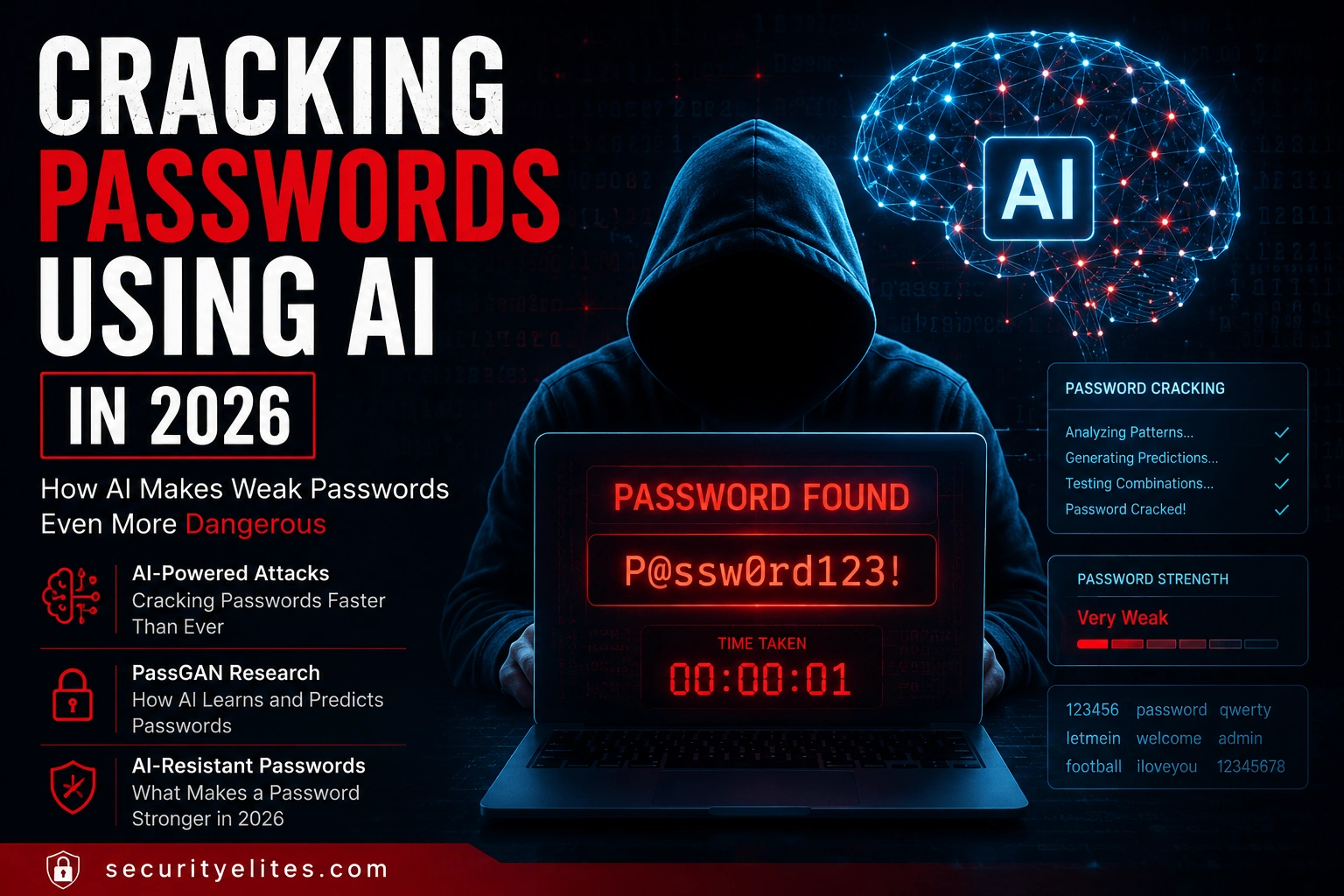
A password that would have taken traditional cracking tools 5 years to crack by brute force can now be cracked in minutes using AI-assisted techniques. PassGAN — a neural network trained on real leaked passwords — generates new password guesses based on the patterns in billions of real passwords that people have actually used and exposed in breaches. This isn’t science fiction; it’s 2023 research from Home Security Heroes that has been replicated, extended, and incorporated into real-world attack tooling. Here’s what the research actually shows, what it means for your passwords, and how to check whether yours are at risk.
What You’ll Learn
How Cracking passwords using AI works — PassGAN and beyond
What the research actually shows vs what was overstated
Which password patterns AI cracks fastest
How to check if your passwords are already exposed
What makes a password genuinely resistant to AI cracking in 2026
⏱️ 10 min read
Cracking Passwords using AI in 2026 – Complete Guide
Check if your specific passwords are already in breach databases — my recommendation is to run this check on your five most-used passwords right now, using the Password Breach Checker — free, uses k-Anonymity so your actual password is never transmitted. Also check the Password Strength Checker to see how your passwords score against current cracking estimates.
How Cracking Passwords using AI in 2026 Works
Traditional password cracking uses wordlists (dictionaries of common passwords and leaked passwords) and rule-based mutations (adding numbers, capitalising letters, substituting characters). AI password cracking learns the statistical patterns of how real humans create passwords — and generates new guesses that match those patterns rather than just testing a fixed list. My explanation of why this matters: it means AI can crack passwords that have never appeared in any breach database, simply by understanding how people typically modify base words.
TRADITIONAL VS AI PASSWORD CRACKING
# Traditional wordlist approach
Hashcat + rockyou.txt: test every known leaked password against a hash
Limitation: only finds passwords similar to those already in the wordlist
# AI-assisted approach (PassGAN and similar)
Trained on: billions of real leaked passwords from breach databases
Learns: statistical patterns — how humans modify base words, common suffixes
Generates: new password candidates matching human creation patterns
Advantage: finds passwords similar to real human choices, not just known ones
# What AI adds to credential stuffing
Password variation prediction: if “Summer2019!” is leaked, AI predicts “Summer2023!”
Cross-site variation: if password is “Netflix123!” AI tries “Amazon123!” on other sites
Personal targeting: AI trained on leaked data about specific person generates personalised guesses
PassGAN — The Research Explained
The PassGAN research from Home Security Heroes (2023) received significant media coverage, some of which overstated the results. My honest reading of what the research actually showed versus what the headlines claimed.
PASSGAN RESEARCH — WHAT IT ACTUALLY SHOWED
# What PassGAN is
A GAN (Generative Adversarial Network) trained on 15.6 million real leaked passwords
Generates new password guesses without explicit rules — learned from pattern data
Published: 2022 academic research, popularised by Home Security Heroes study 2023
# What the 2023 study found
51% of common passwords cracked in under 1 minute
65% cracked in under 1 hour
81% cracked in under 1 month
Important context: these were passwords from common password lists, not random unique ones
# What was overstated in media coverage
Headlines implied PassGAN could crack any password in minutes — not accurate
Long, random passwords (12+ characters, mixed types) still take impractical time
The speed depends heavily on how passwords are hashed — bcrypt is far more resistant
# What it genuinely showed
Human-pattern passwords (words, names, dates with common substitutions) are at risk
AI outperforms traditional tools on human-created password patterns
The gap between “memorable human password” and “crackable password” has narrowed significantly
Which Passwords Are Most Vulnerable
PASSWORD VULNERABILITY BY PATTERN
# Highly vulnerable to AI cracking
Any word + year: Summer2019! · Football2024 · Password2023
Name + numbers: Sarah1234 · John2024 · Mike123!
Common substitutions: P@ssw0rd · S3cur1ty · L0v3you
Three random words (passphrases): “CorrectHorseBattery” — good but AI improves against these
12+ character complex passwords: “Tr0ub4dor&3” — better, but human-patterned
# Genuinely AI-resistant
Random 16+ character strings: “x7Kp#mN2qL9vR4jW” — no human pattern to learn from
Generated by password manager: no personal data, no dictionary words, no patterns
Key insight: if you created the password yourself, it has a human pattern — AI is optimised for this
How to Check Your Passwords Right Now
PASSWORD SECURITY CHECK — FREE TOOLS
# Check 1: Is your password already leaked?
Tool: SecurityElites Password Breach Checker, Go to Tools(Main Menu) — Breach Detection
How: enter your password → checks against 14+ billion leaked passwords
Safe: k-Anonymity means your password is never transmitted — only a partial hash
Result: shows how many times that exact password has been found in breach data
# Check 2: How strong is your password against current tools?
Tool: SecurityElites Password Strength Checker, Go to Tools(Main Menu) — Breach Detection
Shows: estimated crack time using current AI-assisted techniques
Flags: patterns that make passwords vulnerable
# Check 3: Are your accounts safe beyond just the password?
Tool: SecurityElites Email Breach Checker
Shows: every breach database your email has appeared in
Action: if found — treat those passwords as compromised regardless of complexity
What Makes a Password AI-Resistant
The fundamental answer to AI password cracking is straightforward: remove human patterns from your passwords entirely. AI learns from human behaviour — if your password contains no human behaviour, it cannot apply what it has learned. My practical guide to passwords that are genuinely resistant to AI-assisted cracking in 2026 — and the key insight is counterintuitive: making passwords harder for you to remember doesn’t make them harder for AI to crack. Randomness does.
AI-RESISTANT PASSWORD GUIDE
# Rule 1: Let a machine generate it
Password manager (Bitwarden, 1Password) generates truly random passwords
Random = no human pattern = nothing for AI to learn from
You don’t need to remember it — the manager does that
# Rule 2: Length over complexity
16+ random characters beats 8 complex characters every time
Entropy comes from length+randomness, not special character substitutions
# Rule 3: Unique password per site
AI cross-site variation attacks only work on reused passwords
Unique passwords limit any breach to one site regardless of cracking speed
# Rule 4: MFA is still the most important layer
Even a cracked password doesn’t help if MFA is required
FIDO2/passkeys: even better — no password to crack at all
AI-Targeted Cracking — When Attackers Know Something About You
The most dangerous development in AI password security is targeted cracking — where the AI is given personal information about a specific target and generates password guesses based on that data. My concern: in a world where personal data is widely available through breaches and social media, targeted cracking is increasingly feasible against specific individuals rather than bulk credential databases.
TARGETED AI PASSWORD CRACKING
# What personal data informs targeted guesses
Name and birthday: common password components — “Sarah1990” · “Smith1990!”
Pet or child names: frequently used in passwords — widely available on social media
Sports team or hobby: “ManUnited2024” · “Chelsea#1fan”
Previous passwords: leaked older passwords predict current ones via variation analysis
# The OSINT-to-password-guess pipeline
Attacker gathers: name, birthday, pets, sports team, school, city from social media
Feeds to AI tool: generates thousands of personalised password guesses
Tests against: target’s email login or corporate VPN
Why it works: even “creative” personal passwords follow predictable personal patterns
# How to protect against targeted cracking
No personal data in passwords: no birthdays, names, pets, sports teams, places
Password manager: random strings have no personal data — targeted attacks have nothing to use
Privacy settings: reducing publicly available personal data reduces targeting surface
How AI Changes the Wordlist Game
Traditional cracking relies on wordlists — pre-compiled lists of known passwords, common words, and variations. The RockYou 2021 wordlist contains 8.4 billion entries. An AI model doesn’t work from a fixed list: it generates candidates on the fly, adapts to patterns it finds, and creates guesses specifically tuned to what it has learned from billions of real human passwords. My explanation of why this is meaningfully different from just building a bigger wordlist is important for understanding why traditional password advice is no longer sufficient.
AI VS TRADITIONAL WORDLIST COMPARISON
# Traditional wordlist approach
Strengths: fast, covers all known leaked passwords, predictable
Weakness: can only find passwords that are already in the list or trivially derived
Example miss: a unique phrase with personal significance not in any wordlist
# AI (PassGAN-style) approach
Strengths: generates novel candidates matching human patterns, adapts to target context
Weakness: slower generation, less efficient on purely random passwords
Example win: generates variations of patterns never explicitly in training data
# Current practical reality
Best attack chains combine both: wordlists first (speed) then AI generation (coverage)
Documented in security research: hybrid approaches outperform either method alone
Implication: the overlap between “memorisable password” and “crackable password” is now very large
💡 The One Thing That Defeats All of This: MFA (multi-factor authentication) means a cracked password still doesn’t give access. Even if an attacker correctly guesses your password using AI-assisted techniques, they still need your authenticator code, hardware key, or biometric to log in. This is why I recommend the combination of password manager (random passwords) plus MFA (second factor) as the two-part solution — they address different attack vectors simultaneously. A cracked password with MFA enabled is a wasted attack.
Enterprise Password Security in the AI Era
For security teams and IT managers, AI password cracking changes the calculus on password policy. My updated recommendations for enterprise password standards in 2026 reflect the clear shift in both NIST and NCSC guidance: from “complex rules” to “length plus randomness plus MFA as mandatory.”
AI-resistant: password manager-generated random 16+ characters + unique per site + MFA
Your Password Security — Act Now
Check your most important passwords in the Password Breach Checker now. Any that appear in breach data should be changed immediately to a password manager-generated random string. The Password Strength Checker shows you exactly how yours score against current cracking estimates.
Quick Check
A user changes their leaked password “Summer2019!” to “Summer2024!” after reading about AI password cracking. How effective is this change?
Frequently Asked Questions
Can AI crack any password?
No — the effectiveness of AI password cracking depends heavily on the password’s pattern and how it was hashed. AI excels at cracking passwords that follow human patterns (words, names, dates, common substitutions). Long, randomly generated passwords (16+ characters from a password manager) with strong hashing (bcrypt, Argon2) remain computationally impractical to crack. The key insight: AI is trained on human behaviour patterns — remove human patterns and AI has nothing to learn from.
What is PassGAN?
PassGAN is a password guessing tool that uses a Generative Adversarial Network (GAN) trained on leaked real-world passwords. Unlike traditional tools that apply fixed rules to wordlists, PassGAN generates new password candidates by learning the statistical patterns in how real humans create and modify passwords. It was the subject of widely-covered research in 2023 showing it could crack a high percentage of common passwords faster than traditional methods.
How long should my password be in 2026?
16+ characters for randomly generated passwords from a password manager. If you’re creating a memorable password (for a master password or device unlock), use a passphrase of 4+ random unrelated words (e.g., “correct-horse-battery-staple”) which provides strong entropy while remaining memorable. The most important factors are: length, randomness (no dictionary words or personal data), uniqueness per site, and MFA as the second layer.
Is a password manager safe?
Reputable password managers (Bitwarden, 1Password, Dashlane) encrypt your vault with your master password before it leaves your device — the service provider cannot read your passwords. The main risk is your master password being stolen. Use a strong, unique master password you don’t use anywhere else, and enable MFA on the password manager itself. The security tradeoff is clearly positive: a password manager with one strong master password is significantly more secure than remembering weak passwords across sites.
→ Check Now
Password Breach Checker — Free
→ Check Now
Password Strength Checker — Free
Further Reading
Password Breach Checker— Check your specific passwords against 14+ billion leaked credentials. Uses k-Anonymity — your password is never transmitted.
Is My Password Leaked? Full Guide— The complete breach check guide — email breach checking, interpreting results, dark web data lifecycle, and priority response order.
How Hackers Bypass 2FA— Even with a cracked password, MFA blocks account access. But not all MFA is equal — understand which types are resistant and which can still be bypassed.
HaveIBeenPwned — Pwned Passwords— The original k-Anonymity password breach checker. 847+ million real-world passwords from data breaches checked without transmitting your actual password.
ME
Mr Elite
Owner, SecurityElites.com
The insight from AI password research that I find most useful for everyday guidance: the problem isn’t that passwords are getting harder to crack — it’s that humans are predictable. AI learns that predictability. The solution isn’t a more complex rule for creating passwords. The solution is removing the human from the password creation process entirely and using a password manager to generate random strings you don’t need to remember. That single change addresses AI cracking, traditional cracking, and password reuse risk simultaneously.
Founder of Securityelites and creator of the SE-ARTCP credential. Working penetration tester focused on AI red team, prompt injection research, and LLM security education.