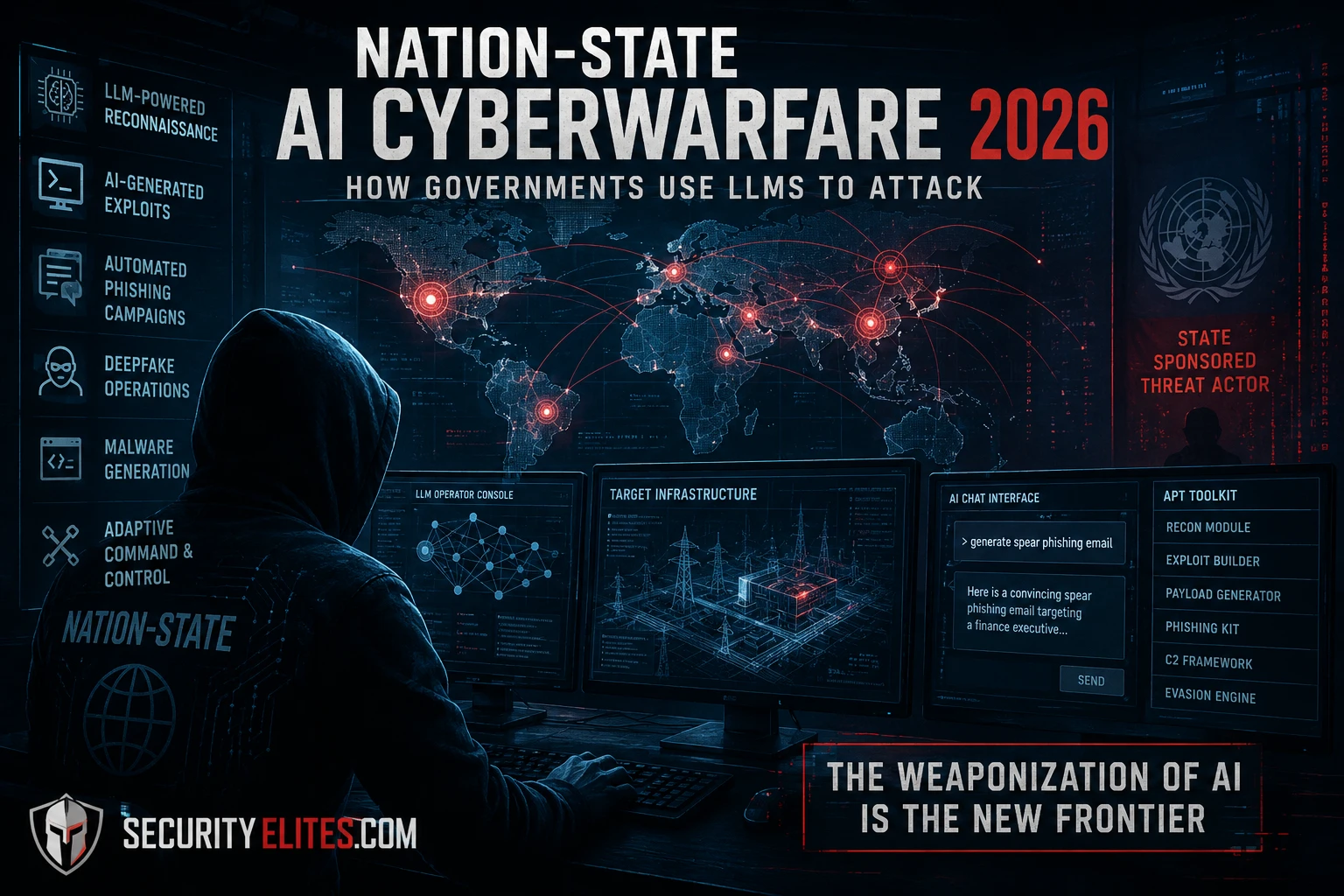
Nation-State AI Cyberwarfare — How Governments Use LLMs to Attack

Nation-State AI Cyberwarfare — How Governments Use LLMs to Attack
The most significant change in nation-state cyber operations over the past two years isn’t a new exploit technique or a novel malware family. It’s the integration of large language models into every phase of the attack lifecycle — from initial reconnaissance through spear-phishing generation, vulnerability research, lateral movement planning, and disinformation at scale. I track these campaigns because understanding what the most well-resourced threat actors are doing today defines what every organisation will face tomorrow. The AI tools nation-states are deploying operationally right now will be commoditised and available to criminal groups within 18 months. This is the briefing I give before every red team engagement in the public sector.

What You’ll Learn

How nation-state actors are integrating AI into offensive cyber operations
Documented APT AI capabilities from public intelligence reports
The specific AI tools and LLM use cases at each phase of the kill chain
How AI changes attribution — and what defenders must adapt
The defensive posture shift required against AI-assisted adversaries

⏱️ 35 min read · 3 exercises

Nation-state AI operations sit at the intersection of the AI Security series and the Penetration Testing methodology — the techniques documented in state actor campaigns are the same techniques red teams simulate. The AI Red Teaming Guide covers how to test for the AI-assisted attack patterns described here.


Documented Nation-State AI Use Cases

My starting point for every nation-state AI briefing is the public record. Microsoft’s Threat Intelligence reports, OpenAI’s own disclosures of nation-state threat actors removed from their platform, and CISA advisories provide a documented baseline that I don’t need to speculate about. The key actors publicly confirmed to be integrating AI into cyber operations span four major nation-state threat groups.

DOCUMENTED NATION-STATE AI CAPABILITIES — PUBLIC RECORD
# Russia — Fancy Bear / APT28 (Forest Blizzard)
Disclosed: Using LLMs for research into satellite communication protocols
Disclosed: Scripting and automation tool development using AI assistance
Disclosed: Research into radar signal processing (critical infrastructure targeting)
Source: Microsoft Threat Intelligence + OpenAI disclosure (Feb 2024)
# North Korea — Lazarus / Kimsuky (Emerald Sleet)
Disclosed: AI-generated spear-phishing targeting defence and think tank researchers
Disclosed: Social engineering content generation in multiple languages
Disclosed: Research into publicly known vulnerabilities for exploitation planning
Source: OpenAI disruption report (Feb 2024)
# China — APT40 / Volt Typhoon (Salmon Typhoon)
Disclosed: Using LLMs to research technical topics relevant to operational targets
Disclosed: Translation tasks for intelligence processing
Disclosed: Researching Western intelligence techniques and public reporting
Source: Microsoft + OpenAI joint disclosure (Feb 2024)
# Iran — APT35 / Charming Kitten (Crimson Sandstorm)
Disclosed: Phishing campaign assistance, social engineering content
Disclosed: Research into open-source tools for red team activity
Disclosed: Code writing assistance for malware development workflows
Source: OpenAI disruption report (Feb 2024)

My Reading of the Disclosures: The February 2024 OpenAI and Microsoft joint report is the most important public document on nation-state AI use to date. What’s striking isn’t what they were doing — most uses were research assistance and content generation, not novel AI exploitation. What’s striking is that these actors were caught using commercial AI APIs that log everything. My assessment: the disclosed activity represents the lowest-sophistication tier of their AI operations. The classified tier will be running private models with no telemetry.

AI Across the Cyber Kill Chain

My framework for thinking about nation-state AI integration maps each kill chain phase to the specific AI capability that changes the threat. The pattern is consistent: AI compresses the time and skill requirements at every phase, and it particularly narrows the gap between state-level and criminal-level capability.

AI IN THE CYBER KILL CHAIN — NATION-STATE APPLICATIONS
# Phase 1: Reconnaissance
Traditional: analysts manually review LinkedIn, public docs, job postings
AI-enabled: automated OSINT synthesis → target profiles at 10,000x scale
LLM use: “Generate a targeting profile from this LinkedIn data and identify insider risk indicators”
Impact: breadth of targeting now unconstrained by analyst headcount
# Phase 2: Weaponisation / Spear-Phishing
Traditional: one native-language operator per language target → low scale
AI-enabled: hyper-personalised spear-phish in any language, any register
Documented: North Korean operators using LLMs to write English-language research lures
Impact: language barrier eliminated → every target reachable in native language
# Phase 3: Delivery / Initial Access
AI use: optimising payload delivery based on target’s email client, AV profile
AI use: generating convincing cover identities for watering hole operations
AI use: vulnerability research for zero-day discovery (see AQ49)
# Phase 4: Post-Exploitation / Lateral Movement
AI use: LLM-assisted code generation for custom implants → faster development
AI use: real-time “what should I do next” guidance from AI given network context
Research: AI C2 frameworks where the model decides lateral movement targets
Impact: operator skill floor drops significantly → less experienced operators achieve more
# Phase 5: Exfiltration / Objectives
AI use: automated document triage — “which of these 50,000 files contain nuclear data?”
AI use: translation of exfiltrated foreign-language documents at scale
AI use: pattern detection in structured data (financial, communications) for intelligence value

EXERCISE 1 — THINK LIKE A NATION-STATE (15 MIN)
Map AI Capabilities to a Hypothetical Campaign
SCENARIO: You are a red team operator simulating a nation-state actor.
Target: A defence contractor with 500 employees and classified contracts.
Constraints: No zero-days. AI tools only. 4-week operation.

For each kill chain phase, design the AI-assisted approach:

WEEK 1 — Reconnaissance:
Which AI tools accelerate target profiling?
What public data sources feed the LLM synthesis?
What is the output — what does the AI-generated target dossier look like?

WEEK 2 — Spear-Phishing Campaign:
How does AI generate the lure content?
What makes the emails convincingly specific to each target?
How many targets can one operator reach vs. without AI?

WEEK 3 — Post-Exploitation:
Given a foothold on one workstation, how does AI assist lateral movement planning?
What context do you provide the LLM to get the best “next step” recommendation?

WEEK 4 — Exfiltration:
40,000 documents on a shared drive. How does AI identify the highest-value ones?
What LLM prompt triages effectively without false positives?

Compare: which phase benefited MOST from AI assistance in your design?

✅ In my red team work, the phase that benefits most from AI is reconnaissance — because it’s the phase that was most constrained by analyst time in the pre-AI era. A good analyst could produce 5–10 detailed target profiles per day. An AI-assisted analyst produces 500. That 100x scale multiplier means you can target every employee simultaneously rather than picking the top 5. When every employee gets a personalised, contextually accurate phishing email, someone clicks. The attack surface is now every employee, not just the most-targeted few.


AI and the Attribution Problem

Attribution has always been difficult in nation-state cyber operations. AI makes it harder. My concern when I brief defenders: the traditional attribution signals — linguistic tells, code style, tooling fingerprints — are increasingly unreliable when AI generates the artifacts. A Russian operator writing AI-generated English phishing emails looks like an English-speaking attacker. An AI-generated implant has no individual programmer’s style to fingerprint.

HOW AI DEGRADES ATTRIBUTION SIGNALS
# Traditional attribution signal → AI degradation
Language/grammar: AI generates flawless target-language content → no linguistic tell
Code style/patterns: AI-generated code has no individual developer fingerprint
Tooling reuse: AI generates custom tools per engagement → no shared tool signatures
Operational hours: AI automation removes timezone-based operator schedule tells
Victimology patterns: AI enables wider targeting → harder to infer geopolitical intent from targets
# Attribution signals that remain (for now)
Infrastructure reuse: C2 infrastructure, registrar patterns still attributable
Target selection logic: strategic interests still reflect actor’s geopolitical goals
Operational mistakes: human errors in OPSEC still leak context
AI model choice: which model/API was used can sometimes be inferred from output patterns
TTP consistency: mission objectives constrain variation regardless of AI tooling
# My attribution framework adjustment for AI-era operations
Weight infrastructure > content analysis
Weight strategic target selection > tactical execution style
Weight long-term TTP patterns > individual artifact forensics


AI-Enabled Disinformation Operations

Disinformation is the nation-state AI capability that receives the most media attention and — in my view — the most underestimation of its sophistication. The public discourse focuses on deepfake videos. My concern is the infrastructure layer: AI-generated personas at scale, automated content adaptation to local cultural context, and systematic narrative injection into legitimate news ecosystems that makes the false information appear to come from credible domestic sources.

AI DISINFORMATION INFRASTRUCTURE
# Documented operations (public record)
Dragonbridge (China-linked): 4,800+ fake accounts using AI-generated profile photos
Secondary Infektion (Russia): automated translation of narratives across 7 languages
Iran influence ops: AI-generated op-ed articles submitted to real publications
# The 2026 capability tier above public awareness
Persona networks: thousands of AI-maintained social identities with posting history
Narrative amplification: bots that engage with real users to artificially amplify reach
Context injection: AI identifies trending topics and inserts disinformation into trending conversations
Credibility laundering: false narratives planted in smaller publications → cited by larger ones
# Defensive signals I monitor for
Account age vs. engagement level mismatch
Language register inconsistency (AI-generated tells at paragraph level)
Coordinated inauthentic behaviour: identical narratives appearing simultaneously across platforms
Profile photo reverse image search: AI-generated faces have characteristic artefacts

EXERCISE 2 — BROWSER (15 MIN)
Research Documented Nation-State AI Operations
Step 1: Read the primary source
Search: “OpenAI disrupting nation-state threat actors 2024”
Find the February 2024 OpenAI blog post on nation-state actors removed
List the 5 actors named and what they were doing with AI

Step 2: Microsoft Threat Intelligence
Search: “Microsoft Threat Intelligence nation-state AI 2024”
Find the companion report
What additional capabilities did Microsoft document beyond what OpenAI disclosed?

Step 3: CISA advisories on AI threats
Go to cisa.gov and search for AI-related advisories from 2024-2026
Have any advisories specifically addressed AI-enhanced threat actors?

Step 4: Synthesis question
Based on what’s publicly documented, which phase of the kill chain
do you think nation-state actors are getting the most operational value from AI?
Is it the same phase I identified in Exercise 1, or different?

Document: the 5 actors + capabilities + your synthesis answer.

✅ The synthesis question has a defensible answer from the public record: spear-phishing at scale is where nation-states are getting documented operational value right now. The OpenAI disclosures show multiple actors using AI for phishing content generation. My read: this isn’t because reconnaissance or post-exploitation AI tools don’t provide value — it’s because phishing content generation is a well-understood, measurable use case that integrates immediately into existing campaigns without requiring new infrastructure. The more sophisticated AI integration (AI-guided lateral movement, AI-accelerated zero-day research) is either classified or not yet disclosed.


Defensive Adaptation — What Changes

The defensive posture shift I recommend to organisations facing AI-enhanced nation-state threats is not about deploying AI on the defensive side (though that’s valuable). It’s about recognising that the threat model has changed in ways that make some traditional defences less effective and others more critical.

DEFENSIVE POSTURE SHIFT — AI-ERA NATION-STATE THREATS
# What becomes LESS effective
Phishing training based on “spot the grammar mistake” — AI eliminates grammar errors
Attribution-based blocking — AI degrades attribution confidence
Signature-based detection — AI-generated custom tools evade signatures
Language/culture-based filtering — AI breaks the language barrier for attackers
# What becomes MORE critical
Zero-trust architecture: assume compromise, verify every access continuously
Behaviour-based detection: what the attacker DOES vs what their tools look like
Phishing-resistant MFA: FIDO2/passkeys eliminate credential phishing impact
Network segmentation: limit lateral movement radius even after initial access
Data classification + DLP: constrain exfiltration even if AI identifies high-value files
# My top 3 defensive priorities against AI-enhanced adversaries
1. FIDO2 MFA everywhere — eliminates the value of AI-generated phishing at scale
2. EDR with behavioural detection — flags post-exploitation regardless of tool novelty
3. Aggressive patch cadence — narrows the exploitable vulnerability window AI can target

EXERCISE 3 — THINK LIKE A DEFENDER (15 MIN)
Design an AI-Resilient Security Programme for a Critical Sector Organisation
ORGANISATION: A water utility serving 2 million people.
Current posture: email + password MFA, basic EDR, annual phishing training.
Threat: nation-state actor targeting critical infrastructure (documented APT40 pattern).

Design the defensive programme upgrade:

1. PHISHING DEFENCE (AI-generated attacks are coming)
Current training teaches grammar spotting — that’s now obsolete.
What replaces it? What’s your new phishing defence stack?

2. MFA UPGRADE
TOTP/SMS MFA is vulnerable to AI-assisted real-time phishing proxies.
What MFA standard eliminates this vector?
What’s the implementation challenge at a utility with field workers?

3. NETWORK ARCHITECTURE
If AI-assisted lateral movement compresses post-exploitation time from days to hours,
how does your network segmentation need to change?
Which OT/ICS systems need air-gapping?

4. DETECTION
Behaviour-based detection is now more important than signature-based.
What 5 behavioural indicators would you monitor for?

5. INCIDENT RESPONSE SPEED
AI-compressed attack timelines mean you have less time to respond.
What automated containment capability do you deploy?

Write the 3 highest-priority changes and justify each with the AI threat it addresses.

✅ The MFA upgrade (point 2) is almost always the highest-priority recommendation for any organisation facing nation-state threats. FIDO2 hardware keys are the single control that eliminates AI-generated phishing value at scale — because even a perfect clone of the login page can’t use a credential without the physical key, and the key only responds to the legitimate domain. For a water utility with field workers, the implementation challenge is real (hardware keys are hard to distribute and manage for non-desk workers), but the risk justifies the friction. My recommendation: FIDO2 for all admin/IT/OT access. Mobile push with number matching for field workers as an interim.

Nation-State AI Cyberwarfare — Key Points

Documented: Russia, China, North Korea, Iran all confirmed using LLMs in cyber operations (Feb 2024)
AI compresses skill and time requirements at every kill chain phase
Attribution is degraded — language, code style, tooling fingerprints all weakened by AI
Phishing training based on grammar spotting is now obsolete — FIDO2 MFA is the fix
Behaviour-based detection > signature-based as AI generates novel tools per engagement

Nation-State AI Cyberwarfare 2026

The documented baseline, kill chain integration, attribution degradation, disinformation infrastructure, and the defensive posture shift required. The next article in the AI Queue covers AI-powered phishing at the tactical level — the same spear-phishing capability nation-states use, accessible to any attacker.


Quick Check

In February 2024, OpenAI and Microsoft disclosed nation-state actors using commercial LLM APIs. What was the most significant implication for attribution — not for what these actors were doing, but for what the disclosures reveal about their sophistication?


Frequently Asked Questions

Which nation-states have been publicly confirmed to use AI in cyber operations?
As of 2024, OpenAI and Microsoft confirmed disrupting operations from actors linked to Russia (Forest Blizzard/APT28), China (Salmon Typhoon/APT40 and others), North Korea (Emerald Sleet/Kimsuky), and Iran (Crimson Sandstorm/APT35). All were using commercial LLM APIs for tasks including research assistance, phishing content generation, scripting, and code development. This represents the public record — classified intelligence assessments cover additional actors and capabilities.
How does AI change nation-state cyber operations?
AI primarily changes three dimensions: scale (operations that required 10 analysts can now be automated), skill floor (less technically skilled operators achieve more with AI assistance), and language barriers (operators can now produce convincing native-language phishing content for any target population). The strategic objectives of nation-state operations don’t change — AI makes existing objectives faster and cheaper to achieve rather than enabling fundamentally new capabilities.
How does AI affect cyber attribution?
AI degrades the content-based attribution signals that investigators have historically relied on: linguistic analysis, code style fingerprinting, and tooling reuse. AI-generated phishing emails have no characteristic grammar of the operator’s native language. AI-generated malware has no individual programmer’s coding patterns. Attribution increasingly depends on infrastructure analysis (C2 patterns, registrar choices), strategic target selection, and long-term TTP patterns rather than artifact forensics.
What is the most effective defence against AI-powered nation-state phishing?
FIDO2/WebAuthn hardware security keys or passkeys. These phishing-resistant MFA standards work by binding the credential to the legitimate domain — a cloned login page, however convincing, cannot use the credential because the key won’t respond to the wrong domain. This eliminates the value of even AI-perfect spear-phishing that steals credentials and OTPs via real-time proxy attacks.
← Previous

AI API Authorization Vulnerabilities 2026

Next →

AI-Powered Phishing 2026

Further Reading

  • AI Red Teaming Guide 2026 — How to simulate nation-state AI capabilities in authorised red team engagements. The attack patterns documented in nation-state campaigns are the same ones red teams reproduce to test enterprise defences.
  • AI Supply Chain Attacks 2026 — Nation-states are documented as key actors in AI supply chain operations, including the North Korean Lazarus group’s npm package compromises targeting developers.
  • How Hackers Use Social Engineering 2026 — The human-layer attack surface that AI-enhanced phishing exploits. The seven social engineering methods nation-states use, updated for 2026 AI capabilities.
  • Microsoft — Staying Ahead of Threat Actors in the Age of AI — The primary source document for nation-state AI use. The joint OpenAI/Microsoft disclosure of five nation-state actors disrupted from commercial AI platforms in February 2024.

ME
Mr Elite
Owner, SecurityElites.com
The shift I’ve observed in public sector client briefings over the past 18 months: executives used to ask “are nation-states really using AI?” — now they ask “what are they using it for?” The question has changed because the evidence is no longer theoretical. My answer always starts with the February 2024 disclosures — the documented record — and then moves to the classified briefings I’m not able to discuss publicly. What I can say: what’s in the public record is the floor, not the ceiling.

Join free to earn XP for reading this article Track your progress, build streaks and compete on the leaderboard.
Join Free
Lokesh N. Singh aka Mr Elite
Founder, Securityelites · AI Red Team Educator
Founder of Securityelites and creator of the SE-ARTCP credential. Working penetration tester focused on AI red team, prompt injection research, and LLM security education.
About Lokesh ->

Leave a Comment

Your email address will not be published. Required fields are marked *