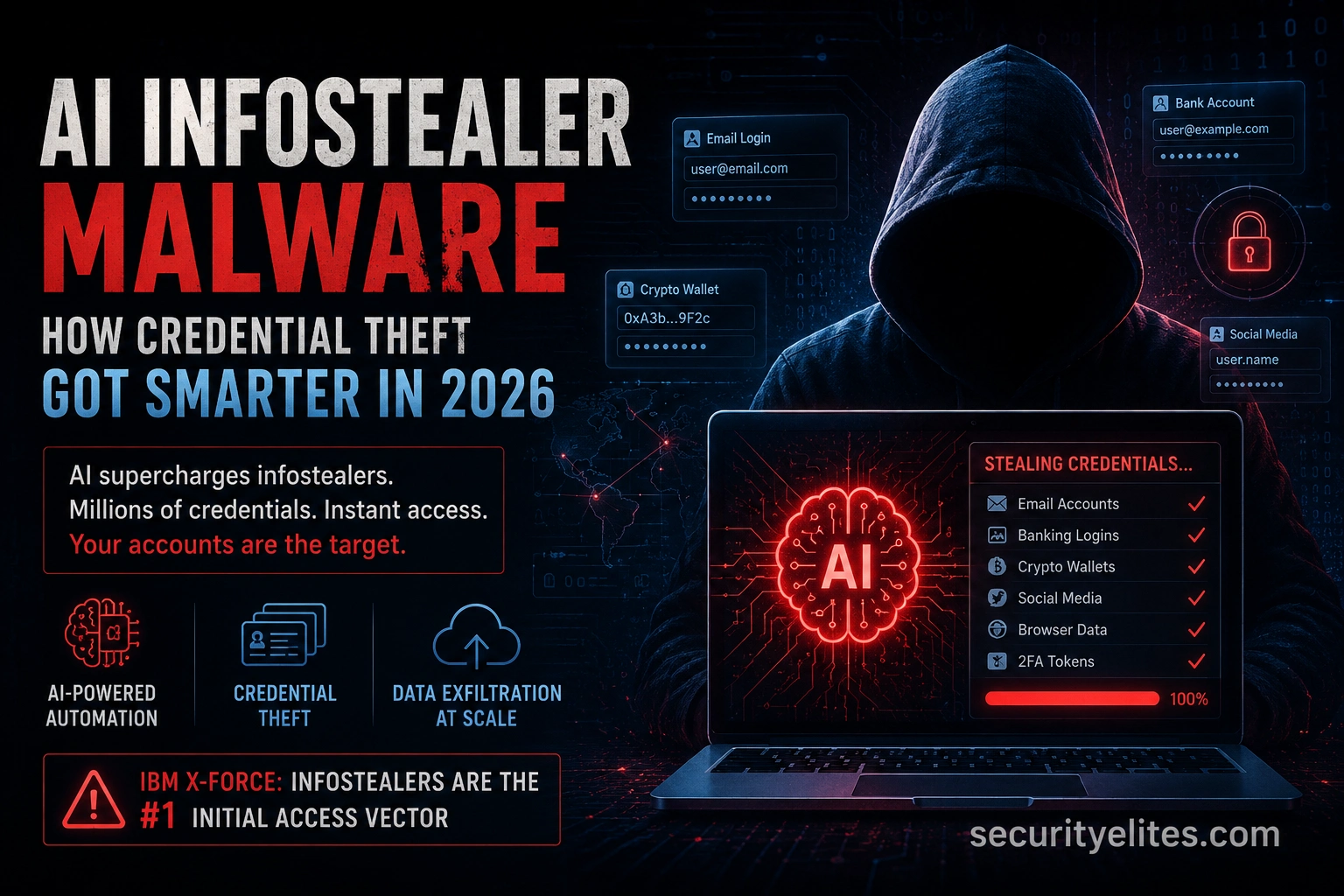
AI Infostealer Malware — How Credential Theft Got Smarter in 2026

AI Infostealer Malware — How Credential Theft Got Smarter in 2026
IBM’s X-Force Threat Intelligence Index 2026 identified credential theft as the single most common initial access technique — ahead of every exploitation technique — confirming that attacking the credential layer is more reliable for attackers than exploiting unpatched vulnerabilities — used in more attacks than any vulnerability exploit. Infostealers are the primary delivery mechanism: malware that silently harvests saved passwords, session tokens, browser cookies, and crypto wallets from infected machines. In 2026, AI has made infostealers faster to create, harder to detect, and more precisely targeted. My breakdown of how infostealer malware works, how AI has changed it, and the specific steps that protect your accounts and your organisation.

What You’ll Learn

What infostealer malware is and how it harvests credentials
How AI has changed infostealer capabilities in 2026
Why stolen credentials are more dangerous than you might think
How to check if your credentials have been stolen
The specific controls that stop infostealer attacks

⏱️ 12 min read

Infostealers are the harvesting tool for the credentials that enable AI-powered phishing campaigns to succeed. Check your own credential exposure right now with the Email Breach Checker and Password Breach Checker. The broader AI attack landscape is in the AI agent attack guide.


What Infostealer Malware Is

Infostealers are the most economically significant malware category in 2026 from a pure credential-theft perspective — IBM X-Force confirmed this finding with data drawn from thousands of real-world incidents globally across multiple sectors. An infostealer is a category of malware designed specifically to harvest credentials and sensitive data from an infected machine and exfiltrate them to an attacker. Unlike ransomware — which announces itself — infostealers operate silently. The infected user typically has no idea anything has happened until credentials start appearing in breach databases or their accounts start being accessed. My classification of what a modern infostealer targets.

WHAT INFOSTEALERS HARVEST
# Browser data (highest value)
Saved passwords from Chrome, Firefox, Edge, Safari password managers
Session cookies — allows account takeover without needing the password
Autofill data — credit cards, addresses, form data
Browser history — reveals which services the victim uses
# System credentials
Windows credential manager — stored corporate credentials
SSH keys — private keys allowing server access
VPN credentials — remote access to corporate networks
RDP credentials — remote desktop access
# Developer and cloud credentials
.env files — API keys, database passwords, service credentials
AWS/Azure/GCP credential files — cloud infrastructure access
git credentials — source code repository access
Crypto wallets — wallet files and seed phrases
# Notable infostealer families (active 2026)
Lumma Stealer, Redline, Raccoon, Vidar, MetaStealer — all active campaigns
Delivery: phishing emails, fake software downloads, malvertising, game cheats


How AI Amplifies Infostealers

IBM X-Force noted in their 2026 report that “the growing use of AI chatbots and agents in business operations creates a new attack surface for infostealer malware.” My analysis of the three specific ways AI has made infostealers more dangerous in 2026.

AI + INFOSTEALERS — THREE AMPLIFICATION VECTORS
# Amplification 1: AI-assisted targeting
Traditional: spray infostealer broadly — random victims with random credentials
AI-assisted: OSINT targets high-value individuals — executives, developers, finance staff
Result: infostealer campaigns yield high-value credentials, not random consumer accounts
# Amplification 2: AI chatbot credential harvesting
New surface: employees storing AI API keys, ChatGPT session tokens in browsers
Infostealer harvests: AI platform credentials → attacker accesses victim’s AI tools
Secondary attack: AI tool access used for further social engineering of colleagues
# Amplification 3: AI-generated infostealer variants (Slopoly)
Attackers use LLMs to generate unique infostealer variants rapidly
Each variant has different code structure → AV signatures don’t match
Volume: one operator can now produce hundreds of unique variants per day
IBM X-Force: 44% year-over-year increase in public-facing application exploitation


Why Stolen Credentials Are So Dangerous

The question I get most often when presenting on infostealers: “why does my password matter if I use MFA?” My answer: infostealers don’t just steal passwords. They steal session cookies — and session cookies bypass MFA entirely because they represent an already-authenticated session. This is the critical misunderstanding that leaves MFA-protected accounts vulnerable to infostealer compromise.

WHY SESSION COOKIE THEFT BYPASSES MFA
# How MFA normally works
User enters password → prompted for MFA code → authenticates → session cookie issued
Session cookie: “this browser passed MFA, trust it until it expires”
# How infostealer bypasses it
Infostealer steals the session cookie from the victim’s browser
Attacker imports cookie into their browser → already authenticated, no MFA prompted
The session token IS the authentication proof — no password or MFA code needed
# Real documented cases
Multiple high-profile account takeovers via session cookie theft despite MFA (2023–2026)
Google account takeovers where attackers maintained access after password change
Corporate SSO compromise via stolen session tokens
# The developer credential risk
AWS credential files: infostealer harvests ~/.aws/credentials
Attacker has full AWS access — can create resources, exfiltrate data, deploy backdoors
No MFA stands between the attacker and the cloud infrastructure

EXERCISE — BROWSER (10 MIN)
Check Your Credential Exposure
Step 1: Check your email address
Go to SecurityElites Email Breach Checker: /tools/email-breach-checker/
Enter every email address you use for work or important personal accounts

Step 2: Check your passwords
Go to SecurityElites Password Breach Checker: /tools/password-breach-checker/
Check the passwords you reuse across multiple accounts

Step 3: Check Have I Been Pwned
haveibeenpwned.com — check email addresses for known breach appearances
Note: which breaches? When? What data was included?

Step 4: Audit your browser’s saved passwords
Chrome: chrome://password-manager/passwords
Look for: reused passwords, old passwords, passwords for sensitive accounts
Count how many accounts use the same password

Step 5: Check for exposed developer credentials
If you’re a developer: grep -r “password\|api_key\|secret” ~/.ssh ~/ (be careful — read only)
Check: are any credentials stored in plaintext files on your machine?

✅ The browser password audit in Step 4 is consistently the most alarming exercise for participants. Most people have 50–200 saved passwords in their browser, many reused across multiple services, many for accounts they no longer actively monitor. An infostealer harvesting a browser credential store gets immediate access to the full list. The priority remediation: change passwords on any account where the same password is used across multiple services, and enable MFA on all accounts containing financial, medical, or professional data.


Controls That Stop Infostealer Attacks

INFOSTEALER DEFENCE — PRIORITY CONTROLS
# Personal: stop infostealers getting in
Never download software from unofficial sources or torrent sites
Don’t install game cheats, cracked software, or “free” premium tools
Use a password manager — not browser-saved passwords (standalone PM = separate process)
Phishing-resistant MFA (hardware key or passkey) where available
# Personal: limit damage if compromised
Unique passwords everywhere — password manager makes this practical
Don’t save sensitive credentials in browser — use a password manager with encryption
Session management: log out of sensitive services when done (kills the session cookie)
# Developer: credential hygiene
Credentials in environment variables only — never in .env files committed to git
AWS credential files: use AWS IAM roles instead of static credentials where possible
Short-lived credentials: use credential rotation and short expiry periods
# Enterprise: detection and response
Enrol in credential monitoring services — alert when employee credentials appear in breach data
Conditional access: require re-authentication for sensitive actions regardless of session age
Enforce phishing-resistant MFA for all corporate accounts — hardware keys or passkeys


The Infostealer Underground Economy

My picture of the infostealer ecosystem in 2026 isn’t just about the malware itself — it’s about the economy that’s built around it. Infostealers are not typically used by the people who write them. They operate as Malware-as-a-Service products, sold or rented to operators who deploy them and then sell the harvested credentials in underground marketplaces. Understanding this economy helps defenders prioritise — the most valuable stolen credentials get resold fastest and used most aggressively.

INFOSTEALER UNDERGROUND ECONOMY
# How the economy works
Developer: writes infostealer, sells as MaaS (Malware-as-a-Service) subscription
Operator: rents the malware, deploys via phishing/malvertising/fake downloads
Stolen logs: harvested credential packages sold on underground markets (Russian Market, Genesis)
Buyer: purchases credential sets for account takeover, corporate access, fraud
# What stolen logs contain and what they’re worth
A single corporate machine infection can yield: 50–500 saved passwords, session cookies, VPN credentials
Corporate access logs: sold for $10–200 depending on organisation size and access level
Premium: developer machines (AWS keys, GitHub tokens), finance team machines (banking creds)
AI platform credentials now listed as premium items in credential markets
# How AI changes this economy
AI reduces infostealer development cost → lower MaaS pricing → more operators
AI targeting: operators increasingly using AI to identify high-value victims before deploying
Volume: more infostealer campaigns running simultaneously → more credential leaks


Corporate Infostealer Risk — What Security Teams Miss

The individual credential theft risk is well-understood. My concern for corporate security teams is the organisational risk profile: employees working from personal devices, using personal browsers with corporate credentials saved, connecting to corporate systems from home networks. Every personal device an employee uses to access corporate resources is a potential infostealer exposure surface that the corporate security team has limited visibility into.

CORPORATE INFOSTEALER RISK PROFILE
# Attack surface corporate teams miss
Personal devices: employee’s home laptop with corporate SSO saved in browser
Contractor machines: third-party contractors with VPN access, not under corporate MDM
Developer personal machines: side projects, open-source work, same SSH keys as corporate
# IBM X-Force 2026 finding
Credential theft is the most common initial access technique globally
Most credential theft doesn’t involve phishing the corporate email — it involves
infostealers on personal devices that happen to have corporate credentials saved
# Controls that address this
Phishing-resistant MFA: even if credentials are stolen, the session can’t be hijacked from a new device
Conditional access: require compliant/managed device for sensitive resource access
Continuous authentication: re-authenticate for sensitive actions regardless of session age
Credential monitoring: alert when employee credentials appear in infostealer logs


AI Platform Credentials — The New High-Value Target

IBM X-Force’s 2026 report specifically highlighted AI chatbot and agent credentials as a new high-value infostealer target. My concern about this category: an attacker who steals an employee’s ChatGPT or Claude session token doesn’t just gain access to the victim’s conversation history. They inherit the victim’s AI agent permissions — meaning any MCP servers, tool integrations, and autonomous capabilities the victim’s AI agent was granted.

AI CREDENTIAL THEFT — WHAT ATTACKERS GET
# From a stolen ChatGPT/Claude session token
Access to conversation history — may contain sensitive business context
Custom GPT/agent access — if victim built agents with tool access, attacker inherits those
Memory access — persistent memory features reveal ongoing projects and relationships
# From stolen AI API keys (developer)
Full API access at the victim’s account level and billing
Attacker can run expensive operations on the victim’s bill
Cost amplification: deliberately expensive API calls → denial of service via billing cap
# Defence
AI platform sessions: log out of AI tools when not in use — kills the session cookie
API keys: store in secret manager, not browser or .env files committed to git
Billing alerts: set spending caps and alerts on AI API accounts

AI Infostealers — Key Points

IBM X-Force 2026: credential theft is the #1 initial access technique
Infostealers harvest: browser passwords, session cookies, SSH keys, .env files, cloud credentials
Session cookies bypass MFA — already-authenticated sessions need no password
AI amplifies: precision targeting, AI chatbot credential harvesting, Slopoly variants
Defence: unique passwords + password manager + phishing-resistant MFA + no software piracy

Check Your Exposure Now

Use the Email Breach Checker and Password Breach Checker to check your current exposure. If your credentials appear in breach data, change them immediately and enable MFA on the affected accounts.


Quick Check

A developer’s laptop is infected by an infostealer. They have MFA enabled on all accounts and use strong unique passwords. Why are they still at serious risk?


Frequently Asked Questions

What is infostealer malware?
Infostealer malware is a category of malicious software designed to silently harvest credentials and sensitive data from infected computers. Unlike ransomware, infostealers operate without announcing themselves — victims typically don’t know they’re infected. Infostealers target browser-saved passwords, session cookies, SSH keys, cloud credential files, crypto wallets, and developer configuration files. IBM X-Force’s 2026 Threat Intelligence Index identified credential theft facilitated by infostealers as the most common initial access technique used in attacks.
Does MFA protect against infostealers?
Partially. MFA protects against attackers using stolen passwords to log in — they still need the second factor. However, most infostealers also steal session cookies — authentication tokens that represent already-authenticated sessions. Importing a stolen session cookie into a browser gives an attacker account access without triggering any MFA prompt, because the session has already been authenticated. Phishing-resistant MFA (hardware keys, passkeys) provides stronger protection because the session binding is cryptographically tied to the original device.
How do infostealers get onto devices?
Primary delivery mechanisms in 2026: phishing emails with malicious attachments or links, malicious advertisements (malvertising) on legitimate websites, fake software downloads disguised as legitimate tools, game cheat software and cracked commercial applications, and malicious browser extensions. The common thread is downloading and executing untrusted code. The most effective prevention: only install software from official sources, use a reputable endpoint security product, and never install pirated or cracked software.
← Related

AI Phishing 2026 — Multi-Persona BEC

→ Check Now

Email Breach Checker

Further Reading

  • Email Breach Checker — Check your email addresses against known breach databases immediately. If your credentials are in breach data, change the affected passwords and enable MFA on those accounts today.
  • AI Phishing 2026 — The delivery mechanism that gets infostealers onto devices. How AI-generated phishing achieves 3–5x higher click rates and how multi-persona BEC campaigns work.
  • How Password Attacks Work — The full methodology of credential-based attacks including credential stuffing, password spraying, and how stolen credential databases are used across services.
  • IBM X-Force Threat Intelligence Index 2026 — The primary source identifying credential theft as the #1 initial access vector, with AI-amplified credential harvesting and the infostealer data cited above.

ME
Mr Elite
Owner, SecurityElites.com
The session cookie theft point is the one I spend the most time on in security briefings because it’s the least understood. People invest in MFA — rightly so — and believe it makes their accounts unassailable. When I explain that an infostealer on their machine harvests the cookie that proves they’ve already passed MFA, the implication lands immediately. The protection isn’t just in the authentication mechanism — it’s in keeping infostealers off the machine in the first place, and in limiting the value of what they’d steal if they got on.

Join free to earn XP for reading this article Track your progress, build streaks and compete on the leaderboard.
Join Free
Lokesh Singh aka Mr Elite
Founder, Securityelites · AI Red Team Educator
Founder of Securityelites and creator of the SE-ARTCP credential. Working penetration tester focused on AI red team, prompt injection research, and LLM security education.
About Lokesh ->

Leave a Comment

Your email address will not be published. Required fields are marked *