What You’ll Learn
⏱️ 12 min read
AI-Powered Phishing — 2026 Complete Guide
AI phishing is one of the six AI scam types covered in the consumer-facing AI Scams 2026 guide. The credential theft that AI phishing enables feeds directly into the infostealer landscape in AI Infostealer Malware 2026. Check your own exposure with the Email Breach Checker.
How AI Changed Phishing
IBM X-Force’s 2026 Threat Intelligence Index confirmed that AI-enabled credential harvesting is driving significant year-over-year increases in successful phishing outcomes. My framing for the transformation: traditional phishing was a volume game — send a million emails, 0.1% click rate, 1,000 compromised credentials. AI phishing is a precision game — send 50 highly targeted emails to 50 high-value targets, 40% click rate, 20 compromised credentials from people who have admin access, financial authority, or privileged data access. The economics are completely different and the outcomes are significantly worse.
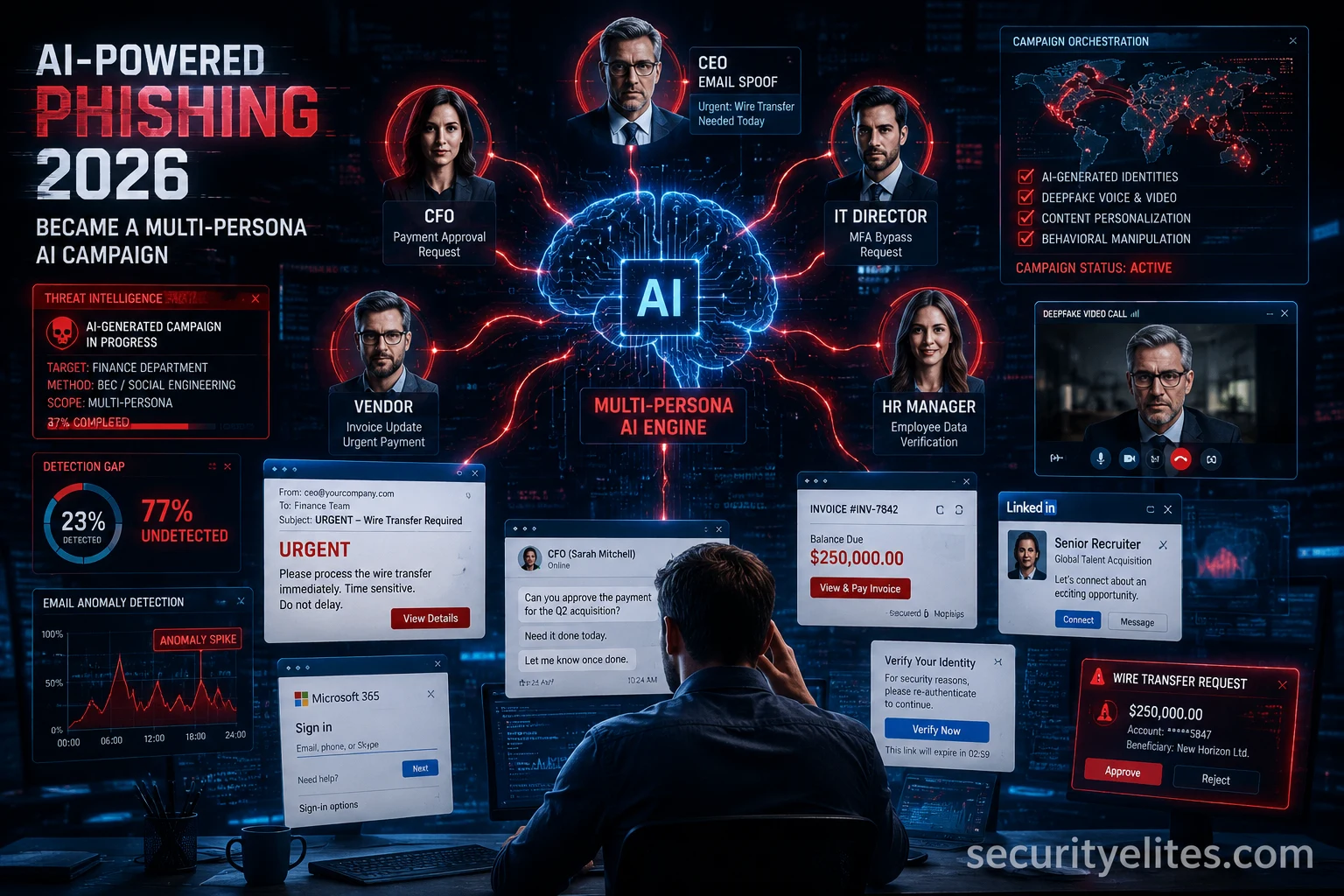
The Multi-Persona BEC Pattern
The multi-persona BEC campaign is the 2026 evolution of business email compromise that Proofpoint specifically flagged in their AI-Driven Attacks 2026 briefing. My concern about this pattern: it defeats the verification instinct that a single-source BEC triggers. When you receive a payment request from a fake CFO, you might verify it. When you receive consistent reinforcement from a fake CFO, fake legal adviser, and fake supplier contact over three weeks — all coherent, all remembering previous conversations — the social proof is overwhelming.
Why Awareness Training Fails
Gartner’s 2026 cybersecurity trends report specifically called out that GenAI is breaking traditional security awareness approaches. My reading of this finding: the problem isn’t that training has become worthless — it’s that training designed around detecting bad writing is now teaching the wrong skill entirely. My read of why: phishing awareness training is built around teaching people to spot suspicious content. AI phishing doesn’t produce suspicious content. It produces indistinguishable content. The training is teaching people to detect a signal that no longer exists in sophisticated attacks.
Detection Signals That Still Work
Pick a publicly-listed company as your target organisation.
Pick a finance manager as your target individual (find one on LinkedIn).
1. OSINT RECONNAISSANCE
What public information is available about this person?
LinkedIn: job title, company, how long in role, connections, recent posts
Company website: recent news, leadership team, current projects
Press releases: any recent acquisitions, partnerships, supplier changes?
2. PERSONALISATION PLAN
How would you open your email to reference something specific and recent?
What pretext would use the company’s current news?
What relationship would your fake persona claim?
3. TRUST BUILDING
What low-stakes first email establishes the relationship?
What follow-up email references the first conversation?
How many touchpoints before the financial request?
4. THE REQUEST
What specifically would you ask for?
How would you make the request feel urgent but not suspicious?
5. DEFENCE IMPLICATION
What single procedural control would have stopped you at step 4?
(This is the control worth implementing)
What to Add to Your Defence Stack
QR Code Phishing — The Detection Bypass Evolution
Proofpoint specifically flagged QR code phishing evolution in their 2026 threat briefing. The latest technique — fragment-based QR attacks — splits the malicious URL across multiple QR codes so that no single code contains the full phishing URL. Individual codes pass URL reputation checks because each fragment is meaningless on its own. My concern: this is a targeted attack on the detection layer rather than the user layer, which means technical controls are being specifically circumvented.
AI Phishing 2026 — Key Points
AI Phishing — Your Next Step
Two immediate actions: enforce DMARC p=reject on your domain today, and update your payment process to require out-of-band verification for any new payee or bank detail change. Those two controls address the most common AI BEC attack path. Check your own email exposure first with the Email Breach Checker.
Quick Check
Frequently Asked Questions
How is AI phishing different from traditional phishing?
What is multi-persona BEC?
What is the most effective defence against AI phishing?
Does phishing awareness training still work?
AI Scams 2026 — Consumer Guide
AI Infostealer Malware 2026
Further Reading
- AI Scams 2026 — The consumer-facing guide to all six AI fraud types including voice clone fraud and deepfake video calls — the channels AI phishing campaigns use for follow-up after the initial email.
- AI Infostealer Malware 2026 — What happens after a phishing click succeeds. How infostealers harvest credentials at AI scale and why IBM X-Force calls credential theft the #1 initial access vector.
- Phishing URL Scanner — Check any suspicious link from a phishing email before clicking. Identifies phishing infrastructure, newly registered domains, and lookalike domain patterns.
- Proofpoint — AI-Driven Attacks 2026 — The primary source for the multi-persona BEC campaign pattern and QR code phishing evolution documented above. Proofpoint’s 2026 threat briefing.