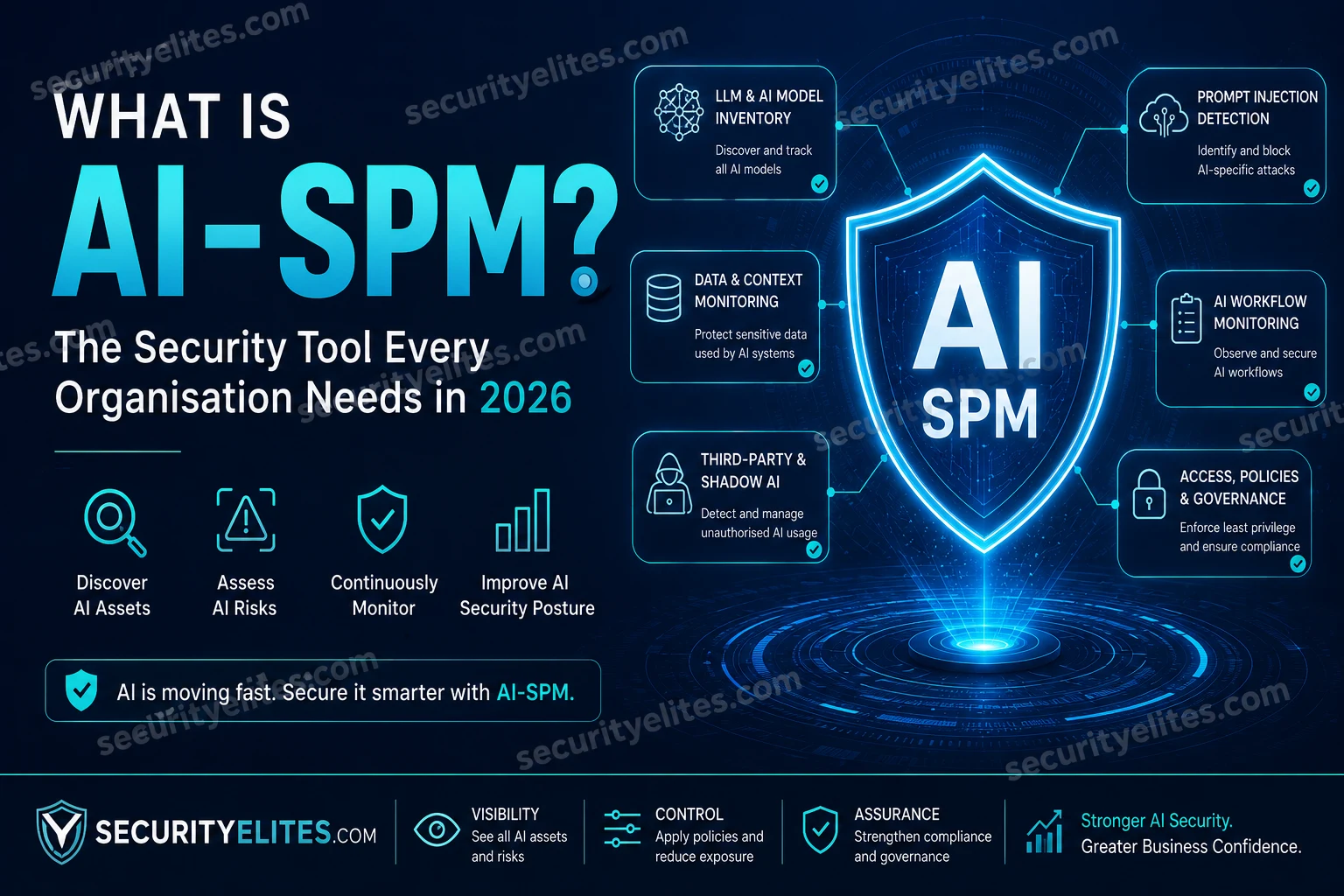
AI Security Posture Management – The Security Tool Every Organisation Needs

AI Security Posture Management – The Security Tool Every Organisation Needs
You can’t secure what you can’t see, and most organisations currently have zero visibility into their AI models, training data, and agent deployments. AI-SPM is the emerging category of security tools that provides exactly that visibility — monitoring AI workloads, models, and agents the same way Cloud Security Posture Management tools monitor cloud infrastructure configurations.

What You’ll Learn

What AI-SPM is and how it differs from CSPM and traditional security tools
What an AI-SPM tool monitors and the risks it surfaces
The leading AI-SPM tools in 2026 and what each covers
How to evaluate whether your organisation needs AI-SPM now
What to do if you’re not ready for a full AI-SPM tool yet

⏱️ 10 min read

AI-SPM provides the visibility layer that SAIF Principle 2 (detection and response) requires. It addresses the inventory and monitoring gaps identified in the non-human identity guide. The shadow AI problem documented in the shadow AI guide is one of the primary use cases AI-SPM addresses.


What AI-SPM Is

AI Security Posture Management is the category of security tools that provides continuous visibility and risk assessment for AI systems — models, training data, AI agents, and LLM applications. My one-sentence definition: AI-SPM does for your AI workloads what CSPM does for your cloud infrastructure. It discovers what AI systems exist across your environment, assesses each against security best practices and known risk patterns, and continuously alerts on configurations, behaviours, or data flows that represent a security or compliance risk.

AI-SPM vs CSPM — WHAT’S DIFFERENT
# CSPM (Cloud Security Posture Management)
Monitors: cloud infrastructure — S3 buckets, VMs, network configs, IAM policies
Finds: misconfigured cloud resources, overly permissive IAM, exposed endpoints
Gap: doesn’t understand AI workloads, models, training data, or LLM APIs
# AI-SPM (AI Security Posture Management)
Monitors: AI models, training pipelines, LLM applications, AI agents, prompts
Finds: sensitive data in training sets, insecure AI configs, prompt injection exposure
New: understands the AI-specific risk categories that CSPM doesn’t model
# Why traditional security tools miss AI risks
SIEM: logs infrastructure events — doesn’t analyse AI model inputs/outputs
DLP: catches data by content pattern — doesn’t understand data flowing into AI training
EDR: monitors process behaviour — doesn’t see inside LLM inference pipelines
The gap: Palo Alto calls it “the visibility gap that DSPM and AI-SPM are designed to close”


What AI-SPM Monitors

My assessment of what a mature AI-SPM implementation covers, based on current tool capabilities. The category is still maturing — not all tools cover all areas equally — but this is the full scope of what AI-SPM should provide visibility into.

AI-SPM MONITORING SCOPE
# Model inventory and risk
Discovers all AI models deployed in your environment (including shadow AI)
Assesses: model provenance, known vulnerabilities, training data risks
Alerts: unapproved models, models with known security issues
# Training data security
Scans training datasets for sensitive data (PII, credentials, regulated data)
Monitors: who has access to training data, data lineage
Alerts: sensitive data inadvertently included in training sets
Analyses prompt and response traffic for injection attempts
Monitors: data being submitted to AI (shadow AI detection)
Alerts: anomalous prompt patterns, data exfiltration via AI responses
# AI agent activity
Monitors: agent actions, API calls, external contacts
Baseline: normal agent behaviour patterns
Alerts: agent behaviour deviating from baseline (potential compromise or injection)
# Configuration and compliance
Assesses AI system configurations against security frameworks (SAIF, OWASP LLM)
Tracks: AI-specific compliance requirements as regulations emerge


Leading AI-SPM Tools in 2026

AI-SPM TOOL LANDSCAPE — 2026
# Wiz AI-SPM
Coverage: AI model inventory, training data risk, AI workload security in cloud
Strength: integrates with existing Wiz CSPM — unified cloud + AI visibility
Context: Google Cloud Next featured Wiz + Google Cloud AI security integration (April 2026)
# Palo Alto Prisma AI-SPM
Coverage: AI application security, LLM traffic analysis, agent monitoring
Strength: integrates with broader Prisma Cloud platform
# Microsoft Defender for Cloud (AI workload protection)
Coverage: Azure AI services, Copilot Studio agents, Azure OpenAI workloads
Strength: native integration with Microsoft AI stack
# Emerging dedicated AI-SPM vendors
Aim Security, Protect AI, HiddenLayer — purpose-built AI security platforms
Strength: deeper AI-specific coverage; trade-off: less integration with existing stack
# Honest assessment of maturity
AI-SPM is a new category — tools are maturing rapidly but coverage gaps exist
Best approach: evaluate against your specific AI stack and use cases
Most organisations: start with the CSPM vendor’s AI-SPM add-on module rather than introducing a separate tool and a new console to manage

EXERCISE — THINK LIKE A SECURITY ARCHITECT (10 MIN)
Evaluate AI-SPM Fit for Your Environment
Answer these questions to assess whether you need AI-SPM and which type:

1. AI WORKLOAD INVENTORY
How many AI models does your organisation use or host?
Are any AI models trained on internal data?
Do you have AI agents taking autonomous actions?

2. CURRENT VISIBILITY
Can you currently answer: “What data is being submitted to AI tools in my org?”
Can you currently answer: “What are our AI agents doing right now?”
Can you currently answer: “Does any training data contain PII or sensitive information?”

3. REGULATORY PRESSURE
Are you in a regulated industry (finance, healthcare, government)?
Do you process EU personal data (GDPR applies)?
Is AI compliance becoming a customer or audit requirement?

4. AI-SPM READINESS SCORE
Give yourself 1 point for each “yes” to questions 1 (any AI models = 1pt, internal training = 2pts, agents = 2pts)
Subtract 1 point for each “yes” to questions 2 (each “yes” = current visibility exists)
Add 2 points for each “yes” to question 3

Score 5+: AI-SPM is a near-term security investment priority
Score 3-4: Evaluate AI-SPM tooling in your next annual planning cycle
Score 0-2: Manual SAIF controls are sufficient for now — revisit this assessment in 6 months as your AI deployment grows

✅ Most organisations with any AI agents deployed will score 5+ on this assessment. The key driver is the visibility gap — if you can’t answer “what is my AI agent doing right now?” then you have the exact gap AI-SPM addresses. My recommendation for organisations that score 3-4: don’t wait for a full AI-SPM procurement process. Implement the manual SAIF controls (logging, approved tool list, NHI inventory) now, which reduces the urgency while building the foundation AI-SPM tools build on.


What to Do Without a Full AI-SPM Tool

AI-SPM tools have significant licence costs and procurement timelines. My practical guidance for organisations that need AI visibility now but aren’t ready for a dedicated tool: the manual controls that approximate AI-SPM coverage using capabilities you likely already have.

MANUAL AI-SPM EQUIVALENT CONTROLS
# Model and agent inventory (SAIF Principle 1)
Quarterly NHI audit — enumerate all AI agents, models, and AI API credentials
Approved AI tool list — document what’s authorised and for what data types
# LLM traffic monitoring (SAIF Principle 2)
Add LLM API endpoints to SIEM egress monitoring
Alert: non-approved processes calling LLM APIs (PROMPTFLUX detection signal)
CASB: if you have one, add AI platform categories to inspection rules
# Training data review
Run DLP scan on any dataset before it goes into AI training
Check for PII, credentials, and regulated data patterns before training
# Agent action logging
Ensure all AI agent actions write to a log that goes to your SIEM
Create one alert rule: agent action volume spike or new external contact


AI-SPM in Practice — The Five Core Use Cases

My assessment of where AI-SPM tools deliver tangible value in 2026, based on what I’m seeing in actual deployments. The category is still maturing, so not every tool covers every use case equally. My recommendation: evaluate against these five use cases and pick the tool with the strongest coverage for your specific AI stack, not the most complete marketing checklist.

AI-SPM USE CASES — WHERE VALUE IS DELIVERED
# Use case 1: Shadow AI discovery
Problem: you don’t know which AI tools employees are using or what data they’re submitting
AI-SPM: monitors egress traffic to AI platforms, logs what’s being sent
Value: replaces the “we think they’re using ChatGPT” with actual data
# Use case 2: Training data sensitivity scanning
Problem: PII, credentials, or regulated data accidentally included in training datasets
AI-SPM: scans proposed training data before it enters the training pipeline
Value: prevents the “we accidentally trained on customer PII” GDPR incident
# Use case 3: Prompt injection detection
Problem: user inputs or external content manipulating AI agent behaviour
AI-SPM: analyses prompt traffic for known injection patterns and anomalous instructions
Value: the detection layer for the attack described in agentic AI security
# Use case 4: AI model inventory and provenance
Problem: developers deploying third-party models without security review
AI-SPM: discovers all models in use, flags unapproved or unreviewed models
Value: visibility into the AI supply chain before an incident
# Use case 5: Agent behaviour baseline and alerting
Problem: no visibility into what AI agents are doing or when they deviate
AI-SPM: establishes normal agent behaviour baselines, alerts on deviations
Value: the detection capability that catches prompt-injected agents before major damage


AI-SPM Readiness — When to Buy vs When to Wait

The honest answer to “do we need AI-SPM now?” is that it depends on your AI workload profile. My readiness framework based on what I’ve seen work in real environments.

AI-SPM READINESS FRAMEWORK
# Buy AI-SPM now if:
You’re training models on internal data (training data scanning is immediate value)
You have multiple AI agents with autonomous tool access
You’re in a regulated industry with AI compliance requirements emerging
You’ve already had a shadow AI incident or near-miss
# Build manual controls first if:
You use commercial AI APIs but don’t train models
Your AI deployment is limited to 1-2 specific use cases, both well-understood
Your security team is already stretched — adding a new tool category adds management overhead
# The procurement approach that works
Start with your existing CSPM vendor’s AI-SPM module — lower integration complexity
Run a minimum 30-day trial against your actual AI traffic and agent activity before committing to any annual licence
Measure: how many shadow AI users did it find? How many anomalous agent actions?

AI-SPM — Key Points

AI-SPM: continuous automated visibility and real-time security risk assessment for AI models, AI agents, and training data
Palo Alto 2026: specifically called AI-SPM a “nonnegotiable cloud security imperative” — closes the AI visibility gap
What it monitors: model inventory, training data PII, LLM traffic, agent actions, configurations
Leading tools: Wiz, Palo Alto Prisma, Microsoft Defender, Aim Security, Protect AI, HiddenLayer
Without a tool: NHI audit + LLM egress monitoring + CASB + agent action logging = 80% coverage

AI-SPM — Your Visibility Baseline

Whether or not you’re ready for a dedicated AI-SPM tool, implement the four manual controls above this week. They cost nothing and address the most critical visibility gaps. When you’re ready to evaluate tools, the SAIF scoring exercise gives you the evaluation framework.


Quick Check

A CISO asks: “We already have CSPM and SIEM. Why do we need AI-SPM on top of those?” What is the most important gap to explain?


Frequently Asked Questions

What is AI-SPM?
AI Security Posture Management (AI-SPM) is a category of security tools that provides continuous visibility and risk assessment for AI systems — AI models, training data, LLM applications, and AI agents. It functions similarly to Cloud Security Posture Management (CSPM) but targets AI-specific risks that traditional security tools don’t model: training data exposure, prompt injection vulnerabilities, shadow AI usage, and agent behaviour anomalies. Palo Alto Networks called AI-SPM a nonnegotiable cloud imperative for 2026 as AI workloads become primary attack targets.
What is the difference between AI-SPM and CSPM?
CSPM monitors cloud infrastructure configuration — it finds misconfigured S3 buckets, overly permissive IAM policies, and exposed cloud endpoints. It doesn’t understand AI workloads or model-specific risks. AI-SPM monitors AI-specific assets and behaviours — AI model inventory and provenance, sensitive data in training sets, LLM prompt traffic, and AI agent actions. The two tools are complementary: CSPM for the infrastructure layer, AI-SPM for the AI workload layer above it. Most CSPM vendors are adding AI-SPM capabilities as AI workloads become significant infrastructure components.
Do small organisations need AI-SPM?
If you use AI agents that take autonomous actions or train models on internal data, AI-SPM visibility is worth pursuing. The scale of implementation can match your scale of AI usage — a small organisation might start with the manual controls described (NHI inventory, LLM egress monitoring, agent action logging) rather than a full commercial AI-SPM platform. The AI-SPM readiness scoring exercise earlier in this guide provides a structured way to assess readiness and build the business case. For most small organisations in 2026: implement SAIF manual controls first, evaluate commercial AI-SPM when your AI workload complexity warrants the investment.

Further Reading

  • Google SAIF Framework — The programme framework that AI-SPM supports. SAIF Principle 2 (detection and response) is exactly what AI-SPM tools implement at the technical layer.
  • Shadow AI Security 2026 — The primary use case for AI-SPM’s LLM traffic monitoring — discovering what AI tools employees are using and what data they’re submitting.
  • Agentic AI Security 2026 — AI-SPM’s agent monitoring capability addresses the detection gap in agentic deployments. The CyberStrikeAI incident is exactly the scenario AI-SPM agent anomaly detection specifically targets and catches.
  • Palo Alto — 6 Cybersecurity Predictions 2026 — The primary source for AI-SPM being described as a “nonnegotiable cloud imperative,” with the data trust and AI visibility gap analysis that drives this conclusion.

ME
Mr Elite
Owner, SecurityElites.com
My honest position on AI-SPM in 2026: the category is real and the problem it solves is real, but the tools are still maturing. My recommendation to security teams currently evaluating AI-SPM options is to start with your CSPM vendor’s AI extension rather than introducing a standalone tool — you get integrated visibility without the complexity of another console, and the major CSPM vendors are investing heavily in this space. If you’re running a significant AI workload that your CSPM vendor’s extension doesn’t cover, that’s when dedicated AI-SPM vendors become worth evaluating. But don’t let tool procurement paralysis stop you from implementing the manual controls now — the visibility gap costs you nothing to start closing.

Join free to earn XP for reading this article Track your progress, build streaks and compete on the leaderboard.
Join Free
Lokesh N. Singh aka Mr Elite
Founder, Securityelites · AI Red Team Educator
Founder of Securityelites and creator of the SE-ARTCP credential. Working penetration tester focused on AI red team, prompt injection research, and LLM security education.
About Lokesh ->

Leave a Comment

Your email address will not be published. Required fields are marked *