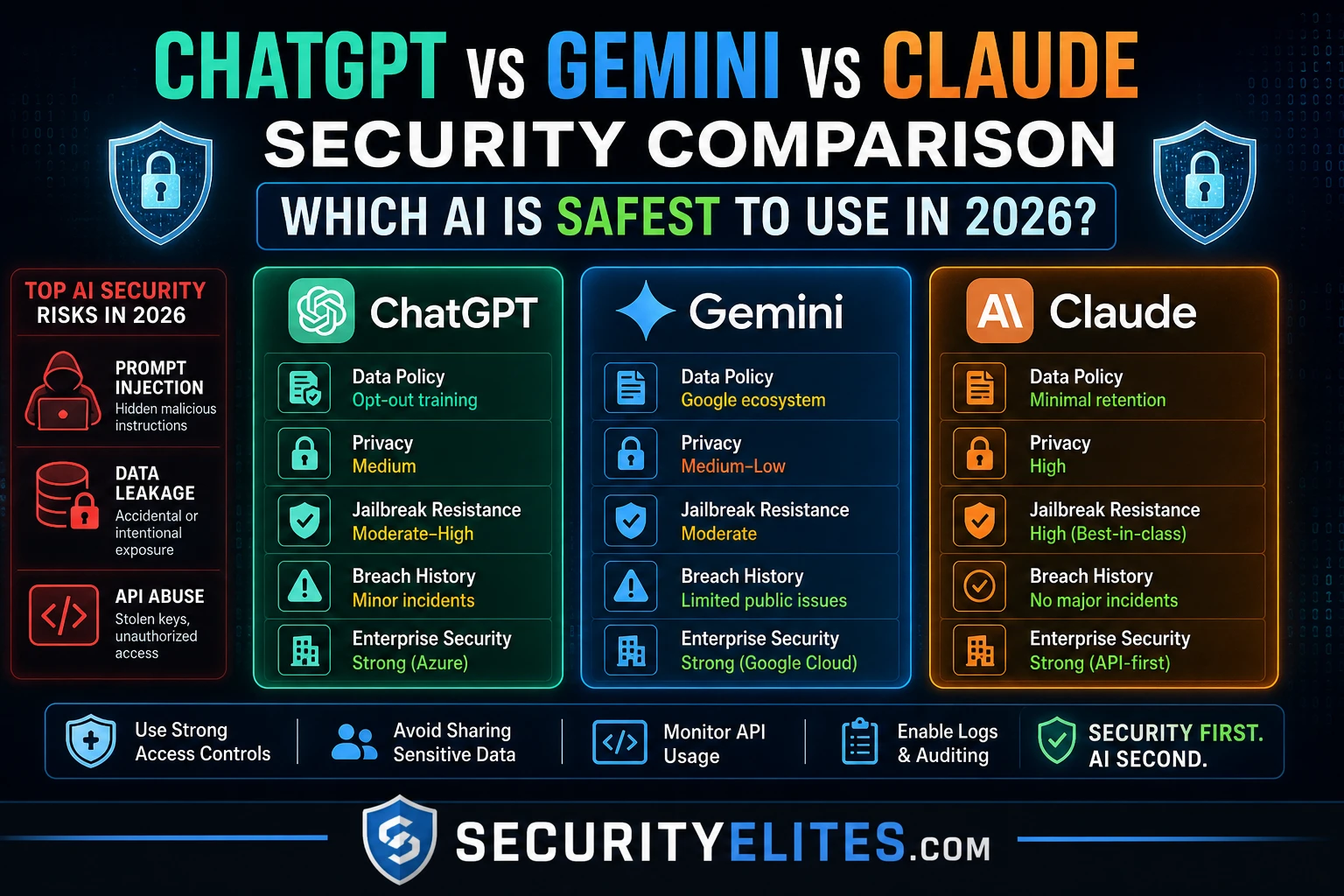
All three are excellent AI assistants. But “which is best” and “which is safest” are different questions with different answers. I use all three professionally — in security assessments, in research, and in client work. My evaluation here isn’t about which writes better poetry — there are thousands of articles doing that comparison. It’s about data retention policies, breach history, jailbreak resistance, what each company can see from your conversations, and which plans offer meaningful privacy protections. Here is the security-focused comparison nobody else is giving you.
What You’ll Learn
Data retention and training policies for all three platforms compared
Breach and security incident history for each
Jailbreak resistance — which platform is hardest to manipulate
Enterprise and privacy options side by side
My recommendation for different use cases
⏱️ 12 min read
ChatGPT vs Gemini vs Claude Security Comparison in 2026
My starting point for any AI platform security evaluation is the data policy — specifically: what does the company store, how long do they keep it, can employees read it, and does your conversation data improve their model? The answers differ meaningfully between platforms and between plan tiers within each platform.
DATA POLICIES — THREE PLATFORMS COMPARED
# ChatGPT (OpenAI) — Free and Plus
Training use: YES by default — opt out in Settings → Data controls
Storage: conversations retained until deleted by user
Human review: possible for safety and quality purposes
Data location: primarily US-based servers
# Gemini (Google) — Free and Advanced
Training use: YES by default — conversations used to improve Google’s AI
Storage: retained for up to 3 years by default (reviewable/deletable)
Human review: yes — Google states human reviewers may read conversations
Integration: Google account data (Search, Gmail history) may inform responses
# Claude (Anthropic) — Free and Pro
Training use: YES by default — conversations used for model improvement
Storage: conversations retained per privacy policy
Human review: possible for safety review purposes
Opt out: Settings → Privacy — disable conversation training
# Key comparison insight
All three use conversations for training on free/standard plans by default
All three allow opt-out via settings
All three offer business/enterprise plans with no-training commitments
Gemini’s 3-year default retention is the longest of the three
securityelites.com
Data Policy Comparison — Free/Standard Plans
Feature
ChatGPT
Gemini
Claude
Used for training
Yes (opt-out)
Yes (opt-out)
Yes (opt-out)
Retention period
Until deleted
Up to 3 years
Per policy
Human review
Possible
Yes
Possible
Temporary chat
Yes ✓
Yes ✓
Yes ✓
Business plan (no training)
Team/Enterprise
Workspace
Claude for Work
📸 Data policy comparison for free/standard consumer plans across all three platforms. All three default to using conversations for model improvement but provide opt-out mechanisms. All three offer business plans with no-training commitments. Gemini’s 3-year default retention period stands out as the longest of the three for consumer accounts.
Security Incident History
Examining the public security incident record for each platform gives a baseline for how each company handles vulnerabilities. My assessment: all three have had incidents — the question is transparency of disclosure and speed of remediation.
SECURITY INCIDENTS — DOCUMENTED RECORD
# ChatGPT / OpenAI incidents
March 2023: bug exposed conversation titles + partial payment info to other users (confirmed, patched)
2023: 101,134 credentials found on dark web — stolen via malware, not OpenAI breach
2024: internal employee forum accessed by attacker — no customer data compromised
OpenAI disclosed the March 2023 bug promptly — transparency score: good
# Gemini / Google incidents
2023: researcher demonstrated Gemini indirect prompt injection via Google Docs content
2024: Gemini Advanced shown to produce confidently wrong outputs used in high-stakes contexts
No confirmed major data breaches of Gemini specifically as of 2026
Google’s scale means broader data ecosystem risk — Gemini accesses your Google account data
# Claude / Anthropic incidents
No major public data breaches confirmed as of 2026
Prompt injection and jailbreak research published against Claude (as with all platforms)
Anthropic publishes Constitutional AI research — most transparent about safety methodology
# Assessment
OpenAI: documented incidents but good disclosure practices
Google: broader data ecosystem risk due to Google account integration
Anthropic: cleanest public incident record of the three
Jailbreak and Safety Resistance
All three platforms invest significantly in safety — and all three have been successfully jailbroken by researchers. The honest picture is that no AI platform has fully solved the jailbreak problem. The differences are in how robustly each platform resists manipulation and how quickly they patch newly discovered techniques.
JAILBREAK RESISTANCE COMPARISON
# Claude (Anthropic) — Constitutional AI approach
Method: trained to reason about ethics rather than follow rules list
Approach: Constitutional AI — model trained to critique its own outputs
Result: generally considered most resistant to simple jailbreaks among the three
Limitation: sophisticated multi-step attacks still work; not immune
# ChatGPT (OpenAI) — RLHF + safety layer
Most researched platform for jailbreaks due to largest user base
Most documented jailbreak techniques — but also fastest patching of known methods
GPT-4 more resistant than GPT-3.5 — model generation matters significantly
# Gemini (Google) — safety filtering approach
Multi-modal capabilities (text/image/video) create a larger attack surface
Documented: image-based prompt injection demonstrated (text in images)
Google’s safety research team is world-class — but Gemini is newer than ChatGPT
# My working assessment
For standard use: all three are appropriately safe for normal tasks
For adversarial use: none are immune, all have documented bypasses
Claude tends to maintain refusals more consistently under pressure
Enterprise and Privacy Options
ENTERPRISE PRIVACY OPTIONS COMPARED
# ChatGPT Enterprise (OpenAI)
No training on conversations: YES — contractual commitment
Data residency: EU option available
Admin controls: usage policies, SSO, audit logs
BAA: available for HIPAA-covered entities
Price: custom — typically enterprise contract
# Google Workspace with Gemini
No training on conversations: YES for Google Workspace plans
Data residency: strong — Google’s enterprise data residency options
Admin controls: Google Admin Console — extensive
Advantage: integrates with existing Google Workspace (Docs, Gmail, Drive)
# Claude for Enterprise (Anthropic)
No training on conversations: YES — contractual commitment
Data residency: available
Admin controls: SSO, audit logs, usage policies
BAA: available
Advantage: strongest safety track record — most privacy-forward public communications
Which to Use — By Use Case
My honest recommendation varies by use case. There is no single “safest” answer — the right choice depends on what you’re doing, what data is involved, and your organisation’s existing infrastructure. My recommendation framework: match the tool to the data sensitivity, not the other way around.
RECOMMENDATION BY USE CASE
# Personal use (no sensitive data)
Any of the three with training opt-out enabled
Use Temporary Chat / equivalent for anything you’d rather not retain
# Privacy-conscious personal use
Claude Pro — cleanest incident record, Constitutional AI safety approach
Disable training in settings regardless of which platform you choose
# Business use with sensitive data
Already on Google Workspace: Gemini for Workspace — data stays in your tenant
Microsoft-first environment: Microsoft 365 Copilot — stays in your M365 tenant
Platform-agnostic: ChatGPT Team/Enterprise or Claude for Work/Enterprise
Use all three — each has different strengths and different blind spots
Claude for thoughtful safety reasoning; ChatGPT for breadth of capability
Always use Temporary Chat for anything assessment-related
# High-sensitivity regulated data (HIPAA, legal privilege)
Enterprise plan with BAA for healthcare: ChatGPT Enterprise or Claude Enterprise
Legal: none of the three with confidence — get legal counsel’s guidance first
Privacy Settings — All Three Platforms
Regardless of which platform you choose, these are the settings I configure immediately on any new AI account. All three platforms provide these controls — most people simply never find them.
PRIVACY SETTINGS — STEP BY STEP
# ChatGPT — disable training
openai.com → Settings → Data controls → toggle OFF “Improve the model for everyone”
For sensitive conversations: use Temporary Chat (pencil icon → Temporary chat)
# Gemini — disable training and activity
myaccount.google.com → Data & Privacy → Gemini Apps Activity → turn off
Also: disable “Include your Google Workspace data” if you don’t want work data accessed
For sensitive conversations: use Gemini with activity off — not saved to Google account
For sensitive conversations: new conversation without memory features enabled
# Universal settings check
Connected apps: revoke any third-party app connections you don’t actively use
Account security: MFA enabled on all three accounts
Review active sessions: remove any devices you don’t recognise
💡 The Setting Most People Miss on Gemini: Gemini on free accounts can optionally pull context from your Gmail, Google Drive, and Search history to personalise responses. My recommendation: unless you have a specific reason to enable this, turn it off. The additional personalisation isn’t worth the data exposure for most use cases. Find it in myaccount.google.com → Data & Privacy → Gemini Apps — the “Include related activity” toggle. This is separate from the conversation training toggle and many users enable it accidentally during initial setup.
The Real-World Choice Most People Face
In practice, most people aren’t choosing between three platforms in isolation — they’re using whichever one their workplace provides, or whichever one their colleagues use, or the one that came bundled with a subscription they already have. My observation from working with organisations across different sectors: the platform decision is often made before the security evaluation happens. Here’s how to make the best of whatever you’re using.
PRACTICAL GUIDANCE BY SITUATION
# “My company gave me Microsoft 365 Copilot”
Best outcome: data stays in your Microsoft tenant under your existing agreement
Action: verify your IT team has enabled the enterprise data protection settings
Caution: Copilot has access to your entire M365 data — apply least-privilege file permissions
# “I use free ChatGPT for work sometimes”
Risk: you’re on a consumer plan with training enabled
Fix: disable training toggle + switch to Temporary Chat for work content
Better fix: propose a Team plan to your IT/security team
# “I only use it personally for non-sensitive things”
Risk: low — any of the three is appropriate with training disabled
Choose: the one with the interface and capabilities you find most useful
Security is not a meaningful differentiator for low-sensitivity personal use
ChatGPT vs Gemini vs Claude — Security Summary
Data policies: all three use conversations for training by default — all three allow opt-out
Incidents: ChatGPT has most documented (largest platform) · Claude has cleanest record
Jailbreak resistance: Claude generally considered most resistant · none immune
Google risk: Gemini integrates with your Google account — broader data ecosystem exposure
Enterprise: all three offer no-training plans · choose based on your existing stack
Your Recommendation
For personal use: any with opt-out enabled. For business: match to your existing stack or choose an enterprise plan. For maximum privacy: Claude Pro with training disabled has the strongest combination of safety methodology and clean incident record. Always use Temporary Chat for sensitive topics regardless of platform.
Quick Check
A company uses Gmail and Google Docs for all internal work. An employee asks which AI assistant is most private for work use. What is the most accurate guidance?
Frequently Asked Questions
Which AI is safest — ChatGPT, Gemini, or Claude?
For privacy: Claude has the cleanest security incident record and Anthropic is the most transparent about its safety methodology. For business integration: Gemini for Google Workspace or Microsoft 365 Copilot keeps data within your existing enterprise tenant. For raw safety resistance to manipulation: Claude’s Constitutional AI approach is generally considered the most robust of the three. All three offer appropriate enterprise options with no-training commitments for business use.
Does Google read my Gemini conversations?
On free consumer Gemini: yes — Google’s privacy policy states human reviewers may read conversations and they are used to improve Google’s AI products. On Google Workspace enterprise plans: conversations are not used for training. Gemini also has access to your broader Google account data (search history, Gmail context on some settings) which creates a larger data exposure surface than ChatGPT or Claude on equivalent plans.
Has Claude been hacked?
No major public data breach of Anthropic’s Claude platform has been confirmed as of 2026. Prompt injection and jailbreak research has been published against Claude (as with all AI platforms), but these are AI-layer vulnerabilities rather than platform breaches. Anthropic has the cleanest public security incident record of the three major platforms, though this is partly because it’s younger and has a smaller user base than OpenAI or Google.
Which AI has the strongest jailbreak protection?
Claude is generally considered the most resistant to jailbreaking attempts due to its Constitutional AI training approach, which teaches the model to reason about ethics rather than follow a rules list. However, all three platforms have documented jailbreak techniques and none is immune to sophisticated multi-step attacks. The differences are meaningful for casual manipulation attempts but less so for determined security researchers using advanced techniques.
→ Related
Is ChatGPT Safe for Work? Privacy Guide
→ Related
ChatGPT Security Incidents — Full Record
Further Reading
ChatGPT Security Incidents— The full documented record of security issues affecting ChatGPT: the March 2023 conversation exposure bug, credential theft via malware, and prompt injection vulnerabilities.
Is ChatGPT Safe for Work?— Detailed guidance on ChatGPT data policies, the Samsung source code incident, plan tier comparison, and settings to change for better privacy — applicable across all three platforms.
What Is Prompt Injection?— The AI-layer vulnerability affecting all three platforms. Understanding prompt injection explains why no AI assistant processing external content is fully secure regardless of the platform’s safety investments.
Anthropic Privacy Policy— The primary source for Claude’s data practices, retention periods, training use, and opt-out mechanisms. Compare with OpenAI’s and Google’s equivalent policies for an accurate side-by-side view.
ME
Mr Elite
Owner, SecurityElites.com
My practical experience using all three: Claude is the one I use for security research where I want the most considered response to edge cases. ChatGPT is the one I use when I need breadth and speed on well-documented topics. Gemini is the one I use when I need Google-integrated research with real-time web access baked in. For privacy in all three, the single most impactful setting change is disabling training and switching to temporary chat for anything work-related. The platform you choose matters less than the settings you configure and the data you choose not to enter.
Founder of Securityelites and creator of the SE-ARTCP credential. Working penetration tester focused on AI red team, prompt injection research, and LLM security education.