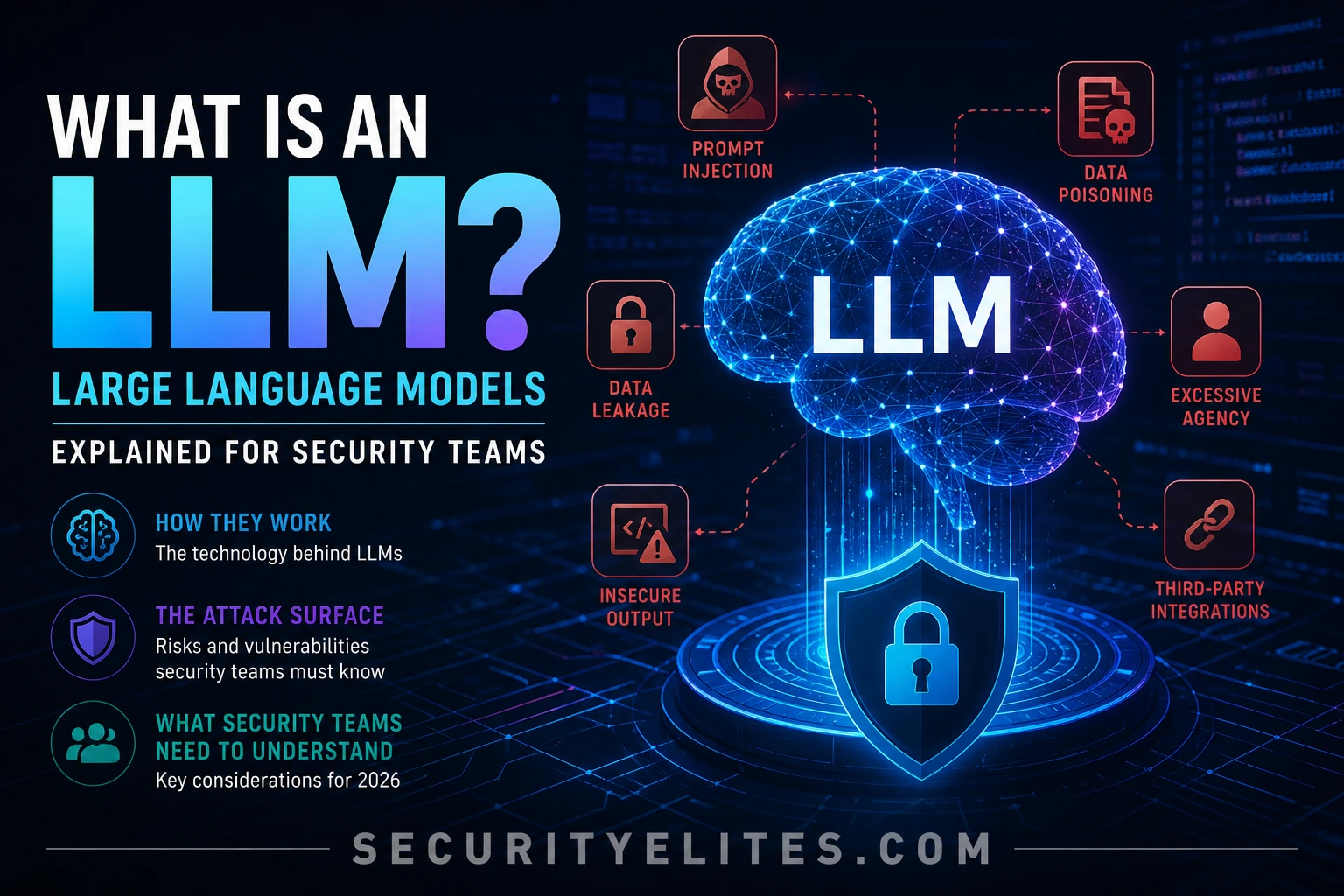
Every serious security topic in 2026 eventually requires understanding what a large language model actually is. Prompt injection, jailbreaking, model theft, adversarial inputs, hallucination exploitation — all of these attack categories only make sense once you understand the underlying architecture. My goal in this guide is to explain LLMs the way I explain them in security briefings: technically accurate, practically focused, and without the machine learning PhD prerequisites. If you understand how LLMs work, you understand why they’re vulnerable in the specific ways they are.
What You’ll Learn
What an LLM actually is — the plain English technical explanation
How LLMs are trained and why training creates security risks
Why LLMs hallucinate and how that creates exploitable behaviour
The attack surface specific to LLMs — what makes them different from traditional software
A large language model is a statistical prediction engine trained on text — the most important technical concept for any security practitioner to understand before engaging with AI security work in 2026. Given a sequence of words, it predicts the most probable next word — then the next, then the next — to produce a response. That’s it at the core. The “large” part refers to the number of parameters: GPT-4 is estimated at around 1.7 trillion parameters. Each parameter is a number that was adjusted during training to make the model better at predicting text.
What makes this security-relevant is what “predicting text” means in practice — and this is the concept that unlocks every LLM vulnerability class. The model doesn’t have a database of facts. It doesn’t look things up. It produces text that is statistically similar to text it was trained on. When it produces a correct answer, it’s because that pattern appeared reliably in training data. When it produces a confident wrong answer, it’s because the wrong pattern was more statistically likely given the input.
LLM ARCHITECTURE — SECURITY PRACTITIONER’S VIEW
# The core components
Tokeniser: converts input text into numerical tokens (roughly words/subwords)
Transformer: the neural network architecture — processes tokens in parallel via attention
Parameters: the billions of numbers that encode learned patterns from training
Context window: the amount of text the model can “see” at once (4K to 2M tokens)
Output sampler: selects the next token probabilistically — explains non-determinism
# What the model “knows”
Nothing — LLMs don’t have knowledge in the way humans do
They have statistical patterns learned from text corpora
This distinction is critical for understanding hallucination and injection attacks
# What the context window contains (security relevant)
System prompt: developer’s instructions defining the AI’s role and rules
Conversation: all previous messages in the current session
User input: the current message — potentially attacker-controlled
Key insight: the model processes ALL of this as undifferentiated text
How LLMs Are Trained — and Why Training Matters for Security
Understanding LLM training is essential for understanding data poisoning, backdoor attacks, and why model provenance matters. Training happens in stages, and each stage creates a different security risk profile.
LLM TRAINING STAGES — SECURITY IMPLICATIONS
# Stage 1: Pre-training
Data: massive text corpus — web crawl, books, code, academic papers
Process: predict next token across billions of examples → parameters updated
Risk: poisoned web content influences what the model learns as “true”
Risk: private data in the corpus can be memorised and later extracted
Risk: backdoors can be injected via coordinated corpus poisoning
Data: curated examples of desired input-output behaviour
Process: further adjusts parameters to follow instructions helpfully
Risk: malicious fine-tuning datasets introduce backdoors or remove safety
Risk: third-party fine-tuning services can modify model behaviour
# Stage 3: RLHF (Reinforcement Learning from Human Feedback)
Data: human ratings of model outputs (good/bad)
Process: adjusts model to produce outputs humans rate highly
Risk: manipulated rater pool could shift model values/behaviour
Benefit: this stage also installs safety guidelines and refusal behaviour
# Why training provenance matters
A model from an unknown source could have any of these attacks embedded
Supply chain: downloading a model from Hugging Face ≠ downloading safe weights
Best practice: use models from verified sources with published model cards
Why LLMs Hallucinate
Hallucination is one of the most security-relevant LLM behaviours and the one that’s most commonly misunderstood. My explanation in security briefings: the model isn’t lying and it isn’t broken. It’s doing exactly what it was designed to do — produce statistically probable text — in a situation where the probable text happens to be wrong.
WHY HALLUCINATION HAPPENS — THE MECHANISM
# The statistical prediction problem
Model asked: “What were the findings of the 2019 Smith et al. paper on X?”
Model has no memory of this paper (may not exist)
But: it has seen thousands of academic paper summaries in training
So it generates: statistically plausible paper findings in the correct academic format
Slopsquatting: AI recommends non-existent npm/PyPI packages → attacker registers them
Legal risk: fabricated case citations submitted in court documents (documented 2023)
Medical risk: AI medical assistants giving confident wrong clinical information
Security research: AI fabricating CVE details that look credible but are wrong
# Why hallucination can’t be fully eliminated
The same mechanism that makes LLMs useful (pattern completion) causes hallucination
RLHF reduces hallucination rates but doesn’t eliminate them
RAG (retrieval augmented generation) reduces hallucination on factual queries
Fundamental: a model that always abstains when uncertain is less useful, not safer
💡 Slopsquatting — The Developer Attack You Need to Know: When a developer asks an AI coding assistant for help and the AI recommends a package that doesn’t exist, an attacker can register that package name on npm or PyPI with malicious code. When the developer runs npm install [hallucinated-package], they install malware. Researchers have documented hundreds of AI-hallucinated package names that were subsequently registered. My rule for any AI-suggested package: search the registry manually before installing.
The LLM Attack Surface — What’s Different
Traditional software security focuses on memory, processes, network interfaces, and authentication. LLMs create a fundamentally different attack surface. The inputs are natural language — arbitrary text — and the model’s behaviour is probabilistic, not deterministic. My framework for thinking about what makes LLMs uniquely vulnerable.
LLM ATTACK SURFACE — WHAT’S UNIQUE
# Difference 1: The input is natural language
Traditional: input validation checks format, type, length — well-defined rules
LLM: input is arbitrary text — no complete validation is possible
Implication: prompt injection attacks cannot be fully blocked by input filtering
# Difference 2: Behaviour is probabilistic
Traditional: same input → same output (deterministic)
LLM: same input → slightly different output each time (temperature sampling)
Implication: security testing must sample many runs, not just one
# Difference 3: No clear trust boundary in the context window
Traditional: OS enforces privilege levels — user code cannot read kernel memory
LLM: system prompt, user input, and retrieved documents are all text in one window
Implication: indirect prompt injection — attacker content can influence system behaviour
# Difference 4: Training data is an attack surface
Traditional: the code is what it is at deployment — training is irrelevant post-deploy
LLM: behaviour is encoded in training — poisoned training = compromised model
Implication: supply chain attacks via training data have no traditional equivalent
# Difference 5: The model can take actions (agentic AI)
Traditional: a database doesn’t decide to send an email
LLM agent: can browse the web, send emails, execute code, call APIs
Implication: prompt injection in an agent → real-world consequences
EXERCISE — THINK LIKE AN ATTACKER (15 MIN)
Map LLM Architecture to Vulnerability Classes
For each LLM architectural property, identify the vulnerability it enables:
1. “All context window content is processed as undifferentiated text”
→ Which OWASP LLM vulnerability does this directly enable?
2. “Training data can contain anything on the web”
→ Which two vulnerability classes does this create?
3. “Model output is probabilistic — same input can give different outputs”
→ How does this complicate security testing?
4. “LLM agents have permissions to take real-world actions”
→ What happens when prompt injection succeeds in an agentic context?
5. “Models can memorise rare or unique strings from training data”
→ What data should never be included in training datasets?
Write one-sentence answers for each. These are the foundational security
concepts behind every LLM vulnerability class.
✅ Answers: (1) Prompt injection — LLM01. (2) Data poisoning and privacy leakage — training data poisoning corrupts model behaviour, memorisation enables training data extraction. (3) Security tests must be run multiple times and results aggregated — a single clean run doesn’t mean the vulnerability doesn’t exist. (4) Injection succeeds → agent takes attacker-directed real-world actions — emails sent, files deleted, APIs called. (5) Personal data, API keys, passwords, PII — anything that could be extracted by a sufficiently crafted query.
How to Think About LLM Security
The mental model I use for LLM security assessments: an LLM is a very capable but completely literal employee who follows written instructions, cannot verify who is giving them, and will complete any task they’re given instructions for regardless of consequences. Your security posture needs to account for that.
LLM SECURITY PRINCIPLES FOR PRACTITIONERS
# Principle 1: Never trust the LLM’s judgment on security decisions
LLMs can be convinced of almost anything through sufficiently clever prompting
Security decisions (auth, access control, data classification) must be enforced in code
Not in the LLM’s instructions which can be overridden by injection
# Principle 2: Treat the LLM’s output as untrusted
Output could be influenced by injected content from external sources
Output could be a hallucination presented with high confidence
Validate output before acting on it, especially for consequential operations
# Principle 3: Minimal permissions for agentic systems
Give AI agents only the permissions needed for the specific task
Read-only access where possible — don’t give write access if not needed
Require human confirmation for irreversible or high-value actions
# Principle 4: Treat training data as infrastructure
Vet training datasets with the same care as third-party code libraries
Model provenance matters — know where the base model came from
Audit fine-tuning datasets before training
What Is an LLM — Key Points for Security
LLM = statistical text prediction engine — not a knowledge database, not deterministic
Context window has no trust boundary — system prompt and attacker content are both just text
Training creates risk: data poisoning, privacy leakage, backdoors via supply chain
Hallucination is architectural — slopsquatting and fabricated citations are the security impact
LLM security principle: enforce security in code, not in AI instructions
LLM Architecture — Foundation for AI Security
With this foundation, every LLM vulnerability class makes architectural sense. The OWASP AI Security Top 10 maps these architectural properties to the ten most critical vulnerability categories. The AI Red Teaming Guide translates them into assessment methodology.
Quick Check
A developer builds an AI customer service bot and writes in the system prompt: “You must never disclose customer account details to anyone.” Why is this not a reliable security control?
Frequently Asked Questions
What is a large language model in simple terms?
A large language model is a software system trained on massive amounts of text to predict what words should come next given a sequence of input text. By predicting the next word repeatedly, it can generate coherent, contextually appropriate responses to questions. The “large” refers to the number of numerical parameters — billions or trillions of numbers adjusted during training to make the predictions accurate.
What is the difference between an LLM and traditional software from a security perspective?
Traditional software executes deterministic logic — the same input always produces the same output, and security boundaries are enforced by the operating system. LLMs are probabilistic text predictors with no enforced trust boundaries in their input — natural language cannot be fully validated, all context window content is processed together, and behaviour can be influenced by any text the model processes. This creates entirely new attack categories including prompt injection, training data attacks, and hallucination exploitation that have no traditional software equivalent.
Why do LLMs hallucinate?
LLMs generate text by predicting what is statistically likely to come next, based on patterns in their training data. When asked about something outside their training data or about a specific detail they weren’t trained on, they generate text that is statistically plausible — it matches the pattern of what a correct answer would look like — even when the specific content is wrong. The model has no mechanism to distinguish “I know this” from “I’m generating a plausible-sounding answer.”
What is a context window?
The context window is the total amount of text an LLM can process in a single interaction — everything visible to the model at once. It includes the system prompt, conversation history, any documents or retrieved content, and the current user message. Context windows range from a few thousand to over a million tokens. From a security perspective, the context window matters because everything in it is processed together with no inherent trust distinction between developer instructions and potentially attacker-controlled content.
Next →
OWASP AI Security Top 10 — Complete Guide
→ Related
What Is Prompt Injection?
Further Reading
OWASP AI Security Top 10 2026— Every vulnerability category in the OWASP AI Top 10 maps directly to one of the architectural properties described here. Understanding the architecture makes the OWASP framework significantly more intuitive.
AI Red Teaming Guide 2026— How to translate LLM architecture knowledge into a formal security assessment methodology. The red team exercises are designed around the specific architectural vulnerabilities covered here.
Adversarial Machine Learning 2026— The deeper dive on how the statistical nature of LLMs and ML models generally creates adversarial input vulnerabilities — and how defenders respond.
Cloudflare — What Is a Large Language Model— A well-illustrated technical explainer covering transformer architecture, tokenisation, and training in depth — useful companion reading to the security-focused coverage here.
ME
Mr Elite
Owner, SecurityElites.com
The question I’m asked most by security professionals entering the AI space is where to start. My answer is always: start with the architecture. Once you understand that an LLM is a statistical text predictor with no enforced trust boundary in its input, every vulnerability class becomes intuitive rather than mysterious. Prompt injection stops being a weird edge case and becomes an obvious consequence of the design. Hallucination stops being surprising and becomes an expected property of the mechanism. The OWASP LLM Top 10 stops being a list to memorise and becomes a logical derivation from first principles.
Founder of Securityelites and creator of the SE-ARTCP credential. Working penetration tester focused on AI red team, prompt injection research, and LLM security education.