This article ranks cybersecurity certifications based on actual job listing data from LinkedIn, Indeed, and Glassdoor rather than marketing claims, providing role-specific guidance on which certifications employers demand and which justify self-funding. It addresses the problem that most certification rankings are written by people without hiring experience or are sponsored by training providers, leading job seekers to pursue irrelevant or overpriced credentials. The article matters because certification choices represent significant time and financial investment, and selecting the wrong path delays career entry or wastes resources on low-ROI qualifications.
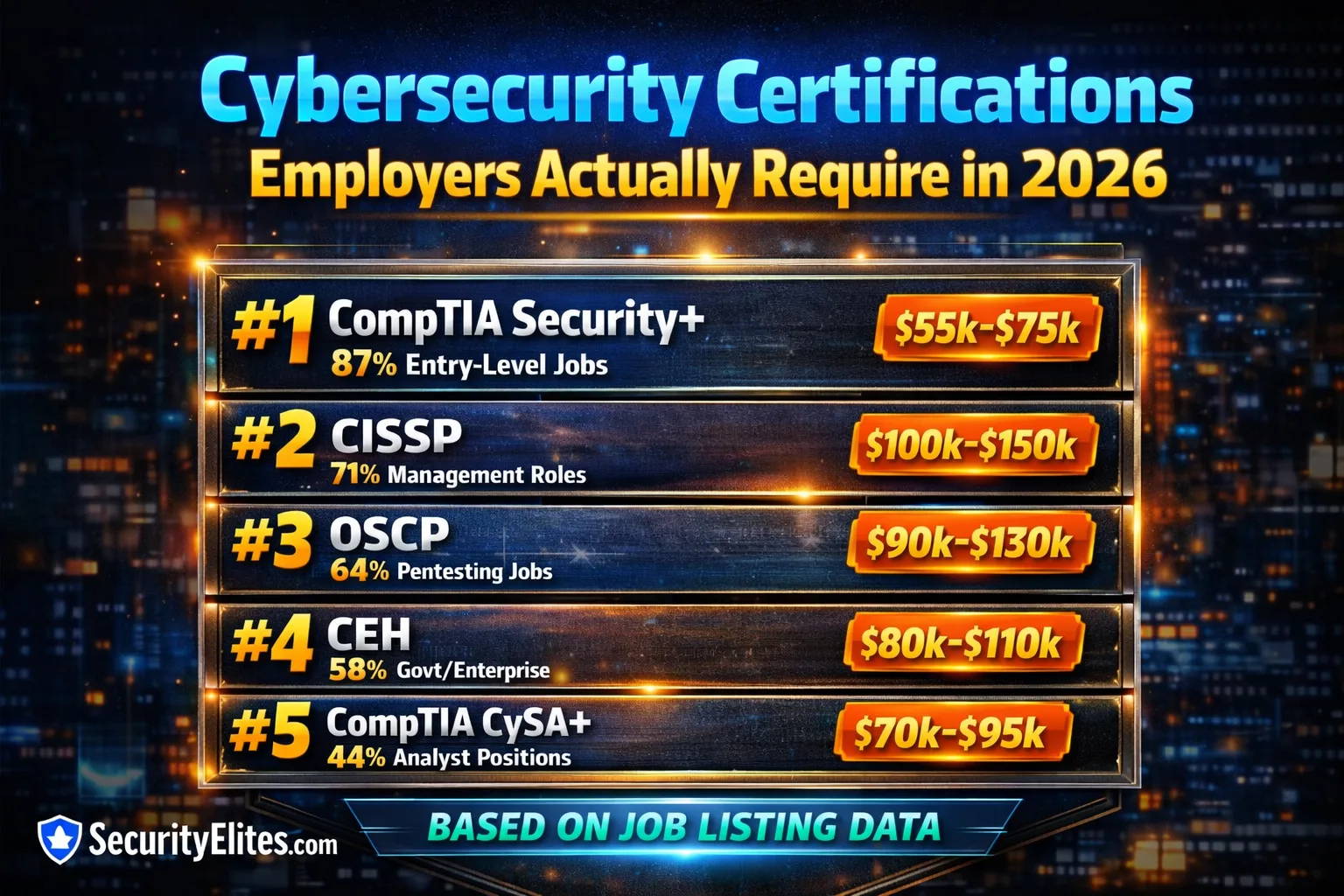
- Demand varies dramatically by role typeSecurity+ dominates entry-level roles at 87% of relevant listings, CISSP dominates senior positions at 71%, OSCP leads penetration testing at 64%, CEH appears in 58% of enterprise roles, and CySA+ in 44% of analyst roles. These percentages represent frequency within relevant job listings for each role type, not overall market share, meaning the 'best' certification depends entirely on career trajectory rather than general popularity.
- Methodology uses job listings, not vendor marketingThe ranking analyzed real cybersecurity job postings across UK and US markets, scoring each certification on frequency in requirements, associated salary premiums, cost-to-benefit ratio, and differentiation value. This approach replaces marketing claims from certification providers with empirical data about what employers actually list as required or preferred qualifications, providing significantly more actionable information than generic rankings.
- Security+ offers highest entry-level ROICompTIA Security+ costs approximately $400 for the exam, requires 2-3 months study, satisfies US DoD 8570/8140 compliance requirements that gate significant portions of government and contractor positions, and is worth self-funding at entry level. The article identifies Security+ as the most reliable path from zero experience to first cybersecurity job, often preceded only by CompTIA Network+ if networking fundamentals are weak.
- OSCP justified for specialist pentest rolesOSCP costs approximately $1,499 all-in including 90-day lab access and requires completing a 24-hour practical exam, making it significantly more expensive and demanding than entry-level options. The article recommends self-funding OSCP only when specifically targeting penetration testing specialist roles, particularly at consulting firms where it appears in 64% of relevant listings.
- CEH requires careful ROI assessmentCEH costs $500+ for the exam plus either $3,000 for training or experience verification, making it expensive relative to its market demand at 58% of enterprise listings. The article recommends self-funding CEH only if it specifically appears in target job listings; otherwise it should be pursued only when employers pay, as the cost-benefit ratio does not justify personal investment for many career paths.
- CISSP requires experience prerequisiteCISSP costs approximately $699 for the exam, requires 5 years of relevant experience to sit, and demands 4-6 months study time, but delivers significant salary premiums and dominates senior/management positions at 71% of relevant listings. The article identifies CISSP as worth self-funding if the experience requirement is already met, as it becomes relevant only in mid-to-late career transitions to management or compliance-heavy roles.
- Location and market segment heavily influence certification relevanceThe article notes that penetration tester roles in London's consulting market list OSCP and CREST far more frequently than CEH, while US government contractor roles emphasize Security+ and CISM instead. Generic certification rankings are described as misleading because 'the right certification depends entirely on your specific role, location, and career stage,' making a 15-minute job listing research exercise more valuable than any general ranking.
- Hands-on skills support theoretical certificationsThe article recommends simultaneously building practical skills through TryHackMe, HackTheBox, or free SecurityElites courses alongside pursuing theoretical certifications like Security+. This combination provides the practical evidence that supports exam-based credentials and better demonstrates real competency to employers beyond what a certificate alone communicates.
Bottom line: Before investing time and money in any cybersecurity certification, conduct 15 minutes of job listing research for your specific target role, location, and career stage to determine which certifications actually appear in employer requirements—this empirical data is more valuable than any generic ranking and reveals that Security+ offers the highest entry-level ROI while OSCP, CISSP, and CEH are worth self-funding only when they appear in your specific market's job listings or you meet their pre
🎯 What This Guide Covers
⏱️ 40 min read · 3 exercises
📊 Where are you in your cybersecurity career?
📋 Cybersecurity Certifications Employers Require in 2026 — Demand Rankings
How This Ranking Was Built
This ranking is based on analysis of cybersecurity job listings across LinkedIn, Indeed, and Glassdoor in the UK and US — not marketing claims from certification providers. Each certification is assessed on: frequency in job listing requirements or strong preferences, salary premium associated with holding the certification (from compensation survey data), cost-to-benefit ratio (exam cost + study time vs salary impact), and differentiation value (how much does holding this certification stand out in the applicant pool for target roles).
⏱️ Time: 15 minutes · LinkedIn Jobs or Indeed
Search for your specific target role in your target location:
Examples: “Security Analyst London”, “Penetration Tester NYC”,
“SOC Analyst”, “Cybersecurity Engineer”
Step 2: Filter to: posted in last 30 days, 20+ results
Step 3: Open 10 job listings in your target role
For each, check the “Required” or “Preferred” section:
Tally certifications mentioned in each listing:
| Cert | # Mentions out of 10 |
|——|———————|
| Security+ | ? |
| OSCP | ? |
| CEH | ? |
| CISSP | ? |
| CySA+ | ? |
| CISM | ? |
| Others | ? |
Step 4: Calculate YOUR specific market’s requirements:
Which certification appears most in YOUR target role?
Which offers the highest salary listed?
Step 5: Search for your top certification on LinkedIn Learning
or the certification provider’s site:
– Exam cost?
– Study time estimate?
– Experience requirements?
Based on your research: what is the highest-ROI certification
for your specific target role in your target market?
📸 Share your job listing certification tally and your highest-ROI finding in #certifications on Discord.
The Top 5 by Employer Demand — Honest Assessment
Entry-Level Path — Security+ to First Job
The most reliable path from zero experience to first cybersecurity job in 2026 is not the most exciting one: CompTIA Network+ (if networking is weak) → CompTIA Security+ → first analyst or junior engineer role. Security+ opens the highest volume of entry-level positions and satisfies DoD 8570/8140 requirements that gate a significant portion of US cybersecurity job listings. Simultaneously building hands-on skills via TryHackMe, HackTheBox, or the SecurityElites free courses provides the practical evidence that supports the theoretical certification.
⏱️ Time: 10 minutes · No tools
CURRENT STATE:
– Your current role/experience level:
– Your target role in 2 years:
– Your target salary in 2 years:
– Your employer’s cert sponsorship policy:
CERTIFICATION SCORING (score each 1-5):
For each cert that appears in your target role listings:
| Cert | Appears in My Target Jobs? | Cost | Time | Employer Pays? | SCORE |
|——|—————————|——|——|—————-|——-|
| Security+ | Y/N | $400 | 2-3mo | Y/N | |
| OSCP | Y/N | $1499 | 6mo | Y/N | |
| CEH | Y/N | $1500+ | 3-4mo | Y/N | |
| CISSP | Y/N | $699 | 5mo | Y/N | |
| eJPT | Y/N | $200 | 1-2mo | Y/N | |
SCORING FORMULA:
5 = Appears in >50% of target job listings AND employer pays
4 = Appears in >50% of target listings, self-funding justified
3 = Appears in 25-50% of target listings
2 = Appears in <25%, only if employer pays
1 = Does not appear in target listingsYour #1 certification based on this analysis?
Your study start date?
Your target exam date?
📸 Share your certification ROI scoring table in #certifications on Discord.
Which Are Worth Self-Funding vs Employer-Pay Only
⏱️ Time: 10 minutes · Browser only
Search for “cybersecurity” salaries filtered to your target location
Step 2: Use salary comparison filters to find:
Does Security+ certification show a salary premium vs no cert?
Does OSCP show a premium for pentester roles?
Does CISSP show a premium for senior roles?
Step 3: Go to (ISC)² Global Workforce Study 2025 OR 2026
Search: “(ISC)2 cybersecurity workforce study 2025”
Find salary data by certification
Note: what is the CISSP premium over non-certified?
Step 4: Search: “CompTIA salary survey 2025 certifications”
Find CompTIA’s own compensation data for Security+
Note: median salary with vs without certification
Step 5: Calculate break-even time for OSCP self-funding:
OSCP cost: ~$1,499
Estimated salary premium from your research: £X/year
Break-even time: $1,499 ÷ (annual premium / 12) = ? months
If OSCP pays for itself in under 6 months via salary premium
for your target role → clear self-funding justification.
📸 Share your break-even calculation for your target certification in #certifications on Discord. Tag #cybercerts2026
🧠 QUICK CHECK — Certifications
📚 Further Reading
- OSCP vs CEH 2026 — Which Is Worth Your Money — Deep dive into the OSCP vs CEH decision specifically — exam format, employer recognition by sector, cost analysis, and who should choose each.
- CEH Exam Preparation 2026 — Complete CEH study guide if your job listing research confirms CEH is the right certification for your target role — domains, EC-Council terminology, and 90-day study plan.
- Cybersecurity Certifications Hub — SecurityElites complete certifications category covering all major cybersecurity credentials with detailed cost, format, and career impact analysis.
- (ISC)² Cybersecurity Workforce Study — The annual global cybersecurity workforce study — the primary data source for compensation benchmarks, certification salary premiums, and workforce supply/demand analysis.
- CompTIA Cybersecurity Research — CompTIA’s annual security trends and compensation data — includes Security+ salary impact analysis and employer survey data on which certifications they value most in hiring decisions.