This article provides a comprehensive preparation guide for the CEH v13 certification exam, addressing why many candidates with strong practical security knowledge fail despite their expertise. The guide reveals that EC-Council's proprietary terminology and specific question format, rather than conceptual gaps, cause most first-attempt failures, and demonstrates that structured study methodology—particularly daily practice questions aligned with domain weightings—produces consistent passing results. Understanding this distinction is critical for enterprise and government roles where CEH certification appears in procurement specifications.
- EC-Council terminology differs from industry standardEC-Council uses proprietary definitions that diverge from common industry usage—for example, 'Clearing Tracks' (their term for Phase 5 of their methodology) versus the industry-standard 'anti-forensics,' and their specific five-phase hacking model (Reconnaissance → Scanning → Gaining Access → Maintaining Access → Clearing Tracks) where 'Gaining Access' is their term rather than 'Exploitation.' Experienced penetration testers often fail because they select correct industry answers when the exam requires EC-Council's specific vocabulary, making terminology study as critical as conceptual knowled
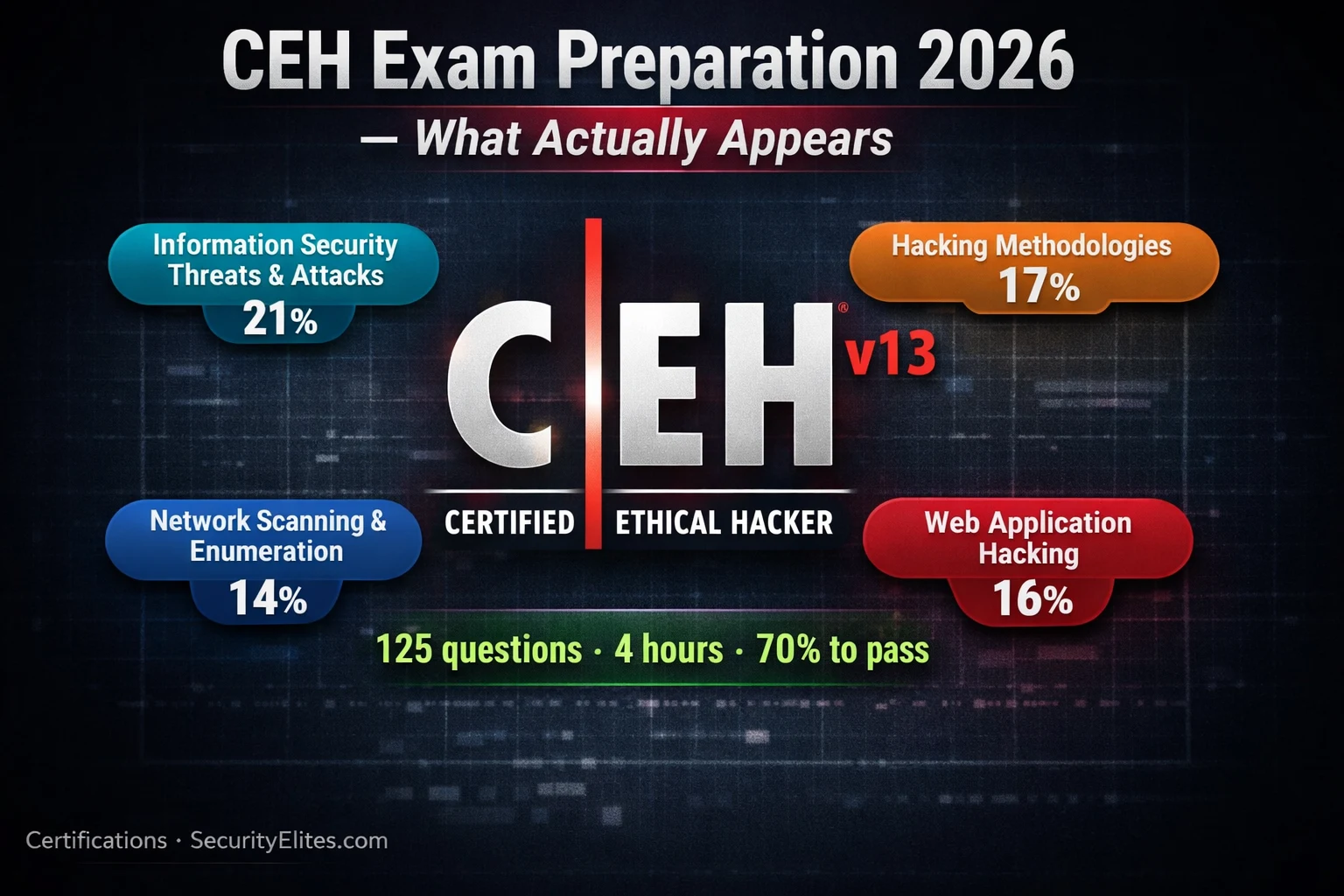
- Domain weight distribution guides study priorityThe top five domains account for approximately 78% of exam content: Information Security Threats & Attack Vectors (21%), Web Application Hacking (16%), Hacking Methodologies & Frameworks (17%), Network Scanning & Enumeration (14%), and Cryptography & Encryption (10%). The remaining 15 domains comprise only 22% combined, making concentrated study on high-weight domains the highest-return strategy rather than equal coverage of all 20 domains.
- Exam format and baseline performance assessmentThe CEH v13 exam comprises 125 multiple-choice questions completed in 4 hours (approximately 2.88 minutes per question), requiring roughly 70% correct (87-88 answers) to pass. The article recommends establishing a baseline score using free practice exams to identify whether failures stem from domain knowledge gaps or EC-Council terminology misalignment—a critical distinction that determines which study approach will be effective.
- Daily practice questions accelerate exam performanceCandidates who consistently complete 25-50 practice questions daily for 60 days typically improve from 55-60% baseline to 80-85% on simulated exams before test day. This daily discipline builds familiarity with EC-Council's question style faster than reading study materials alone, and the article emphasizes not booking the real exam until consistently scoring 75-80%+ on practice exams, targeting 80%+ before registration.
- 90-day structured study plan with domain sequencingThe recommended approach front-loads high-weight domains in Month 1 (Information Security Threats Week 1, Hacking Methodologies Week 2, Web Application Hacking Week 3, Network Scanning Week 4), expands coverage in Month 2 with remaining domains and targeted weak-area review, then transitions to full 125-question timed simulations in Month 3. This sequencing builds strong foundations before expanding breadth rather than distributing effort equally across all domains throughout.
- Most effective study resources are EC-Council alignedThe article identifies EC-Council's official courseware as most effective because the exam is written to this material with exact terminology matching, followed by Matt Walker's CEH All-in-One Exam Guide (noted as widely regarded third-party guide with clear explanations), and 500+ question practice banks from reputable providers. Generic cybersecurity books using different terminology and YouTube videos without practice questions are identified as less effective, as they do not build the specific EC-Council vocabulary required.
- CEH versus OSCP strategic decision frameworkCEH is a multiple-choice knowledge exam demonstrating conceptual understanding, recognized in enterprise and government compliance contexts, passable through study methodology without prior penetration testing experience. OSCP requires 24 hours of practical machine exploitation and cannot be passed by memorization alone. The article recommends CEH first for enterprise IT or government roles where certification lists appear in procurement; OSCP first for penetration testing firm roles where technical hiring managers evaluate direct skills.
- Job listing research validates certification ROIThe article directs candidates to research specific target job listings for which certifications employers actually require or prefer (CEH versus OSCP versus CompTIA Security+ versus CISM versus CISSP) in their target geography and role. This empirical approach to certification selection reveals that CEH appears frequently in UK and European enterprise security analyst roles while OSCP appears more frequently in penetration testing specialist positions, making the hiring market—not objective quality—the true determinant of certification value.
Bottom line: CEH exam success depends primarily on mastering EC-Council's proprietary terminology and question format through daily structured practice (25-50 questions daily for 60+ days), not on raw cybersecurity knowledge—making study discipline and terminology alignment more predictive of passage than practical experience. Before investing in CEH preparation, verify through job listing research that CEH actually appears in your target roles' requirements, as OSCP may provide better value for the same cos
🎯 What This Guide Covers
⏱️ 45 min read · 3 exercises
📊 Where are you in your CEH journey?
📋 CEH Exam Preparation 2026 — Complete Guide
- CEH v13 Exam Format — 125 Questions, 4 Hours, 20 Domains
- The High-Weight Domains Worth Most of Your Study Time
- Study Resources — What Works, What Doesn’t
- The 90-Day Study Plan That Consistently Produces Passes
- What Actually Trips Candidates Up — EC-Council’s Terminology Traps
- CEH vs OSCP — Which One Should You Pursue?
CEH v13 Exam Format — 125 Questions, 4 Hours, 20 Domains
The CEH v13 exam consists of 125 multiple-choice questions to be completed in 4 hours (2.88 minutes per question average). The passing score is approximately 70%, which means approximately 87-88 correct answers. The exam can be taken at a Pearson VUE testing centre or via remote proctoring. EC-Council requires either completion of their official 5-day training or submission of 2 years of information security experience to be eligible to sit the exam.
The High-Weight Domains Worth Most of Your Study Time
Information Security Threats and Attack Vectors (21%) — the highest-weighted domain. Covers malware types and characteristics (trojans, viruses, ransomware, rootkits), social engineering attack vectors, insider threats, APT characteristics, and vulnerability classification. EC-Council uses specific definitions — “virus” and “worm” have EC-Council specific definitions that differ slightly from common usage. Know the exact EC-Council taxonomy.
Web Application Hacking (16%) — covers OWASP Top 10, web server attack types, SQL injection variants (blind, error-based, union-based), XSS types (reflected, stored, DOM), CSRF, buffer overflow in web contexts, and web session management attacks. This domain rewards practical knowledge — if you have completed the DVWA labs in this series, this domain will feel familiar.
Hacking Methodologies and Frameworks (17%) — covers EC-Council’s specific five-phase hacking methodology (Reconnaissance, Scanning, Enumeration, Vulnerability Analysis, System Hacking), the CEH attack phases, Cyber Kill Chain stages, MITRE ATT&CK framework basics, and Diamond Model of Intrusion. Know these frameworks by name and their specific stage definitions — exam questions frequently test the correct order and exact name of each phase.
⏱️ Time: 12 minutes · Browser only · free practice questions
securityelites.com/tools/ceh-practice-exam/
It is built specifically for CEH v13 — 25 questions,
timed to 1 hour, domain-weighted to match the real exam.
No login required.
Alternative external options: examtopics.com or
examcompass.com (search “CEH v12” or “CEH v13”)
Step 2: Take a 25-question practice set
Time yourself — you have 2 minutes per question average
Step 3: After completing, review every wrong answer carefully:
– Was it an EC-Council terminology issue?
(You knew the concept but used different terminology)
– Was it a domain knowledge gap?
(You genuinely didn’t know the answer)
– Was it a question style issue?
(You misread the question or didn’t know what was being asked)
Step 4: Categorise your wrong answers by domain:
Which domain had the most errors?
That domain needs the most study time.
Step 5: Note any questions where you knew the concept but
selected the wrong EC-Council specific term
(Example: “vulnerability scanner” vs “network discovery tool”
in EC-Council’s specific context)
Step 6: Calculate your baseline score
Passing is ~70% (17-18 out of 25)
Are you above or below passing on this baseline test?
📸 Share your baseline score and top weak domain in #certifications on Discord.
Study Resources — What Works, What Doesn’t
Most Effective: EC-Council Official Courseware (the exam is written to this material — terminology will match); Matt Walker’s CEH All-in-One Exam Guide (widely considered the best third-party guide — clear explanations and good practice questions); exam-specific practice question banks with 500+ questions from reputable providers. The official EC-Council iLabs provide hands-on practice that complements the theoretical knowledge.
Less Effective: Generic cybersecurity books not written specifically for CEH (different terminology); YouTube videos alone without practice questions (passive learning does not build exam performance); studying only practical skills without reviewing EC-Council’s theoretical framework definitions. The most common failure mode is over-indexing on practical knowledge while under-preparing for EC-Council’s specific conceptual terminology.
CEH Practice Exam — 25 Questions, Timed, Domain-Weighted
Our free CEH Practice Exam tool mirrors the real CEH v13 format exactly — 25 multiple-choice questions, 1-hour timer, and questions weighted by domain so the highest-volume domains (Threats 21%, Methodologies 17%, Web App 16%) appear proportionally. Use it to baseline your knowledge before studying, drill weak domains mid-study, and run full timed simulations before booking the real exam. No login required.
⏱️ Time: 8 minutes · No tools · text editor or paper
study time per day, build your 90-day plan:
AVAILABLE TIME ASSESSMENT:
□ 30 min/day → plan for 90 days, exam in month 3
□ 1 hour/day → plan for 60 days, exam in month 2
□ 2+ hours/day → plan for 45 days, exam in month 2
90-DAY PLAN STRUCTURE:
MONTH 1 — Domain Foundations (Days 1-30):
Week 1: Information Security Threats (21% — highest weight)
Week 2: Hacking Methodologies + EC-Council 5-phase model
Week 3: Web Application Hacking
Week 4: Network Scanning & Enumeration
Daily: 25 practice questions on that week’s domain
MONTH 2 — Full Coverage + Weak Areas (Days 31-60):
Week 5-6: Remaining domains (Malware, Social Engineering,
Cryptography, Cloud, IoT, Mobile)
Week 7-8: Review YOUR weak domains from Exercise 1 baseline
Daily: 50 mixed practice questions + review all wrong answers
MONTH 3 — Exam Simulation + Final Review (Days 61-90):
Week 9-10: Full 125-question timed practice exams
Week 11: Review all wrong answers and EC-Council terminology list
Week 12: Final review + exam booking
Target: 80%+ on practice exams consistently before booking
Write your specific daily schedule for Month 1.
📸 Share your Month 1 schedule in #certifications on Discord.
What Actually Trips Candidates Up — EC-Council’s Terminology Traps
The most common source of avoidable failures is EC-Council’s proprietary terminology. Several concepts have EC-Council-specific definitions that differ from how the same terms are used in general industry practice or other certification programmes.
CEH vs OSCP — Which One Should You Pursue?
The honest comparison: CEH demonstrates knowledge; OSCP demonstrates skill. CEH is a multiple-choice exam that can be passed with excellent study methodology without having ever run a real penetration test. OSCP requires 24 hours of practical machine exploitation and cannot be passed by memorisation alone.
Pursue CEH first if: your employer will pay for it and it appears in job listing requirements for your target role; you are working in enterprise IT or government security where certification lists matter for procurement; or you want a structured curriculum covering the breadth of ethical hacking concepts before specialising.
Pursue OSCP first if: you are targeting penetration testing job roles at security consulting firms where technical hiring managers evaluate skills directly; you have the budget for one certification and want maximum employer recognition among technical practitioners; or you are willing to accept a longer, harder preparation process for a more differentiated credential.
⏱️ Time: 10 minutes · Browser only
Note the current exam cost and eligibility requirements
(Training required OR 2 years experience application)
Step 2: Go to LinkedIn Jobs or Indeed
Search for your target job role in your target location
(Example: “Security Analyst London” or “Penetration Tester”)
Filter to 20+ recent results
Step 3: In each job listing, check the “Required” or “Preferred”
certifications section
Tally: how many mention CEH? How many mention OSCP?
How many mention CompTIA Security+? CISM? CISSP?
Step 4: Calculate the CEH total cost for you specifically:
– If employer pays: just exam cost (roughly $500-900 USD)
– If self-funding: exam + training or experience verification
Total self-funded path: ~$1,500-3,000 USD
Compare: OSCP all-in: ~$1,499 USD
Step 5: Based on your job listing research:
Does CEH appear more than OSCP in your target roles?
→ If yes: CEH is a practical career investment for those roles
→ If no or equal: OSCP is better value for the same cost
Step 6: Note one specific job listing where CEH is listed as
required or preferred — save the URL
📸 Share your job listing research results in #certifications on Discord. Tag #ceh2026
🧠 QUICK CHECK — CEH Preparation
📋 CEH Exam Quick Reference 2026
❓ Frequently Asked Questions
What is the CEH exam and how hard is it?
How long does it take to prepare for CEH?
What is the difference between CEH and OSCP?
Which CEH study materials are most effective?
Is CEH worth it in 2026?
100-Day Ethical Hacking Course (Free)
📚 Further Reading
- 📝 CEH Practice Exam Tool — Free — 25-question timed practice exam mirroring the real CEH v13 format — domain-weighted, instant scoring, EC-Council terminology questions. Use it to baseline, drill, and simulate before booking the real exam. No signup.
- 100-Day Ethical Hacking Course — The free ethical hacking course provides the practical foundation that makes CEH’s theoretical domains tangible — cover both together for the most efficient CEH preparation.
- TryHackMe vs HackTheBox 2026 — Practical skill building on these platforms strengthens the practical CEH exam component and builds the hands-on experience required for the EC-Council eligibility pathway.
- DVWA Labs Hub — The DVWA lab series covers web application vulnerabilities that make up 16% of the CEH exam — hands-on lab experience reinforces the theoretical knowledge from CEH study materials.
- EC-Council CEH Official Page — The official CEH v13 exam page with current pricing, eligibility requirements, exam blueprint, and links to official study materials and iLab access.