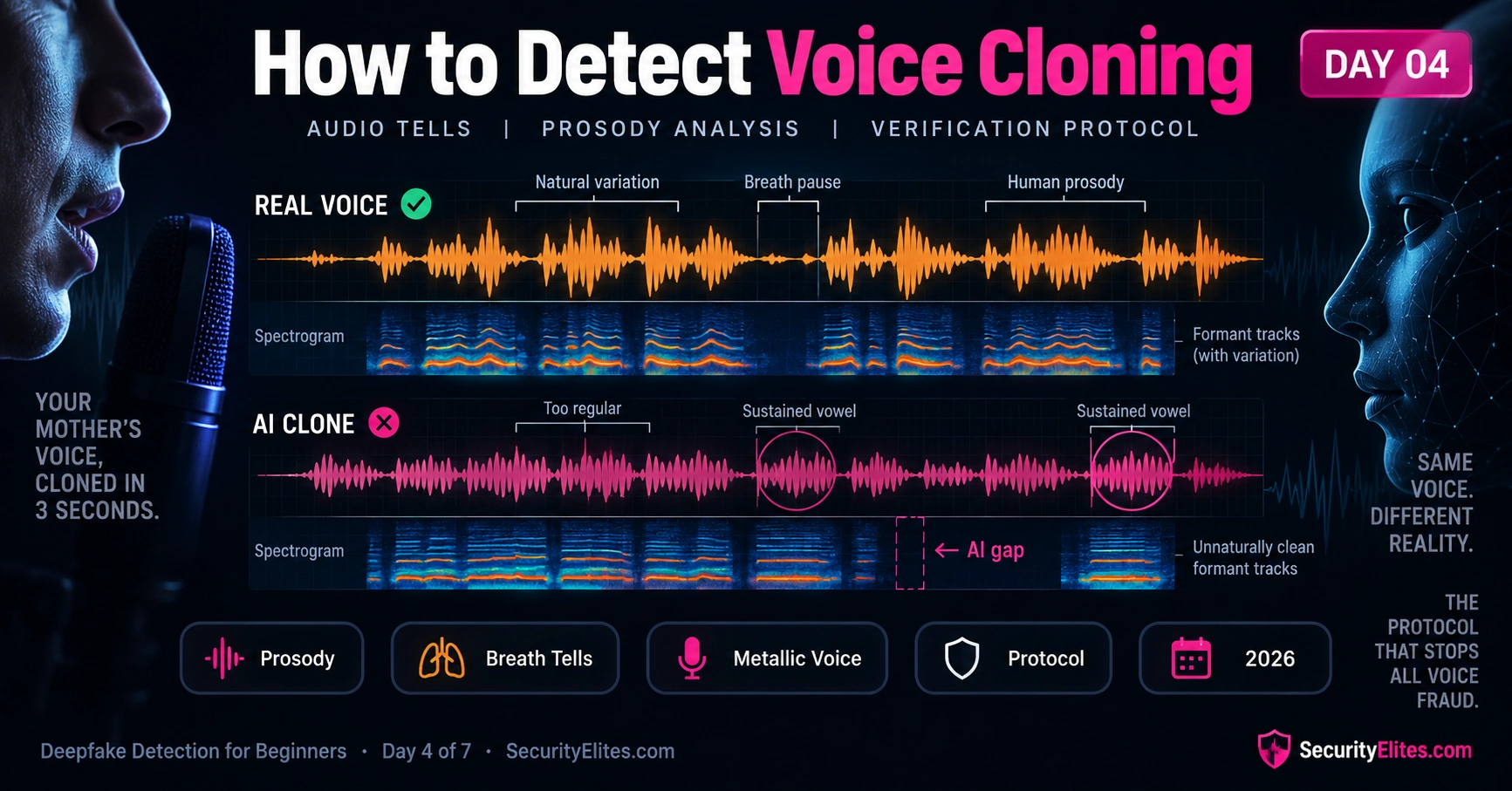
The techniques below explain how voice cloning works so you can defend against it. Do not clone anyone’s voice without their explicit written consent. Voice fraud is a serious criminal offence under BEC (Business Email Compromise) laws in most jurisdictions. If you’re the target of a voice clone attack, contact your bank immediately, report to your national fraud reporting body (IC3.gov in the US, Action Fraud in the UK), and consult legal counsel for follow-up.
Let me start with a scenario I want you to take seriously. In 2026, one of the fastest-growing forms of CEO fraud isn’t happening through email anymore — it’s happening through audio. Imagine you’re a finance director and, late in the afternoon, a WhatsApp voice message arrives from what appears to be your CEO’s number. You press play. You know that voice immediately. The warmth is there. The slight pause before technical words is there. Even the faint accent from years spent abroad sounds exactly right. Then the message asks you to process an urgent supplier payment before the end of the day.
You process it. The wire clears at 4:47 PM. At 6:12 PM, you call the CEO to confirm the transaction. He tells you he never sent the message. That’s when you realise what happened: the attacker created the voice clone from just 11 seconds of audio taken from a public YouTube interview six weeks earlier. You had worked with this person for two years, knew their voice extremely well, and still didn’t catch it.
That is why learning how to detect voice cloning matters. I’ve found that people approach fake voices in the wrong way. They listen for something obviously robotic, distorted, or computer-generated. Modern voice clones don’t always give you that luxury. A good clone can sound warm, emotional, familiar and remarkably convincing. If you rely entirely on your instincts, you’re giving the attacker an advantage.
In this lesson, I’m going to show you exactly what I listen for when I examine suspicious audio. We’ll look at prosody, breathing, pauses, vowel sounds, unnatural consistency and the small timing errors that can reveal an AI-generated voice. I’ll also show you why a spectrogram can sometimes expose details that your ears miss. And yes, we’ll get to the famous “metallic vowel” effect — once you hear the pattern and understand what causes it, you’ll start noticing it much more easily.
But I want to make one point clear before we start: detection is not the real defence. Even if you’re highly trained, there will be situations where a voice clone sounds completely convincing. That’s why I teach an out-of-band verification protocol alongside the audio tells. The goal isn’t to become so good at spotting AI that you never make a mistake. The goal is to make sure that even when the clone fools you, the attacker still can’t get the money, access or approval they want.
So don’t just read this section. Listen carefully to the examples, compare real voices with cloned voices, and train yourself to notice the differences. By the end, you’ll have a practical listening checklist and a verification procedure you can actually use the next time a supposedly familiar voice asks you to do something sensitive.
🎯 What You’ll Master in Day 4
⏱ 23 min read · 3 exercises · Headphones strongly recommended
- Day 1 complete: What Are Deepfakes? — GAN and diffusion basics apply to audio generation too
- Headphones or good speakers — you’ll be listening for subtle audio characteristics that phone speakers mask
- Optional but useful: How Hackers Use Social Engineering 2026 — attack context for voice fraud
How to Detect Voice Cloning — Day 4 of 7
- How Voice Cloning Works — The 3-Second Threshold
- Prosody Analysis — Stress and Rhythm Tells
- Breath Patterns and the Formant Problem
- The Metallic Vowel — Listening for AI Audio Quality
- Real-Time Voice Clone Attacks — What’s Possible in 2026
- The Out-of-Band Verification Protocol
- When Ears Aren’t Enough — Audio Detection Tools
- Questions and Answers
How to detect voice cloning is probably the deepfake question I get most often from HR and finance leaders in 2026. And I understand why. A convincing voice can bypass the normal suspicion we apply to an unfamiliar email or text message because when we hear someone we know, our first instinct is usually to trust the voice.
The problem is that attackers no longer need hours of recordings to imitate someone. A surprisingly small amount of publicly available audio can give an AI system enough material to create a convincing starting point. That means the attack surface isn’t limited to celebrities or executives. Anyone whose voice appears in a podcast, interview, company video, social-media post or other public recording can potentially become a target.
This is where I want you to change the way you think about voice authentication. I don’t treat a familiar voice as proof of identity. I treat it as one signal that still needs to be verified. The safest approach is to authenticate through a channel independent of the original contact — the same basic security principle we use when independently verifying other forms of digital identity. It’s the mental model behind certificate verification too, which is exactly what the SSL Certificate Checker helps you examine.
I’ll come back to that principle throughout this guide because it is the part that actually stops fraud. Learning how to detect voice cloning helps you recognise suspicious audio, but an independent verification step protects you when the clone is good enough to fool your ears. This guide is part of the AI Deepfake Hub, with the wider AI security material connected through the LLM Hacking Hub.
How Voice Cloning Works — The 3-Second Threshold
I use the same demonstration whenever I teach voice-clone detection. I take a short recording of a student’s voice — sometimes only a few seconds — and show them what a modern voice-cloning system can produce from it. Then I play the generated result back to them. The reaction is almost always the same: they go quiet for a moment. Hearing your own voice say something you never actually said makes the threat suddenly feel very real. No slide deck or security lecture creates that reaction quite as effectively.
That is the first thing I want you to understand about modern voice cloning: the attacker doesn’t necessarily need a long recording of the target. With clean source audio, some current systems can extract enough information from only a few seconds to create a usable voice model. That source might come from a YouTube interview, a podcast, a voicemail, a recorded phone conversation, an Instagram Story, a company webinar or a video someone uploaded years ago. The target doesn’t have to think of the recording as “public.” If an attacker can obtain the audio, it may become useful source material.
Once you understand what the system is learning, the detection problem becomes much easier to understand. A voice isn’t just a collection of words. When I analyse a voice, I’m listening for several layers of information at once. Timbre is the overall tonal character that makes one person’s voice sound different from another person’s. Prosody covers rhythm, stress, pitch movement and the musical pattern of speech. Formants are the resonant frequency patterns produced by the speaker’s vocal tract and are particularly important in shaping vowel sounds. Then there is delivery style — speaking speed, pauses, breathing, emphasis and those little habits that make a person’s speech recognisable.
The cloning system attempts to capture those characteristics statistically. It analyses the source recordings, builds a representation of the target’s vocal characteristics, and then uses that representation to generate new speech. The important part is what happens next: the system can produce words and sentences the person has never actually spoken. Your CEO might never have recorded the sentence asking for a particular supplier payment. The model can nevertheless generate that sentence in a voice that sounds remarkably similar to the CEO.
This is where I want you to stop thinking about voice cloning as traditional audio editing. Older forms of manipulation often involved cutting, splicing, speeding up, slowing down or otherwise modifying an existing recording. In those cases, an investigator could sometimes look for evidence of the edit. A synthetic voice presents a different forensic problem. The attacker may not have edited a genuine recording of the target saying the sentence at all. The sentence may have been generated from scratch.
A Concrete Detection Example
Here’s the kind of example I use when teaching someone how to detect voice cloning. Imagine you receive a 12-second voice message supposedly from your CFO:
“I need you to approve the Acme payment today. It’s already been cleared by procurement. Please don’t wait for me — I’m heading into another meeting.”
At first listen, everything sounds normal. The voice has the right pitch, accent and vocabulary. Now I ask the trainee to listen again, but this time to the transitions between words rather than the words themselves.
On the second listen, you may notice that the vowel in a stressed word remains unusually stable for its entire duration. The speaker’s pitch also follows an almost perfectly controlled movement into the next word. Then comes the pause before “I’m heading into another meeting.” It sounds like a natural pause, but the silence is unusually clean — there is no small breath, mouth movement or room sound leading into it.
None of those observations proves that the recording is synthetic. That’s important. I never teach people to declare a voice fake because they heard one strange vowel or one unusually clean pause. Instead, I treat those observations as signals that justify verification.
Now compare the suspicious message with three genuine recordings of the CFO speaking spontaneously. In the genuine recordings, the CFO’s stressed vowels vary slightly in duration and pitch. Breaths appear at inconsistent points. Some word transitions are softer than others. There are tiny hesitations, changes in speaking rate and occasional vocal imperfections. The suspicious message is noticeably more uniform.
That comparison gives you something much stronger than the vague feeling that “the voice sounds a little off.” You’re looking at a pattern of inconsistencies: unusually stable vowels, mechanically smooth transitions, missing micro-breaths and unnatural pause structure. Those are the kinds of details I want you to train yourself to notice.
And there’s an important lesson here: don’t challenge the caller or sender based solely on what you hear. If the message requests money, credentials, access or another sensitive action, stop the transaction and verify the request through a trusted channel you already know. Call the CFO using the number stored in your company’s directory. Don’t reply to the suspicious message and don’t use a phone number supplied inside it.
That’s the distinction I want you to remember throughout this guide. Audio analysis can tell you that something deserves suspicion. Independent verification is what turns that suspicion into a security control.
And that’s exactly what we’re going to train your ears to recognise next. The goal isn’t to listen to every suspicious voice message and hope you get a feeling that something is wrong. I want you to learn what to listen for, understand why each tell appears, and then combine those observations with independent verification. Because the best voice-clone detection technique isn’t simply being able to say, “That sounds fake.” It’s knowing what evidence supports that conclusion — and knowing what to do when the audio sounds completely real.
Prosody Analysis — Stress and Rhythm Tells
Prosody is the first tell I listen for when I’m checking a suspicious voice because it is often harder to reproduce convincingly than the basic sound of the person’s voice. Modern cloning systems can get remarkably close to someone’s timbre — the colour and tonal character of their voice. What I often find more revealing is what happens around the words: where the speaker puts emphasis, how quickly they move between phrases, how their pitch rises and falls, and whether the delivery actually feels spontaneous.
Think of prosody as the musical layer of speech. It includes rhythm, stress, pitch movement and intonation, but it also changes with context and emotion. Take the word “really.” If I say, “I really love this,” the emphasis might be mild and enthusiastic. If I say, “You really did that?” the pitch and stress can immediately communicate surprise or disbelief. And if I say, “I’m really tired,” the same word may be delivered more slowly with a falling, exhausted tone. The word hasn’t changed. The surrounding meaning has changed, so the delivery changes with it.
That’s one of the things I listen for in a suspected clone: does the emotional shape of the sentence match what the words are actually saying? A synthetic voice can have the correct accent, pitch and vocal texture while still delivering the sentence in a way that feels slightly disconnected from its meaning.
My 20-Second Prosody Test
Here’s a simple test you can perform yourself. Imagine you receive a voice message saying, “Are you sure you approved that payment?” Don’t listen to the voice first. Listen to the sentence as if you’re reading it in your own head. You naturally expect the question to have some form of rising or questioning intonation.
Now listen to the recording again. I’m not asking you to decide whether it is AI from that one feature. Instead, compare three things: word stress, pitch movement and timing. Does the speaker naturally emphasise the important word? Does the pitch movement communicate a genuine question? Does the rhythm change slightly as the speaker reaches the important part of the sentence?
If the voice has excellent timbre but delivers the entire sentence with almost the same pitch movement and timing it would use for a statement, I mark that as a prosody anomaly. It doesn’t prove the audio is cloned, but it gives me a reason to investigate further.
Three Prosody Tells I Look For
1. Too-regular stress. Real speakers don’t distribute emphasis evenly. Some words receive extra weight while others are compressed or almost swallowed. Cloned speech can sometimes sound as though every syllable has been given the same level of attention. The result isn’t necessarily robotic. It can be much subtler — the voice sounds polished, but it lacks the uneven emphasis you expect from spontaneous conversation.
2. The wrong intonation. This is one of my favourite checks because it is easy to demonstrate. A genuine question, a warning, a sarcastic comment and a confident statement don’t normally have identical pitch contours. A clone may reproduce the words accurately while getting that melodic shape wrong. You hear the right sentence in the right voice, but the delivery doesn’t quite match the intention.
3. The “reading aloud” effect. This is probably the hardest tell to describe until you’ve heard it yourself. The words may be perfectly conversational, but the delivery has the controlled quality of somebody reading from a script. There is less hesitation, less variation in timing and fewer tiny adjustments in emphasis. Everything is just a little too clean.
Here’s a practical comparison I use when teaching this. Take a genuine recording of someone explaining something spontaneously and compare it with a synthetic recording containing a similar sentence. In the real recording, you’ll usually hear small variations: a word comes slightly faster than expected, a pause lasts longer than the previous pause, the speaker changes emphasis halfway through a sentence, or their pitch moves in response to the meaning. The cloned version may reproduce the person’s overall voice beautifully while making those micro-decisions in a more uniform way.
That distinction is important because prosody analysis is not about finding one magic “AI sound.” There isn’t one. I look for a cluster of small inconsistencies. If the timbre sounds right but the stress is wrong, the pauses are unusually uniform and the emotional delivery doesn’t match the words, my confidence that something needs verification goes up.
And here’s the habit I want you to build: don’t ask yourself, “Does this sound like AI?” Ask, “Does this person sound like themselves in this specific situation?” That is a much better question. You’re comparing the recording against the person’s normal conversational behaviour rather than searching for an artificial-sounding voice.
Once you train yourself to hear that difference, you’ll start noticing why a technically impressive clone can still feel slightly unnatural. The next tell takes us even deeper: breathing and micro-pauses. Those tiny physical events between words are easy to ignore when you’re listening for content — but they can be surprisingly useful when you’re trying to detect voice cloning.
Quick Prosody Listener Checklist
When I listen to a suspicious voice message, I run this quick checklist before deciding what to do next:
- Stress: Are the important words naturally emphasised, or does every word receive roughly the same weight?
- Questions: Does the pitch and rhythm actually sound like a question when the sentence is asking one?
- Emotion: Does the emotional delivery match the meaning of the words?
- Timing: Do pauses and speaking speed vary naturally, or are they unusually uniform?
- Spontaneity: Does it sound like someone talking naturally, or like someone reading a perfectly prepared script?
- Consistency: Do you notice the same suspicious rhythm or pitch pattern across several sentences?
My rule: one unusual feature is not enough to call a voice fake. Several anomalies together are a reason to stop and independently verify the request.
Breath Patterns and the Formant Problem
I started taking the breath test seriously after a case where a 45-second voice clone sounded convincing in almost every other respect. The timbre was right. The prosody was good. Even the subtle vowel artefacts I’d normally listen for weren’t obvious. But something kept bothering me: the speaker never seemed to breathe. At the end of several long phrases, there was no audible recovery breath, no tiny change in airflow, and no natural respiratory pause.
That observation wasn’t enough to prove the recording was synthetic. A compressed WhatsApp recording, aggressive noise reduction or a poor microphone can remove breath sounds too. But it gave me something important: a reason to investigate further. That’s how I recommend using breath patterns. Don’t treat the absence of one breath as a verdict. Look for a repeated pattern that doesn’t fit the way the person normally speaks.
Real conversation has a respiratory rhythm underneath the words. A speaker often inhales before a longer sentence, releases air while speaking, takes a small recovery breath after sustained speech and occasionally pauses simply because they need another breath. Those pauses don’t always line up neatly with punctuation. You might hear a tiny inhale halfway through a sentence or a slightly longer pause before the speaker continues an explanation.
When I’m checking suspicious audio, I therefore listen between the words. After a long sentence, does the speaker naturally recover? Before another long phrase, is there an inhale? Do the pauses appear to follow the person’s physical need to breathe, or do they seem to occur only at perfectly convenient linguistic boundaries?
There are two broad breath patterns that can make me suspicious. The first is missing breath altogether. Some synthetic voices can produce long stretches of speech with remarkably little evidence of breathing. The second is almost the opposite: breathing that sounds too regular or too clean. A generated voice may include breaths, but the breaths can appear at surprisingly predictable intervals or lack the small irregularities you hear in genuine recordings.
Again, context matters. A professional recording may have been edited. A phone system may suppress quiet inhalations. A person speaking into a headset may naturally produce very little audible breath. So I don’t ask, “Can I hear breathing?” I ask a better question: “Does the breathing pattern make physiological sense for this speaker and this sentence?”
My Breath Test
Here’s a simple exercise. Find a genuine recording of the person speaking continuously for 20 to 30 seconds. Then listen to a suspicious recording of roughly the same length. Ignore the actual words for a moment. Listen only to the spaces between phrases.
In the genuine recording, mark the points where you hear an inhale, exhale, throat movement or small respiratory pause. Then do the same with the suspicious recording. You’re not looking for an identical pattern — you want to see whether the suspicious recording contains a consistent absence or an unusually artificial rhythm.
If the speaker delivers several long sentences without any audible respiratory recovery, or if every breath appears in almost exactly the same type of position, I flag it. I then combine that observation with prosody, timing and vowel behaviour rather than making a decision from breath alone.
The Formant Problem
The second thing I listen for in this part of the analysis is formant behaviour. Formants are resonant frequency regions created by the shape of the vocal tract. They are a major reason two vowels can sound completely different even when the speaker’s fundamental pitch stays similar.
Think about what happens when you move from one vowel to another. Your tongue, jaw and other parts of the vocal tract are constantly changing position. The acoustic result isn’t simply one vowel stopping and another starting. The resonant frequencies transition through the surrounding sounds. In natural speech, those transitions can be smooth, abrupt or somewhere in between depending on the phonetic context.
This is where I sometimes hear what I call a vowel-boundary blur. The clone gets the overall vowel sound close enough, but the transition into or out of that vowel doesn’t quite behave like the target’s natural speech. Some systems can make the transition sound unnaturally smooth, as though neighbouring sounds have been blended together. Other generated speech can contain a sharper transition than you’d expect from the speaker.
You don’t need to understand acoustic phonetics to notice this. Start with a simple comparison: find a genuine recording and a suspected clone containing the same vowel sounds. Listen specifically to the moment before and after the stressed vowel. Does the vowel seem to “lock” into place too cleanly? Does the transition sound slightly blurred? Does the vowel quality change in a way that feels disconnected from the surrounding consonants?
For more technical analysis, this is where a spectrogram becomes useful. Instead of relying entirely on your ears, you can inspect the frequency structure of the recording and look at how the formant tracks move through speech. I don’t use a spectrogram to search for one universal “AI signature” — there isn’t one. I use it to compare suspicious material against known-good recordings from the same speaker and look for differences that deserve closer examination.
The key lesson from both breath and formants is the same: you’re looking for behaviour, not a magic tell. A missing breath can have an innocent explanation. A strange vowel can be caused by compression. A smooth formant transition doesn’t automatically mean AI. But when breath timing, vowel transitions, prosody and other acoustic features all start pointing in the same direction, you have a much stronger basis for treating the audio as suspicious.
That is the approach I want you to carry into the next section: don’t hunt for one sound that screams “AI.” Build a pattern of evidence, compare it with a trusted sample, and then verify the identity through an independent channel before anyone acts on the request.
Quick Breath & Formant Listener Checklist
- Long phrases: Does the speaker recover naturally after sustained speech?
- Inhales: Do breaths occur naturally before longer phrases, rather than at predictable intervals?
- Pause rhythm: Do pauses reflect natural breathing, or do they line up suspiciously neatly with sentence structure?
- Breath quality: When breaths are audible, do they have natural variation, or sound unusually clean and repetitive?
- Vowel transitions: Do vowels blend naturally into surrounding sounds, or is there a subtle blur or abrupt boundary?
- Pattern: Do you hear the same anomaly repeatedly across different sentences?
My rule: never treat one missing breath or unusual vowel as proof of a clone. Use repeated patterns, compare against a trusted recording, and independently verify any sensitive request.
The Metallic Vowel — Listening for AI Audio Quality
The “metallic vowel” is the phrase I use when I’m explaining subtle AI voice artefacts to people who aren’t audio engineers. It is easy to understand because you don’t need a spectrogram or a machine-learning classifier to notice the basic phenomenon. Once you’ve compared a few genuine recordings with synthetic ones, you may start hearing a quality that sounds slightly hollow, glassy or unnaturally smooth.
But I want to make an important distinction: a metallic-sounding vowel is not proof that a voice is AI-generated. Compression, noise reduction, microphones, codecs, room acoustics and ordinary vocal characteristics can all create similar effects. I treat it as one acoustic clue that becomes useful when it appears alongside other anomalies.
The effect, when it is present, is often easiest to notice on sustained vowels — particularly when a speaker holds a vowel for a noticeable fraction of a second. Instead of sounding completely natural from beginning to end, the vowel may seem to develop a slightly hollow or synthetic resonance. You might describe it as a voice coming through a very thin tube, or as a vowel that has an unusually polished, almost glass-like quality.
Here’s how I teach people to listen for it. Don’t listen to the sentence as a whole. Find one vowel that the speaker holds for a moment and focus on the middle of that sound. Ask yourself whether the resonance remains naturally alive and variable or whether it seems to settle into an unusually uniform acoustic shape. Then compare the same speaker’s vowel sounds in a trusted recording.
Why can this happen? Human speech is produced by a physical vocal system with a particular anatomy. The vocal tract acts as an acoustic filter, and its shape changes continuously as we speak. The resulting resonance patterns — including the formant structure that shapes vowels — contain speaker-specific characteristics. A voice-generation system is attempting to reproduce those characteristics from learned data rather than recreating the person’s actual vocal tract.
That reconstruction can sometimes introduce smoothing or other artefacts. On a short syllable, your ear may barely notice them because there isn’t much time for the acoustic pattern to become apparent. On a sustained vowel, however, the sound gives you more information to examine. If the generated resonance is slightly unnatural, the effect can become easier to hear.
My Metallic-Vowel Test
Try this with headphones. Take a genuine recording of the person and find a sustained vowel. Then find a comparable vowel in the suspicious recording. Listen to each one three times.
- First listen: hear the sentence normally and ignore the technical details.
- Second listen: focus only on the sustained vowel.
- Third listen: compare its resonance and transition with the genuine recording.
If the suspicious recording has a slightly hollow or metallic quality that repeatedly appears on sustained vowels while the genuine recording does not, I mark it as an acoustic anomaly. I don’t mark it “AI confirmed.” That’s an important discipline in forensic analysis.
And don’t expect every modern clone to have this tell. Better synthesis systems can reduce or eliminate obvious metallic artefacts, while a poor recording chain can make a genuine human voice sound metallic. The value of this exercise is not that it gives you a perfect classifier. It trains your ear to notice small deviations that you can combine with prosody, breath behaviour, timing and independent verification.
That is the real training goal for Day 4. I don’t want you walking away thinking, “Metallic equals fake.” I want you to hear something slightly unnatural and immediately think, “That’s interesting. Let me compare it with a trusted sample and verify the request through another channel.” That response is much more useful than simply recognising an AI sound.
Metallic Vowel — Quick Takeaway Checklist
- Sustained vowels: Listen to longer “ah” or “oh” sounds rather than the whole sentence.
- Resonance: Does the vowel sound slightly hollow, glassy or metallic?
- Consistency: Does the same quality appear across multiple vowels or sentences?
- Comparison: Does a trusted recording of the same speaker sound different?
- Context: Could compression, microphone quality or noise processing explain the effect?
- Decision: Treat the metallic quality as a clue — never as standalone proof of AI.
Remember: you’re training your ear to notice an anomaly, not training it to make an instant verdict. Combine what you hear with prosody, breath patterns, timing and independent verification.
Real-Time Voice Clone Attacks — What’s Possible in 2026
Real-time voice conversion is the development I pay particular attention to when assessing voice-fraud risk because it changes one important assumption: a convincing fake voice no longer has to be a pre-recorded message. An attacker can potentially speak naturally while software transforms that speech into the target’s voice. For organisations that still treat a familiar voice on a phone call as an authentication factor, that distinction matters.
The basic idea is straightforward. The attacker speaks into a microphone, a voice-conversion system processes the speech, and the transformed audio is delivered to the person on the other end of the call. The attacker can then respond to unexpected statements, change the conversation and maintain a live dialogue rather than playing a fixed recording. That makes the attack much harder to defeat simply by asking the caller to repeat a particular sentence.
There are still technical limitations. Real-time conversion has to process speech quickly enough to maintain a conversation, so latency and occasional artefacts can appear. Rapid changes in speech, overlapping conversation and poor network conditions can expose glitches. Telephone codecs and aggressive noise suppression can also alter the audio. In some implementations, background noise or room characteristics from the attacker’s environment may remain audible.
But I don’t want you relying on those limitations. The important security lesson is that a trained ear is not a sufficient authentication control for a live call. A good attack may sound imperfect and still be persuasive enough to get someone to approve a payment, disclose information or bypass a procedure. Conversational pressure makes subtle audio analysis even harder because you’re concentrating on what the person is asking you to do rather than on the acoustic details of their voice.
Use an Unexpected-Context Test
When I suspect that a familiar person on a call might be impersonated, I don’t turn the conversation into a theatrical interrogation. I use a simple contextual check. I ask something that is relevant to our shared situation but isn’t part of the transaction itself.
For example: “Before we continue, what did we discuss last Tuesday when you called me about the Millers project?”
Or, in a personal situation: “What did I bring you when I visited last time?”
The point isn’t to create a traditional security question. Questions such as a mother’s maiden name, date of birth or school name may already exist in public records or compromised databases. Instead, I’m testing whether the person on the other end can provide context that is genuinely connected to the current relationship.
Even then, I treat the answer as a signal rather than proof. A determined attacker may have researched the relationship beforehand, and a genuine person may simply forget an obscure detail. If the request involves money, credentials, access, confidential information or a material business decision, I move to the control that matters most: independent verification.
That means ending or pausing the transaction and contacting the person through a trusted channel that was established before the suspicious interaction. I might call the executive’s known company number, contact them through the internal directory or confirm the request through an existing business workflow. I don’t use the number provided by the suspicious caller or rely on replying to the same message.
This is the mindset I want you to take away from real-time voice attacks. Don’t try to win a battle of ears against an AI system. If the voice sounds strange, investigate. If it sounds perfect, verify anyway when the requested action is sensitive. The attacker is trying to make you believe that identity has already been established because you recognise the voice. Your job is to separate “I recognise this voice” from “I have independently verified this person’s identity.”
That distinction is what makes the defence resilient even as voice-conversion quality improves.
Real-Time Voice Clone Response Checklist
When a live call feels unusual or the caller asks for a sensitive action, this is the sequence I want you to follow:
- Pause the action. Don’t approve a payment, disclose credentials, change account details or grant access while you’re still on the suspicious call.
- Slow the conversation down. Tell the caller you need a moment to verify the request. Urgency is not a reason to bypass your normal controls.
- Ask one contextual question. Use something relevant to your shared situation rather than a publicly discoverable security question. Treat the response as a signal, not proof.
- Check the audio. Listen for unusual prosody, unnatural pauses, missing or repetitive breathing, timing irregularities and metallic or unstable vowel sounds.
- End the original channel. If the request is sensitive, don’t continue verification inside the same call. A convincing clone can remain convincing throughout the conversation.
- Verify independently. Contact the person through a trusted number, internal directory, previously established channel or approved business workflow — not a number or link supplied during the suspicious interaction.
- Record and report. Preserve the message or call details where your organisation’s policy permits, document what was requested, and report the incident to your security or fraud team.
The rule I teach: if a voice asks you to move money, reveal secrets, change payment instructions or bypass a control, recognising the voice is never enough. Pause, verify independently, then act.
ElevenLabs publishes sample voices and allows free listening without an account. This exercise trains your ear on the difference between well-cloned and real audio — the same way Day 2 trained your eye on faces. Headphones matter here. Phone speakers and laptop speakers smooth over exactly the subtle characteristics you’re trying to learn to detect. Use over-ear headphones if you have them, in-ear buds if not, but do not do this exercise on a laptop speaker.
- Go to elevenlabs.io and browse the voice library. The gallery of sample voices is free to listen to without an account. Pick 5 voices covering different accents, genders, and speaking styles — pick voices that sound convincing on first listen.
- For each of the 5 voices, listen to the sample audio at normal volume through headphones. Note the exact moment (in seconds) when the voice first sounds “off” to you. Some may pass initial listening entirely — that’s fine, note it.
- Find a YouTube clip of a well-known public figure whose voice has been documented as commonly cloned — a tech CEO who does frequent interviews, a politician with public speeches, a podcaster with hundreds of hours of natural audio. Listen to 30 seconds of their real voice.
- Now find or generate a clone of that same person’s voice using ElevenLabs Voice Library or a fact-check article that includes clone samples. Compare their real voice versus the clone, focusing specifically on sustained vowels (“ohhh,” “ahhh,” long words with prolonged vowels) and end-of-sentence intonation.
- Listen once more to the original 5 ElevenLabs samples from step 1. Can you now hear the metallic vowel quality on sustained syllables? Note which ones now sound clearly cloned that didn’t on first listen.
The Out-of-Band Verification Protocol
This is the single most important lesson I want you to take from this course. Voice-clone detection is uncertain; independent verification doesn’t have to be. Even a trained listener can be fooled by a high-quality clone, a short recording, background noise or a compressed phone call. That’s why I don’t build a security decision around whether a voice “sounds real.” I use the voice as one signal and verify the identity separately.
The five-point protocol below is the one I want you to remember. Print it. Save it somewhere you can reach quickly. Put it into your finance team’s payment procedure. Teach it to your family. If you remember nothing else from this lesson, remember these five steps.
Point 1. Treat unexpected financial or credential requests as requiring verification. I don’t care how familiar the voice sounds. If someone suddenly asks me to transfer money, change bank details, reveal a password, share an authentication code or bypass an established procedure, the request itself triggers verification. “But it sounded exactly like my CEO” is not an authentication control. A familiar voice is evidence of familiarity, not proof of identity.
Point 2. Never verify through the same channel that delivered the request. This is the heart of out-of-band verification. If someone calls asking me to approve a payment, I don’t authenticate them by continuing to question them on that call. I end the interaction and contact the person through a trusted, independently established channel — for example, a known company number, an internal directory, an existing business workflow or an in-person confirmation. I never use a phone number, link or contact detail supplied by the suspicious interaction itself.
Point 3. Establish private challenge phrases in advance where they make sense. With family members, trusted colleagues or business partners who may legitimately make urgent requests, an agreed phrase can provide an additional signal during an unexpected interaction. The important part is that the phrase must be established privately before an incident occurs and must never be written into the same public profile or workflow an attacker could discover. A challenge phrase is an additional control — it should not replace independent verification for high-value transactions.
Point 4. Require dual approval for sensitive financial transactions. This is where organisational controls become more powerful than individual detection skills. A payment should not depend on one employee deciding whether a familiar voice is genuine. Use dual authorisation, separation of duties and established payment procedures for material transactions. Ideally, the second approver performs their own verification rather than simply accepting the first person’s confirmation. One person can be fooled. Requiring two independent checks makes the attack substantially harder.
Point 5. If you’re uncertain on a live call, say: “I need to call you back to verify.” You don’t need to prove that the caller is a fraudster before you pause the transaction. This sentence gives you permission to step outside the attacker’s chosen channel. A legitimate colleague may be completely comfortable with the procedure; an attacker may try to create urgency or discourage you from following it. Either way, you don’t need to argue. End the interaction and verify independently.
The Rule I Want You to Memorise
Recognising the voice is not verifying the person.
When the request is sensitive, use this sequence:
- Pause the requested action.
- Leave the original communication channel.
- Contact the person through a trusted, independently known channel.
- Confirm the exact request and relevant details.
- Proceed only after verification succeeds.
That’s the defence I want you to rely on as voice cloning improves. You don’t have to become perfect at detecting synthetic speech. You need a process that remains safe when your ears are wrong.
Point 6. If You Already Acted, Switch Immediately to Incident Response
This is the step I don’t want anyone to overlook. Sometimes you realise the problem after the payment has been approved, credentials have been shared or sensitive information has been disclosed. Don’t waste the next ten minutes trying to work out exactly how convincing the clone was. Once you suspect impersonation, move straight into incident response.
- Stop further action. Don’t send additional money, codes, documents or information, and don’t continue communicating with the suspected attacker.
- Contact the relevant security or fraud team immediately. For a business incident, follow your organisation’s incident-response and payment-fraud procedure.
- Contact the bank or payment provider. If money has been transferred, report the suspected fraud immediately and ask what recovery or transaction-reversal options are available.
- Secure compromised accounts. If credentials, authentication codes or account access were exposed, use the organisation’s approved process to reset credentials, revoke sessions or rotate affected secrets.
- Preserve evidence. Keep the original voice message, call details, timestamps, caller information and relevant transaction records where your policy and applicable law permit. Don’t edit the original recording.
- Record the timeline. Write down when the contact occurred, what the caller requested, what information was disclosed and what action was taken. Memory becomes less reliable as an incident develops.
- Report the incident through the appropriate external channel. Follow your organisation’s legal, regulatory and law-enforcement reporting requirements where applicable.
My emergency rule: if you think you’ve been fooled by a voice clone, speed matters more than certainty. You don’t need forensic proof before you report a suspected incident. The earlier the bank, security team or account administrator knows, the more options they may have to contain the damage.
When Ears Aren’t Enough — Audio Detection Tools
The tools are useful. I use them as a second opinion, not as a final verdict. That’s an important distinction because automated voice-clone detectors can make mistakes — especially when the recording is short, compressed, noisy or generated by a model the detector hasn’t seen before.
That’s also why I taught the verification protocol first. Detection tools are a support layer underneath the protocol, not a replacement for it. If a supposedly familiar voice asks you to move money, reveal credentials or bypass a security control, I don’t wait for a detector to tell me whether the audio is fake. I pause the request and verify the person through a trusted, independent channel.
There are several tools worth knowing in 2026. Hive Moderation offers audio detection alongside its image and video analysis tools and can be useful as a quick first-pass check when you have an audio file available. I treat its result as an indicator rather than a percentage-based guarantee — performance can vary significantly depending on the type and quality of the recording.
ElevenLabs also provides detection capabilities for identifying AI-generated speech. This can be particularly useful when you’re investigating content associated with its own ecosystem, but I wouldn’t assume that a detector tied to one generation platform can reliably identify every voice clone produced elsewhere. Different generators leave different artefacts, and some detection approaches depend on provenance information rather than simply analysing the sound itself.
Adobe Content Credentials are another useful part of the picture. Where compatible content has been created and signed using supported Adobe workflows, provenance information can help establish how the media was produced or modified. That’s valuable evidence, but there’s an important limitation: absence of a credential does not automatically mean that the audio is fake. Unsigned content can simply be content that never went through a supported signing workflow.
So I don’t think of audio detection as a simple “upload file → get truth” problem. Automated detection is affected by recording quality, compression, background noise, language, speaker characteristics and the particular generation system involved. A detector may correctly flag one clone and miss another. It may also flag heavily processed genuine audio.
The Detection Stack I Actually Recommend
For a non-technical person, I keep the workflow deliberately simple. First, apply the out-of-band verification protocol. Second, listen for the human tells we’ve covered — prosody, breathing, timing, vowel behaviour and unusual consistency. Third, if you have the original audio file and there’s time to investigate, run it through an appropriate detection or provenance tool.
Think of the three layers this way:
- Layer 1 — Protocol: Independently verify the person’s identity and the request. This is the primary defence.
- Layer 2 — Human listening: Look for clusters of unusual prosody, breath patterns, timing or acoustic behaviour.
- Layer 3 — Automated analysis: Use a reputable detector or provenance system as additional evidence.
If all three point in the same direction, your confidence increases. If they disagree, don’t average the results and hope for the best. Go back to the security decision: independently verify the person and the request.
That’s the mindset I want you to keep. A detector saying “likely AI” is useful. A detector saying “likely real” is useful. Neither one should override a proper identity-verification process when the consequences of being wrong are serious.
My rule: use AI detection tools to investigate suspicious audio, not to authenticate a person. Your ears can miss a good clone, and a detector can miss one too. Independent verification is the control that still works when both are wrong.
Reader Action Checklist — What to Do When Audio Looks Suspicious
Here’s the checklist I want you to actually use. Don’t try to make a perfect forensic decision from one strange sound. Work through the steps in order.
- Stop the sensitive action. Don’t approve a payment, share credentials, disclose an OTP, change bank details or grant access while you’re still evaluating the voice.
- Save the original audio. Keep the original message or recording where your policy permits. Avoid editing, re-exporting or repeatedly converting the file before analysis.
- Listen twice. On the first pass, listen normally. On the second, focus specifically on prosody, pauses, breathing, vowel quality and unusual repetition or timing.
- Compare a trusted recording. If you have legitimate older audio from the same person, compare their rhythm, pitch movement, breathing and natural speaking habits rather than simply asking whether the voice “sounds similar.”
- Run a detection or provenance check. If the original file is available, use an appropriate reputable tool as a secondary source of evidence. Record the result, but don’t treat it as authentication.
- Verify independently. Contact the supposed speaker through a trusted number, internal directory, established communication channel or approved workflow. Never use contact details supplied by the suspicious message itself.
- Report when appropriate. If the interaction involved money, credentials, sensitive information or an attempted bypass of security controls, preserve the evidence and report it through your organisation’s security or fraud process.
The decision rule I want you to remember: suspicious audio → pause → analyse → independently verify → then act. If the request is sensitive, a detector result should never be the final step.
Map the CEO voice clone fraud attack chain — from target selection to successful wire transfer. Understanding the attacker’s decision points reveals where the defence is strongest. This is the exact analytical exercise I put in front of finance teams before they adopt the out-of-band protocol formally. Once they’ve walked through the attack from the attacker’s side, adoption of the protocol goes from “extra overhead” to “obvious necessity.”
- Choose your target: the CFO of a 200-person manufacturing firm. Standard mid-size company, no dedicated fraud team, regular supplier payment activity.
- Map the attack chain. Who is the CFO? Where is their voice publicly available (LinkedIn interviews, industry conference recordings, quarterly earnings calls)? Who is the specific target — which employee has wire transfer authority without secondary approval? What wire transfer amount stays under the CFO’s board-approval threshold?
- Choose your social engineering hook. End-of-quarter urgency (“the auditors need this closed today”)? Confidential acquisition (“don’t mention this to anyone until it announces”)? Supplier emergency (“they’ll cancel our next shipment if payment doesn’t clear today”)? Which one gives you the best combination of plausibility and urgency?
- Consider the moment when the finance director says “I need to verify this with the CFO directly.” Would you as the attacker push back, or accept the verification? What language would you use to push back? What tone?
- Identify the single detection signal for the finance director. If you were writing the one-line training instruction that would stop this attack, what would it say?
Spectral visualisation converts audio to visual — a spectrogram displays audio frequencies over time as a colour-coded image. Spectrograms make voice clone artifacts visible to the eye that were subtle to the ear. This bridges the gap between “it sounds slightly off” and “here’s exactly what I can see is wrong.” Once you can read a spectrogram, you gain a permanent forensic tool for any suspicious audio.
- Get a free spectrogram tool. Spek at spek.cc is a free desktop download for Windows/Mac/Linux and produces the clearest spectrograms. Alternative: any browser-based spectrogram viewer works (search “online spectrogram” for options).
- Prepare two audio clips of 20 to 30 seconds each. Clip A: a real voice recording — record yourself, or extract audio from a podcast episode, or download a YouTube audio clip. Clip B: an ElevenLabs-generated clone of that same voice or another public-figure voice.
- Run both clips through your spectrogram tool. You’ll see frequency (vertical axis) plotted against time (horizontal axis), with colour intensity showing amplitude at each frequency-time point.
- Compare three specific regions of the two spectrograms. First: formant tracks (the horizontal bands of colour where vowels concentrate energy). Real voices show subtle irregularity in formant tracks. Clones often show more regular, cleaner tracks. Second: harmonic structure above 5 kHz. Real voices carry rich harmonic content at high frequencies. Clones often show either too much (synthetic energy) or too little (missing harmonics). Third: noise floor between speech segments. Real recordings have room tone and ambient noise even in “silent” pauses. Clone gaps often appear as pure black on the spectrogram — impossibly clean.
- Document the visual differences with screenshots. The clean gaps between words in the clone spectrogram versus the ambient-noise gaps in the real spectrogram are the most visually striking difference and the easiest evidence to explain to non-technical stakeholders.
Questions and Answers
My company requires approving transactions from executive calls — what should I actually do?
Talk to your compliance or risk officer about implementing dual approval for wire transfers above a threshold. This isn’t a technical control — it’s a process control, and it costs almost nothing to implement. Even a light version helps: any wire transfer above (say) $50K requires a callback to the requester on a known phone number before execution, with the callback logged. Framed as fraud prevention rather than distrust, most executives welcome this because it protects them too — a real CEO doesn’t want to be impersonated any more than the finance team wants to be defrauded. The Hong Kong $25M case was preventable by exactly this process control. If your company won’t add dual approval, at minimum add mandatory callback verification for transactions above your discretionary limit.
Can voice cloning be detected from a WhatsApp voice message?
Partially. WhatsApp uses Opus audio codec which preserves most voice characteristics well enough for prosody and breath analysis. What WhatsApp strips is metadata about the file’s origin — you can’t tell whether the file was recorded on someone’s phone or generated by ElevenLabs and uploaded. The audio content itself remains analysable. Run the same prosody and metallic vowel checks you’d run on any other audio. If it fails those checks, treat it as suspicious regardless of the WhatsApp source. Also worth knowing: WhatsApp voice messages support forwarding, which means a real voice message from a real person could be forwarded to you by an attacker in a completely different context to build false credibility. Voice authenticity alone doesn’t prove context authenticity.
ElevenLabs has detection tools for their voices — how effective are they?
Very effective for content their platform generated, near-useless for content from competing platforms. ElevenLabs signs their AI-generated audio with cryptographic markers that their detection tool checks. If the audio was created on ElevenLabs and the markers are intact, detection is near-perfect. If the audio was created on a competitor platform (PlayHT, Murf, Descript, open-source RVC), ElevenLabs’s tool doesn’t detect it because it’s checking for their signature specifically. The broader industry direction is toward C2PA cryptographic signing across all major platforms — but adoption is uneven and the open-source ecosystem is unlikely to sign at all. Trust the tool for what it’s built for; don’t extrapolate its capabilities.
My organisation can’t change wire transfer procedures — what’s realistic?
Personal protocols still work even when organisational ones don’t change. If you personally receive a request to authorise a transfer, you personally can call back to verify — no policy required. Frame the callback as “let me confirm this with the CFO directly before executing” — that’s not disobedience, that’s professional caution. If pushed back, that pushback is itself the fraud signal, and you have a legitimate reason to escalate to your manager or compliance directly. The out-of-band protocol works at the individual level even without organisational adoption. It just requires you to be willing to be briefly inconvenient to a real executive in order to defeat every voice fraud attempt. Real executives understand.
Can I train my parents or elderly relatives to detect voice clone scams?
Yes, and this is one of the highest-leverage conversations you can have in 2026. The training doesn’t need to cover audio tells — it just needs to establish the protocol. Set a family code word — a random word only known to close family. Rule: if anyone claiming to be you or another family member calls with an emergency, they must say the code word or you don’t help until you’ve called back on a known number. Practice it in a low-stakes situation. Elderly relatives are the primary target demographic for family-emergency voice clone scams (“grandma, I’m in jail, I need bail money urgently”), and a code word takes 60 seconds to set up and defeats every one of these attacks. This single conversation with your parents is worth more than most technical training.
Are there any voice authentication systems that resist cloning?
Yes, but they’re specialised. Voice authentication systems used in banking (like Nuance’s technology used by HSBC, Citi, and others) use additional signals beyond voice content — active liveness detection, challenge-response phrases, and biometric properties that resist cloning. These work reasonably well because they’re not asking “does this sound like the customer” but rather “is this a live human producing biometric signatures consistent with the customer.” The commercial systems are proprietary and expensive. For individual use there’s no equivalent yet. The best consumer-level equivalent is the out-of-band protocol combined with challenge phrases established in advance — essentially manual liveness testing. That’s what today’s protocol implements at zero cost.
Further Reading
- AI Scams: How Criminals Use AI 2026 — the broader AI-enabled fraud landscape
- How Hackers Use Social Engineering 2026 — the psychological engineering behind voice fraud
- SSL Certificate Checker — the authentication verification mental model applied to certificates
- Sensity AI — professional deepfake detection platform including audio
- Content Authenticity Initiative — the C2PA standard extending to audio content signing