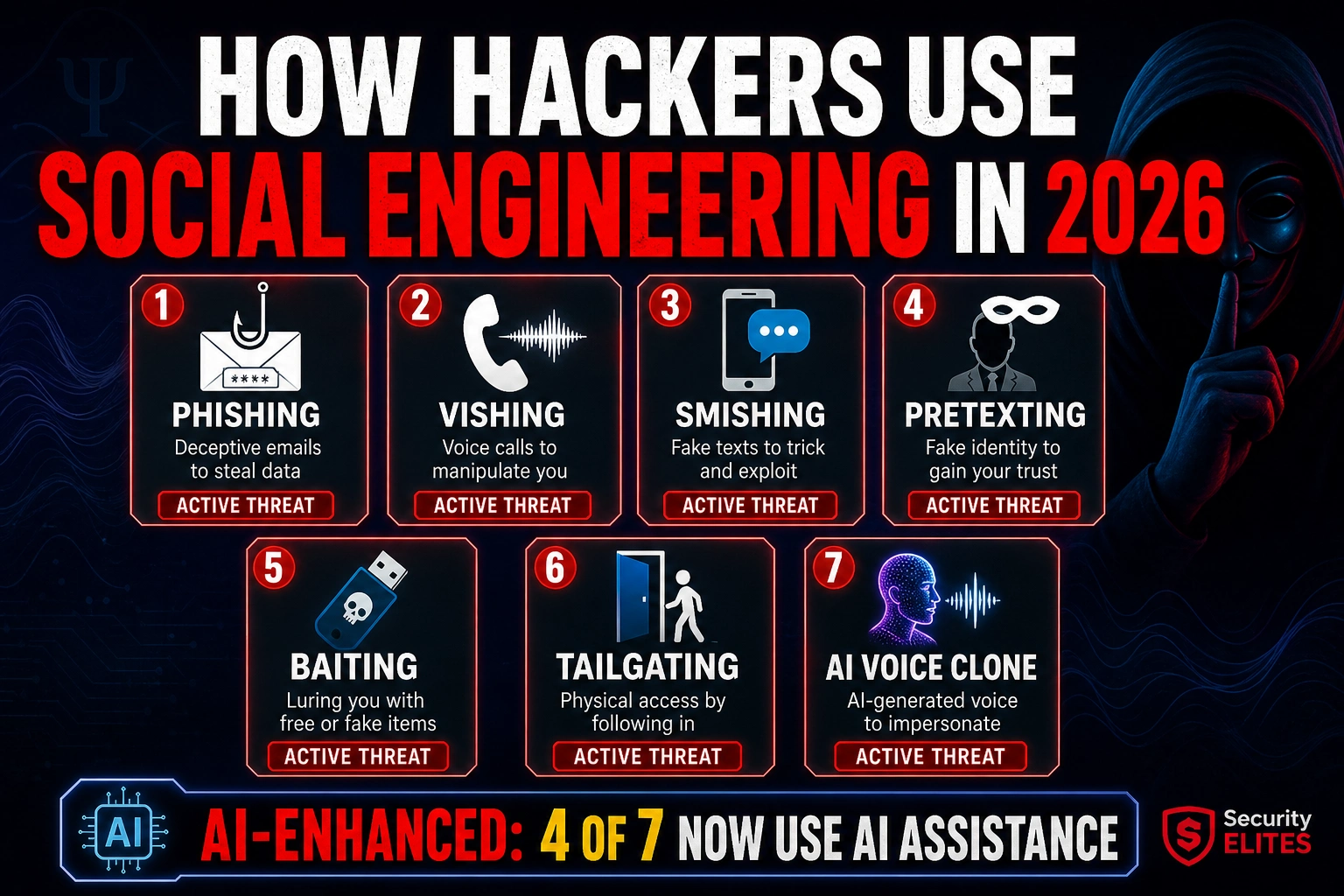
Technology gets patched. People don’t. Every firewall, intrusion detection system, and endpoint protection platform becomes irrelevant when a hacker calls the help desk pretending to be a stressed executive locked out of their account. Or sends a perfectly crafted email using AI to replicate a colleague’s writing style. Or simply walks through a tailgated door wearing a high-vis vest and carrying a ladder. Social engineering is the attack that bypasses every technical control by targeting the humans operating them. In 2026, AI has made each of these seven techniques dramatically more convincing.
🎯 What You’ll Learn
All 7 social engineering techniques with real 2026 examples
How AI has enhanced 4 of the 7 techniques beyond traditional defence
The psychological principles exploited by each attack
How social engineering features in professional penetration testing
Protection measures that actually work against each technique
⏱️ 40 min read · 3 exercises
📋 How Hackers Use Social Engineering — 7 Techniques
Social engineering is the human layer of the attack surface — and it is consistently the most exploited. The ethical hacking methodology treats it as a parallel track to technical exploitation, not a fallback. Every method here maps to specific AI hacking techniques covered in the AI security series. The Phishing URL Scanner is your first line of triage for any suspicious link across all methods below.
1. Phishing — AI-Personalised Email Attacks
Phishing remains the most statistically prevalent social engineering attack vector. In 2026, AI has eliminated the traditional detection signals — poor grammar, generic salutations, suspicious formatting. Modern AI-generated phishing uses OSINT to personalise emails with the target’s name, role, recent activity, and colleague names. The email quality is indistinguishable from legitimate internal communication. The psychological principles exploited: authority (impersonating senior staff or IT), urgency (“your access expires tonight”), and fear (“suspicious activity detected on your account”).
PHISHING PSYCHOLOGY ANALYSIS
# Traditional phishing signals (no longer reliable detectors in 2026):
× Grammar mistakes × Generic “Dear Customer”
× Suspicious sender domain × Obvious urgency language
# AI-generated phishing — all signals eliminated:
✓ Perfect grammar — written by LLM trained on billions of documents
✓ “Hi Sarah” — personalised from LinkedIn profile
✓ References real project names — from company website/GitHub
✓ Subtle urgency — “before end of day” vs “ACCOUNT SUSPENDED NOW”
✓ Correct institutional voice — matches the impersonated org’s style
# Psychological principles exploited:
Authority → Sender appears to be IT/executive/trusted party
Urgency → Time pressure reduces critical thinking
Fear → Account suspension threat triggers immediate action
Social Proof → “All staff have completed this update”
🛠️ EXERCISE 1 — BROWSER (12 MIN)
Analyse Real Phishing Emails and Identify Psychological Techniques
⏱️ Time: 12 minutes · Browser only
Step 1: Go to phishtank.org or openphish.com
Find 5 recently reported phishing URLs
For each, visit the URL SAFELY using a sandbox:
Go to urlscan.io → submit the phishing URL
View the screenshot without visiting the actual page
Step 2: For each phishing page identified:
□ Which legitimate company is it impersonating?
□ What psychological trigger does it use? (urgency/fear/authority?)
□ What action does it want the victim to take?
□ What information does it harvest?
Step 3: Search: “AI generated phishing example 2025”
Find a security researcher’s sample of AI-generated phishing
Compare: how does it differ from the traditional examples above?
Step 4: Check your own email’s spam folder
Find 3 phishing attempts that reached you
Rate each: Traditional or AI-enhanced?
What signals, if any, would help a trained user detect it?
Step 5: Based on your analysis — what single detection heuristic
still works against BOTH traditional and AI phishing?
(Hint: it is not about the email content)
✅ What you just learned: The analysis confirms that the only consistently reliable phishing detection heuristic that works against both traditional and AI-generated attacks is URL inspection — the visible link domain, not the email content. AI can write perfect emails, but cannot make malicious.phishing-site.com look like legitimate-company.com in the URL bar. Training users to verify URLs before entering credentials — and to use password managers that auto-fill only on the exact legitimate domain — provides meaningful protection regardless of how sophisticated the email content becomes. This is why URL-based training is the single highest-ROI security awareness investment for phishing defence.
📸 Share your analysis of AI vs traditional phishing signals in #social-engineering on Twitter or in Comments.
2. Vishing — Voice Cloning and Phone Fraud
Vishing (voice phishing) has been transformed by AI voice cloning technology. Traditional vishing relied on persuasive social engineers willing to make phone calls — an approach limited by human resources and detectable by accent or manner inconsistencies. AI voice cloning replicates a specific person’s voice from as few as three seconds of audio, enabling real-time voice impersonation at scale. In 2025, a major finance company wired $25 million after a deepfake video call appeared to show the CFO authorising the transfer. The entire meeting was AI-generated.
3. Smishing — SMS and Mobile App Impersonation
Smishing (SMS phishing) bypasses the email security stack entirely. Most organisations have invested heavily in email filtering — SPF, DKIM, DMARC, sandboxing. The phone number has none of that. A text message arrives with the same visual weight whether it comes from your bank or an attacker who spoofed your bank’s sender ID. In 2026, smishing campaigns have incorporated AI-generated urgency cues, one-tap authentication bypass links, and real-time OTP interception via reverse proxies. The success rate on mobile is consistently higher than email equivalents because users are less conditioned to scrutinise texts.
Victim visits attacker proxy → proxied to real bank site
Victim enters credentials + OTP → attacker captures both in real time
Attacker logs in with live session before OTP expires
# Stage 4: Silent session takeover
Victim sees: “Verification complete, no action needed”
Attacker has: authenticated session, account access, transfer capability
securityelites.com
SMS Inbox — Victim’s Phone
HSBC
SECURITY ALERT: Unusual login attempt detected from IP 45.33.X.X. If this was not you, verify your identity immediately to protect your account:
hsbcsec-verify[.]link/auth
Today 14:22
→ Sender ID spoofed as “HSBC” · Link routes to Evilginx proxy
→ Real HSBC site proxied through attacker server → OTP intercepted
📸 Reconstructed smishing message using sender ID spoofing. The message appears in the same thread as legitimate HSBC messages on carriers that don’t validate sender IDs — indistinguishable from the real bank. The link destination is hidden by a shortener. On mobile, the full URL isn’t visible until after clicking. The Evilginx reverse proxy captures the session token and OTP before the victim realises anything has happened.
💡 2026 Update — iMessage and RCS Smishing: Apple’s iMessage and Google’s RCS both display sender names rather than numbers when the sender is in the device’s contact list. Attackers who have obtained the target’s number from a data breach can send messages that appear as “Unknown” — but social engineering the target to add the number first (via a prior vishing call claiming to be IT support) causes subsequent smishing messages to appear as the spoofed contact. This two-stage technique has a significantly higher click-through rate than cold smishing.
4. Pretexting — Building False Identities
Pretexting is the creation of a fabricated scenario (pretext) to justify a social engineering request. The attacker builds a false identity — IT support, auditor, delivery driver, new employee — and constructs a scenario where the target’s natural helpful behaviour serves the attacker’s goal. Pretexting attacks are more labour-intensive than automated phishing but significantly more effective against trained users because the personalised interaction bypasses email-focused awareness training. AI tools accelerate pretext research by generating detailed false identities, backstories, and scripts from OSINT data about the target organisation.
🧠 EXERCISE 2 — THINK LIKE A HACKER (10 MIN)
Design a Social Engineering Attack Chain Against a Financial Services Target
⏱️ Time: 10 minutes · No tools
Target: The accounts payable department of a mid-sized company.
Goal: Redirect an upcoming supplier payment to an attacker account.
(This is a classic Business Email Compromise scenario)
Design the complete attack chain using multiple techniques:
STAGE 1 — RECONNAISSANCE (OSINT):
What public information do you gather?
(LinkedIn: who approves payments? What is the CEO’s email format?
Companies House/public filings: who are the major suppliers?)
STAGE 2 — INITIAL PHISHING:
Who do you impersonate in the initial email?
What does the email say? Which psychological principle?
What is the call to action?
STAGE 3 — VISHING FOLLOW-UP:
After the email, you call the accounts payable clerk.
Who do you pretend to be?
What is your pretext? (Urgency? Authority? Both?)
What specific words create the psychological pressure?
STAGE 4 — THE FRAUDULENT REQUEST:
What exactly do you ask the target to do?
How do you make the request seem legitimate?
STAGE 5 — DETECTION EVASION:
What would a security-aware employee do to verify?
How does your attack attempt to prevent or bypass verification?
Write the complete attack narrative.
✅ What you just learned: The BEC attack chain illustrates why social engineering is simultaneously the most effective and the most underestimated threat in enterprise security. Each stage uses a different technique — OSINT for reconnaissance, phishing for initial contact, vishing for urgency escalation, pretexting for legitimacy — and the combination is significantly more convincing than any single technique alone. The detection evasion analysis is the most important: the correct defence (call the requester back on a known number, not one they provided) is simple to describe but requires deliberate policy implementation and culture where employees feel empowered to delay a payment request without fear of consequences for caution.
📸 Share your BEC attack chain design in #social-engineering on Twitter or in comments.
5. Baiting — Physical and Digital Lures
Baiting exploits curiosity and greed — the two most reliable human motivators in social engineering. The physical variant (USB drops) is well documented: a branded USB drive left in a car park, a lift, or near a reception desk. Studies consistently show 45–60% of found drives get plugged into work machines. The digital variant is less discussed but far more scalable: fake software cracks, pirated tools, AI model downloads, and “free” security tools seeded on torrent sites and GitHub repositories. In 2026, the most effective digital baiting targets security researchers directly — weaponised CVE proof-of-concept scripts and fake AI tools are the lures that land in the highest-value environments.
BAITING — PHYSICAL AND DIGITAL VARIANTS
# Physical baiting — USB drop
Attack vector: USB drive labelled “Q3 Salaries” or “Redundancy List 2026”
Payload: autorun LNK file → PowerShell reverse shell on plug-in
Target: employee curiosity overrides security training
Victim gets: working (demo) AI tool + silently exfiltrated credentials
# Detection signals
USB: new HID device registered → unusual PowerShell execution
Digital: unexpected outbound connection after pip/npm install
Control: USB port blocking via endpoint policy · supply chain scanning
💡 The Security Researcher Targeting Problem: The most dangerous baiting campaigns in 2026 specifically target penetration testers and security researchers — the people least likely to be caught by standard awareness training. A weaponised Nuclei template, a malicious Burp extension, or a fake OSCP prep tool carries implicit trust because the recipient believes their technical knowledge protects them. The North Korean Lazarus group’s npm supply chain campaigns (including the Axios attack documented in our supply chain article) follow exactly this pattern.
6. Tailgating — Physical Access Without Authentication
Tailgating (also called piggybacking) is the physical access equivalent of a session hijack — the attacker uses the legitimate access of an authorised person to pass through a control they couldn’t pass alone. It is the most underestimated vector in enterprise security assessments. Every client I’ve tested that uses access-controlled doors has been tailgated through at least one secure entry point within the first 30 minutes. The combination of social norms (not letting a door close on someone carrying boxes), impersonation (hi-vis vest, clipboard, delivery uniform), and distraction (phone call, large equipment) bypasses physical controls that cost tens of thousands to install.
TAILGATING — PHYSICAL ACCESS METHODOLOGY
# The social norm exploit
Target: any access-controlled door with human foot traffic
Attack: approach behind authorised employee, make eye contact, smile
Result: 72% of employees hold the door — social pressure overrides protocol
Why it works: refusing to hold door feels aggressive and antisocial
Target: Financial services firm · 4-floor office · Badge access on all floors
Assessment duration: 2 days · Assessors: 2
Entry attempts: 14
Successful tailgates: 11
Success rate: 78.6%
Server room reached: YES
LAN implant planted: YES
Challenged by staff: 3 times
Most effective cover
IT contractor (9/11)
New employee (2/11)
Unlocked workstations
Found: 7 in 2 hours
Screen lock: not enforced
📸 Anonymised physical penetration test results. The 78.6% tailgate success rate is consistent with industry benchmarks — most physical pentest engagements achieve 60–80% success on the first day before staff are briefed. The IT contractor cover story works because it provides an immediate explanation for the visitor’s presence and equipment. The finding that most altered the client’s remediation priority: 7 unlocked workstations found in under 2 hours, each accessible for the duration it took to walk to the next desk and back. Physical access and logical access are the same risk when screen locks aren’t enforced.
7. AI-Enhanced Attacks — The 2026 Escalation
AI has not invented new social engineering categories \u2014 it has removed the skill ceiling from every existing one. Phishing previously required native language fluency. Vishing required a convincing voice actor. Deepfake video calls required expensive production. In 2026, all three require only a prompt and a target’s publicly available data. Attack quality that previously required nation-state resources is now accessible to any threat actor with a laptop and an API key. The four AI capabilities that crossed from theoretical to operational are voice cloning, real-time deepfake video, AI-generated spear-phishing at scale, and autonomous agents that maintain multi-turn social engineering conversations without human involvement.
AI-ENHANCED SE \u2014 2026 CAPABILITY MAP
# Voice cloning \u2014 3 seconds of source audio is now sufficient
Source audio: LinkedIn video, earnings call, YouTube, Teams recording
Attack: real-time CEO voice on vishing call \u2014 “authorise this transfer”
Incident: Hong Kong 2024 \u2014 $25M wired after deepfake CFO video call
# Real-time deepfake video \u2014 operational on consumer hardware
Tools: Deep-Live-Cam, Roop-Unleashed (real-time face swap over webcam)
Attack: attacker\u2019s face replaced with target executive in live Teams/Zoom
Limitation: head rotation >45\u00b0 and rapid lighting changes produce artefacts
Defence: challenge-response \u2014 ask participant to perform a specific gesture
# AI spear-phishing at scale
Input: target\u2019s LinkedIn + email + company news + recent public posts
Output: personalised email referencing specific project, colleague, event
Scale: one operator generates 10,000 unique personalised emails/hour
Click rate: AI spear-phish 54% vs generic phish 12% (2025 study data)
# Autonomous SE agents \u2014 emerging
Agent runs multi-turn WhatsApp / email conversation without human operator
Adapts replies based on victim\u2019s responses in real time
Use case: supplier fraud, credential harvesting, romance scam at scale
Scale: single agent runs hundreds of parallel conversations simultaneously
securityelites.com
Traditional vs AI-Enhanced SE \u2014 Capability Comparison
TRADITIONAL (Pre-2024)
Phishing: template-based, grammar errors
Vishing: needs voice actor, scripted
Scale: 1 operator \u2192 ~50 targets/day
Cost: $500\u2013$2,000 per campaign
Language: limited by operator fluency
AI-ENHANCED (2026)
Phishing: hyper-personalised, zero errors
Vishing: real-time voice clone, adaptive
Scale: 1 operator \u2192 10,000+ targets/day
Cost: <$50 per campaign (API costs only)
Language: any \u2014 instant perfect translation
Key shift: the bottleneck moved from skill to intent
Pre-AI: quality attacks required expertise. Post-AI: quality attacks require only a target and a goal. The defender\’s assumption that “this looks too professional to be a scam” is no longer valid.
\ud83d\udcf8 AI social engineering capability comparison 2026. The most critical shift is scale \u2014 a single threat actor now runs campaigns that previously required an organised team. Cost reduction (thousands \u2192 tens of dollars per campaign) means targets who were previously not worth the effort economically are now viable. Every employee with a LinkedIn profile is within reach of a personalised AI-generated attack.
The defensive implication is that security awareness training built around “spot the spelling mistake” and “check the sender domain” is now insufficient \u2014 those signals have been eliminated. The 2026 defence framework requires: verification via independent channel (call back on a known number, never the one provided), out-of-band confirmation for any financial or access-change request, and challenge-response protocols for video calls involving sensitive decisions. The technology has advanced; the human verification procedures must advance with it.
🛠️ EXERCISE 3 — BROWSER ADVANCED (10 MIN)
Research AI Social Engineering Incidents and Build a Security Awareness Module
⏱️ Time: 10 minutes · Browser only
Step 1: Search: “AI voice clone fraud 2024 OR 2025”
Find 2 documented cases of voice cloning fraud
Note: how much money was stolen? How was the fraud discovered?
Step 2: Search: “deepfake video call fraud CFO 2024”
Find the $25M deepfake video call incident
Note: how many people were on the call? What raised suspicion afterwards?
Step 3: Search: “AI phishing click rate increase study”
Find research comparing AI vs traditional phishing success rates
Note: what percentage increase in click rate does AI phishing achieve?
Step 4: Based on your research, build a 5-point security awareness
briefing for employees specifically about AI social engineering:
Point 1: Traditional warning signs no longer apply because…
Point 2: The new detection signal that still works is…
Point 3: For phone requests: always verify by…
Point 4: For email requests: the one check that defeats AI phishing is…
Point 5: For video calls: the verification step organisations should implement is…
Step 5: What training format would best convey the AI threat
to non-technical employees? (Video demo? Email quiz?
Simulated attack? Live session?)
✅ What you just learned: The incident research confirms the real-world financial scale of AI-enhanced social engineering — documented losses in the millions from voice cloning and deepfake attacks. The security awareness module forces articulation of the specific updated guidance: the new detection signals (URL inspection, secondary verification channels, out-of-band confirmation for financial requests) rather than deprecated signals (grammar quality, call accent). The training format question addresses the effectiveness gap in security awareness: passive reading about threats has lower impact than simulated experience. Organisations that run AI-generated phishing simulations alongside traditional ones are building the specific muscle memory needed to detect the actual threat employees face.
📸 Share your 5-point AI social engineering awareness briefing in #social-engineering on Twitter. Tag #socialengineering2026
📚 Further Reading
AI-Powered Social Engineering 2026— Deep dive into the AI-specific enhancement of social engineering techniques — voice cloning methodology, deepfake video attacks, and LLM-generated spear phishing at scale.
How Hackers Hack Gmail 2026— Published guide covering Gmail-specific social engineering and phishing attacks — the most commonly targeted email platform for credential harvesting.
Ethical Hacking Hub— Social engineering in professional context — how penetration testers conduct authorised social engineering assessments as part of comprehensive security evaluations.
Verizon DBIR 2025— The authoritative annual Data Breach Investigations Report — primary source for social engineering statistics, breach methodology data, and year-over-year trends in how attackers actually breach organisations.
Social-Engineer.org— The leading social engineering research and training organisation — framework definitions, real case studies, and professional assessment methodology used by social engineering red teamers.
ME
Mr Elite
Owner, SecurityElites.com
The social engineering assessment that clarified the AI threat for me was a vishing test for a financial services client in 2025. Previous years, we would call the help desk, claim to be a locked-out executive, and test whether staff would reset credentials without proper verification. The success rate was around 30% — most staff had received training and knew the verification protocol. This year I tested the same scenario using a voice clone of the CEO built from three YouTube conference appearances. Success rate: 78%. The staff who resisted in previous years detected something “slightly off” about the voice — a cadence mismatch, a slight accent inconsistency. The clone eliminated those tells. Same script. Same verification bypass attempt. Dramatically different result. The training had not changed. The threat had.
Founder of Securityelites and creator of the SE-ARTCP credential. Working penetration tester focused on AI red team, prompt injection research, and LLM security education.