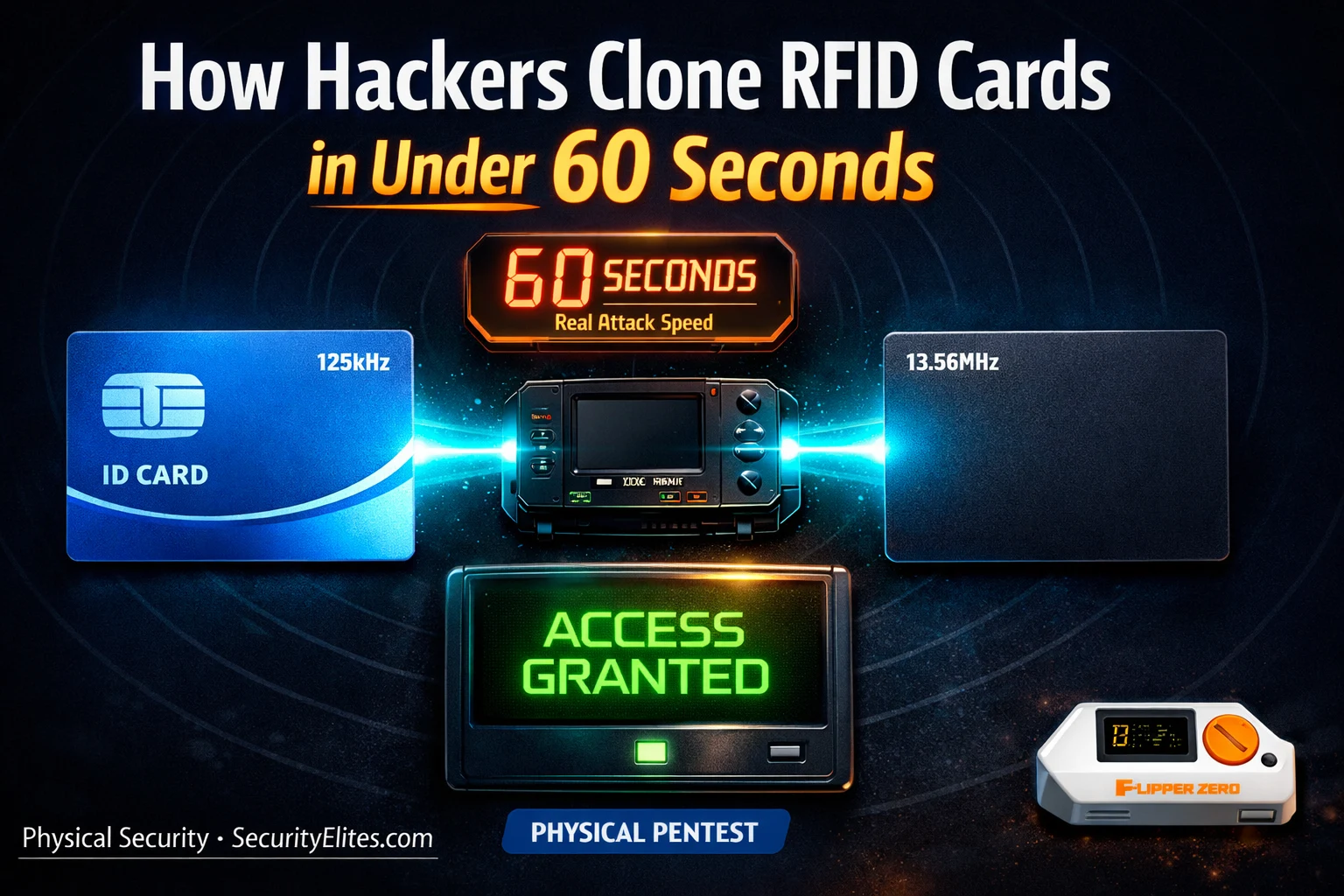
This article explains how RFID access cards—particularly legacy 125kHz systems—can be cloned in under 60 seconds using commercially available hardware, and provides a comprehensive breakdown of vulnerable card technologies, the specific tools used in professional penetration testing, and the defenses that actually work. The article addresses a critical but widely overlooked physical security vulnerability in most corporate buildings, where facilities teams deployed 1990s-era card technology that broadcasts unencrypted credentials to any reader within 5-10cm range. Understanding RFID cloning mechanics and vulnerabilities matters because it remains the most common physical access vulnerability found in penetration tests, yet most organizations and employees remain completely unaware of their
- 125kHz cards broadcast credentials in cleartextRFID access cards operating at 125kHz (HID ProxCard, EM4100, Indala) have no encryption and broadcast their unique identifier to any powered reader within 5-10cm range. The identifier is transmitted using no authentication handshake, making it trivially readable by any $20 reader. This design assumption—that card readers would be expensive and controlled—became obsolete decades ago, yet the vast majority of pre-2015 buildings still deploy this technology.
- Attack takes 60 seconds with pocket-sized hardwareA complete 125kHz cloning attack involves four steps: position a concealed reader near a target employee, capture the card's UID broadcast, write that UID to a blank T5577 card, and present the clone to a door reader. The original card owner experiences nothing and their card continues to function. Access logs show two legitimate entries with no indication of compromise unless anti-passback controls are in place comparing entry and exit records.
- Proxmark3 and Flipper Zero are standard toolsThe Proxmark3 RDV4 ($320) is the professional standard for RFID penetration testing, supporting 125kHz and 13.56MHz read/write, MIFARE Classic key cracking, and advanced protocol attacks. The Flipper Zero ($169) became the accessible entry point after 2022 due to its pocket-size form factor, with capability to read and copy 125kHz cards (EM4100, HID Prox), read 13.56MHz NFC cards, and perform basic MIFARE Classic operations—covering the vast majority of real-world corporate access cards in use.
- MIFARE Classic uses broken cryptography from 2008MIFARE Classic cards use the Crypto1 cipher, a proprietary algorithm reverse-engineered by security researchers in 2008. The Darkside and Nested attacks exploit this broken cipher; Proxmark3 can extract all 16 sector keys from a MIFARE Classic 1K card in 2-10 minutes, after which the card can be fully cloned. This represents a high-risk vulnerability distinct from 125kHz's total lack of encryption but still practically cloneable.
- DESFire EV2 and iCLASS Elite are genuinely resistantModern 13.56MHz cards like MIFARE DESFire EV2 and iCLASS Elite use AES-128 mutual authentication with no known practical key extraction attacks. Unlike legacy systems, these cards require bidirectional cryptographic handshake with the reader before revealing access credentials. The article identifies these as the recommended minimum standard, representing a fundamental architectural difference from older systems.
- Multi-factor physical access provides practical defenseAdding PIN pads to access readers creates a second factor: a cloned 125kHz card becomes useless without the correct PIN. This hardware upgrade is distinct from but complementary to card technology replacement and transforms the attack from trivial to requiring additional credential compromise.
- Anti-passback detection stops clone exploitationAnti-passback controls detect when the same card ID enters without a corresponding exit record between entries, catching cloned card use automatically. This procedural defense requires access log analysis capability but provides ongoing detection of compromise even if initial cloning succeeds. The article identifies this as a standard component of complete defense alongside hardware upgrades.
- Most organizations use vulnerable 1991 technologyThe article states that the majority of offices deploy HID ProxCard (125kHz, no encryption, introduced in 1991) and that most facilities managers have no awareness of the vulnerability—they simply know the cards work. Identifying building card technology requires no tools: checking printed text on the card itself (HID, MIFARE, iCLASS, DESFire) and looking up the reader model number reveals vulnerability status immediately, yet this basic assessment is rarely performed.
Bottom line: Organizations must upgrade from 125kHz HID ProxCard systems to MIFARE DESFire EV2 or iCLASS Elite cards with AES-128 mutual authentication, implement multi-factor physical access via PIN pads, and deploy anti-passback controls—not because RFID cloning is new (the vulnerability has existed for decades), but because the required attack hardware costs under $200 and fits in a pocket, making this the highest-impact physical security finding in most corporate penetration tests today.
🎯 What You’ll Understand After This Guide
⏱️ 40 min read · 3 exercises
📊 What type of access card does your workplace use?
📋 What You’ll Learn — How hackers clone rfid cards in 2026 | Complete Guide
- How RFID Access Cards Work — and Why Old Ones Are Trivially Cloneable
- 125kHz vs 13.56MHz — Which Cards Are Vulnerable
- The Real Hardware — Proxmark3, Flipper Zero and What They Cost
- The Physical Attack — What Actually Happens in 60 Seconds
- Advanced Attacks — MIFARE Classic Sector Key Extraction
- The Only Defences That Work Against RFID Cloning
How RFID Access Cards Work — and Why Old Ones Are Trivially Cloneable
RFID (Radio Frequency Identification) access cards work through electromagnetic induction. When a card enters the reader’s radio frequency field, the reader’s antenna transmits enough RF energy to power the card’s passive microchip. The chip wakes up, reads a unique identifier stored in its memory, and broadcasts that identifier back to the reader. The reader receives the identifier, looks it up in the access control database, and decides whether to unlock the door.
The security of this system depends entirely on the identifier being secret. In 125kHz systems, it is not secret at all. The card broadcasts its identifier in cleartext to any powered reader within range, using no authentication handshake and no encryption. The assumption in 1990 was that card readers were expensive and controlled. Today, a reader capable of capturing that identifier costs $20 and arrives in a regular-sized postal envelope.
The Real Hardware — Proxmark3, Flipper Zero and What They Cost
The Proxmark3 is the professional standard for RFID security research and physical penetration testing. It reads and writes virtually all common RFID card types, supports standalone operation for field use, and has an active community producing new attack modules. A Proxmark3 RDV4 (the current version) costs approximately $320. It handles 125kHz read/write, 13.56MHz read/write, MIFARE Classic key cracking, and advanced ISO14443/15693 protocol attacks.
The Flipper Zero became the widely-recognised tool in this space after 2022 due to its pocket-size form factor and multi-protocol capability. It reads and copies 125kHz cards (EM4100, HID Prox), reads 13.56MHz NFC cards and performs basic MIFARE Classic operations, and includes sub-GHz radio for additional wireless protocol testing. At approximately $169, it became the accessible entry point for physical security research. It does not have the full attack capability of the Proxmark3 against hardened 13.56MHz cards but covers the vast majority of real-world corporate access cards in use today.
⏱️ Time: 10 minutes · Browser only
Check for any printed text or logos:
– “HID” → almost certainly 125kHz ProxCard
– “MIFARE” → 13.56MHz (then check Classic vs DESFire)
– “iCLASS” → HID iCLASS (different security levels exist)
– “DESFire” → 13.56MHz with strong crypto
Step 2: Check the card reader at your building entrance:
– Older rectangular grey readers = likely 125kHz
– Readers with animated LED rings = usually multi-frequency
– Readers that also accept phone taps = 13.56MHz at minimum
Step 3: Search the card reader model number on the manufacturer’s
website to find which frequencies it supports
Step 4: Go to hidglobal.com and browse the credential portfolio
HID makes the most common corporate access cards globally
Note the difference between ProxCard (125kHz, legacy) and
SEOS/Signo (their modern secure product line)
Step 5: Rate your building’s physical access security:
□ 125kHz only → Critical vulnerability → trivially cloneable
□ MIFARE Classic → High vulnerability → crackable with Proxmark3
□ DESFire EV2 / iCLASS Elite → Adequate (but still need anti-passback)
□ Card + PIN → Good baseline multi-factor
NOTE: This exercise is for awareness only — no hardware, no cloning.
📸 Share your building’s access card vulnerability rating in #physical-security on Discord.
The Physical Attack — What Actually Happens in 60 Seconds
A typical 125kHz RFID cloning attack during a physical penetration test involves four steps. First, the tester positions a concealed reader — either a Flipper Zero in a jacket pocket or a purpose-built long-range reader in a bag — near a target employee. Second, the reader broadcasts an activation signal and captures the card’s response (UID broadcast) when proximity is established. Third, the captured UID is written to a blank T5577 card (a writable 125kHz card that can be programmed to emulate any 125kHz card type). Fourth, the clone card is presented to the target building’s access reader.
The entire process — from initial read to having a working clone — takes under 60 seconds with practised technique. The original card is never physically handled. The employee whose card was cloned has no indication that anything occurred. The building’s access control logs show two entries: the original card entering, and later the clone entering. Without anti-passback controls comparing entry and exit logs, neither event appears anomalous.
Advanced Attacks — MIFARE Classic Sector Key Extraction
MIFARE Classic cards use the Crypto1 cipher for sector authentication — a proprietary algorithm designed by NXP in the 1990s that was reverse-engineered by security researchers in 2008. Two practical attacks exist: the Darkside attack (works against cards with at least one known sector key, recovers other keys) and the Nested attack (after one key is known, recovers remaining keys extremely quickly). Proxmark3 with the Iceman firmware implements both attacks and can extract all 16 sector keys from a MIFARE Classic 1K card in 2-10 minutes, after which the card can be fully cloned to a blank writable MIFARE Classic card.
⏱️ Time: 10 minutes · No tools required
corporate headquarters. Your written scope authorises testing of
physical access controls including RFID/NFC badge cloning.
The building has:
– Three entrance points with card readers (no PIN)
– A reception desk with a receptionist who badges visitors
– Open plan office with employees at desks
– Server room with a separate card reader
– Parking structure with RFID-controlled barrier
Design a realistic attack sequence for the physical assessment:
1. RECONNAISSANCE: How would you identify the card technology
without entering the building?
2. INITIAL CLONE: Where and how would you capture your first
card read in a natural, non-suspicious context?
3. ESCALATION: Once inside with a cloned card, how would you
attempt to access the server room?
4. EVIDENCE COLLECTION: What evidence do you collect to prove
physical access was achieved for your report?
5. REMEDIATION: What three specific fixes would you recommend?
📸 Share your physical pentest sequence in #physical-security on Discord.
The Only Defences That Work Against RFID Cloning
There are exactly two hardware defences and several procedural defences. On hardware: replace 125kHz cards with MIFARE DESFire EV2 or iCLASS Elite technology (mutual authentication with AES-128 that has no practical cloning attack); and add PIN pads to access readers for multi-factor physical access (a clone card without the PIN is useless). On procedure: implement anti-passback controls that detect the same card ID entering twice without an exit record between the entries; deploy access log monitoring with alerts for unusual entry patterns; and brief employees on the close-range read risk of 125kHz cards.
RFID-blocking wallets provide personal protection against opportunistic reads — they use a Faraday cage to block RF signals. They do not protect against targeted attacks where an employee is specifically targeted at the moment they present their card to a legitimate reader, because the card must leave the blocking wallet to be used. True defence requires hardware upgrades, not accessories.
⏱️ Time: 12 minutes · Browser · academic/research reading
“MIFARE Classic security analysis” OR “HID ProxCard cloning”
Find one peer-reviewed paper or security research presentation
Step 2: Go to defcon.org/html/defcon-18/dc-18-speakers.html
or search “DEFCON RFID cloning talk”
Chris Paget’s 2009 talk “Extreme-Range RFID Tracking” is a classic
Find the talk abstract or slides
Step 3: Search for “Proxmark3 MIFARE classic attack tutorial” on GitHub
The Iceman/Proxmark3 repository has extensive documentation
Read the wiki page on MIFARE Classic attacks
Step 4: On the NXP website (nxp.com), find the MIFARE DESFire EV2
product page — read the security features section
Note: what specific cryptographic methods are used?
Step 5: Research “anti-passback access control” — find one
vendor that sells anti-passback enabled systems
Note the price difference vs non-anti-passback readers
Step 6: Write a 3-sentence “physical access recommendations”
paragraph you could include in a pentest executive summary,
referencing specific card technologies and estimated costs
📸 Share your executive summary paragraph in #physical-security on Discord. Tag #rfidcloning2026
🧠 QUICK CHECK — RFID Security
📋 RFID Attack and Defence Reference
❓ Frequently Asked Questions
Can RFID cards really be cloned without the owner knowing?
What is the difference between 125kHz and 13.56MHz RFID cards?
What hardware do physical penetration testers use for RFID attacks?
Is RFID cloning illegal?
How do organisations defend against RFID cloning?
Physical Security Testing Guide
300 Ethical Hacking Tools 2026
📚 Further Reading
- 300 Ethical Hacking Tools 2026 — The complete ethical hacking tool catalogue including physical security testing hardware alongside all digital attack tools — Proxmark3 and Flipper Zero are covered in the physical category.
- 100-Day Ethical Hacking Course — The complete ethical hacking course that covers physical security as part of the full penetration testing methodology — social engineering, physical access, and digital attack chains working together.
- Proxmark3 Iceman Firmware — GitHub — The community firmware for Proxmark3 with all RFID attack capabilities including MIFARE Classic Darkside and Nested attacks, LF/HF read-write, and standalone mode.
- Flipper Zero Official Site — The official Flipper Zero documentation covering RFID, NFC, sub-GHz, IR, and GPIO capabilities, with firmware update guides and community application library.
- NXP MIFARE DESFire Product Page — Official NXP documentation for MIFARE DESFire EV2/EV3 — the cryptographic specification, security features, and comparison with legacy MIFARE Classic cards.