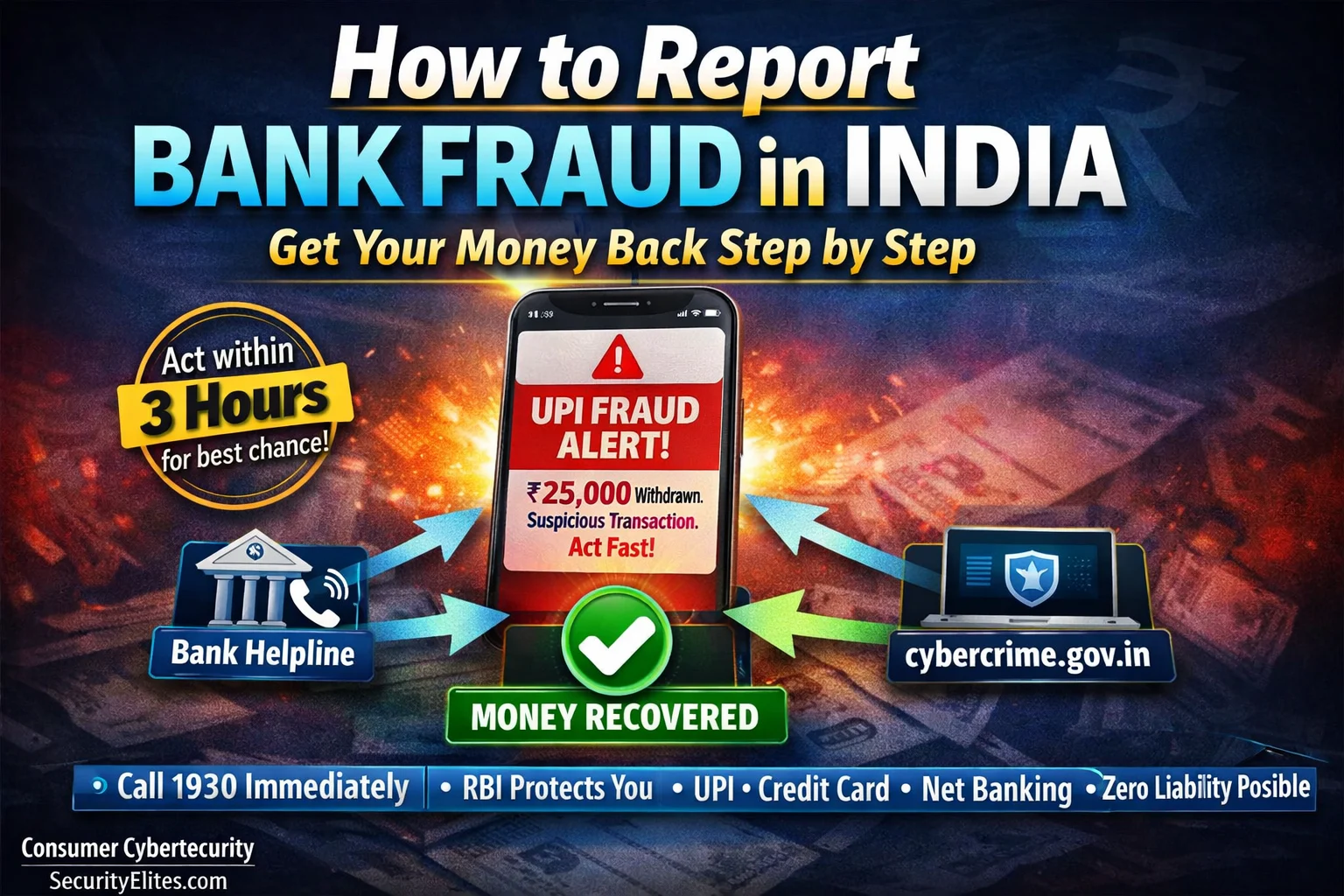
This guide provides a comprehensive, step-by-step framework for Indian bank fraud victims to recover money by explaining the critical first actions, regulatory protections, and proper escalation procedures. It addresses the urgent problem that most fraud victims waste critical recovery hours through panic and ignorance of the system, when calling 1930 within minutes can freeze funds before they disappear. The article matters because India received over 1.5 million financial fraud complaints in 2023, and understanding the specific sequence of actions and the timing windows can mean the difference between full recovery and total loss.
- The 1930 helpline as active intervention systemThe National Cyber Crime Helpline 1930, operated 24/7 under the Ministry of Home Affairs' Citizen Financial Cyber Fraud Reporting & Management System, is not merely a reporting line but an active intervention platform. When a victim calls 1930, operators can immediately alert the destination bank to flag and freeze fraudulent funds in real time before they transfer further. This capability exists because the system connects directly to all major banks, making the first call within minutes potentially the most powerful recovery tool available.
- The three-hour recovery window and why timing mattersThe article establishes that recovery probability drops dramatically based on when fraud is reported: 0–1 hour offers the best chance because money may still be in the receiving account and freeze is possible; 1–3 hours provides good odds if reversal is requested before further transfers; 3–24 hours shows reduced chance as funds may have moved multiple times; and 24+ hours makes freezing unlikely, though RBI refund rights and police investigation remain possible. This timing gradient exists because fraudsters immediately move stolen money through multiple accounts to cash it out, making the fi
- RBI zero liability protection and reporting deadlinesThe Reserve Bank of India's Customer Protection Circular defines victim liability based on fault and reporting speed: if fraud results from bank negligence or data breach, liability is zero regardless of reporting timing; if third-party breach occurs, reporting within 3 working days results in zero liability, with capped liability (₹5,000–₹25,000 depending on account type) for reports between 4–7 working days; if the victim shared credentials like OTPs or PINs, they bear full liability. However, even when credentials were shared, filing complaints still enables recovery if funds can be frozen
- Written complaint requirement and formal documentation trailThe article emphasizes that calling 1930 is insufficient; victims must file a written complaint with their bank within 3 working days to create a formal paper trail that establishes RBI protection eligibility and prevents banks from claiming they were not properly notified. This complaint must include the account number, transaction details, transaction reference numbers, statement that authorization was not given, a description of how fraud occurred, the 1930 reference number, and a request for provisional credit within 10 working days. Without this written documentation, the bank can more ea
- Cybercrime portal and police FIR filing sequenceAfter calling 1930 and contacting the bank, victims must file on cybercrime.gov.in (the National Cyber Crime Reporting Portal) within 3 days to create a formal government record, then file an FIR at a police station or dedicated cybercrime cell. The article specifies that cybercrime portal filing requires uploading fraudulent SMS screenshots, bank statements, transaction IDs, and fraudster details; it provides a separate reference number distinct from the 1930 reference. An FIR is legally required for insurance claims, court proceedings, and to strengthen bank complaints, and police cannot leg
- RBI Ombudsman escalation and free dispute resolutionIf a bank rejects a fraud claim without valid justification or fails to respond within 30 days, victims can file with the RBI Integrated Ombudsman at cms.rbi.org.in or via helpline 14448 at no cost and without requiring legal representation. The Ombudsman can order the bank to refund the fraudulent amount, pay interest from the fraud date, provide compensation up to ₹1 lakh for mental harassment, and reimburse reasonable filing costs. The article presents this as a powerful tool specifically because it is free, accessible, and has regulatory authority over banks—most valid fraud cases are reso
- Common fraud scripts and credential extraction tacticsThe article identifies four prevalent fraud scenarios that work by manipulating victims into voluntarily surrendering credentials: 'account blocked' calls requesting OTPs (the OTP is actually for account access, not verification); phishing links in WhatsApp messages claiming KYC updates required; fake UPI reversal requests where clicking 'receive' prompts victims to enter their PIN, which authorizes a payment rather than receiving funds; and screen-sharing scams where fraudsters request installation of TeamViewer or AnyDesk to see banking apps and OTPs live. All four share the characteristic t
- Multi-level escalation ladder and persistence strategyThe article outlines five escalation levels that victims can pursue if initial bank complaint fails: Level 1 is the bank's internal grievance process (0–30 days); Level 2 is the RBI Integrated Ombudsman (30+ days, no cost); Level 3 is Lok Adalat for amounts under ₹20 lakh (free, one-sitting resolution); Level 4 is Consumer Court with filing fees (refund plus interest plus compensation); Level 5 is High Court writ for systemic bank failure (requires lawyer, extreme cases). The article's key insight is that knowledge of this ladder itself is a negotiating tool—a complaint that explicitly referen
Bottom line: The single most critical action for fraud victims is calling 1930 within the first hour while simultaneously blocking their card through their bank's fraud helpline, because only this early notification can freeze funds before fraudsters transfer them out of reach; everything that follows—written complaints, cybercrime portal filing, FIR, and RBI Ombudsman escalation—serves to formalize the recovery process and ensure the victim's legal rights are protected. The system in India does work for fra
Have you or someone you know experienced bank or UPI fraud in India?
🎯 What You’ll Know After This
⏱️ 25 min read · bookmark this now
📋 How to Report Bank Fraud in India 2026 — Complete Recovery Guide Contents
- IMMEDIATE — Call 1930 (First 5 Minutes)
- IMMEDIATE — Block Your Card and Account
- Know Your Rights — RBI Zero Liability Rule
- File Written Complaint with Your Bank
- File on cybercrime.gov.in
- File an FIR at the Police Station
- Escalate to RBI Ombudsman (If Bank Rejects)
- Specific Steps by Fraud Type
- Documentation Checklist
STEP 1 — Call 1930 Immediately (First 5 Minutes)
📞 1930 — National Cyber Crime Helpline — Call Right Now
1930 is not just a reporting line. It is an active intervention system. When you call 1930 and report a fraudulent transaction, the operators can directly alert the destination bank to flag and freeze the funds before they move further. This is the most powerful tool available to fraud victims in India and most people have never heard of it.
The helpline operates 24 hours, 7 days a week. It is run under the Ministry of Home Affairs’ Citizen Financial Cyber Fraud Reporting & Management System (CFCFRMS) — a platform that connects to all major banks in real time. When a transaction is flagged through 1930, an alert goes to the receiving bank immediately. If the money is still sitting in the receiving account, the bank can put a hold on it.
STEP 2 — Block Your Card and Account Immediately
While someone is calling 1930 (or right after), immediately block your debit card, credit card, or UPI using the fastest method available to you. This prevents additional fraudulent transactions while you work on recovering the money already lost.
Know Your Rights — RBI’s Zero Liability Rule
This is the most important thing most fraud victims don’t know: the Reserve Bank of India legally requires banks to protect you. Under RBI’s Customer Protection Circular (RBI/2017-18/15 dated July 6, 2017), your liability in an unauthorised transaction depends on who was at fault and how quickly you reported it.
The critical implication: If a third party hacked your account, obtained your data through a data breach, or used a SIM swap — and you did not share any credentials — your liability can be zero if you report within 3 working days. The bank is legally required to refund you. If they refuse without valid reason, the RBI Ombudsman can compel them to comply.
STEP 3 — File a Written Complaint with Your Bank
Calling the helpline is Step 1, but it is not enough. You must file a written complaint to create a formal paper trail. Without a written complaint, the bank can claim they were not properly notified, which weakens your case for a refund. Do this within 3 working days of the fraud — this is the RBI deadline for zero liability protection on third-party fraud.
⏱️ 15 minutes · Do this now — before fraud happens
Action 2: Save your bank’s 24×7 fraud helpline number in your contacts
Action 3: Note your bank’s fraud/grievance email address (write it here)
Action 4: Take a screenshot of your debit/credit card number
(last 4 digits + expiry — for complaint forms)
Action 5: Enable transaction SMS alerts from your bank
(Settings → Alert Preferences in your bank app)
Action 6: Bookmark this page: cybercrime.gov.in
Action 7: Note your bank branch address and IFSC code
Action 8: Check your bank’s policy on blocking card via SMS
(some banks: SMS “BLOCK [last 4 digits]” to a shortcode)
The goal: if fraud happens at 3 AM, you should be able to
call 1930 and block your card within 3 minutes — without
Googling anything.
📸 Share this checklist with family members who might not know about 1930. Tag #BankFraudIndia
STEP 4 — File Complaint on cybercrime.gov.in
The National Cyber Crime Reporting Portal (cybercrime.gov.in) is the official government platform for reporting financial cybercrime. Filing here creates a formal government record of your complaint, which strengthens your case with the bank and provides the basis for police investigation. The portal is connected to state cybercrime cells nationwide.
| When | What to Do | Get Reference |
| 0–5 min | Call 1930, block card/UPI | 1930 complaint no. |
| Same day | File on cybercrime.gov.in | Portal complaint no. |
| Within 3 days | Written complaint to bank | Bank complaint no. |
| Within 3 days | File FIR at police station | FIR number |
| Day 30+ | If bank unresponsive → Ombudsman | Ombudsman ref. no. |
| Day 60+ | If Ombudsman unresolved → Consumer Court | Court filing no. |
STEP 5 — File an FIR at the Police Station
An FIR (First Information Report) creates a legal record of the crime and initiates a police investigation. Many people skip this step thinking it’s futile — don’t. An FIR is required for: insurance claims if you have cybercrime insurance, court proceedings if you need to sue, and it strengthens your bank complaint significantly. Police cannot legally refuse to register an FIR for a cognisable offence — cyber fraud qualifies.
STEP 6 — Escalate to RBI Ombudsman (If Bank Rejects Your Claim)
If your bank rejects your fraud complaint without valid justification, or does not respond within 30 days, you have a powerful tool: the RBI Integrated Ombudsman. This is a free, accessible dispute resolution service that has the authority to direct banks to refund money and pay compensation. You do not need a lawyer. You do not pay any fees.
⏱️ 15 minutes · Pure awareness exercise
Understanding them makes you immune to them.
SCENARIO 1 — “Your account is blocked”
Caller: “Sir/Madam, your SBI account has been blocked.
To verify and unblock, please confirm your OTP.”
ANALYSIS: Banks NEVER call asking for OTPs. The OTP they’re
asking you to read is actually an account access/transfer OTP.
If you read it out → they’re in your account.
WHAT TO DO: Hang up. Call your bank’s official helpline directly.
SCENARIO 2 — “KYC Update Required”
WhatsApp message: “Your account will be closed in 24 hours.
Please update KYC by clicking this link.”
ANALYSIS: Phishing link. The website looks like your bank’s
but captures your login credentials.
WHAT TO DO: Delete. Never click links in WhatsApp/SMS for banking.
SCENARIO 3 — “UPI Reversal Request”
You sold something on OLX. Buyer sends ₹1 request via UPI.
It says “₹5000 pending” — you click to collect.
ANALYSIS: Clicking a UPI RECEIVE request requires YOUR PIN.
If you enter your PIN, you’re authorising a PAYMENT, not receiving.
WHAT TO DO: Understand: YOU NEVER ENTER YOUR PIN TO RECEIVE MONEY.
SCENARIO 4 — Screen Sharing Scam
“Customer care” asks you to install TeamViewer/AnyDesk for help.
ANALYSIS: Once you share screen, they see your banking app,
OTPs, everything.
WHAT TO DO: Never install screen sharing apps at someone’s request.
FOR EACH SCENARIO: What is the ONE phrase that gives it away?
📸 Share these four scenarios with your parents and family members. They need this more than you do. Tag #BankFraudAwareness
Specific Steps by Fraud Type
UPI Fraud: Call 1930. Deactivate your UPI ID in your app (Profile → Settings → Deactivate UPI ID). File complaint with NPCI at 1800-120-1740. Report the fraudster’s UPI ID at the payment app’s fraud reporting section (GPay, PhonePe, Paytm all have this). NPCI can block the receiving UPI ID.
Credit/Debit Card Fraud: Call the card hotline immediately (printed on back of card). Dispute the transaction online — log in to your credit card portal and mark the transaction as “disputed/fraudulent.” For international transactions, also file a chargeback request — card networks (Visa/Mastercard) have buyer protection programmes.
Internet Banking Fraud: Change your password immediately, disable all registered devices, and check for any changes to payee lists or email IDs. If you cannot log in, call the bank immediately — your login may have been changed by the fraudster.
SIM Swap Fraud: You’ll notice your phone loses signal suddenly. Call your telecom operator immediately on another phone to freeze your SIM. Then call your bank — a SIM swap is a technical fraud (how SIM swap works explained) that RBI classifies as “not customer’s fault,” meaning zero liability if reported promptly.
⏱️ 15 minutes · Browser only
Go to: https://cybercrime.gov.in
Verify the URL is correct (government .gov.in domain)
Bookmark it now
Step 2: Read RBI’s actual Customer Protection Circular
Go to: https://rbi.org.in
Search: “Customer Protection Limiting Liability of Customers”
Find the 2017 circular. Read Section 6 (Liability of Customer)
Note the exact reporting window requirements
Step 3: Test the RBI Ombudsman portal
Go to: https://cms.rbi.org.in
What information does it require to file a complaint?
What types of complaints does it accept?
Step 4: Check your state’s cybercrime cell
Search: “[Your State] Cybercrime Police Station”
Note the address and phone number of your nearest cybercrime cell
This is faster than a regular police station for cyber FIRs
Step 5: Save the Lok Adalat option
Search: “Lok Adalat bank fraud India”
What is Lok Adalat? How is it useful for small fraud recovery amounts?
Many bank fraud disputes under ₹20 lakh can be resolved
through Lok Adalat at no cost and much faster than courts
📸 Screenshot the RBI circular section on customer liability. Share in #BankFraudIndia on social media.
Complete Documentation Checklist
📋 Keep ALL of These — They Are Your Evidence
🧠 QUICK CHECK — Bank Fraud Recovery
🔖 Bookmark This Page — Share It With Family
You now know more about recovering from bank fraud than 95% of Indians. More importantly — share this with your parents, grandparents, and colleagues. Elderly family members are the most targeted demographic for phone banking fraud. The 1930 number alone could save someone you know tens of thousands of rupees.
❓ Frequently Asked Questions — Bank Fraud India 2026
What is the first thing to do after bank fraud in India?
What is RBI’s zero liability rule?
How long does money recovery take after bank fraud in India?
Can I get money back after UPI fraud?
What is the RBI Banking Ombudsman and how do I reach them?
What documents do I need to report bank fraud in India?
Bank Fraud Guide — USA
Bank Fraud Guide — UK
📚 Further Reading & Official Resources
- How to Report Bank Fraud in the US — Complete step-by-step guide for US customers covering Regulation E rights, CFPB complaints, FBI IC3, and the federal escalation ladder.
- How to Report Bank Fraud in the UK — UK-specific guide covering the October 2024 PSR mandatory APP fraud reimbursement, Section 75 Consumer Credit Act, Action Fraud, and the Financial Ombudsman.
- cybercrime.gov.in — National Cyber Crime Reporting Portal — Official government portal to file financial fraud complaints — your starting point after calling 1930.
- cms.rbi.org.in — RBI Integrated Ombudsman — Free online portal to escalate bank fraud complaints when your bank fails to resolve them within 30 days.
- How Hackers Bypass 2FA in 2026 — Understanding how SIM swaps and OTP theft work helps you recognise the exact attack before you become a victim.
- RBI Customer Protection Circular 2017 — The actual RBI circular defining your zero liability rights — read this so you can cite it precisely when your bank tries to deny your claim.
- NPCI — National Payments Corporation of India — Governs UPI, RuPay, and IMPS — the dispute resolution authority for UPI fraud where bank-level resolution has failed.