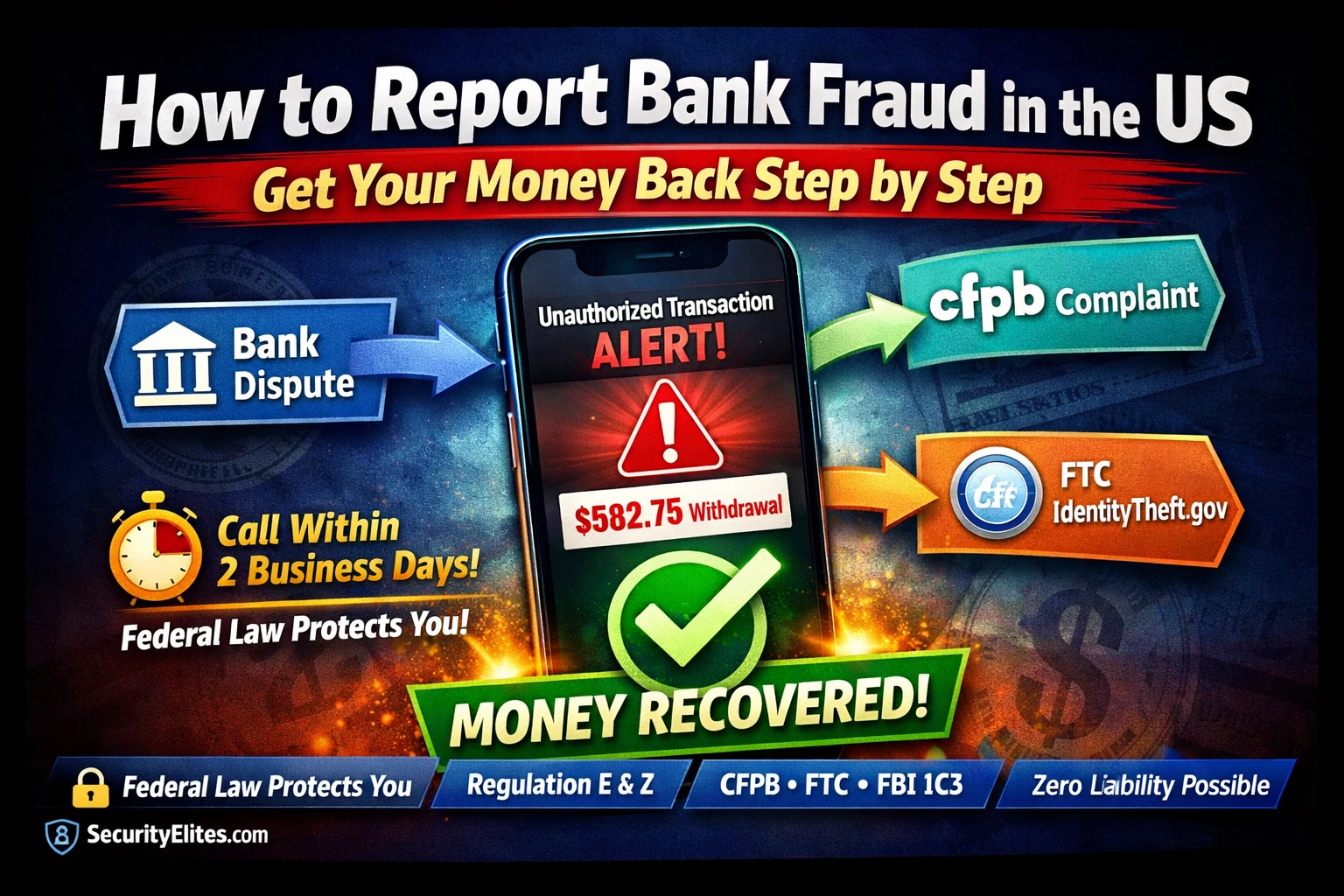
This article provides a comprehensive, step-by-step guide for US bank and credit card fraud victims to report fraud, understand their federal legal protections, and recover lost money. It explains the critical time-sensitive nature of fraud reporting (particularly the 2-business-day window under Regulation E), details specific federal regulations that protect consumers, and maps out an escalation ladder from immediate bank contact through CFPB complaints to small claims court. The guide matters because most Americans are unaware of their enforceable federal rights or the proper sequence of actions, causing them to give up after initial bank denials rather than pursuing available remedies.
- Federal liability windows determine maximum recoveryRegulation E (debit/bank accounts) imposes strict time thresholds: reporting within 2 business days caps liability at $50, within 60 days from statement caps it at $500, and after 60 days creates potentially unlimited liability. Regulation Z (credit cards) offers more protection with federal maximum liability of $50 and most major issuers offering $0 liability, with a 60-day reporting window from the billing statement. The article emphasizes the 2-business-day clock starts when the victim could reasonably have known about the fraud, typically upon receiving a transaction alert or statement.
- Immediate bank fraud line call is time-critical actionThe article provides specific fraud department phone numbers for major US banks (Bank of America 1-800-432-1000, Chase 1-800-935-9935, Wells Fargo 1-800-869-3557, etc.) and requires calling these dedicated fraud lines rather than general customer service. The victim must have ready their account number, transaction details, and last four digits of SSN, and must document the fraud case number, agent name, call time, and date for later evidence.
- Written dispute letter creates legal paper trailUnder both Regulation E and Regulation Z, sending a certified dispute letter to the bank's disputes address triggers specific legal obligations and creates documentary evidence of timely action. The article provides a template citing the relevant regulation, transaction details, and reference numbers from prior phone calls, and requires keeping copies with USPS tracking confirmation as evidence the bank received notice within required timeframes.
- CFPB complaint dramatically increases resolution ratesFiling at consumerfinance.gov/complaint or calling 1-855-411-2372 forces banks to respond within 15 days and achieves dramatically higher resolution rates than individual customer complaints. The CFPB tracks complaint patterns and can take enforcement action against banks with systemic problems. The article identifies this as the most powerful free escalation tool available to fraud victims and notes banks are 'betting most customers stop after Level 1.'
- Provisional credit must be requested after 10 business daysUnder Regulation E, if the bank's investigation exceeds 10 business days, the bank must provide provisional credit to the account during the investigation period. The article advises following up around day 10 and specifically citing the 'Regulation E provisional credit requirement' if the credit has not been applied, as many banks do not proactively provide this.
- Wire and Zelle transfers require different recovery approachesWire transfers are generally irreversible and excluded from Regulation E protections once completed; recovery requires same-day bank recall request (SWIFT recall for international wires) and immediate FBI IC3 filing, with recovery rates dropping to near zero after 48 hours. Zelle fraud is complicated: unauthorized transfers FROM your account are covered by Regulation E, but sending Zelle yourself while deceived was historically treated as authorized; however, several major US banks updated Zelle policies in 2023 following regulatory pressure to cover some scam scenarios, requiring victims to c
- Small claims court and contingency attorneys provide leverageThe article outlines small claims court (typically $10K-$25K depending on state) as an underused escalation level requiring no lawyer, where citing Regulation E/Z violations can result in refunds plus statutory damages. Regulation E violations can result in liability for actual damages, statutory damages of $100-$1,000 per violation, and attorney fees, making consumer protection attorneys willing to take cases on contingency for larger amounts—banks frequently settle rather than send lawyers to dispute these cases.
- FTC Identity Theft Report provides specific legal rightsFiling at identitytheft.gov or calling 1-877-382-4357 produces a legally recognized FTC Identity Theft Report (PDF) that grants specific federal rights not available without it: the right to place 7-year extended fraud alerts, obtain free credit reports for 7 years, block fraudulent information from credit reports, stop debt collectors pursuing fraudulent accounts, and use the report as legal documentation for bank disputes and law enforcement.
Bottom line: Federal law provides concrete, enforceable consumer protections (Regulation E for debit/bank accounts, Regulation Z for credit cards) with specific time windows and bank obligations, but the majority of victims recover nothing because they stop after the first bank denial, unaware of escalation tools like CFPB complaints, state banking regulators, and small claims court that dramatically increase resolution rates. The critical action is calling the bank's fraud line immediately within 2 business
Have you or someone you know experienced bank or credit card fraud in the US?
🎯 What You’ll Know After This
⏱️ 25 min read · bookmark this now
📋 How to Report Bank Fraud in USA 2026 — Complete Recovery Guide
- IMMEDIATE — Call Your Bank’s Fraud Line
- Know Your Federal Rights — Reg E & Reg Z
- Freeze Your Credit and Place Fraud Alerts
- File at IdentityTheft.gov (FTC)
- Send a Written Dispute to Your Bank
- File a CFPB Complaint (If Bank Denies You)
- Report to FBI IC3 and Local Police
- Special Cases — Wire Fraud, Zelle, ACH
- Full Escalation Ladder
- Documentation Checklist
STEP 1 — Call Your Bank’s Fraud Line Immediately
📞 Call the number on the back of your card or your bank’s website — right now.
Do not call the general customer service number. Look specifically for the fraud department or dispute center — this gets you to trained fraud specialists who can act immediately rather than routing you through general support queues. Every major bank has a 24/7 fraud line.
Know Your Federal Rights — Regulation E and Regulation Z
Two federal laws are on your side. Know them by name — because citing them specifically to your bank gets a different response than a generic complaint. And if your bank stonewalls you, these are what the CFPB will enforce.
Regulation E (Electronic Fund Transfer Act) covers debit cards, ATM cards, ACH transfers, and most electronic banking transactions. Key rules: your bank must investigate your dispute within 10 business days (or 5 for certain POS transactions). During the investigation, if it takes longer than 10 days, the bank must provide provisional credit to your account. Final resolution: 45 days (90 for POS or foreign transactions). If the transaction was unauthorized, the bank must restore your funds. If it claims you authorized it, it must provide written explanation and evidence.
Regulation Z covers credit cards. Federal law caps your liability at $50 for unauthorized charges — every major issuer (Visa, Mastercard, AmEx, Discover) goes further with zero-liability policies. The bank must acknowledge within 30 days and resolve within two billing cycles. During that window, they cannot collect the disputed amount, charge interest on it, or hit your credit.
STEP 2 — Freeze Your Credit and Place Fraud Alerts
If your personal information was compromised (name, SSN, date of birth, account numbers) alongside the fraud, act immediately to prevent the fraudster from opening new credit accounts in your name. This is separate from disputing existing fraudulent transactions — it’s about preventing new fraud.
STEP 3 — File an Identity Theft Report at IdentityTheft.gov (FTC)
IdentityTheft.gov is managed by the Federal Trade Commission (FTC) and is the official US government resource for identity theft recovery. Filing here is not just a formality — an FTC Identity Theft Report is a legally recognized document that gives you specific rights under federal law that you do not have without it.
⏱️ 15 minutes · Do this now — before fraud happens
Label it: “BANK FRAUD LINE [Bank Name]”
ACTION 2: Write down your account’s last 4 digits somewhere offline
(You’ll need this for identity verification when calling)
ACTION 3: Bookmark these three sites right now:
→ identitytheft.gov (FTC recovery plan)
→ consumerfinance.gov/complaint (CFPB)
→ ic3.gov (FBI Internet Crime Complaint Center)
ACTION 4: Enable transaction alerts on ALL your bank accounts
Bank app → Notifications → Enable for every transaction
ACTION 5: Check whether your bank offers free credit monitoring
Most major banks now offer this through their app
ACTION 6: Locate your bank’s mailing address for written disputes
(On your statement or bank website — needed for Reg E/Z letters)
ACTION 7: Note your nearest FBI field office
Search: “FBI field office near me” — bookmark or save the address
ACTION 8: Check your state’s consumer protection laws
Search: “[Your State] consumer protection bank fraud”
Some states (California, New York) have stronger protections than federal law
The goal: If fraud happens at midnight on a Saturday, you should be
able to call the fraud line, freeze credit, and file at
identitytheft.gov — all within 30 minutes, without Googling anything.
📸 Share this checklist with family members. Tag #BankFraudUSA
STEP 4 — Send a Written Dispute to Your Bank
Calling the fraud line is critical for speed, but a phone call alone doesn’t always create the legal paper trail that protects your rights. Under both Regulation E and Regulation Z, a written dispute letter triggers specific legal obligations for your bank and creates evidence you acted within the required timeframes.
STEP 5 — File a CFPB Complaint (If Bank Denies or Ignores You)
The Consumer Financial Protection Bureau (CFPB) is arguably the most powerful tool available to individual bank customers in the US. When you file a complaint, the CFPB contacts the financial institution directly and the institution is required to respond within 15 days. Banks settle CFPB complaints at a dramatically higher rate than individual customer complaints — partly because the CFPB tracks complaint patterns and can take enforcement action against banks with systemic problems.
| When | Action | Reference to Get |
| Immediately | Call bank fraud line, block card | Bank case number |
| Same day | Credit freeze / fraud alert | Freeze confirmation # |
| Same day | File at identitytheft.gov | FTC report PDF |
| Within 2–3 days | Written dispute to bank (certified mail) | USPS tracking # |
| Within 2–3 days | Police report / FBI IC3 | Police report #, IC3 ref # |
| Day 10+ | Follow up — demand provisional credit | Bank update reference |
| Day 15+ (if denied) | File CFPB complaint | CFPB complaint ID |
STEP 6 — Report to FBI IC3 and Local Police
The FBI’s Internet Crime Complaint Center (IC3) at ic3.gov is the national clearinghouse for cybercrime complaints including online banking fraud, phishing, wire fraud, and romance scams. Filing here does not guarantee a personal investigation — the FBI prioritizes cases by scale and pattern — but your complaint feeds into national intelligence databases that help identify fraud rings and can lead to investigations and prosecutions. It also creates a federal record that supports your bank dispute.
⏱️ 15 minutes · Awareness exercise — share with family
Caller ID shows your bank’s real number. Person says they’re from
the fraud department and need to verify your identity by
confirming a “verification code” sent to your phone.
ANALYSIS: This is a one-time passcode (OTP) theft.
The fraudster triggered a real password reset and needs
your OTP to complete it. Your real bank NEVER needs you to
read back a code they just sent you.
WHAT TO DO: Hang up. Call the number on your card directly.
SCENARIO 2 — Zelle / Venmo “Accidental Transfer” Scam
Someone texts saying they accidentally sent you $500 on Zelle.
They ask you to send it back. You check your account — there’s
actually $500 there.
ANALYSIS: They deposited a fraudulent check or used a stolen
account to send the $500. When you “refund” them via Zelle,
you’re sending real money. The original $500 will be reversed.
You’re left $500 short.
WHAT TO DO: Never “refund” money this way. Tell your bank immediately.
SCENARIO 3 — Fake “Bank Security Alert” Text
Text from what looks like your bank: “Unusual sign-in detected.
Click to secure your account: [link]”
ANALYSIS: Phishing site. Looks identical to your bank’s login page.
Once you enter credentials, fraudsters log in to your real account.
WHAT TO DO: Never click banking links in text messages.
Manually type your bank’s URL or use the app.
SCENARIO 4 — Tech Support Scam
A pop-up warns your computer is infected. Call “Microsoft Support”
at the number shown. They ask for remote access to fix it.
ANALYSIS: Once they have remote access, they can see your banking
session, transfer funds, or install keyloggers.
WHAT TO DO: Microsoft/Apple NEVER calls you or pops up with a phone number.
Close the browser. Do not call the number.
FOR EACH: What is the single action that would have prevented the loss?
📸 Share these four scenarios with older family members. They are the most common fraud vectors targeting Americans over 60. Tag #BankFraudAwareness
Special Cases — Wire Fraud, Zelle, and ACH Fraud
Wire Transfer Fraud is the hardest case. Wire fraud is increasingly preceded by AI-powered social engineering — attackers use voice cloning and personalised emails to create convincing pretexts before requesting the transfer. Wire transfers are generally irreversible once completed — they are specifically excluded from Regulation E’s protections in most cases. However: call your bank the same day and ask them to file a recall request (known as a SWIFT recall for international wires). Banks have a very short window — often just same-day — to attempt to recall a wire. If the money went to a domestic account, the FBI can sometimes freeze it. File with ic3.gov immediately. Recovery rates drop to near zero after 48 hours but immediate action gives the best odds.
Zelle Fraud is complicated. UK customers facing similar “authorised but deceived” payment fraud now have stronger protection — the UK PSR mandatory reimbursement rule (October 2024) covers these cases up to £85,000. If a fraudster made a Zelle transfer FROM your account without your knowledge — that’s unauthorized and covered by Regulation E. But if you were tricked into sending Zelle yourself (as in a scam), banks have historically treated that as an authorized transaction. In 2023, several major US banks updated their Zelle policies following regulatory pressure to cover some scam scenarios — call your bank and specifically ask about their scam reimbursement policy for Zelle. File a CFPB complaint if they refuse unreasonably.
ACH Fraud (unauthorized ACH debits from your bank account) is covered by Regulation E. You have 60 days from the statement date to dispute unauthorized ACH transactions. Call your bank and request an ACH dispute — they can reverse the transaction and block future debits from that originator.
⏱️ 15 minutes · Browser only
→ identitytheft.gov
→ consumerfinance.gov/complaint
→ ic3.gov
→ annualcreditreport.com (the ONLY free official site — not FreeCreditReport.com)
Step 2: Read your actual federal rights
Go to: consumerfinance.gov
Search: “Regulation E unauthorized transaction”
What does your bank ACTUALLY have to do by law?
What are the exact timeframes?
Step 3: Check your bank’s zero-liability policy
Go to your bank’s website and search “zero liability policy”
Is it broader than federal minimum requirements?
What conditions or exclusions apply?
Step 4: Review your state’s consumer protection laws
Search: “[Your State] Attorney General consumer protection banking fraud”
Does your state offer additional protections beyond federal?
(California, New York, Massachusetts often do)
Step 5: Find your State Banking Regulator
Search: “[Your State] Division of Financial Institutions” or
“[Your State] Department of Banking”
Save their complaint filing URL — this is an additional escalation
path if CFPB does not resolve your issue
📸 Screenshot your state banking regulator’s complaint page and save it. Tag #BankFraudUSA
Full Escalation Ladder — When Your Bank Won’t Help
📋 US Bank Fraud Escalation — Level by Level
Documentation Checklist — Keep Everything
📋 Evidence You Must Preserve
🧠 QUICK CHECK — US Bank Fraud Recovery
🔖 Bookmark This Page — Share It With Family
You now know your federal rights and the full escalation path for bank fraud in the US — most Americans don’t. Share this with elderly family members particularly — they are the most targeted demographic for phone banking scams and tech support fraud.
❓ Frequently Asked Questions — Bank Fraud US 2026
What federal law protects me from unauthorized bank transactions?
What is the time limit to report bank fraud in the US?
What is the CFPB and how can they help me?
Can I get my money back after a wire transfer scam?
Do I need a police report to dispute bank fraud?
What is a chargeback and how do I request one?
Bank Fraud Guide — India
Bank Fraud Guide — UK
📚 Further Reading & Official Resources
- IdentityTheft.gov — FTC Recovery Plan — Official US government portal for identity theft reports and personalized step-by-step recovery plans. Filing here gives you specific legal rights under federal law.
- CFPB Complaint Center — File a complaint against your bank if they deny or ignore your fraud claim. Banks must respond within 15 days. The single most powerful escalation tool for US bank fraud victims.
- FBI IC3 — Internet Crime Complaint Center — File cyber and financial fraud complaints with the FBI. Creates a federal record and feeds national fraud intelligence databases.
- How to Report Bank Fraud in India — Complete step-by-step guide for Indian customers covering 1930 helpline, RBI zero liability rules, cybercrime.gov.in, and RBI Ombudsman escalation.
- How to Report Bank Fraud in the UK — UK-specific guide covering PSR mandatory APP fraud reimbursement (Oct 2024), Section 75 Consumer Credit Act, Action Fraud, and the Financial Ombudsman Service.
- How Hackers Bypass 2FA in 2026 — SIM swaps and OTP interception are the technical methods behind most phone-based banking fraud — understanding them makes you immune.
- AnnualCreditReport.com — Free Official Credit Reports — The ONLY government-authorized source for free credit reports from all three bureaus. Check immediately after any account fraud.